
Retention is common in project-based contracts, particularly construction and contracting, where a customer withholds part of an amount due until agreed completion, certification, or performance conditions are satisfied.
A retention invoice or retention payment document should clearly show the gross value of the work, the retention withheld, the VAT treatment, and the net amount currently payable.
For Saudi businesses, there is an important VAT point to understand from the start: retention does not automatically reduce the amount subject to VAT. ZATCA’s current contracting-sector guidance states that where a supplier issues a tax invoice for the full amount due, VAT is due on the full invoiced amount even if the customer withholds part of the payment as retention.
This guide explains how to structure a retention invoice, what information to include, how to calculate the retained amount, how Saudi VAT applies, and how to avoid creating duplicate VAT when the retention is eventually released.
For deeper background on project retention, see HAL’s Retention in Construction: Meaning and Best Practices guide.
Retention is a portion of a contractor’s or supplier’s payment that the customer withholds under the terms of a contract until specified conditions are met.
ZATCA’s 2026 contracting-sector VAT guidance describes retention as an amount withheld to support performance of the contractual works and typically released after successful completion.
The phrase “retention invoice” is commonly used in business to describe invoicing or payment documentation that shows the retained amount. It is not a separate statutory invoice category under Saudi e-invoicing rules.
Depending on the stage of the contract, businesses may be dealing with:
Suppose the certified value of work is SAR 100,000 and the contract allows the customer to retain 5%.
The commercial calculation is:
Certified work value: SAR 100,000
Retention: SAR 5,000
However, the retention should not automatically be treated as a reduction in the taxable value.
For Saudi construction services, ZATCA states that where the supplier invoices the full amount due, VAT is calculated on that full invoiced amount even though the customer pays less cash because part has been withheld as retention.
Clear retention documentation helps both parties understand:
This makes payment reconciliation and later collection of the retained balance easier without confusing retention with a discount or reduction in the value of the underlying supply.
A retention invoice should combine the normal information required for the relevant Saudi tax invoice with project-specific retention information.
Saudi VAT regulations require qualifying tax invoices to contain prescribed information, while FATOORAH adds electronic-invoicing fields and technical requirements for taxpayers within scope. ZATCA’s current e-invoicing educational library was updated in January 2026.
For a broader explanation of Saudi invoice requirements, see HAL’s internal guide to ZATCA E-Invoicing in Saudi Arabia.
Do not show retention as though the underlying work has been discounted.
For qualifying construction supplies, the gross certified or invoiced value remains the starting point for the VAT calculation even when the customer withholds part of the cash payment as retention.
Start with the signed contract.
Confirm:
Do not assume that every project uses the same retention percentage.
Identify the amount certified or otherwise due for the milestone.
For project billing, this may come from:
The invoice should reference the underlying documentation so the customer can reconcile it.
For Saudi construction services, retention does not automatically delay VAT.
ZATCA’s current contracting guideline states that if the supplier issues a tax invoice or another document requesting the full amount due, VAT becomes due on the entire invoiced amount, even if the customer immediately withholds part of the payment as retention.
Special date-of-supply rules can apply to qualifying contracts with Saudi government entities, so government contracts should be reviewed separately.
Apply the percentage or fixed amount exactly as defined in the contract.
For example, if a contract specifies 5% retention against an agreed base:
Retention Amount = Relevant Contract Amount × 5%
Keep the calculation visible so the customer can reconcile the retained amount.
Include all normal tax-invoice information plus the retention breakdown.
A clear presentation can show:
Gross taxable value
+ VAT
= Total invoiced amount
− Retention withheld
= Net amount currently payable
This prevents retention from being mistaken for a price reduction.
The accounting treatment depends on the contractual right to receive the amount.
Under IFRS 15:
Do not automatically label every retained amount “Retention Receivable” without considering the contract conditions and the company’s accounting policy.
Maintain the documents required to demonstrate that retention is releasable, such as:
Also track the expected release date separately from the original invoice due date.
Where the original tax invoice already covered the full taxable amount and VAT, ZATCA’s contracting guideline states that there is no obligation to issue another invoice or declare VAT again merely when the customer releases the retained amount.
The business still needs appropriate commercial and accounting documentation to request, receive, and reconcile the retained balance.
This distinction is important because issuing a second taxable invoice for an amount already included in the original tax invoice can duplicate revenue or VAT.

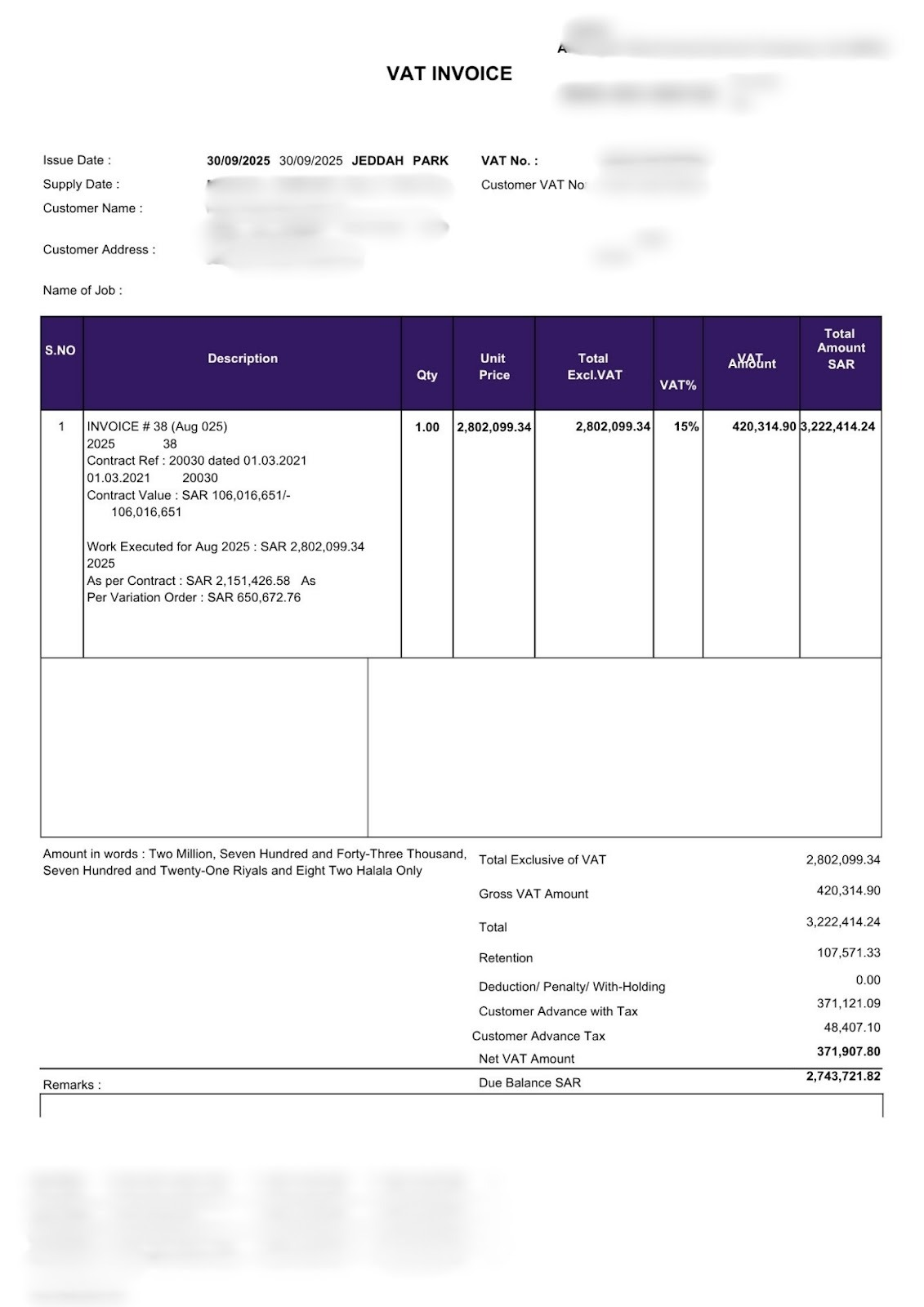
The following example shows how retention can be presented separately from the taxable value.
Illustrative example only: The retention calculation basis and release terms must follow the actual contract.
[Company Legal Name]
Address: [Registered Address]
VAT/TIN: [Tax Identification Number]
Contact: [Email / Phone]
Invoice To:
[Customer Legal Name]
[Customer Address]
Customer VAT/TIN: [If applicable]
Invoice Details
Retention Details
Payment Details
Notes
ZATCA’s May 2026 contracting guideline provides an official example in which VAT is calculated on the full construction invoice even though the customer withholds part of the total payment as retention.
This is the most important mistake to avoid.
For Saudi construction services, ZATCA states that retention does not reduce the VAT payable on a fully invoiced amount merely because part of the cash payment is being withheld.
Fix: Calculate VAT using the correct taxable value first, then show retention separately as an amount withheld from payment.
Retention postpones payment; it does not necessarily reduce the agreed value of the work.
Fix: Show the gross taxable amount separately from the retained amount and net cash currently payable.
If the original tax invoice already included the retained amount and VAT, issuing another taxable invoice for the same amount can duplicate VAT.
Fix: Check how the original transaction was invoiced before processing the release. ZATCA’s construction guidance states that no additional invoice or VAT declaration is required merely when previously retained consideration is repaid.
“Retention invoice” is not a separate FATOORAH invoice category.
Fix: Determine whether the transaction requires a normal tax invoice, simplified tax invoice, prepayment invoice, credit/debit note, or merely commercial documentation of a previously invoiced retention balance.
Without a project, milestone, or certificate reference, the customer may be unable to verify why the amount is due.
Fix: Include the contract number, project, milestone, certification reference, retention percentage, and release condition.
A retained balance is not automatically a normal trade receivable in every case.
Fix: Determine whether the right to payment is unconditional or remains subject to additional performance conditions. Under IFRS 15, that distinction can affect whether the amount is presented as a receivable or contract asset.
Retention percentages and release conditions are contractual.
Fix: Calculate retention from the signed agreement rather than copying a percentage from another project or online template.
Also read: The Benefits of Implementing E-Invoicing Software for Businesses in Saudi Arabia
To see how automation and smart invoicing work in practice, let’s explore how HAL ERP helped a leading Saudi retailer achieve seamless e-invoicing compliance.
Retention is part of a wider project billing and receivables process.
[HAL Invoicing] supports several documented capabilities that can help businesses manage that process, including:
HAL’s support documentation also provides a Record Receivables workflow for amounts owed by customers now or in the future.
These capabilities can support the operational workflow around retention, but finance teams should still configure the retention calculation, VAT treatment, accounting classification, and release process according to the contract and applicable Saudi tax requirements.
A retention invoice should clearly separate the value of work supplied, VAT, the amount withheld as retention, and the net amount currently payable.
For Saudi construction businesses, the most important tax point is that retention generally does not reduce VAT on an amount that has already been fully invoiced. ZATCA’s current Contracting Sector VAT Guideline requires VAT to be accounted for on the relevant full invoiced amount, even when part of the customer payment is withheld as retention.
When that retained balance is later released, finance teams should also check the original invoice before creating another tax invoice so the same consideration and VAT are not recorded twice.
HAL Invoicing supports milestone billing, receivables, payments, reconciliation, and invoice follow-up, while HAL VAT Care supports Saudi ZATCA e-invoicing workflows.
Explore HAL Invoicing for the broader invoicing workflow, or request a demo to discuss how your project billing and retention process can be configured.
For Saudi construction services, withholding part of the payment as retention does not automatically remove that amount from VAT.
ZATCA’s current contracting guideline states that where the supplier issues an invoice for the full amount due, VAT is due on the full invoiced amount even if the customer retains part of the payment.
No.
“Retention invoice” is a commercial term rather than a separate FATOORAH invoice category.
Saudi electronic-invoice specifications provide for documents including tax invoices, simplified tax invoices, prepayment invoices, debit notes, and credit notes.
A clear format should show:
This keeps the retention separate from the value of the taxable supply.
Not necessarily.
If the full amount and VAT were already included in the original tax invoice, ZATCA’s construction guideline states that the supplier does not have another invoice or VAT-declaration obligation merely when the customer pays the previously retained amount.
The retained balance still needs appropriate payment and accounting documentation.
Not always.
Under IFRS 15, an unconditional right to consideration is a receivable. If the right remains conditional on additional performance or another event besides the passage of time, it can instead be a contract asset.
The accounting treatment should follow the contract and the company’s applicable reporting framework.
There is no generic percentage that should be copied into every retention invoice.
The applicable retention rate, calculation basis, maximum amount, and release terms should come from the signed contract.
Depending on the contract, supporting documents can include:
Yes, where the required workflow is configured.
ERP and invoicing software can help link project invoices, receivables, payment status, tax calculations, approvals, and supporting records.
HAL currently documents milestone invoicing, receivables management, online payment reconciliation, configurable tax reporting, and ZATCA e-invoicing capabilities.




%20in%202026.png)