

Every business has fixed assets—computers, office furniture, machinery, or company cars—that serve the business over an extended period.
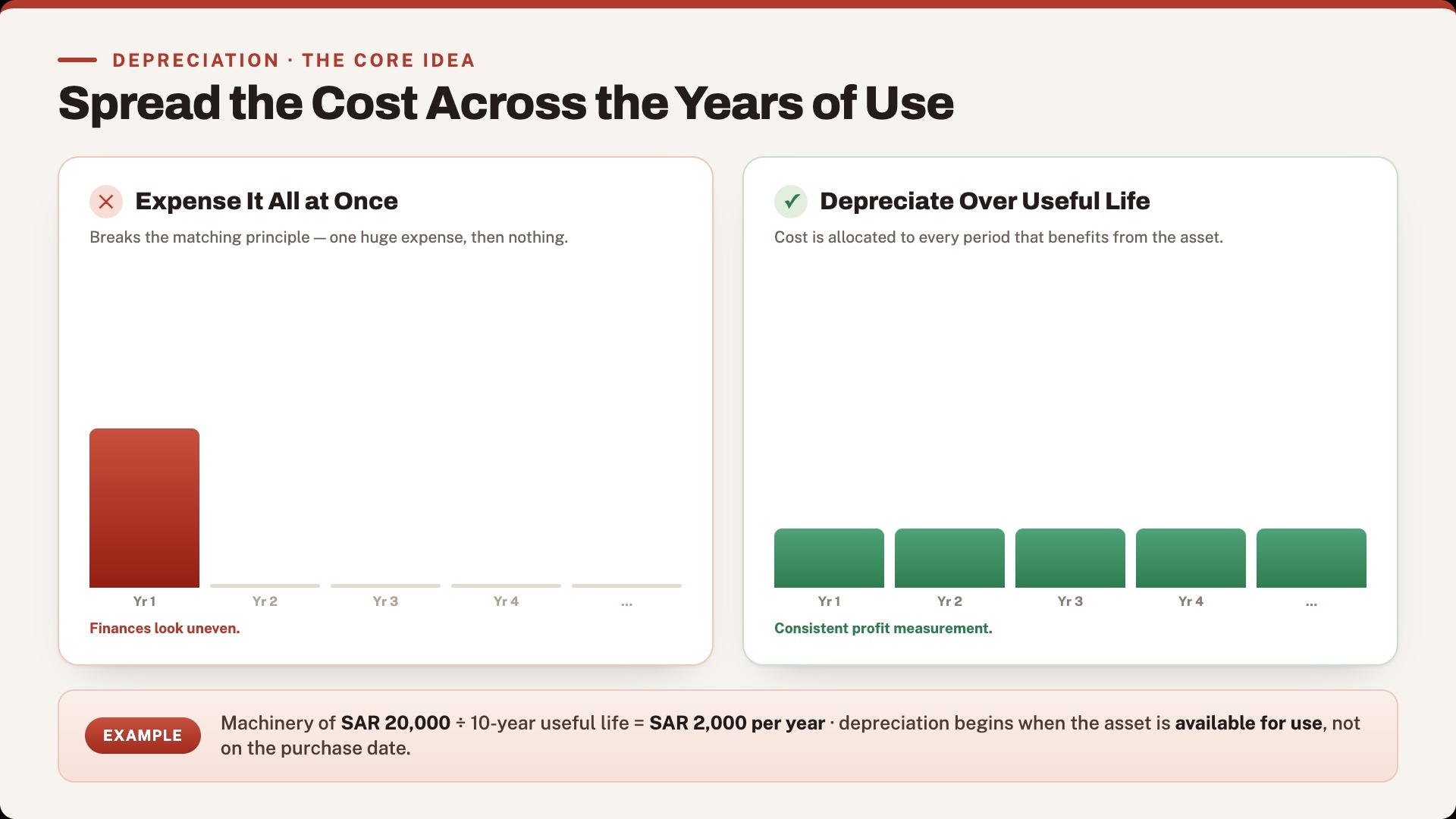
In accounting, the matching principle says we should record expenses in the same period as the revenue they help generate. If we were to deduct the full cost of these assets immediately, it would violate this principle by showing a large expense in the first year and none thereafter, even though the asset continues to be used. This makes the company’s finances look uneven. Depreciation solves this by spreading the cost of the asset over its useful life.
As a CFO or finance leader, you are responsible for ensuring that asset values are correctly reflected in your company’s books. In this blog, we’ll walk you through the fundamentals of depreciation accounting entry.
Let’s begin by diving into what depreciation means and why it matters for your business.

Depreciation is the systematic allocation of a tangible asset’s depreciable amount over its useful life. The depreciable amount is normally the asset’s cost minus its estimated residual value.
Depreciation is therefore an accounting allocation—not an attempt to update the asset to its current market price. It records how the asset’s economic benefits are consumed over the periods in which the business uses it.
Example:
Suppose machinery costs SAR 20,000, has no residual value and is expected to remain useful for 10 years. Under the straight-line method, the annual depreciation expense would be SAR 2,000:
SAR 20,000 ÷ 10 years = SAR 2,000 per year
Depreciation begins when the machinery is available for use, rather than automatically on the purchase or payment date.
Why depreciation matters:
Saudi businesses should apply the relevant SOCPA-endorsed accounting standards, including the applicable requirements of IAS 16. Accounting depreciation should not, however, be described as a VAT requirement or an automatic tax deduction. Tax and Zakat treatment may differ from book depreciation and should be assessed separately under applicable ZATCA rules.
A depreciation journal entry records the portion of a fixed asset’s depreciable amount allocated to the current accounting period. The usual entry debits depreciation expense and credits accumulated depreciation.
Suppose your company purchases office furniture for SAR 50,000. The furniture has a five-year useful life, no residual value and is available for use from the beginning of the financial year.
Using straight-line depreciation:
Annual depreciation = SAR 50,000 ÷ 5 years = SAR 10,000
The year-end journal entry would be:
Debit: Depreciation Expense — SAR 10,000
Credit: Accumulated Depreciation — SAR 10,000
The furniture account normally remains recorded at cost, while accumulated depreciation appears as a contra-asset balance that reduces its carrying amount in the financial statements.
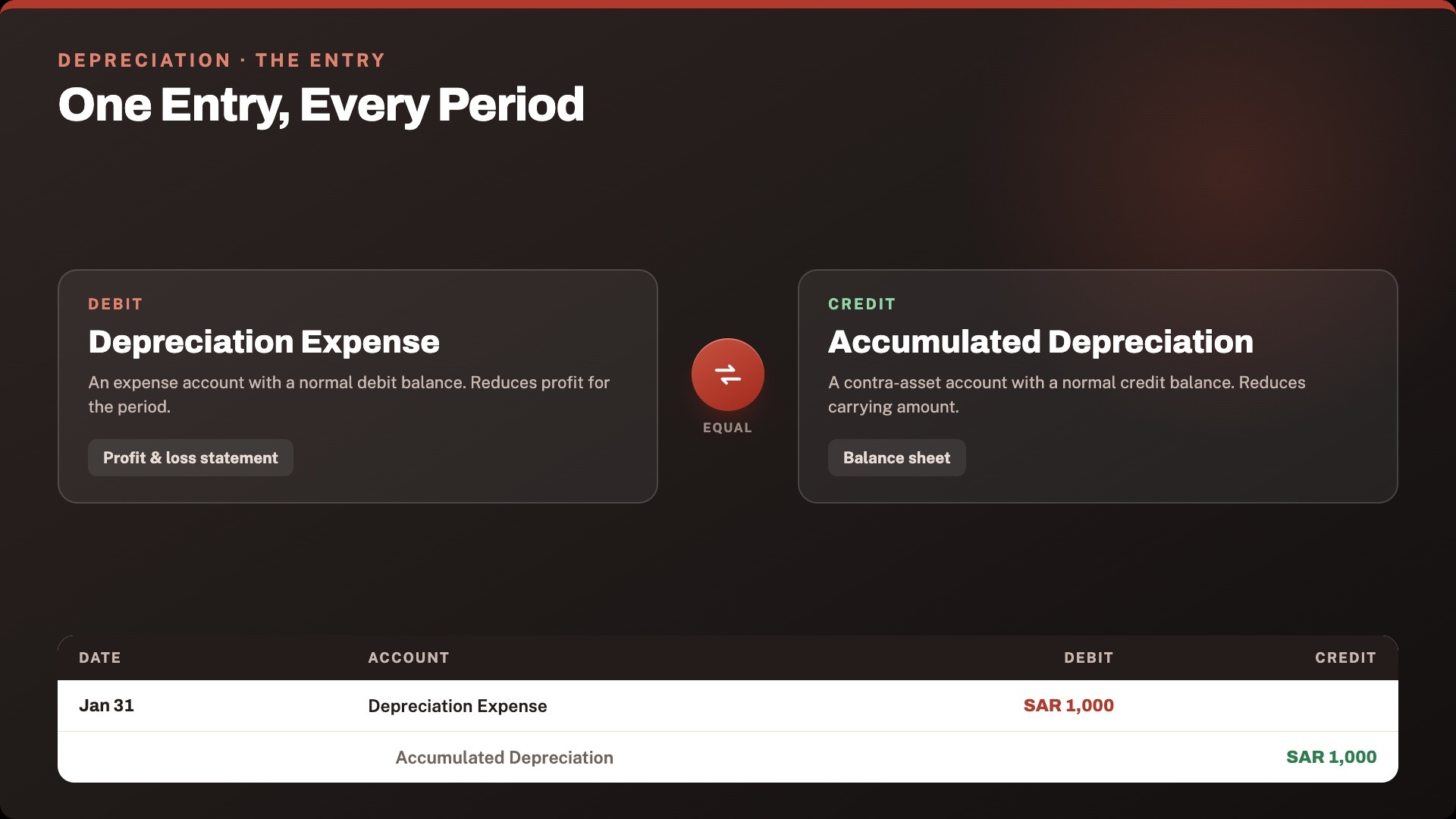
To better understand depreciation, let’s distinguish between accumulated depreciation and depreciation expense.
Both play distinct yet interconnected roles in financial reporting. Here’s how they differ:
With a clear understanding of these concepts, let’s now explore the benefits of depreciation accounting.
Correctly recording depreciation supports:
Depreciation does not create a cash reserve for replacing assets, and book depreciation is not automatically the amount accepted for Saudi tax or Zakat purposes. Businesses may need to reconcile accounting depreciation with the relevant regulatory treatment.
Errors can misstate profit, carrying amounts, financial ratios and disposal gains or losses. An integrated fixed-asset and accounting system helps keep these records aligned as the number of assets grows.
Let’s look at the different methods of calculating depreciation and how they impact your journal entries.
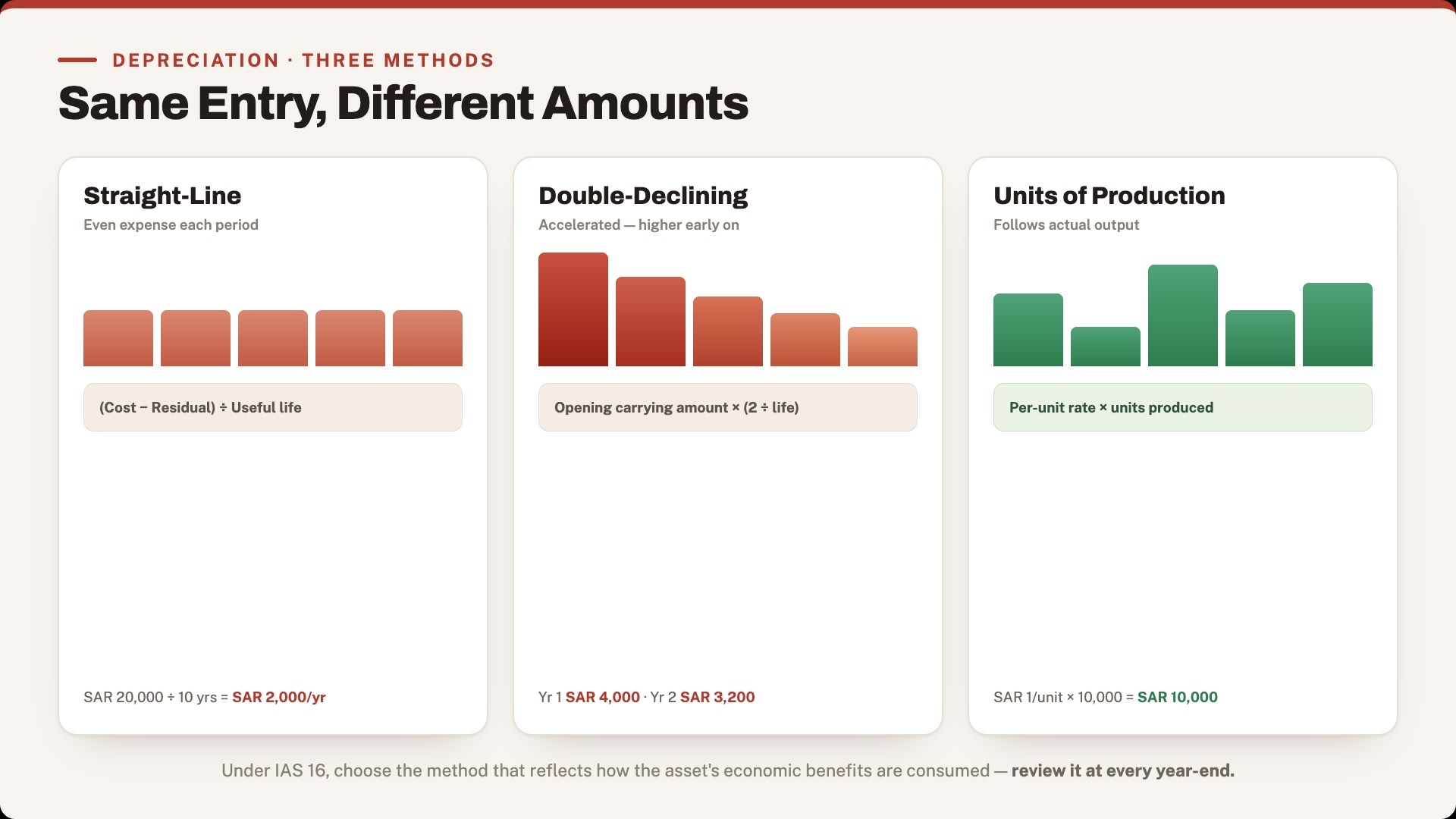
The depreciation method determines the amount recorded each period. However, the basic journal entry normally remains the same:
Debit: Depreciation Expense
Credit: Accumulated Depreciation
Under IAS 16, the selected method should reflect how the business expects to consume the asset’s economic benefits.
Straight-line depreciation records the same expense in each complete period, provided the residual value does not change.
Formula:
Annual depreciation = (Asset cost − Residual value) ÷ Useful life
Suppose machinery costs SAR 20,000, has no residual value and has a useful life of 10 years:
SAR 20,000 ÷ 10 = SAR 2,000 per year
Journal entry:
Double-declining balance is an accelerated method that records higher depreciation in the earlier years and lower depreciation later.
First calculate the double-declining rate:
Double-declining rate = 2 ÷ Useful life
For an asset with a 10-year useful life:
2 ÷ 10 = 20%
The annual expense is then calculated using the asset’s opening carrying amount:
Depreciation expense = Opening carrying amount × Double-declining rate
For machinery costing SAR 20,000:
The asset should not be depreciated below its residual value.
Year 1 journal entry:
The units-of-production method bases depreciation on measurable output or usage rather than elapsed time.
Depreciation per unit = (Asset cost − Residual value) ÷ Expected total units
Period depreciation = Depreciation per unit × Units produced during the period
Suppose a machine costs SAR 100,000, has a residual value of SAR 10,000 and is expected to produce 90,000 units:
Depreciation per unit = (SAR 100,000 − SAR 10,000) ÷ 90,000 = SAR 1
If the machine produces 10,000 units during the year:
Depreciation expense = 10,000 × SAR 1 = SAR 10,000
Journal entry:
The useful life, residual value and depreciation method should be reviewed at least at every financial year-end. When the expected usage pattern changes significantly, the method should be updated and treated as a change in accounting estimate.
For a broader explanation of method selection, read Depreciation in Accounting: The Basics Most Businesses Get Wrong. To explore debit and credit rules in more detail, see HAL’s guide to journal entries.
Now that we’ve explored journal entries and their importance, let’s dive into the steps involved in calculating depreciation.

Before calculating depreciation, confirm four details:
First calculate the depreciable amount:
Depreciable amount = Asset cost − Residual value
The expense for each accounting period then depends on the selected method. For example:
Straight-line annual depreciation = Depreciable amount ÷ Useful life
A zero residual value may be used when it is a reasonable and supportable estimate—not simply because it makes the calculation easier.
Depreciation starts when the asset is available for its intended use. Once the periodic amount has been calculated, it can be recorded through the depreciation journal entry.
Once you have calculated depreciation, you’ll need to record it in your accounting system. Here’s the step-by-step process:
Before recording depreciation, ensure you have the following details:
The method you choose to calculate depreciation depends on the type of asset and how it is used. As mentioned before, here are the common methods:
Using the chosen method, calculate the annual depreciation expense. For example, using the straight-line method:
Formula: Depreciation Expense = (Cost of Asset -Salvage Value)Useful Life
Record the periodic expense using two accounts:
Suppose an asset has annual straight-line depreciation of SAR 12,000 and the company closes its books monthly. The monthly depreciation expense is:
SAR 12,000 ÷ 12 months = SAR 1,000 per month
The January entry would be:
If all 12 monthly entries are posted, accumulated depreciation for the year will increase by SAR 12,000.
With HAL Accounting’s asset models, finance teams can configure asset records and automate recurring depreciation entries instead of calculating and posting every adjustment manually.
Post the journal entry in your accounting software or manual ledger at the end of each period:
After recording, subtract the accumulated depreciation from the asset’s original cost to determine its book value.
To better understand the process, let’s look at an example of a depreciation journal entry.
Suppose your business purchases office furniture for SAR 45,000 on January 1. The furniture has a useful life of 5 years and a SAR 7,000 salvage value. You’ve chosen the straight-line depreciation method, which spreads the cost evenly over the asset's useful life.
First, calculate the annual depreciation expense using the straight-line formula:
Depreciation Expense = (Cost of Asset -Salvage Value)Useful Life
= (45,000 − 7,000)5 years = SAR 7,600 per year
Now that you have the annual depreciation, here’s how you record the journal entry at the end of the year:

A depreciation entry affects the financial statements without creating a cash payment at the time the entry is posted:
These effects make accurate depreciation important for profit analysis, asset reporting, budgeting and financial ratios.
Now, let’s explore common mistakes to avoid when handling depreciation.
Even small mistakes in depreciation can lead to significant errors in financial reporting. Here are some common challenges and how to avoid them:
Solution: Begin depreciation when the asset is in the location and condition necessary for its intended operation. The invoice, payment and available-for-use dates may be different.
Solution: Review the asset’s useful life and residual value at least at every financial year-end. Update the estimates when expectations change and document the basis for the revision.
Solution: Choose the method that reflects the asset’s expected usage pattern. Straight-line may suit assets providing consistent benefits, while diminishing balance or units of production may better reflect other assets.
Solution: An idle asset generally continues to be depreciated unless it is fully depreciated, classified as held for sale or derecognized. Under a units-of-production method, however, the expense may be zero when there is no production.
Solution: Maintain a reconciliation between the accounting fixed-asset register and any separate regulatory depreciation calculation. Do not assume that book depreciation is automatically accepted for every tax or Zakat purpose.
Solution: When an asset is sold or disposed of, remove both its cost and related accumulated depreciation. Record any proceeds received, then recognize the remaining difference as a gain or loss where required.
A typical disposal entry may include:
Solution: Apply the method consistently, but review it annually. If the expected consumption pattern changes significantly, update the method prospectively and document it as a change in accounting estimate.
Accurate depreciation becomes harder to maintain as a business adds more assets, locations, projects and accounting periods. Spreadsheet schedules can become disconnected from the general ledger, particularly when assets are transferred, modified, retired or sold.
HAL ERP’s asset management and accounting capabilities help finance teams manage depreciation through an integrated workflow that can include:
This helps Saudi SMEs and enterprises apply their documented accounting policies consistently and maintain the records required for financial reviews and audits. The business remains responsible for selecting the appropriate accounting treatment and determining any separate tax or Zakat adjustments.
The standard depreciation journal entry is straightforward:
Debit: Depreciation Expense
Credit: Accumulated Depreciation
The more important work is determining the correct cost, residual value, useful life, depreciation method and reporting period. These decisions affect profit, asset carrying amounts and the reliability of financial reports.
An integrated fixed-asset system reduces manual calculation, keeps depreciation schedules connected to the ledger and makes it easier to update records when assets move through their lifecycle.
Request a HAL ERP demo to see how automated asset models and depreciation entries can simplify fixed-asset accounting for your business.
The usual entry is:
Depreciation expense records the amount allocated to the current period, while accumulated depreciation records the cumulative amount recognized for the asset.
Accumulated depreciation normally has a credit balance. It is a contra-asset account that offsets the cost or revalued amount of the related fixed asset on the balance sheet.
Depreciation starts when the asset is available for use—that is, when it is in the location and condition required to operate as management intends. This may be later than its purchase, invoice or payment date.
Calculate the annual depreciation expense and divide it by 12 when equal monthly charges are appropriate.
For example, annual depreciation of SAR 24,000 produces monthly depreciation of SAR 2,000:
Not necessarily. Under IAS 16, depreciation generally continues while an asset is idle unless it is fully depreciated, classified as held for sale or derecognized. A units-of-production method may result in no depreciation when there is no production.
The asset’s original cost and related accumulated depreciation are both removed from the accounts. The business also records the sale proceeds and recognizes any resulting gain or loss on disposal.
Not always. Financial-statement depreciation follows the applicable accounting framework, while tax or Zakat treatment may follow separate ZATCA rules. Businesses should maintain a reconciliation when the amounts differ.




%20in%202026.png)