A Profit and Loss (P&L) statement is a critical financial document that helps businesses understand their profitability, income, and expenses. It allows business owners, managers, and stakeholders to evaluate how well the company is performing financially. But what does a P&L statement really tell you, and how can it help you make better business decisions?
In this blog, we’ll break down the essentials of a Profit and Loss statement, explore its key components, and show you practical examples of how it can be used to gain valuable insights into your business’s financial performance. Let’s begin with the basics.
A Profit and Loss (P&L) statement, commonly called an income statement or statement of profit or loss, reports a company’s income and expenses over a specific period and shows whether those activities resulted in profit or loss.
It focuses on financial performance during a period, unlike the balance sheet, which reports financial position at a specific date.
Common components include:
The P&L is one part of the wider financial-reporting picture. Under IFRS, a complete set of financial statements also includes a statement of financial position, statement of changes in equity, statement of cash flows, and related notes. (IFRS 18)
Also Read: Financial Statements: The Cornerstone of Effective Business Management
With an understanding of what a P&L statement is, it’s important to dive deeper into its key components. Let's take a closer look at how the different parts of a P&L statement work together to reveal your company’s financial standing.
A Profit and Loss (P&L) statement is an invaluable tool for assessing the financial health of a business. It not only shows the company’s overall profitability but also highlights potential areas where costs can be reduced or revenue can be increased.
While understanding why P&L statements are essential, it’s equally important to know how to read them and analyze their contents effectively. Let’s now explore how you can create a P&L statement for your business and what to look for in each section.
Looking to improve the accuracy and efficiency of your P&L reports? HAL ERP integrates seamlessly with your financial systems to automate the preparation of Profit and Loss statements, saving you time and reducing manual errors. Explore how HAL ERP simplifies financial reporting.
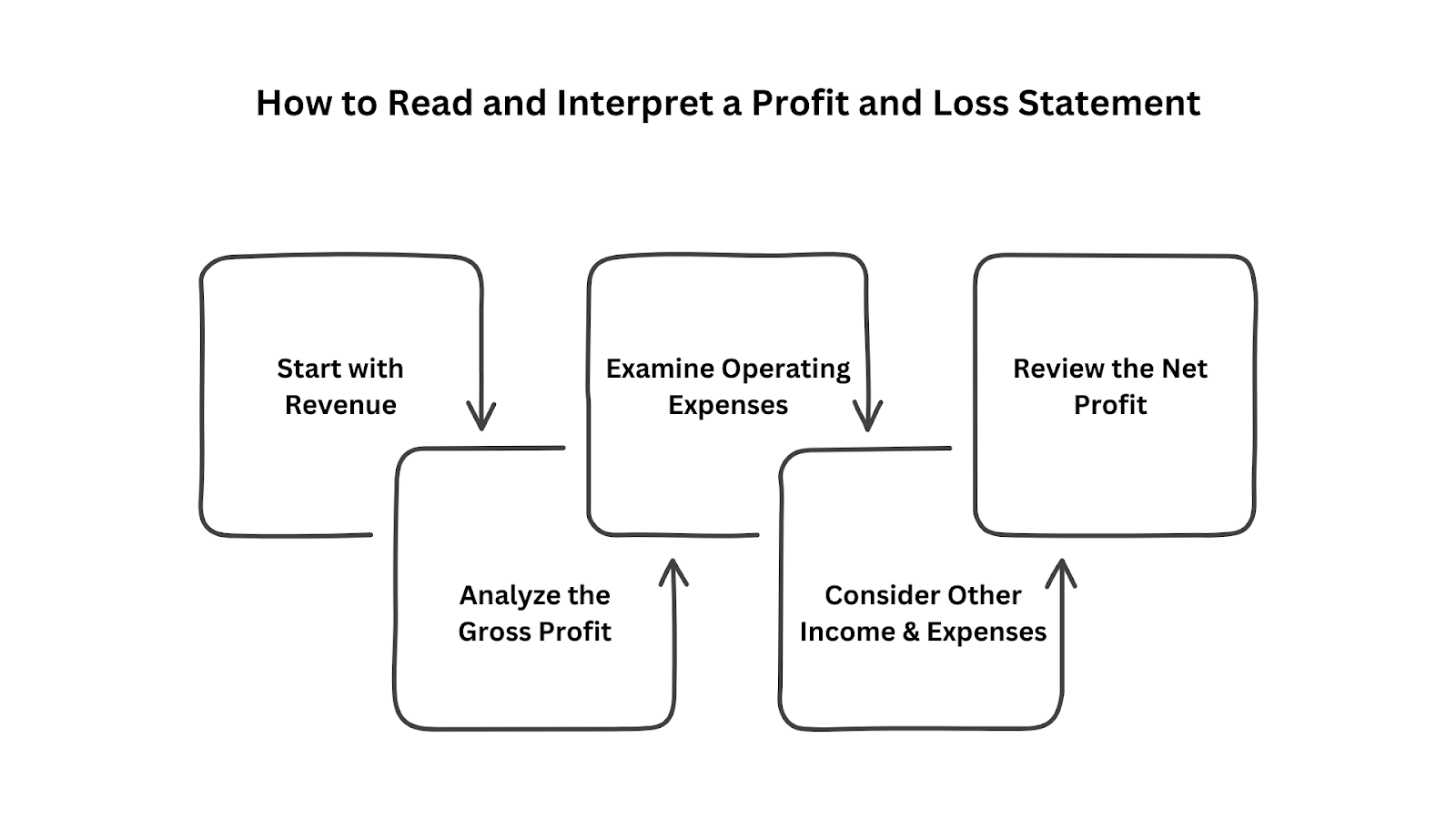
To fully utilize a Profit and Loss statement, it’s essential to understand how to read and interpret each section. Here’s how to approach it:
Example Table: Profit and Loss Statement (2024)
In this example, revenue increased from SAR 1.1 million in 2023 to SAR 1.2 million in 2024, an increase of approximately 9.1%.
Gross profit increased from SAR 550,000 to SAR 600,000, while operating profit increased from SAR 320,000 to SAR 350,000.
Net profit increased from SAR 335,000 to SAR 370,000, or approximately 10.4%, based on the simplified figures shown.
The example shows why readers should look beyond revenue growth alone and compare gross profit, operating expenses, operating profit, and the final profit for the period.
Also Read: Cost Accounting: Definition, Concepts, Types, and Uses
Now that you know how to read and interpret a P&L statement, let’s take a look at some practical examples of Profit and Loss statements from real companies to better understand how these reports are applied in the business world.
The overall purpose of a P&L remains the same, but the revenue and cost structure can vary substantially between industries.
The exact presentation depends on the business model and applicable accounting framework. A service company should not automatically assume that its direct cost of providing services is insignificant.
The profit shown in a company’s P&L is accounting profit. It should not automatically be treated as the final amount subject to Saudi income tax or Zakat.
For businesses subject to Saudi income tax, the tax calculation can require adjustments to accounting expenses.
For example, Article 13 of the Saudi Income Tax Law restricts the deduction of certain amounts paid or benefits provided to shareholders, partners, or specified related family members when they represent salaries, wages, bonuses, or similar payments. The law also contains specific qualifications and exceptions, including treatment for stockholders in stock companies. Related-party payments can also be restricted where they do not meet the required arm’s-length conditions. (Saudi Income Tax Law and Implementing Regulations)
This does not mean every payment to every owner must simply be removed from the accounting P&L.
The correct process is:
Accounting P&L → applicable tax/Zakat adjustments → taxable income or Zakat base
Zakat-paying entities should separately apply ZATCA’s current Implementing Regulation for Zakat Collection, which applies to financial years beginning after January 1, 2024.
Businesses should therefore keep financial-reporting treatment and tax/Zakat treatment separate rather than building tax adjustments directly into a basic P&L explanation.
Gain a better understanding of your financial performance with HAL ERP’s customizable financial reporting features. Whether you’re in retail, services, or manufacturing, HAL ERP adapts to your industry’s needs, helping you track and analyze key metrics. Discover how HAL ERP fits your business model.
Comparing Profit and Loss statements over different periods is essential to understanding the financial trajectory of a company. It helps identify trends in revenue, costs, and profit margins. Regularly comparing P&L statements can also reveal inefficiencies or areas of improvement.
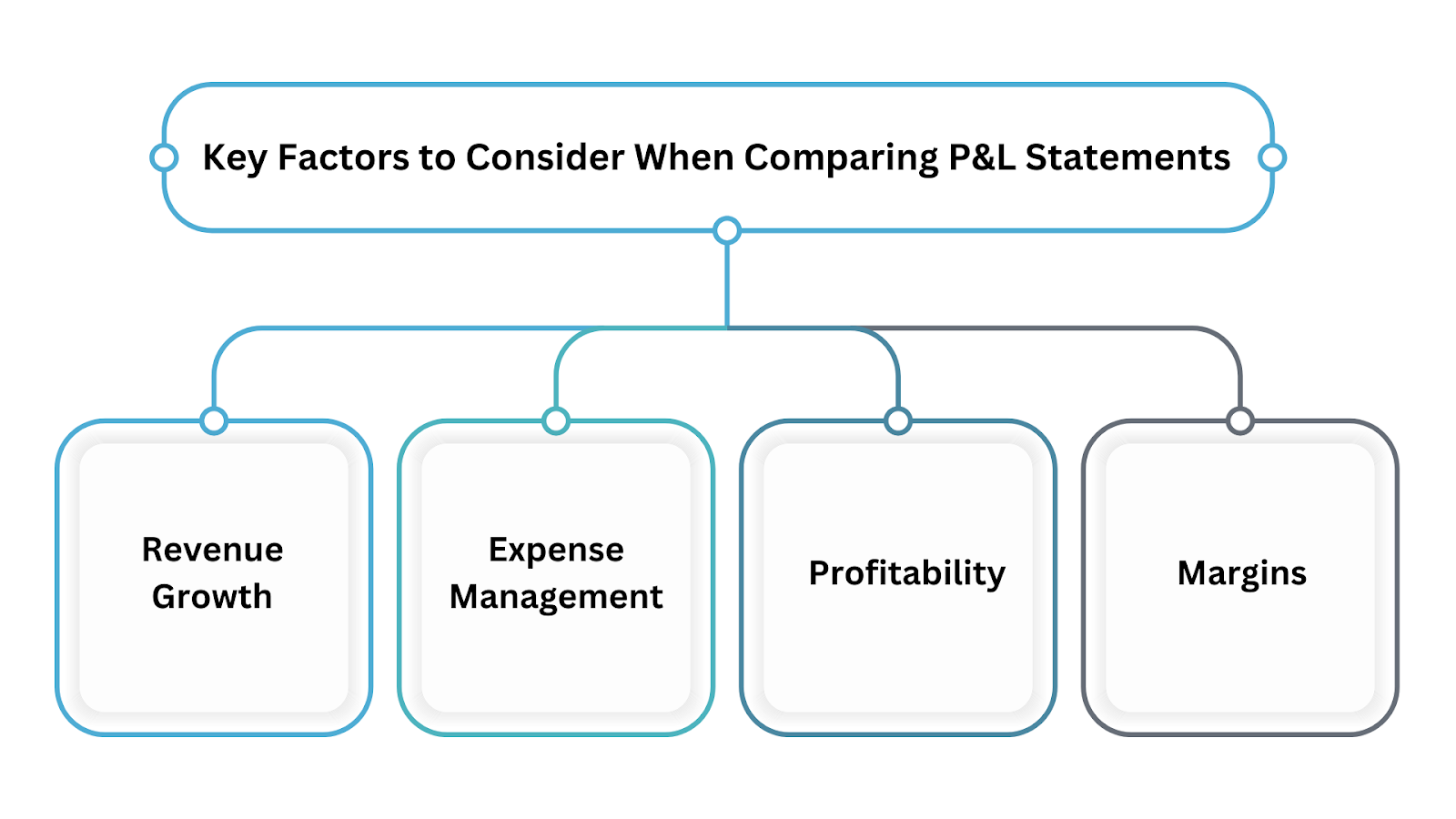
Example of Comparison:
The comparison shows that revenue increased by approximately 9.1%, while operating expenses increased by approximately 8.7%.
Net profit increased by approximately 10.4%, which is faster than revenue growth in this simplified example.
That does not by itself prove that overall cost management improved. Management should examine the individual revenue, cost, margin, and other-income lines to understand what actually drove the change.
Now that we’ve covered how to compare P&L statements, let’s discuss how a Profit and Loss statement works in conjunction with other financial statements to provide a comprehensive overview of a company’s financial health.
A P&L should not be analyzed in isolation.
The balance sheet or statement of financial position reports the company’s assets, liabilities, and equity at a specific date.
Profit earned during the period can ultimately affect equity, subject to distributions and other equity movements.
Profit is not the same as cash.
The cash flow statement explains cash movements through operating, investing, and financing activities and helps readers understand why a profitable company can still experience cash-flow pressure.
This statement explains changes in owners’ equity during the reporting period, including profit or loss, distributions, contributions, and other applicable movements.
The notes provide accounting policies, explanations, breakdowns, estimates, and other information needed to understand the numbers presented in the primary statements.
Under IFRS, these reports and disclosures form part of the wider set of financial statements rather than limiting the analysis to only three statements. (IFRS 18)
Businesses applying full IFRS should prepare for IFRS 18 Presentation and Disclosure in Financial Statements, which becomes effective for annual reporting periods beginning on or after January 1, 2027.
The Saudi Organization for Chartered and Professional Accountants (SOCPA) has adopted IFRS 18 for implementation in Saudi Arabia and permits early adoption.
IFRS 18 introduces several important changes to the statement of profit or loss, including:
For affected Saudi companies, 2026 is therefore a practical preparation year.
Finance teams should review whether their chart of accounts, reporting classifications, report layouts, and ERP reporting structures can support the new presentation requirements.
This does not mean every small Saudi business automatically applies full IFRS. Publicly accountable Saudi entities apply IFRS Accounting Standards endorsed in Saudi Arabia, while qualifying SMEs generally apply the endorsed IFRS for SMEs Accounting Standard, subject to the applicable elections and requirements.
A Profit and Loss statement explains financial performance over a period, but the bottom-line profit number is only the starting point for analysis.
Business owners and finance teams should look at:
They should also compare those results with the balance sheet, cash flow statement, changes in equity, and related financial-statement notes.
For Saudi businesses, accounting profit should also remain distinct from the calculations used for income tax or Zakat.
HAL’s Income Statement reporting allows users to generate P&L information and filter the report by areas such as outlet, customer or project, customer group, and financial period.
HAL Accounting also documents:
These tools can reduce manual reporting work and make it easier to analyze financial results, but management and accounting professionals remain responsible for the accounting classifications, adjustments, estimates, and reporting policies used to produce the final financial statements.
Businesses evaluating their finance and reporting workflow can request a HAL ERP demo.
A Profit and Loss statement reports a business’s income and expenses over a defined period and shows the resulting profit or loss.
It is also commonly called an income statement or statement of profit or loss.
Gross profit generally measures revenue after deducting the direct cost of generating that revenue.
Net profit reflects the final result after the other relevant income and expenses recognized for the period.
No.
A company can report accounting profit while experiencing cash-flow pressure because revenue and expenses are recognized under accounting rules that do not always match the timing of cash receipts and payments.
Not necessarily.
The P&L shows accounting profit. Saudi income tax rules can require adjustments for deductible and non-deductible items before taxable income is determined, while Zakat uses its own calculation framework.
No broad rule should be applied that way.
Saudi Income Tax Law places restrictions on certain salaries, wages, bonuses, benefits, and related-party payments involving owners, partners, shareholders, and specified relatives, but the detailed treatment depends on the entity, transaction, relationship, and applicable exceptions.
IFRS 18 is the new IFRS standard governing presentation and disclosure in financial statements.
It replaces IAS 1 and introduces defined categories and subtotals in the statement of profit or loss. It is effective for annual periods beginning on or after January 1, 2027.
Yes.
HAL’s current support documentation describes an Income Statement/P&L report that can be filtered by outlet, customer or project, customer group, and financial period.