Procurement Cycle in 2026: 7 Key Stages and Best Practices for Growing Businesses
Published By
Sherif Mohamed
Procurement
Jun 12, 2026
Procurement issues often build slowly through delayed approvals, rushed supplier decisions, missing inventory visibility, invoice mismatches, or purchasing requests scattered across emails and spreadsheets.
For growing businesses, these small inefficiencies become harder to control as procurement volumes increase across departments, suppliers, warehouses, and finance teams. Gartner estimates that manual procurement processes can contribute to 3–5% annual overspend due to errors, inefficiencies, and missed purchasing opportunities. That is a high operational cost for businesses trying to scale efficiently.
This is why the procurement cycle matters.
In this blog, we will break down what the procurement cycle is, the seven core stages involved, common procurement challenges businesses face, and the best practices companies use to improve procurement visibility, operational efficiency, and financial control at scale.
Key Takeaways
The procurement cycle is a continuous operational system that helps businesses manage sourcing, purchasing, supplier coordination, approvals, payments, and procurement accountability more efficiently.
A structured procurement cycle improves cost control, supplier performance, operational efficiency, financial visibility, and compliance as businesses scale across departments and suppliers.
The seven stages of the procurement cycle work together to reduce procurement risks, improve purchasing accuracy, and maintain smoother inventory, finance, and supplier operations.
Procurement inefficiencies often originate from poor visibility, weak approval workflows, fragmented supplier management, and disconnected procurement and finance systems.
Businesses that optimize procurement using standardized workflows, supplier analytics, centralized dashboards, and ERP automation gain stronger control over spending, supplier performance, and long-term operational scalability.
What Is the Procurement Cycle?
The procurement cycle (or procurement life cycle) is the strategic, circular process organizations use to identify, source, purchase, and manage goods or services.
This cycle helps businesses acquire everything they need to operate. This can include raw materials, office supplies, software subscriptions, equipment, logistics services, outsourced labor, or production components. But modern procurement goes far beyond simply buying products or services.
Unlike one-time purchasing activities, procurement is continuous. Businesses constantly procure inventory, raw materials, equipment, software, outsourced services, and operational supplies across different departments. Because of this, procurement connects multiple functions together, including finance, operations, inventory management, warehouse teams, and supplier management.
Modern procurement cycles are built around four major priorities:
Improving procurement visibility
Controlling costs and reducing waste
Ensuring compliance and approval accountability
Maintaining reliable supplier performance
As mid-sized businesses scale, procurement cycles become more complex. More suppliers, larger purchasing volumes, and multiple approval layers increase the risk of delays, overspending, invoice mismatches, and poor supplier coordination. This is why businesses increasingly focus on procurement standardization and automation.
Why the Procurement Cycle Matters for Growing Businesses
A well-managed procurement cycle helps businesses create a standardized system for how purchasing decisions are made, approved, tracked, and evaluated. Instead of reactive buying, businesses gain a more predictable and controlled procurement environment.
Better cost control: Structured procurement workflows help reduce overspending, duplicate purchases, and inconsistent supplier pricing. Businesses gain stronger visibility into where money is being spent and how procurement budgets are managed.
Stronger supplier management: The procurement cycle creates a consistent framework for evaluating supplier reliability, pricing, delivery performance, and contract compliance over time.
Improved operational efficiency: Clear approval workflows, centralized purchasing processes, and standardized procurement steps help reduce delays and operational bottlenecks across departments.
Reduced procurement risks: Procurement cycles help businesses minimize risks related to unauthorized purchases, supplier failures, invoice mismatches, compliance issues, and poor vendor accountability.
Better financial visibility: Procurement directly affects budgeting, cash flow, invoice reconciliation, and financial reporting. Centralized procurement systems improve spending transparency and financial control.
Greater scalability: As businesses expand, procurement operations become harder to manage manually. Standardized procurement cycles create consistency across teams, departments, suppliers, and locations.
Stronger compliance and accountability: Structured procurement workflows create audit trails, approval records, supplier documentation, and purchasing accountability that become increasingly important as operations scale.
To understand how procurement works operationally, it helps to break the procurement cycle down into the individual stages that move purchasing from request to supplier evaluation.
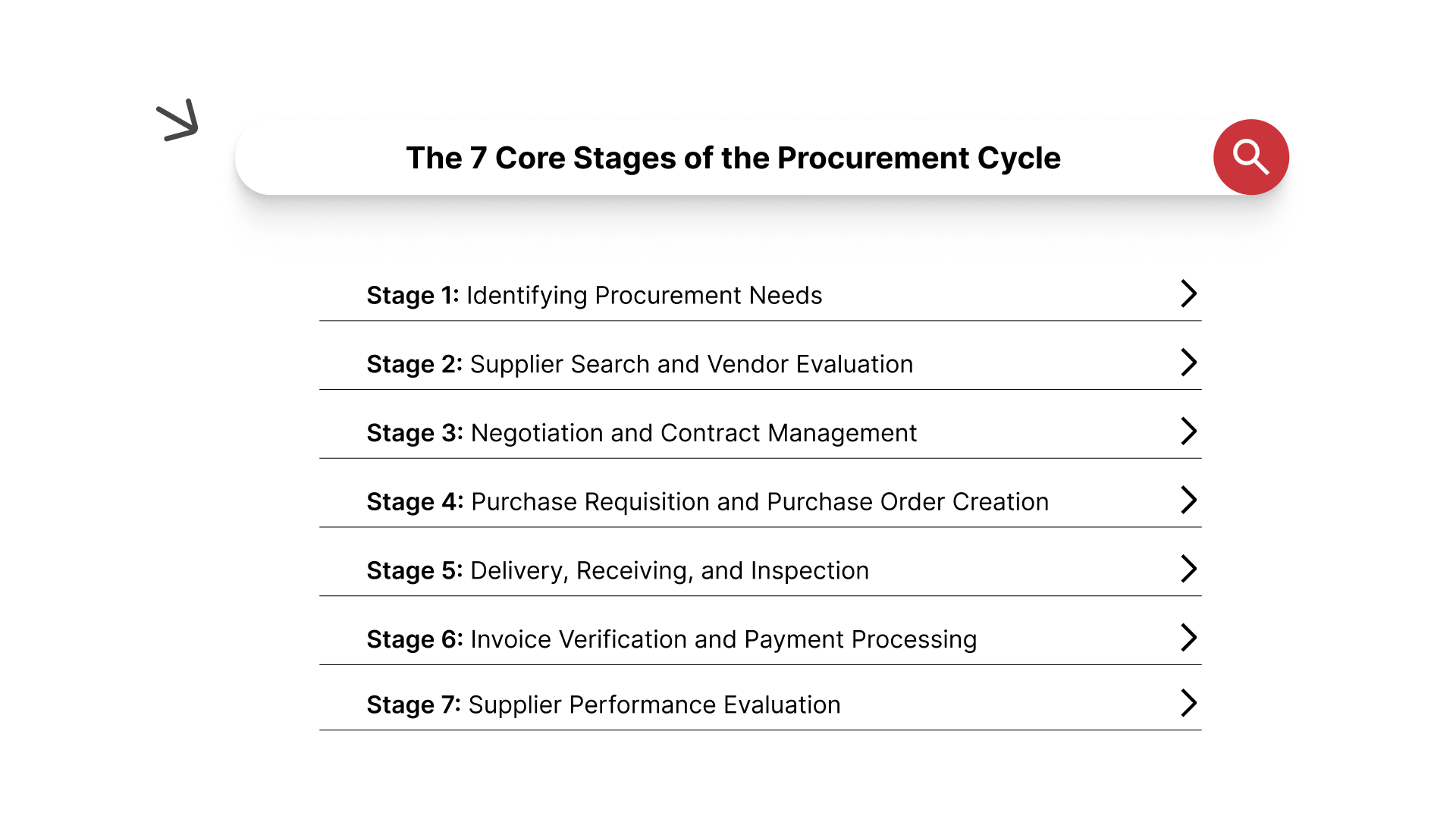
The 7 Core Stages of the Procurement Cycle
Each stage plays an important role in controlling costs, maintaining supplier accountability, reducing procurement risks, and ensuring operational continuity. When one stage breaks down, the impact often spreads across inventory management, finance, project timelines, and supplier relationships.
Here are the seven core stages that make up a modern procurement cycle:
Stage 1: Identifying Procurement Needs
The procurement cycle begins with identifying what goods or services are required, including specifications, quantities, timelines, and operational scope.
This stage focuses on understanding exactly what the business needs before procurement begins. Requests may come from operations teams, warehouse managers, finance departments, project managers, or production units depending on the business structure.
Managing internal purchase requests: Procurement teams collect and review purchasing requests submitted by departments across the organization.
Aligning procurement with department requirements: Different departments may require specific materials, services, timelines, or compliance standards depending on operational needs.
Monitoring inventory thresholds: Businesses often trigger procurement based on minimum stock levels, inventory shortages, or reorder points.
Supporting production planning: Manufacturing and project-based businesses align procurement with production schedules, project phases, and operational timelines.
Forecasting future demand: Procurement planning often relies on sales forecasts, seasonal demand patterns, and historical purchasing data.
Defining technical specifications: Businesses must clearly document product standards, dimensions, service expectations, or quality requirements before supplier sourcing begins.
Ensuring budget alignment: Procurement teams verify that purchasing requests fit approved budgets and financial planning objectives.
Stage 2: Supplier Search and Vendor Evaluation
Businesses then research suppliers, evaluate capabilities, compare pricing, and issue RFQs, RFPs, or RFIs where necessary.
Once procurement needs are clearly defined, businesses begin identifying suppliers capable of meeting operational, financial, and compliance requirements. This stage is critical because supplier selection directly affects pricing, quality, delivery reliability, and long-term procurement stability.
Using different supplier sourcing methods: Businesses may source suppliers through vendor databases, industry networks, procurement marketplaces, referrals, or existing supplier relationships.
Understanding RFQ vs RFP vs RFI: RFQs focus primarily on pricing, RFPs evaluate broader service capabilities and solutions, while RFIs gather preliminary supplier information before formal procurement begins.
Conducting vendor qualification checks: Procurement teams assess supplier experience, certifications, operational capabilities, and industry expertise before approval.
Comparing supplier pricing: Businesses evaluate pricing structures alongside delivery reliability, service quality, and long-term procurement value.
Reviewing financial stability: Financially unstable suppliers may struggle to fulfill contracts consistently or maintain production capacity.
Verifying compliance requirements: Procurement teams often review regulatory compliance, certifications, safety standards, and contractual obligations before onboarding suppliers.
Assessing delivery capabilities: Lead times, logistics infrastructure, fulfillment consistency, and geographic coverage all influence supplier reliability.
Building strategic supplier relationships: Long-term supplier partnerships often improve procurement stability, pricing consistency, and operational coordination.
Stage 3: Negotiation and Contract Management
Procurement teams negotiate pricing, delivery schedules, payment terms, SLAs, and contractual obligations before finalizing supplier agreements.
This stage establishes the commercial and operational framework that governs the supplier relationship. Strong procurement contracts help businesses maintain accountability, reduce disputes, and create clearer expectations around pricing, quality, delivery, and compliance.
Negotiating supplier pricing: Procurement teams negotiate pricing structures, discounts, bulk purchasing terms, and cost adjustments.
Managing payment terms: Businesses establish payment schedules, credit terms, invoice timelines, and financial conditions before procurement begins.
Defining SLAs and penalties: Service-level agreements help define delivery timelines, quality expectations, performance standards, and penalties for non-compliance.
Supporting procurement compliance: Contracts help businesses maintain legal, operational, and regulatory procurement standards.
Managing contract lifecycles: Procurement teams monitor contract renewals, amendments, expiration timelines, and supplier obligations over time.
Reducing contract renewal risks: Missed renewals or outdated supplier agreements can create procurement disruptions and unexpected pricing changes.
Strengthening long-term supplier agreements: Strategic supplier contracts often improve procurement predictability and operational continuity.
Stage 4: Purchase Requisition and Purchase Order Creation
Once approvals are completed, procurement teams generate formal purchase orders that authorize suppliers to fulfill the request.
This stage formalizes procurement approvals and purchasing authorization within the organization. Structured procurement workflows help businesses maintain accountability, spending control, and audit visibility across departments.
Managing requisition workflows: Employees or departments submit formal purchase requests for procurement review and approval.
Establishing approval hierarchies: Procurement approvals may require authorization from department heads, finance teams, procurement managers, or executives.
Maintaining procurement authorization controls: Businesses use approval workflows to prevent unauthorized or non-compliant purchasing activity.
Creating procurement audit trails: Procurement records support financial reporting, compliance documentation, and future auditing requirements.
Validating procurement budgets: Procurement teams confirm that purchases align with approved budgets before issuing purchase orders.
Automating ERP procurement workflows: ERP systems help automate approval routing, purchase order generation, and procurement notifications.
Stage 5: Delivery, Receiving, and Inspection
After delivery, businesses verify whether goods or services meet agreed specifications, quantities, and quality expectations.
This stage ensures that suppliers have fulfilled procurement requirements correctly before inventory is accepted or supplier payments are approved. Receiving and inspection processes are especially important for inventory-heavy, manufacturing, and warehouse-driven operations.
Creating goods receipt notes (GRNs): Businesses document received inventory, delivery quantities, and fulfillment status through GRNs.
Conducting quality inspections: Procurement or warehouse teams inspect received goods to confirm quality standards and technical specifications.
Updating inventory records: Inventory systems or ERP platforms are updated after goods are received and approved.
Managing damaged goods handling: Businesses identify defective, incomplete, or damaged shipments before supplier payment processing.
Resolving fulfillment discrepancies: Procurement teams investigate missing items, incorrect quantities, or delivery mismatches.
Reducing receiving delays: Delayed receiving processes can disrupt production schedules, inventory availability, and operational timelines.
Coordinating warehouse operations: Procurement, inventory, and warehouse teams often work together during receiving and inspection activities.
Procurement visibility often breaks down heavily at the receiving stage in manual systems where inventory updates, inspection records, and delivery confirmations are poorly tracked.
Stage 6: Invoice Verification and Payment Processing
Many organizations use three-way matching to compare the purchase order, goods receipt, and supplier invoice before approving payment.
This stage connects procurement directly with finance operations. Businesses verify that suppliers delivered the correct goods or services before invoices are approved and payments are processed.
Using three-way matching: Finance teams compare purchase orders, goods receipt records, and supplier invoices to validate procurement transactions.
Managing invoice reconciliation: Businesses review pricing discrepancies, quantity mismatches, taxes, and billing details before payment approval.
Preventing duplicate invoice payments: Centralized procurement systems help detect repeated or inaccurate supplier invoices.
Supporting payment approval workflows: Finance and procurement teams collaborate to approve invoices before payment processing.
Managing supplier payment schedules: Businesses process payments based on negotiated terms, due dates, and cash flow planning.
Improving finance integration: ERP systems connect procurement data directly with accounting, budgeting, and financial reporting workflows.
This is where procurement and finance become tightly interconnected. Weak invoice controls can create duplicate payments, reconciliation problems, fraud risks, and financial inaccuracies.
Stage 7: Supplier Performance Evaluation
Businesses assess supplier performance continuously to determine reliability, pricing consistency, quality standards, and long-term partnership viability.
The procurement cycle does not end after payment is completed. Supplier evaluation helps businesses improve procurement decisions, reduce operational risks, and strengthen long-term procurement performance.
Using vendor scorecards: Businesses measure supplier performance using structured evaluation systems and procurement KPIs.
Tracking procurement KPIs: Common metrics include delivery accuracy, lead times, pricing consistency, responsiveness, and fulfillment reliability.
Monitoring delivery performance: Procurement teams evaluate whether suppliers consistently meet agreed timelines and operational expectations.
Reviewing defect rates and quality issues: Product defects, damaged shipments, or recurring quality failures impact supplier evaluations.
Measuring supplier responsiveness: Communication speed, issue resolution, and operational coordination all affect supplier reliability.
Reviewing compliance history: Procurement teams monitor regulatory compliance, contractual adherence, and supplier audit performance.
Supporting supplier consolidation strategies: Many businesses reduce procurement complexity by consolidating purchasing with fewer high-performing suppliers.
Understanding the procurement cycle is only part of the picture. The bigger challenge for many businesses is improving procurement efficiency as operations, suppliers, and purchasing complexity continue growing.
12 Best Practices to Optimize the Procurement Cycle
Strong procurement optimization focuses on visibility, accountability, standardization, and decision-making quality across the entire procurement lifecycle.
Map procurement bottlenecks before automating workflows: Businesses often rush into procurement automation without identifying where delays actually happen. Procurement teams should first analyze approval delays, invoice reconciliation issues, supplier communication gaps, and purchasing bottlenecks before redesigning workflows.
Create standardized intake and requisition rules: One of the biggest procurement problems in growing businesses is inconsistent purchasing requests across departments. Standardized requisition forms, predefined approval routes, required budget fields, and procurement categories improve purchasing accuracy and reduce approval confusion downstream.
Track procurement KPIs beyond cost savings: Many businesses evaluate procurement success only through price reduction, which creates poor supplier decisions and long-term operational risk. Strong procurement teams also monitor requisition-to-order cycle time, supplier lead time accuracy, contract compliance, PO accuracy, invoice mismatch rates, and supplier defect frequency.
Use spend analysis to identify hidden procurement leakage: Procurement inefficiencies often remain invisible without centralized spend analysis. Businesses should continuously analyze spending patterns across departments, suppliers, categories, and locations to identify duplicate vendors, uncontrolled purchases, pricing inconsistencies, and unmanaged spending categories.
Reduce supplier sprawl strategically: Many growing businesses accumulate too many suppliers over time, creating fragmented purchasing, inconsistent pricing, and weaker negotiation leverage. Supplier consolidation strategies help businesses improve purchasing power, simplify vendor management, strengthen accountability, and reduce procurement complexity.
Build supplier scorecards instead of evaluating vendors informally: Supplier performance should be measured using structured scorecards rather than occasional feedback. Procurement teams should track KPIs like on-time delivery, quality consistency, responsiveness, compliance history, invoice accuracy, and fulfillment reliability to support more objective supplier decisions.
Strengthen contract visibility before renewal deadlines: Many procurement disruptions happen because businesses lose visibility into contract obligations, renewal dates, pricing clauses, or SLA commitments. Centralized contract tracking helps procurement teams renegotiate proactively instead of reacting after pricing increases or service failures occur.
Implement controlled approval hierarchies instead of open purchasing: Procurement delays are often caused by unclear approval ownership. Businesses should define approval thresholds based on spend value, procurement category, department, or risk level. Well-structured approval routing reduces bottlenecks while maintaining procurement accountability.
Integrate procurement with inventory and finance data: Procurement decisions become unreliable when inventory, purchasing, and accounting systems operate separately. Connected procurement systems improve inventory forecasting, budget visibility, invoice reconciliation, and procurement planning accuracy across departments.
Use three-way matching consistently for financial control: Businesses should standardize three-way matching between purchase orders, goods receipt records, and invoices before payment approval. This significantly reduces duplicate payments, invoice fraud risks, unauthorized purchases, and reconciliation disputes between procurement and finance teams.
Bring procurement teams into planning earlier: Procurement performs more effectively when involved during operational planning rather than after purchasing needs become urgent. Early procurement involvement improves supplier selection, lead-time planning, contract negotiations, and inventory coordination while reducing reactive purchasing decisions.
Use centralized procurement dashboards for real-time visibility: Fragmented spreadsheets and disconnected procurement tools create visibility gaps across approvals, vendor activity, invoices, and purchasing status. Centralized dashboards help procurement leaders monitor procurement KPIs, spending trends, supplier risks, and approval bottlenecks in real time.
As procurement operations become more complex, managing approvals, suppliers, inventory, invoices, and procurement visibility manually becomes increasingly difficult.
Simplify Procurement Operations with HAL ERP
For growing Saudi businesses, managing procurement across departments, suppliers, approvals, and finance can quickly become difficult without centralized systems. HAL ERP helps businesses:
Automate purchase requests, approvals, and PO workflows
Centralize supplier, inventory, and procurement management
Track procurement spending and approvals in real time
Reduce procurement delays and uncontrolled purchasing
Support VAT and ZATCA-compliant financial workflows
Book a demo to streamline procurement operations with better visibility and control.
Conclusion
Modern businesses need stronger visibility into suppliers, approvals, inventory, spending, invoicing, and procurement performance to keep operations efficient and financially controlled.
Without a structured procurement cycle, businesses often struggle with approval delays, supplier inconsistencies, invoice mismatches, uncontrolled spending, and fragmented procurement visibility across departments.
HAL ERP helps businesses centralize procurement workflows, supplier management, approvals, inventory coordination, invoice tracking, and financial visibility in one connected platform, helping teams improve procurement control and operational efficiency at scale.
Book a demo with HAL ERP to simplify procurement management and build a more connected procurement operation.
FAQs
1. What is the difference between direct procurement and indirect procurement?
Direct procurement involves purchasing production-related materials, while indirect procurement covers operational purchases like software, utilities, and office supplies.
2. How often should businesses review their procurement cycle?
Most businesses should review procurement workflows quarterly or biannually to identify inefficiencies, supplier issues, and approval bottlenecks.
3. What are common signs of an inefficient procurement cycle?
Approval delays, duplicate purchases, invoice mismatches, supplier disputes, uncontrolled spending, and poor inventory visibility often signal procurement inefficiencies.
4. Why is procurement visibility important in growing businesses?
Procurement visibility helps businesses track spending, approvals, supplier performance, and purchasing activity more accurately across departments.
5. How do ERP systems improve procurement decision-making?
ERP systems centralize procurement, inventory, finance, and supplier data to improve purchasing visibility, approval speed, and operational control.
Sherif Mohamed
Sherif Mohamed is a leading ERP delivery consultant and functional expert, driving successful digital transformation projects across Saudi Arabia and the GCC. With deep experience in project management and ERP implementation at HAL Simplify, Sherif is known for enabling sustainable growth and innovation for organizations.







.jpg)
%20Calculated%20Accurately.jpg)