

Walmart operates one of the world’s largest retail supply chains. In fiscal year 2026, the company generated $713 billion in revenue, while approximately 280 million customers and members visited its more than 10,900 stores and ecommerce websites in 19 countries each week.
Supporting this scale requires more than a single ERP platform. Walmart’s published technology strategy includes artificial intelligence, automated distribution centres, warehouse and transportation management systems, route optimization, RFID, supplier analytics and enterprise financial systems.
These technologies perform different but connected roles. ERP links transactions across functions such as procurement, inventory, finance and accounting. Warehouse and transportation systems control the physical movement of goods. Analytics and AI help forecast demand, identify inventory risks and optimize decisions.
This guide examines how Walmart connects these capabilities, where ERP fits into its wider supply-chain architecture and what growing businesses can realistically apply to their own operations.
An ERP system acts as the transactional and financial foundation of the business. It connects processes such as purchasing, sales orders, inventory valuation, supplier invoices, production costs and financial reporting.
However, ERP is not necessarily the only technology involved in supply-chain management. Depending on the organization’s size and complexity, it may work alongside:
ERP connects the financial and operational consequences of these activities. For example, receiving inventory can update stock records, supplier liabilities and accounting entries through one workflow.
Walmart operates at a scale that requires numerous specialized platforms. A growing Saudi business may not need the same number of systems, but it still benefits from connecting procurement, inventory, sales and finance through one reliable data structure.
When considering an ERP system, it's important to understand the primary objectives behind its implementation. Here are the key objectives that companies typically focus on when adopting an ERP system:
With these objectives in mind, let’s see how ERP transforms supply chain management and drives operational excellence.
ERP improves supply-chain control by connecting decisions and transactions across the full order and inventory cycle.
Sales orders, point-of-sale transactions and ecommerce activity provide demand signals. When these systems connect with ERP, teams can compare current demand with available inventory, open purchase orders and production plans.
Forecasting may be performed by the ERP, a connected planning application or an AI platform, depending on the system.
ERP can convert approved demand into purchase requests and purchase orders. It also records supplier prices, lead times, receipts, invoices and payment obligations.
This allows procurement teams to monitor:
Integrated inventory records show where stock is located and how it moves between suppliers, warehouses, production areas and stores.
Capabilities may include:
Warehouse management software may provide additional control over tasks such as put-away, picking, packing and labour allocation.
Manufacturers can connect customer demand and production schedules with raw-material requirements. The system can identify shortages, generate procurement requirements and record material consumption against work orders.
ERP connects confirmed sales orders with available stock, invoicing and accounting. Transportation or route-optimization platforms may then determine how shipments should be consolidated, loaded and delivered.
Every supply-chain action has a financial effect. ERP links inventory receipts, supplier invoices, production costs, sales and stock adjustments with the general ledger.
This gives leaders a clearer view of:
The result is not merely “real-time data.” It is a traceable connection between physical goods, operational decisions and financial outcomes.
Walmart does not publicly describe its global supply chain as being run by one ERP system. Its own publications identify a wider technology ecosystem that includes AI, automation, warehouse and transportation management, route optimization, supplier analytics, RFID and enterprise systems.
Walmart’s current supply-chain capabilities include:
ERP and financial systems support the transactional foundation behind these activities, but Walmart’s example demonstrates that large-scale supply-chain success comes from connecting several specialized capabilities.
Key lesson: Do not look for one system that supposedly “does everything.” Define the required workflows and ensure that purchasing, inventory, fulfilment and finance exchange reliable data.
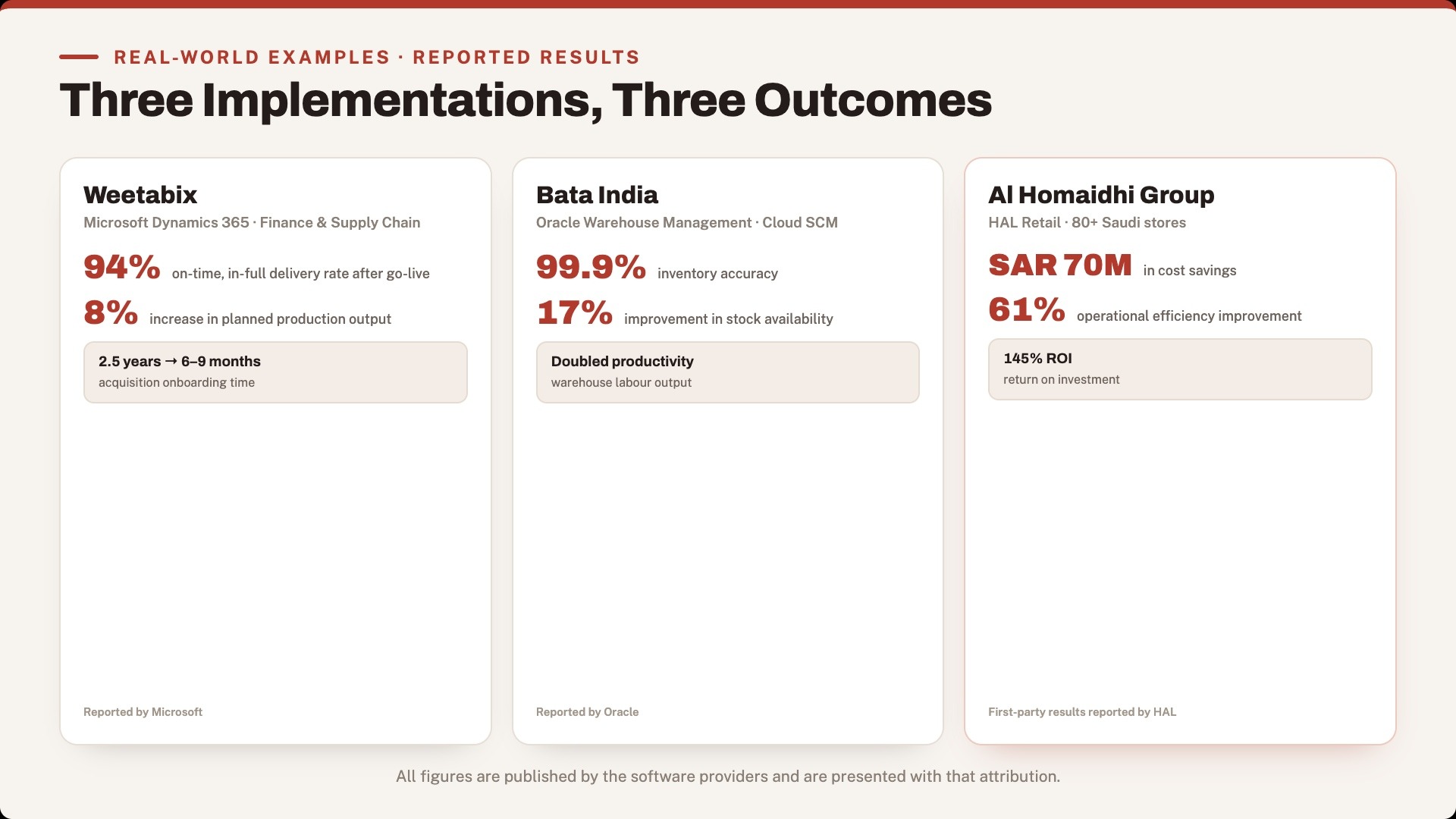
Weetabix modernized its fragmented on-premises environment using Microsoft Dynamics 365 Finance and Dynamics 365 Supply Chain Management.
The programme standardized core processes, connected production devices and unified supply-chain and production planning.
According to Microsoft’s published case study, Weetabix achieved:
The implementation combined technical specialists with internal business-process experts and adapted training for manufacturing employees.
Key lesson: Supply-chain ERP projects work better when process owners participate in the design and change-management plan—not only during final testing.
Bata India’s distribution centres previously used separate warehouse systems, limiting centralized visibility and coordination.
The company implemented Oracle Warehouse Management, part of Oracle Cloud Supply Chain Management, to manage warehouse activity through a shared cloud platform.
Oracle reports that the implementation produced:
Key lesson: Inventory visibility alone is not enough. Location accuracy, standardized warehouse processes and real-time task control determine whether stock can be found and moved efficiently.
Al Homaidhi Group operated more than 80 luxury retail stores in Saudi Arabia. Its legacy environment created delayed reporting, store-level pricing difficulties, disconnected online and offline inventory and stock discrepancies.
The group implemented HAL Retail to connect sales, pricing, inventory, ecommerce and financial information.
The implementation provided:
HAL’s published case study reports SAR 70 million in cost savings, a 61% improvement in operational efficiency and a 145% return on investment. These are first-party results reported by HAL and should be presented with that attribution.
Key lesson: Multi-location retailers gain greater value when ERP connects inventory with sales, pricing, ecommerce and finance instead of treating stock management as an isolated process.
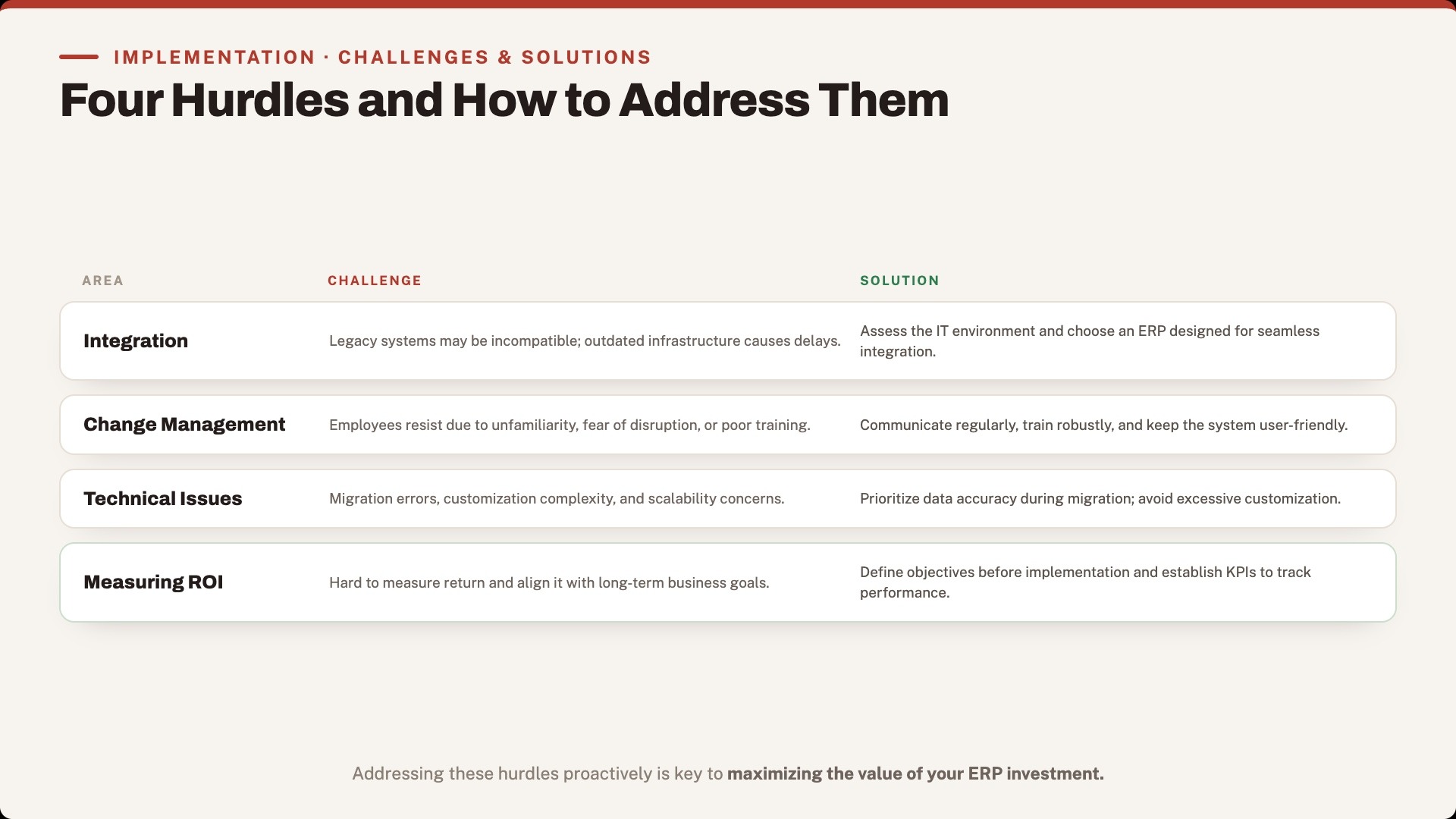
No system is without its challenges, and ERP system implementation is no exception. Addressing these hurdles with proactive solutions is key to maximizing the value of your ERP investment. Here’s a look at common challenges and strategies to overcome them:
Ease your team into ERP adoption with HAL ERP’s user-friendly interface and expert training programs. Check out this video to see it in action.
With these challenges in mind, businesses in Saudi Arabia can confidently adopt ERP systems. But how can they start implementing ERP solutions to achieve operational success like Walmart? Here’s what you need to know.
A Saudi SME does not need to reproduce Walmart’s technology architecture. It needs a system appropriate to its transaction volume, locations, products, workflows and regulatory responsibilities.
Before selecting an ERP, document the complete supply-chain flow:
The ERP evaluation should then cover practical requirements such as:
Businesses should set measurable targets before implementation—for example, reducing stock discrepancies, shortening purchase-cycle time or replacing weekly reporting with daily visibility. These targets provide a clearer basis for evaluating the return on the ERP investment.
For a deeper planning framework, read HAL’s 2026 supply-chain planning guide and procurement planning guide.
HAL ERP connects procurement, inventory, sales, manufacturing and finance through shared records and workflows.
Its supply-chain capabilities include:
HAL’s customer examples demonstrate how these capabilities apply at different stages of the supply chain. Al Homaidhi Group connected inventory, sales and pricing across more than 80 retail locations, while Pan Gulf Optics used HAL Manufacturing to improve material and order tracking and automate work-order processes.
The correct solution depends on your locations, products, transaction volumes, integrations and reporting requirements.
Request a HAL ERP demo to map your current supply-chain workflow and identify the modules required to connect it.
Walmart has historically used SAP financial software as part of its global enterprise environment. However, Walmart does not publicly describe its entire supply chain as operating through one ERP platform. Its documented technology stack also includes proprietary AI, inventory, warehouse, transportation, analytics, RFID and automation systems.
Reliable public evidence confirms Walmart’s historical selection of SAP for global financial processes, but it does not support attributing every current supply-chain capability to SAP S/4HANA. Claims about Walmart’s exact internal ERP version and module architecture should therefore be made cautiously.
Walmart uses interconnected technologies that analyze demand, identify inventory risks, coordinate warehouse and transportation activity and share retail data with suppliers. Current examples include AI-based inventory systems, Walmart Luminate, RFID and automated distribution-centre technology.
ERP connects purchasing, inventory, sales, production and finance through shared transactions. It provides the business and financial foundation, while specialized warehouse, transportation or planning systems may manage more detailed operational activities.
ERP can help reduce stockouts when it maintains accurate inventory, captures demand, records supplier lead times and supports replenishment rules. Results still depend on data quality, forecast accuracy, supplier performance and correctly configured processes.
No. ERP manages wider business processes, including procurement, accounting, sales and inventory valuation. A warehouse management system provides more detailed control over warehouse tasks such as receiving, put-away, picking, packing and labour.
Important capabilities may include multi-location inventory, purchase approvals, lot and serial tracking, barcode workflows, Arabic-English documents, POS and ecommerce integrations, manufacturing or project-stock management, and ZATCA-compatible invoicing.