

Every growing company eventually reaches a point where multiple systems and manual workflows start slowing progress. In Saudi Arabia, the digital transformation market is valued at USD 14.48 billion in 2024 and projected to reach USD 69.82 billion by 2030.
At the same time, over 70% of Saudi enterprises are accelerating ERP and cloud adoption as part of Vision 2030’s push for operational efficiency and data-driven decision-making.
For business owners, IT teams, CFOs, and decision-makers in sectors like manufacturing, contracting, trade, and education, one key question stands out: Should you build an in house ERP system or outsource it to a specialized provider?
In this guide, you’ll learn how both models work, their advantages and challenges, and how to decide which fits your business goals.
Choosing between an in house ERP system and an outsourced one often defines how efficiently your business can scale, adapt, and control its data. Each approach has distinct implications for cost, flexibility, and long-term management.
Below is a detailed comparison across key operational and strategic parameters to help you understand which model aligns better with your business needs.
Consider Reading: A Simple Guide To ERP Costs For Small Businesses
In house systems give businesses the required control but require heavy investment and maintenance, while outsourced ERP solutions offer flexibility, scalability, and lower risk.
If you value autonomy and customization, an in-house ERP may suit you. But if agility and cost efficiency are top priorities, outsourcing might be the smarter move.
%20(3).png)
Now, let’s see the benefits and limitations of an in-house ERP system to help you evaluate it more deeply before making a decision.
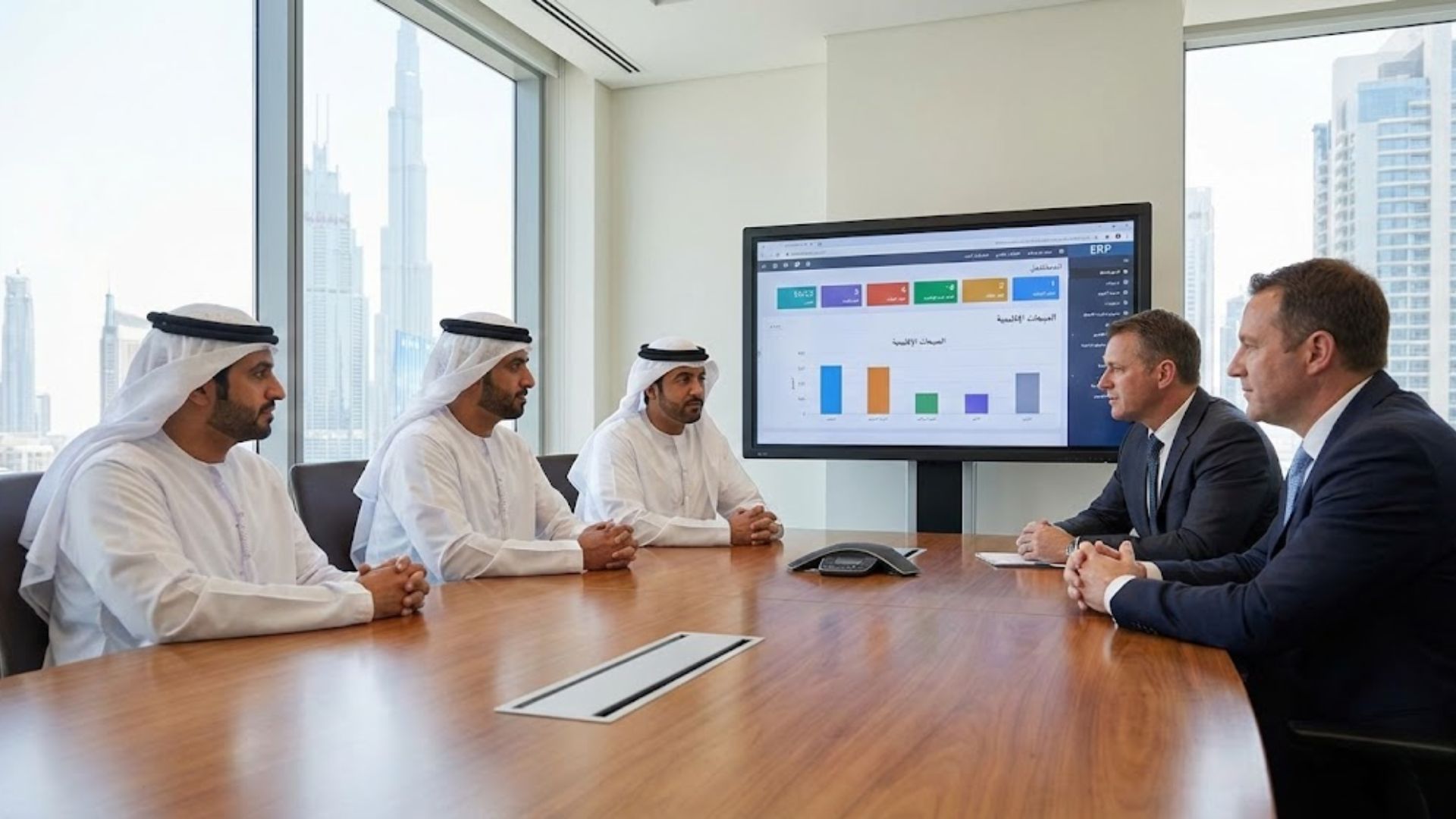
Building an in house ERP system gives businesses full ownership of their software, infrastructure, and data, a fit for organizations prioritizing control and compliance.
Yet in Saudi Arabia, ERP implementation costs often range from SAR 30,000 to over SAR 2 million for large enterprises, highlighting the high initial investment and long-term resource commitments.
Here’s a breakdown of the key pros and cons to help you weigh its suitability for your business:
Must Read: Understanding The ERP Sales Cycle and Its Key Features
While in house ERP systems offer independence and deep personalization, they demand considerable financial and human resources. Companies must weigh long-term ROI against ongoing maintenance and upgrade challenges.
Next, let’s understand the benefits and limitations of outsourcing ERP systems, where flexibility and cost efficiency often redefine operational performance.

Organizations across Saudi Arabia and the GCC are leaning toward outsourced ERP systems to keep pace with digital transformation. Recent data shows the Saudi cloud services market was valued at USD 4.77 billion in 2025 and is projected to reach USD 9.98 billion by 2030, reflecting a strong shift toward cloud-first models.
Below is a clear comparison of outsourced ERP solutions, outlining their advantages and drawbacks to help decision-makers determine if this model aligns with their business strategy:
Also Read: Understanding ERP System Integration: Methods, Importance, and Challenges
Outsourced ERP systems offer significant benefits, especially for growing firms in the trade, manufacturing, contracting and education sectors, but they also mean losing some control and accepting new dependencies.
With both approaches having clear trade-offs, the right choice depends on your business goals and scale.
To help Saudi businesses balance flexibility with control, let’s discuss how HAL ERP delivers the best of services through its localized, cloud-enabled approach.
HAL is a Saudi-based enterprise software provider supporting mid-sized and growing businesses across sectors like contracting, manufacturing, trade, and education. HAL ERP combines the control of an in-house system with the flexibility of a cloud-based solution, giving enterprises the best of services.
It delivers precision through:
Jash Holding, a diversified Saudi group operating across contracting, facilities management, and trading, faced major challenges before adopting HAL ERP, including fragmented data, manual workflows, and limited visibility across subsidiaries.
These inefficiencies slowed reporting, strained payroll management for over 4,000 employees, and increased operational costs.
After integrating HAL ERP, Jash Holding achieved a 60% improvement in operational efficiency, faster project reporting, and complete payroll automation. The company completed full deployment in just 12 weeks, including custom modules for industry-specific needs.
Are outdated ERP systems slowing your growth?
%20(2).png)
The right ERP choice depends on your business stage, priorities, and resources.
An in house ERP system suits large enterprises that demand complete data control, complex custom workflows, and long-term ownership, provided they have the budget and IT capability to sustain it.
In contrast, outsourced ERP solutions are ideal for growing and mid-sized businesses seeking faster deployment, lower costs, and scalability without heavy infrastructure investments.
For Saudi enterprises pursuing agility, compliance, and digital transformation under Vision 2030, a cloud-based AI solution like HAL ERP offers control with flexibility.
Are you ready to modernize your ERP strategy? Learn how HAL ERP empowers businesses in the MENA region to grow smarter and faster. Book a strategic call now.
1. What’s the main difference between in-house and outsourced ERP systems?
An in-house ERP is built, owned, and managed internally, offering full control and customization but with higher costs. Outsourced ERP is managed by a vendor, offering lower setup costs, faster deployment, and scalability, ideal for businesses seeking flexibility without large infrastructure investments.
2. Which ERP model offers better long-term ROI?
Outsourced ERP generally provides better ROI for small and mid-sized businesses due to lower maintenance and faster scalability. In-house ERP offers long-term returns only if the company has the resources, IT team, and stability to maintain it over the years without relying on external vendors.
3. How secure is an outsourced ERP solution?
Modern outsourced ERP systems use advanced encryption, multi-layer firewalls, and compliance standards like ISO 27001 and ZATCA certification to ensure data safety. Security depends on the provider’s infrastructure, so choosing a reputable, compliant ERP vendor is essential for protecting sensitive financial and operational data.
4. Can a business start with outsourcing and later move to in-house ERP?
Yes, many businesses begin with outsourced ERP for cost and speed, then shift to in-house systems as operations expand and control becomes a priority. This hybrid approach allows companies to scale smoothly while balancing flexibility and ownership as their needs evolve.
5. What’s the best ERP option for growing Saudi companies?
For Saudi companies focused on agility, compliance, and Vision 2030 goals, a cloud-based outsourced ERP offers the best balance of cost efficiency and scalability. Localized platforms like HAL ERP combine automation, analytics, and VAT/ZATCA compliance to help businesses grow confidently and stay competitive.