

How much is your business losing every time a supplier quote gets buried in an email thread? According to McKinsey's 2024 Procurement Report, less than 20% of organizations' available procurement data is being used because most businesses still lack integrated systems to process it.
In Saudi Arabia, where procurement volumes are rising sharply alongside Vision 2030-driven expansion, this problem is not a minor inconvenience. It is a direct cost to your business.
Most Saudi businesses still manage their supplier quotations through WhatsApp messages, email chains, and disconnected spreadsheets. The result? Missed follow-ups, inconsistent pricing across projects, no audit trail when disputes arise, and purchasing decisions made on incomplete data.
The root cause is almost always the same. There is no structured system for how quotes are requested, received, and compared. That is exactly what a request for quotation (RFQ) is designed to fix.
This blog explores what an RFQ is, how the process works step by step, and what Saudi businesses specifically need to know about compliance.
A request for quotation (RFQ), or talab urooh al-as’aar in Arabic, is a formal procurement document a buyer sends to pre-qualified suppliers. It asks them to submit pricing, delivery terms, and conditions for a specific set of goods or services.
Unlike a general price inquiry, an RFQ specifies exact quantities, technical requirements, and evaluation criteria. It sets the conditions for a fair comparison.
These three documents confuse a lot of procurement teams. Here is a clean breakdown:
Not every purchase needs a formal RFQ. But here are the four situations where it becomes essential:
Now that you know what an RFQ is and when to use it, let’s look at what one should actually contain, and why that matters even more in Saudi Arabia.

A vague RFQ produces vague quotes. If your suppliers are sending back numbers that are impossible to compare, the RFQ itself is usually the problem.
Here are the eight elements every strong RFQ must include:
Always request the supplier’s Commercial Registration (CR) number and VAT registration certificate alongside their quote. This is critical for ZATCA e-invoicing compliance and protects you legally if a dispute arises.

Also Read: Sales Process Automation in 2026: How ERP Closes Deals Faster in KSA
Now, with the right content in place, the next step is getting the process right. Here is how a well-run RFQ cycle works from start to finish.
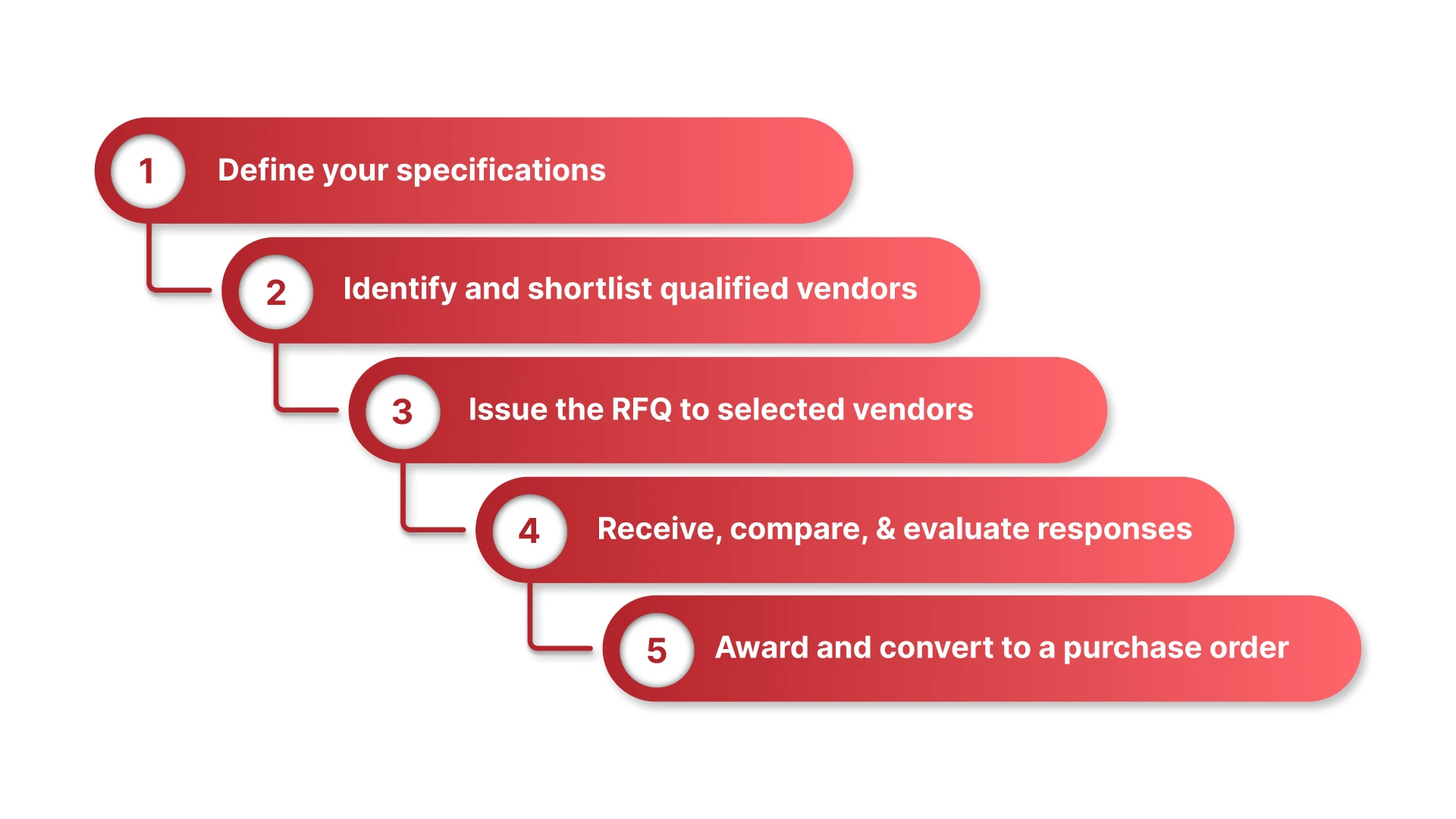
Most procurement delays do not happen because of slow suppliers. They happen because the internal process has gaps. Here is how to run a clean RFQ cycle:
Before you reach out to any supplier, be precise about what you need. Involve your technical or operations team to document exact quantities, materials, and quality standards. Vague specifications are the single most common reason quotes come back incomparable.
Pull from your approved supplier list or vendor registry. For KSA businesses, this step should include a compliance check: confirm that shortlisted suppliers are ZATCA-registered and have a valid CR. For government-adjacent procurement, also check local content requirements.
Send the RFQ simultaneously to all shortlisted suppliers. Sending it at the same time ensures fairness and gives every vendor equal time to respond. If you are using an ERP system, this step is automated, with timestamps, version control, and notifications built in.
However, the problem with email-only RFQ distribution is that there is no audit trail, no way to confirm all vendors received the same version, and no centralized place to track who responded and when.
This is the most underestimated step in the entire process, and the one where manual procurement falls apart most visibly.
When responses come in, you need to compare them across the same dimensions: unit price, VAT-inclusive total, lead time, payment terms, and any quality certifications. Build a structured comparison. A good evaluation scorecard should weigh at a minimum:
Once you select the winning supplier, the accepted quotation becomes the basis for your purchase order (PO). The PO is the legally binding document; the RFQ is not. In HAL ERP, approved quotes convert to purchase orders in a single step, with no manual re-entry. This also starts the document trail that links directly to your ZATCA-compliant invoice when goods are delivered.
Also Read: 10 Common Reasons for Procurement Processes to Fail
The process sounds straightforward, but there are KSA-specific compliance requirements that most procurement guides completely ignore. Let’s look at those next.

Global procurement guides cover the basics. But running procurement in Saudi Arabia comes with regulatory and commercial requirements that are unique to this market.
Under ZATCA regulations, every taxable supply in Saudi Arabia must be traceable through a compliant invoice chain. That chain starts at the RFQ. If your quotation requests pricing without specifying VAT treatment, you will receive inconsistent responses, some inclusive, some exclusive. This will make comparison unreliable and downstream reconciliation painful.
Always request VAT-exclusive unit prices and a separate VAT total in every RFQ. This ensures your comparison is clean and your accounts payable team can match the quote to a ZATCA-compliant invoice without discrepancies.
Before issuing an RFQ, verify that every shortlisted supplier has an active Commercial Registration (CR) and VAT registration. This is not just a best practice. It is a protection. If a dispute arises, an RFQ issued to an unregistered or non-compliant vendor gives you no legal standing.
For best practice, include a field in your RFQ template that requires suppliers to submit their CR number and VAT registration certificate alongside their pricing response.
Many government bodies and semi-government organizations in Saudi Arabia require procurement documents in both Arabic and English. If you are bidding on government-adjacent work or sourcing from government-regulated markets, your RFQ and the responses you receive should be bilingual.
HAL ERP supports bilingual document generation natively, which removes this operational burden from your procurement team.
Now that we have covered the compliance layer, let’s look at how different industries in KSA actually use the RFQ process in practice.
The RFQ process looks different depending on your industry. Here is how the four core sectors HAL ERP serves use it in practice:
Contracting firms issue RFQs on a project-by-project basis, for raw materials, subcontractors, and heavy equipment, often across multiple project phases. A single mid-size construction project in Saudi Arabia can require 50 to 100 separate RFQs across its lifecycle.
The challenge: each phase has its own specs, timelines, and budget allocation. Managing that across email and spreadsheets creates version conflicts, budget overruns, and a complete lack of visibility for project managers or CFOs.
Manufacturers use RFQs to source raw materials and production components at volume. Their RFQs include detailed technical specs, quality certification requirements, and lead times that link directly to production planning. A delay or pricing error at the RFQ stage flows directly into production schedules and cost-of-goods calculations.
Trading companies manage hundreds of SKUs from multiple suppliers simultaneously. Their RFQ process is high-frequency and price-sensitive. For example, even a 2% pricing inconsistency across a large order becomes a significant margin problem at scale. Automated comparison across vendors is a necessity for trading businesses.
Service businesses and educational institutions issue RFQs for IT equipment, facility management, consumables, and contract services. While the volumes are lower, the compliance requirements are the same, and the administrative burden of managing it manually diverts skilled staff from higher-value work.
What all four industries have in common: they all break down when RFQ management runs on manual processes. That is where automation changes everything.
Managing RFQs manually is a structural bottleneck that limits how fast your business can grow. When quotes live in email inboxes, pricing comparisons happen on spreadsheets, and purchase orders get created by re-typing data from PDFs, errors are not a risk. They are a certainty.
HAL ERP’s procurement module is built to eliminate exactly that bottleneck, giving procurement teams, operations managers, and CFOs a single system to manage the entire RFQ-to-invoice cycle.
Here is what HAL ERP does inside the procurement workflow:
HAL ERP does not just digitize the RFQ form. It connects the entire procurement cycle, from need identification to supplier selection, purchase order, goods receipt, and ZATCA-compliant invoice, into one auditable, automated workflow.
Jash Holding manages over 4,000 employees across multiple facilities management contracts throughout Saudi Arabia. Their procurement ran on legacy systems and manual processes, leading to intercompany billing errors, delayed project cost tracking, and significant reconciliation overhead across subsidiaries.
The solution: HAL ERP replaced its fragmented procurement and finance workflows with a single integrated platform. The procurement module automated intercompany billing, gave project managers real-time visibility into material and service costs at the project level, and connected purchasing directly to VAT-compliant invoicing
As a result, Jash Holding saved SAR 50 million through automation and streamlined operations, achieved over 60% ROI, and gained real-time project cost tracking across all subsidiaries, removing the manual bottlenecks that were limiting operational scale.

Also Read: How Purchase Orders Work: Process, Types, and Key Elements
A request for quotation is not just a procurement document. It is the first control point in your entire purchasing cycle. Get it right, and you get better prices, cleaner compliance, and faster decisions. Get it wrong or skip it entirely, and every downstream problem, including pricing disputes, audit gaps, and VAT mismatches, becomes harder to fix.
However, when this process runs inside an ERP system like HAL ERP, it stops being a manual burden and becomes a competitive advantage.
Book your demo today to see the full RFQ-to-invoice workflow in action.
An RFQ (request for quotation) is sent by the buyer to invite suppliers to submit pricing. It is not legally binding. A purchase order (PO) is issued after a quote is accepted and creates a legally binding obligation. The RFQ comes first; the PO follows.
No. An RFQ is an invitation for suppliers to submit bids, not a contractual commitment. However, once a buyer formally accepts a quotation and issues a PO, that acceptance may form the basis of a binding agreement under Saudi commercial law. Always document the acceptance clearly and in writing.
Best practice is 3 to 5 vendors for standard purchases. For high-value or strategic procurement, a wider distribution of 5 to 8 vendors increases competition and improves pricing outcomes. The goal is enough responses to enable genuine comparison without creating unmanageable administrative overhead.
An RFI (Request for Information) is used early in the procurement process to gather general market knowledge. An RFQ is used when specifications are defined, and you need competitive pricing. An RFP is used for complex purchases where you are evaluating solutions, capabilities, and approach, not just price.
The RFQ starts the procurement document chain. An accepted quotation becomes the basis for a purchase order, which links to a goods receipt, which connects to a ZATCA-compliant e-invoice. HAL ERP automates this entire chain, ensuring every document in the cycle is linked, traceable, and compliant with Fatoorah Phase 2 requirements.





.png)
