

As businesses grow, so does the number of decisions they make every day. New suppliers get added, product lines expand, and purchasing happens across teams, branches, and projects. On the surface, everything looks like it’s moving forward.
But over time, this growth creates complexity that is harder to see.
Global supply chains have become more volatile in recent years, and procurement teams are under increasing pressure to manage costs while maintaining reliability. Without a structured approach, decisions start drifting. Costs vary without clear reasons. Supplier performance becomes inconsistent. And teams spend more time reacting than planning.
This is where category management becomes important.
In this blog, you will learn what category management means, how it works in real business scenarios, the core components that support it, the steps involved in applying it, and the strategies that help make it consistent and scalable.
Category management is a strategic approach where businesses group similar products or services into defined “categories” and manage each category as a separate business unit to improve cost control, efficiency, and overall performance.
In 2026, this shift has become more urgent. Procurement is no longer just about buying at the lowest price. Businesses are expected to operate with real-time financial visibility, tighter compliance requirements, and stronger supplier accountability.
For mid-sized Saudi businesses, this shift is critical. Most companies in contracting, trading, retail, or manufacturing still operate procurement in a reactive way:
Category management solves this by structuring procurement and operations around how the market works, not just how the company is organized internally.
Category management operates slightly differently depending on the business function, but the foundation remains the same.
In procurement, category management focuses on grouping external spend into categories such as IT services, raw materials, logistics, or marketing.
In retail, category management focuses on organizing products into groups such as apparel, electronics, or FMCG and managing them for performance.
Across both perspectives, the goal remains the same: treat categories as strategic units that drive business outcomes, not just operational tasks.
Once the concept is clear, the next step is understanding what makes category management work in practice.
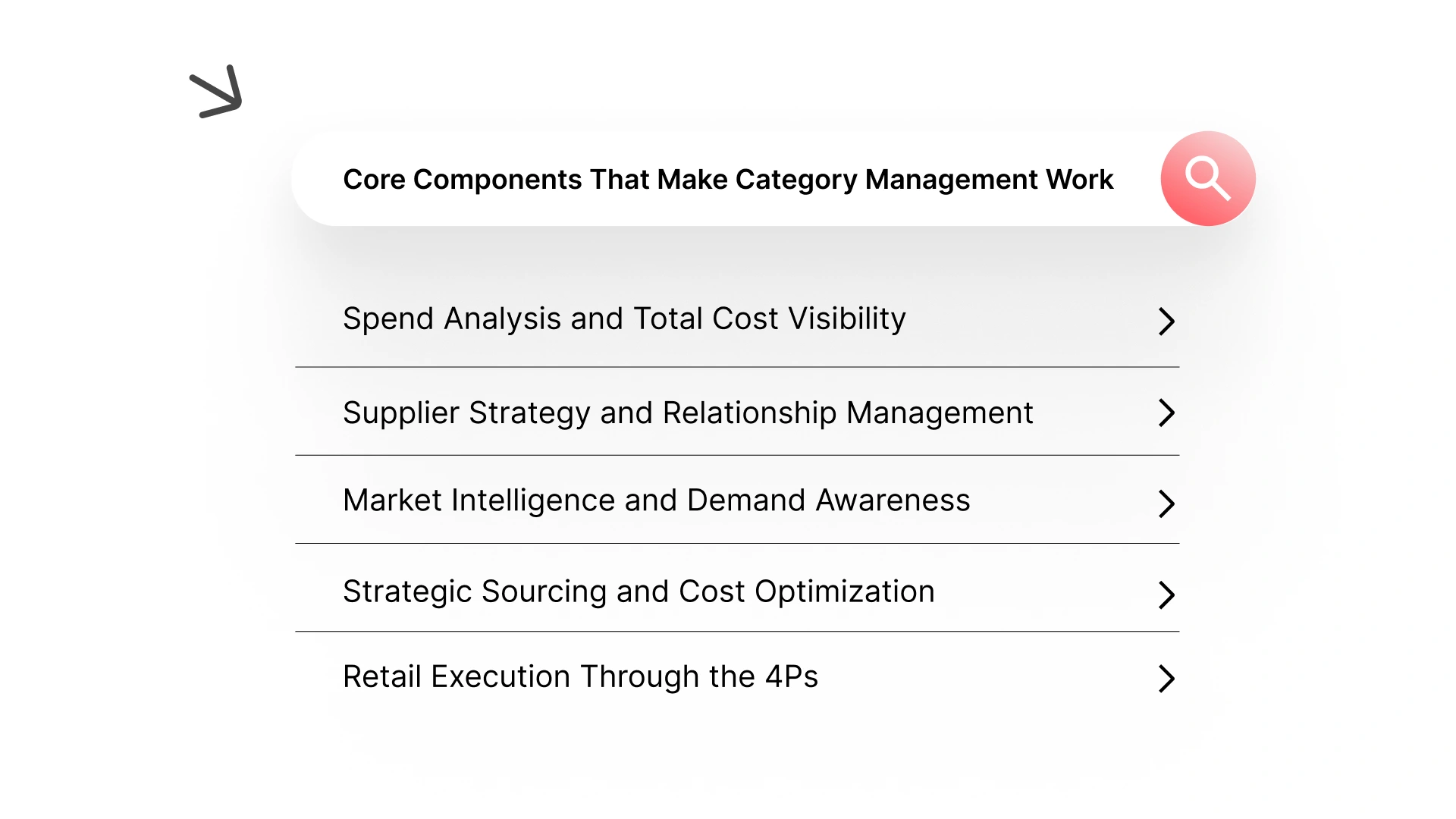
Category management only delivers results when it moves beyond grouping products or spend and becomes a structured, data-driven system. At a foundational level, category management is built on two complementary layers:
When both are aligned, businesses gain control over cost, demand, and profitability.
Most procurement inefficiencies begin with limited visibility. Different departments purchase similar items independently, pricing varies, and finance teams lack a consolidated view of spending.
Category management starts by analyzing:
For Saudi businesses, this step is critical for maintaining consistent records and supporting compliance requirements under ZATCA, where transaction accuracy and traceability matter.
Suppliers are not just vendors. They are long-term partners that directly impact cost, quality, and reliability.
Instead of transactional buying, category management focuses on:
This becomes especially important where supply chain disruptions or import dependencies can affect project timelines.
Internal data alone is not enough. Businesses need to understand what is happening outside.
Category management incorporates:
For example, fluctuations in raw material prices or import delays can significantly impact procurement decisions for trading and manufacturing businesses.
This is where strategy turns into execution. Based on category insights, businesses define how sourcing should be handled.
This includes:
Instead of reactive purchasing, sourcing becomes planned and consistent.
For retail and distribution businesses, category management extends beyond procurement into how products are positioned and sold. This is where the 4Ps framework becomes relevant:
Product
Price
Place
Promotion
For Saudi retailers managing multiple outlets or e-commerce channels, these elements directly influence revenue and customer experience.
Without continuous monitoring, even well-defined strategies lose effectiveness.
When these components work together, category management shifts from a theoretical framework to a practical system. It gives businesses better control over spending, stronger supplier relationships, and more predictable operational outcomes.
At this point, it is important to clear a common confusion that often affects execution.
Category management and strategic sourcing are closely related, but they are not the same thing. Many businesses use the terms interchangeably, which often leads to gaps in execution.
The simplest way to understand the difference is this:
Category management looks at the entire lifecycle of a category. It focuses on how a business should manage a group of products or services over time, including supplier relationships, cost structures, risks, and performance.
Strategic sourcing, on the other hand, focuses on the process of selecting suppliers and negotiating contracts within that category.
Here’s how this difference plays out in real business scenarios:
Category Management (Ongoing, Strategic Layer)
Strategic Sourcing (Execution Layer)
For example, a contracting company in Saudi Arabia may define a category strategy for construction materials. This includes identifying preferred suppliers, setting pricing benchmarks, and planning procurement across projects. That is category management.
When the same company issues tenders, negotiates prices, and selects suppliers for a specific project, that is strategic sourcing.
Also read: How Purchase Orders Work: Process, Types, and Key Elements
Without category management, sourcing becomes reactive and inconsistent. Without strategic sourcing, category strategies cannot be executed effectively.
Once the foundation and core components are in place, category management moves into execution through a structured process.
This process ensures that category strategies are not limited to planning documents but are actively applied across procurement, finance, and operations.
After defining categories at a high level, the next step is to break them down into actionable segments.
This segmentation allows businesses to apply different strategies within the same category instead of treating everything uniformly.
Not all categories require the same level of attention. Prioritization helps focus effort where it delivers the most value.
For example, in contracting or manufacturing, certain materials directly affect project timelines, making them higher priority than indirect spend.
Execution depends heavily on internal coordination. Misalignment across teams is one of the biggest reasons category strategies fail.
In many Saudi businesses, decentralized decision-making leads to inconsistent execution. This step ensures everyone operates within the same framework.
Manual processes limit visibility and slow execution. Digitizing workflows is critical to scaling category management.
This step is particularly important for businesses dealing with multiple branches or project sites, where manual tracking quickly becomes unmanageable.
Category management must stay tightly connected to financial systems to remain effective.
For Saudi businesses, this also supports better audit readiness and smoother financial reporting.
Even well-designed category strategies fail without enforcement.
This step ensures that category management is not bypassed during urgent or high-pressure situations.
The final step is creating a system where insights flow back into decision-making without restarting the entire process.
This makes category management adaptive rather than static, allowing businesses to respond to real operational conditions instead of relying only on initial plans.
Also read: Cost-Effective Procurement Management: How Software Can Help?
Once the process is in place, the real advantage comes from how categories are managed over time.
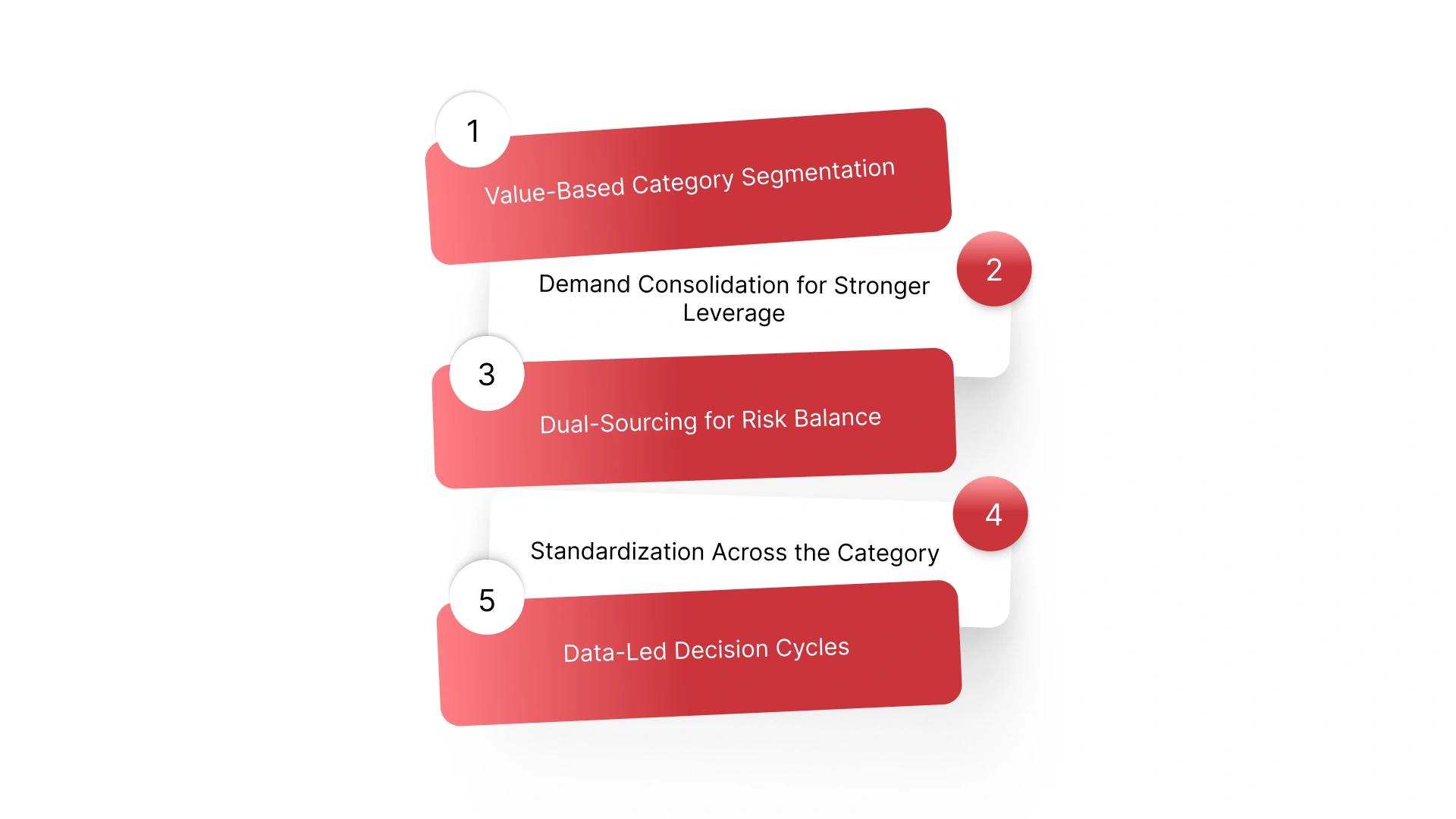
Once the process is in place, the real advantage comes from how categories are managed over time. The strategies below focus on decision-making discipline and operational control, which is where most growing businesses see measurable gains.
Not every category deserves the same strategy. High-spend, high-risk categories need deeper control, while low-impact ones should stay simplified.
This prevents teams from over-managing minor spend while under-managing critical areas.
Fragmented demand weakens negotiating power. Consolidating requirements across projects or branches creates scale.
For businesses operating across multiple locations, this strategy alone can significantly improve cost efficiency.
Relying on a single supplier may seem efficient but creates exposure. On the other hand, too many suppliers reduce control.
This creates a balance between cost optimization and operational continuity.
Variation increases cost, complexity, and errors. Standardizing inputs and processes simplifies category control.
This strategy is especially useful in industries like contracting or manufacturing, where inconsistencies can lead to delays and cost overruns.
Category performance should guide future decisions, not assumptions or one-time analysis.
This keeps category management responsive to operational realities instead of becoming outdated over time.
Most businesses define category strategies but struggle to enforce them consistently across teams and projects. HAL ERP connects procurement, finance, and operations in one system, ensuring category decisions are applied in real time, not managed in disconnected spreadsheets.
Category management only works when your data, suppliers, and decisions are connected. Without that, strategies stay on paper while operations remain fragmented.
HAL ERP brings your procurement, inventory, finance, and supplier data into one system, so every category is managed with real visibility, not assumptions.
With centralized visibility, standardized workflows, and built-in compliance, HAL ERP helps you turn category management into a controlled, day-to-day operational system. Book a demo to see how you can scale procurement without losing control.
What category management does is bring clarity to complexity. It gives businesses a way to connect purchasing decisions with financial outcomes, supplier performance, and operational priorities, instead of treating them as separate activities. Over time, this leads to better predictability, stronger control over costs, and fewer surprises in day-to-day operations.
The real challenge is not understanding the concept, but applying it consistently across teams, locations, and systems.
If your current setup still relies on spreadsheets or disconnected tools, that is usually where execution starts to break down. HAL ERP helps bring procurement, finance, and operational workflows into one system, so category decisions are applied with real-time visibility and control.
Book a demo with HAL ERP to see how category management can become a structured, scalable part of your daily operations.
If your teams are buying similar items from different suppliers, pricing varies across departments, or you lack a clear view of total spend, category management can bring structure and control.
It typically sits with procurement or finance leadership, but it requires cross-functional ownership involving operations, project teams, and management for effective execution.
It depends on the size and complexity of the business, but most companies start seeing improvements within a few months once categories are structured and workflows are aligned.
It is possible at a small scale, but as operations grow, manual tracking limits visibility and consistency, making it difficult to sustain results.
Treating it as a one-time exercise instead of an ongoing system. Without continuous tracking and enforcement, teams often revert to old purchasing habits.





.png)
