
B2B sales are becoming harder to predict, not easier. More data, more tools, more channels, yet fewer teams have clear visibility into what will actually close and why. Decisions still rely on lagging reports, while buyers move faster than the systems meant to track them.
This is why AI is gaining ground so quickly. Research shows that 85% of sales teams report higher productivity with AI, and organizations using AI-driven personalization see up to 35% stronger engagement. The shift is about changing how sales decisions are made in real time.
The question is no longer whether AI can support B2B sales. It is where it fits, what it improves, and how to apply it without adding more complexity.
In this blog, you will explore what AI in B2B sales actually means, the technologies behind it, the strategies that drive measurable results, and how to choose tools that align with real business operations.
AI in B2B sales refers to the use of machine learning, predictive analytics, and automation to improve how businesses identify opportunities, engage prospects, and close deals. Instead of relying on manual tracking, intuition, or delayed reports, AI enables sales teams to work with real-time data, structured insights, and automated workflows.
In practical terms, AI connects sales activity with operational data across the business. It analyzes customer behavior, past transactions, pricing patterns, and pipeline movement to guide decisions at every stage of the sales cycle.
This allows businesses to:
The shift is not about replacing sales teams. It is about giving decision-makers and sales leaders better visibility and control over the entire sales process.
For mid-sized businesses, especially those scaling across multiple branches or projects, AI helps bring structure to what is often a fragmented and reactive sales environment. Instead of chasing deals, teams can focus on the right opportunities with better timing and clearer visibility.
In many Saudi mid-sized businesses, sales processes are still driven by spreadsheets, disconnected tools, and manual coordination between teams. While this may work at a smaller scale, it begins to break down as operations grow more complex.
In contracting, retail, and financial services, the gaps are not theoretical. They show up in day-to-day operations:

As businesses expand across branches, projects, and customer segments, these gaps become harder to manage manually. This is where AI begins to shift sales from reactive execution to structured, data-driven decision-making.
AI in B2B sales is not a single capability. It is built on a combination of technologies that serve different purposes across the sales cycle. Understanding these technologies helps clarify where AI delivers real value, whether it is improving forecasting accuracy, enhancing customer engagement, or automating execution.
Below are the three key AI technologies shaping modern B2B sales operations.
Predictive AI uses machine learning and data modeling to analyze historical sales data and identify patterns that can guide future decisions. Instead of relying on assumptions or static reports, sales teams can use predictive models to anticipate outcomes with greater accuracy.
In B2B sales, predictive AI helps teams:
For example, AI may analyze past CRM data and identify that mid-sized deals close faster when certain support or service conditions are met. Based on this, it can recommend actions that improve deal velocity or prioritize similar opportunities.
This shifts sales planning from reactive reporting to data-backed forecasting and decision-making.
Generative AI focuses on creating new content and recommendations based on large datasets and language models. It enables sales teams to generate communication, insights, and strategies at scale without starting from scratch.
In B2B environments, generative AI is commonly used for:
Adoption is growing, but still evolving. According to industry surveys, only a portion of organizations have fully implemented generative AI at scale, with many still testing targeted use cases.
The value lies in speed and consistency. Sales teams can deliver more relevant communication faster, while maintaining alignment with customer needs and business objectives.
Agentic AI represents a more advanced stage of AI adoption. These systems are designed to take actions independently based on defined goals, data inputs, and real-time context.
In B2B sales, agentic AI can function as an active participant in the sales process by:
For example, an AI assistant can build and execute a lead nurturing workflow, engage prospects through personalized communication, and adjust its approach based on responses, all without constant human intervention.
This reduces manual effort and ensures that opportunities are consistently followed through, even at scale.
Also read: Top 5 Agentic AI CRM Platforms Redefining Customer Engagement in 2026
Why These Technologies Matter Together?
Each of these technologies addresses a different layer of the sales process:
When combined, they create a more structured and scalable sales system where insights, actions, and outcomes are continuously aligned.

AI is not simply improving isolated parts of the sales cycle. It is fundamentally reshaping how B2B sales operates by turning fragmented, intuition-driven processes into coordinated, data-driven systems.
Today, AI introduces a structured model where data, decisions, and actions are continuously connected across the entire sales lifecycle. This transformation is happening through a shift toward AI-enabled selling models that combine human expertise with intelligent systems to improve speed, consistency, and customer outcomes
This shift becomes more visible when you look at how each stage of the B2B sales process evolves with AI.
In many B2B organizations, sales teams react to incoming leads and pipeline updates. Decisions are based on static reports or individual judgment, which often leads to missed opportunities or misallocated effort.
AI changes this by continuously analyzing customer behavior, deal history, and engagement patterns to predict outcomes.
With AI:
This allows sales teams to focus on deals that are most likely to close, improving both conversion rates and resource utilization.
Sales execution often depends on multiple manual steps, follow-ups, internal approvals, and coordination across teams. As businesses scale, this slows down deal cycles and introduces inconsistency.
AI agents streamline this by actively managing workflows across systems.
In practice, AI can:
Instead of relying on manual tracking, workflows become structured and self-operating, reducing delays and operational friction.
Traditional B2B sales funnels are linear. Leads move from stage to stage, often without continuous engagement or personalization. This creates gaps in communication and inconsistent customer experiences.
AI enables a more dynamic approach where customer journeys are continuously adapted based on behavior and intent.
With AI:
This creates a consistent and responsive experience, improving both engagement quality and conversion outcomes.
One of the most significant changes is the emergence of hybrid sales models where AI and human teams work together.
These models include:
This does not replace sales teams. It allows them to focus on high-value activities such as relationship building, negotiation, and complex deal structuring, while AI handles scale and consistency.
In many mid-sized businesses, sales data is spread across multiple tools. CRM holds customer interactions, ERP holds pricing and inventory, and finance tracks revenue. This fragmentation limits visibility and slows decision-making.
AI changes this by integrating and analyzing data across systems.
As a result:
This creates a unified view of the customer and the pipeline, allowing for more accurate and confident decision-making.
Forecasting in traditional B2B sales is often based on static pipeline reviews and manual inputs. This leads to inaccuracies, especially in complex environments with long sales cycles.
AI improves this by continuously updating forecasts based on live data.
With AI-driven forecasting:
This allows businesses to move from periodic reporting to continuous revenue visibility.

AI in B2B sales delivers results only when it is applied to specific commercial problems, not as a generic layer on top of existing processes. The difference between companies that see ROI and those that don’t often comes down to how strategically AI is implemented across the sales cycle.
Below are high-impact, actionable strategies that go beyond surface-level automation and directly improve conversion, forecasting, and revenue performance.
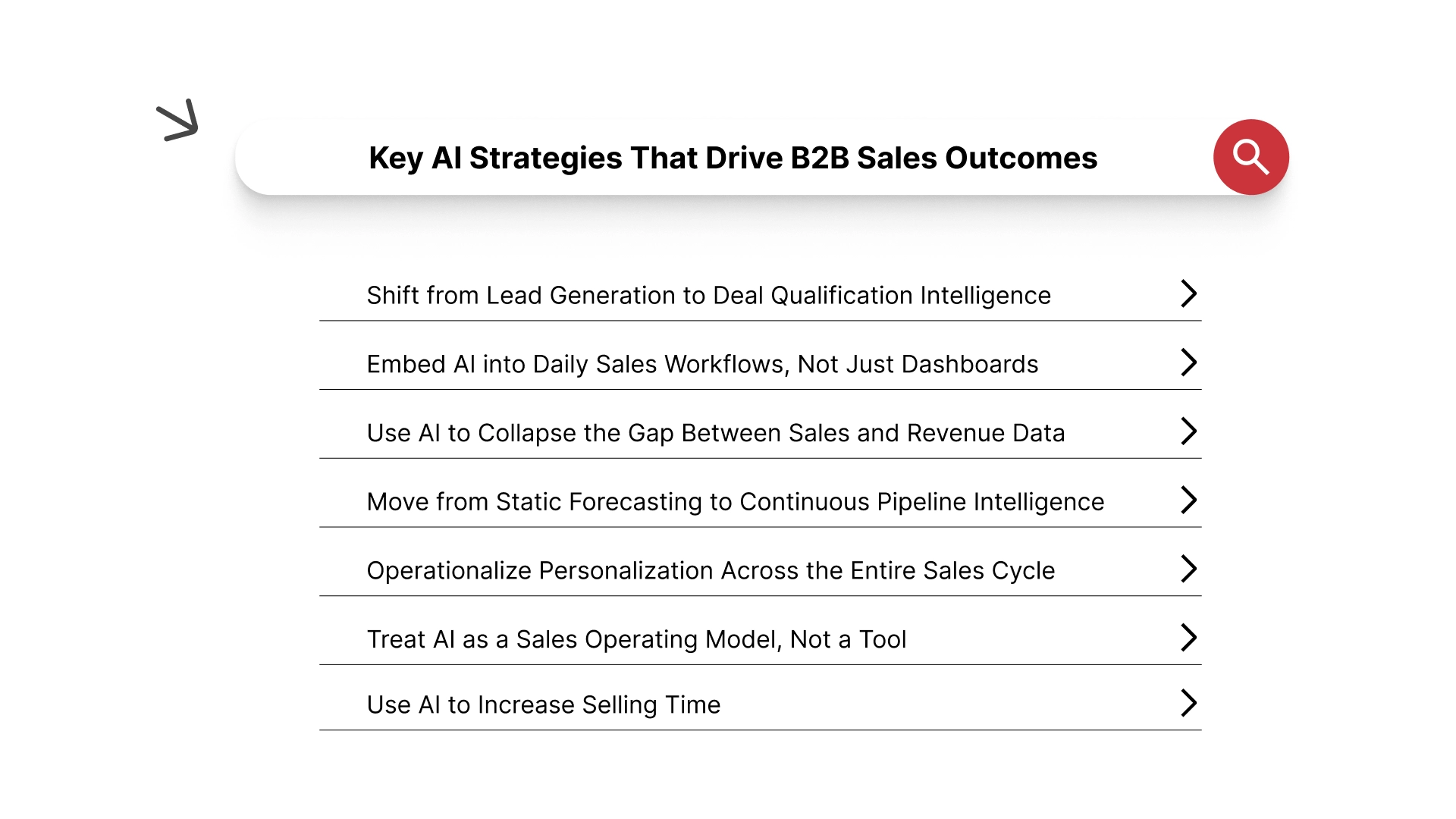
Most B2B teams focus heavily on generating leads, but the real bottleneck is qualifying and prioritizing the right opportunities.
AI changes this by analyzing historical deals, engagement patterns, and firmographic data to rank opportunities based on conversion likelihood.
How to implement:
AI-driven lead prioritization can significantly improve conversion rates and ensure sales teams focus on high-value opportunities instead of spreading effort too thin.
Many businesses use AI only for reporting or analytics. The real impact comes when AI is embedded into day-to-day execution.
How to implement:
AI can automate repetitive tasks like follow-ups, CRM updates, and pipeline tracking, freeing up significant selling time and improving productivity.
One of the biggest failures in B2B sales is that pipeline data and financial reality do not match. Deals look strong in CRM but fail due to pricing, margin, or delivery constraints.
How to implement:
AI becomes significantly more powerful when connected to operational data, enabling sales decisions that reflect real business conditions rather than assumptions.
Traditional forecasting is periodic and often outdated by the time it is reviewed. AI enables continuous, real-time forecasting.
How to implement:
AI-enhanced analytics improve forecast accuracy and revenue predictability, allowing leadership to act early instead of reacting late.
Personalization in B2B sales is often limited to early-stage outreach. AI enables personalization across every interaction, from prospecting to closing.
How to implement:
AI-driven personalization improves engagement rates and helps sales teams communicate more effectively with complex buying groups.
One of the biggest insights from industry research is that AI only creates value when embedded into how the business operates.
How to implement:
Companies that integrate AI into core workflows see significantly higher productivity and revenue impact compared to those that treat it as an add-on.
Sales teams often spend more time on admin work than actual selling. AI’s biggest impact comes from reclaiming that time.
How to implement:
AI can free up selling time and improve conversion rates by allowing reps to focus on customer conversations instead of operational tasks.

The companies that win are not the ones using AI the most. They are the ones using it where it directly impacts revenue decisions.

Choosing an AI tool for B2B sales is more about fixing how sales decisions are made across the business. For mid-sized companies in contracting, trading, retail, and services, sales are closely tied to pricing, inventory, delivery timelines, and financial controls.
An effective AI tool should connect these moving parts and bring clarity to decisions that directly impact revenue and profitability.
Below are the key factors to evaluate when selecting the right AI-driven sales solution:
Also read: Unleashing the Power of HAL CRM (ERP) Systems
HAL ERP brings these capabilities into a single, integrated environment, combining AI-driven insights, real-time visibility, pricing control, and compliance readiness to support scalable B2B sales growth.
AI in B2B sales is becoming a requirement for staying relevant. As sales cycles grow more complex and data volumes increase, manual processes and disconnected systems simply cannot keep up.
The real value of AI comes when it is connected to how your business actually operates. When sales, pricing, inventory, and financial data work together, decisions become faster, more accurate, and more predictable.
HAL ERP brings this together in one system. With AI-driven insights, real-time visibility, and integrated control across sales and operations, it helps businesses move from reactive selling to structured, scalable growth.
Book a demo with HAL ERP to see how your sales process can become faster, smarter, and fully aligned with your business operations.
Most businesses begin seeing improvements in efficiency and visibility within a few months, especially in areas like lead prioritization and workflow automation. However, full impact depends on how well AI is integrated into core sales processes.
While larger datasets improve accuracy, mid-sized businesses can still benefit from AI using existing CRM, sales, and operational data. The key is having clean, structured, and connected data rather than large volumes alone.
Yes. AI can track interactions across stakeholders, analyze engagement patterns, and support personalized communication for each decision-maker involved in the deal.
Businesses typically need to standardize their sales processes, clean up existing data, and align teams on how AI insights will be used. Without this foundation, AI adoption may not deliver expected results.
AI shifts the role of sales teams toward higher-value activities such as relationship building, negotiation, and strategic decision-making, while reducing time spent on administrative and repetitive tasks.