
Cash flow determines whether a business can pay its bills, fund growth, and stay financially stable. Yet, 82% of small and medium-sized businesses fail due to poor cash flow management, according to a U.S. Bank study. A PwC report further notes that 61% of CFOs consider real-time cash visibility crucial for business continuity.
That’s where cash flow forecasting becomes essential. It helps predict when money will flow in and out, identify shortfalls early, and guide smarter financial decisions.
In this blog, we’ll break down how to create an accurate cash flow forecast and how understanding it can strengthen your company’s financial control and resilience.
Cash flow forecasting is the process of guessing how much money will come into and go out of your business over a certain time period, usually once a week, once every two weeks, or once every three months.
It lets you know ahead of time if you'll have enough cash on hand to pay for upcoming costs, make investments, or handle periods of slow sales without any problems.
In simple terms, it’s a financial map showing when money enters (through sales, receivables, or funding) and when it leaves (for salaries, rent, supplier payments, or taxes).
By tracking these patterns, businesses gain clarity on future cash positions and can make informed decisions about spending, saving, or securing financing.
Forecasting accurately helps businesses plan, avoid cash flow problems, and improve their financial management. It is one of the most important tools for long-term growth.
Now that you know what cash flow forecasting means, the next step is learning how to create one. The process is simpler than it seems when broken down into clear, actionable steps.
Must Read: HAL Trade: Run Your Trading Operations with Precision
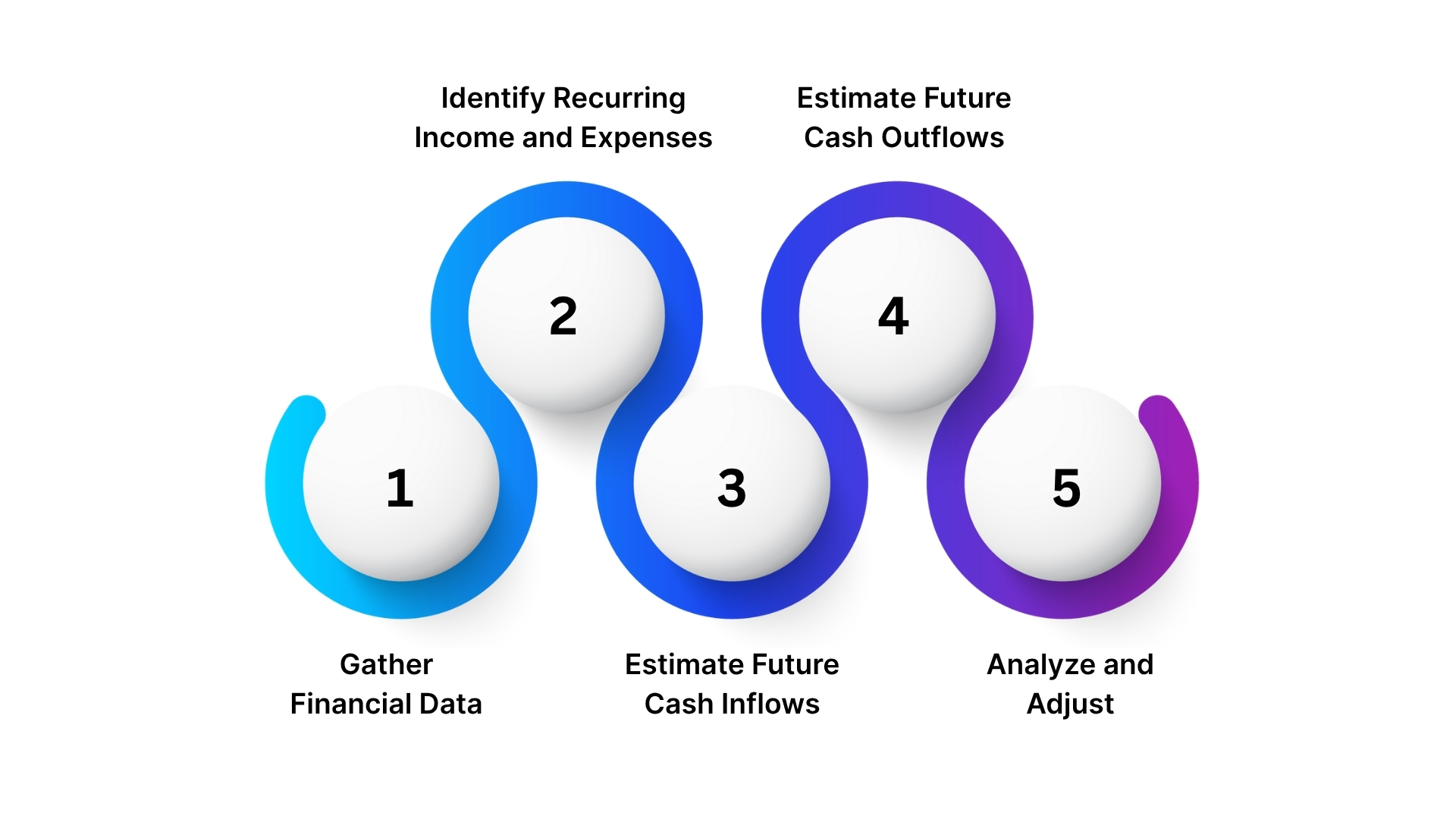
Creating a cash flow forecast helps you anticipate when money will enter and leave your business, allowing you to plan for shortfalls or surpluses before they happen.
Here’s a clear step-by-step breakdown to build one effectively.
Start by collecting accurate and complete financial data.
You’ll need:
This information provides the foundation for your forecast. When financial data is scattered across different teams or systems, consolidating it into a single view ensures accuracy and eliminates duplicate entries.
Once you have your data, separate recurring transactions from one-time events. This helps you understand the predictable part of your cash flow.
Recurring income includes:
Recurring expenses include:
By noticing these patterns, you can make a stable base for your forecast. It also shows you where small changes, like renegotiating payment terms, can make your cash flow better.
Next, estimate how much cash you expect to receive and when it will arrive.
Consider:
Be realistic about when things will happen. Just because you made a sale doesn't mean you'll get cash right away. Payment behavior, not just total revenue, should be included in forecasts.
List all upcoming expenses your business will need to pay.
These can be:
Categorizing them as fixed (predictable, like rent) and variable (changing, like inventory) gives a clearer picture of what can be adjusted if cash becomes tight.
Automation tools or ERP systems can simplify this step by tracking and classifying expenses automatically, ensuring that forecasts stay current as spending changes.
Subtract total outflows from total inflows for each period to determine your net cash flow.
The key is to analyze these results regularly. Compare forecasts with actual outcomes, identify gaps, and adjust future estimates accordingly. Continuous monitoring allows you to adapt quickly to shifting market conditions or customer payment patterns.
This process is faster and more accurate with real-time financial dashboards and reporting tools. These help you spot warning signs early and make smart decisions.
Once your forecast is in place, the real value lies in how you use it. Here’s a look at the key benefits of cash flow forecasting and why every business should make it a regular practice.
Must Read: The best inventory management solution in Saudi Arabia
You can use a cash flow forecast to do more than just see how much money your business has. It also gives you the confidence to make better, faster financial choices. It can be one of the most useful planning tools in your organization if it is done right and looked over regularly.
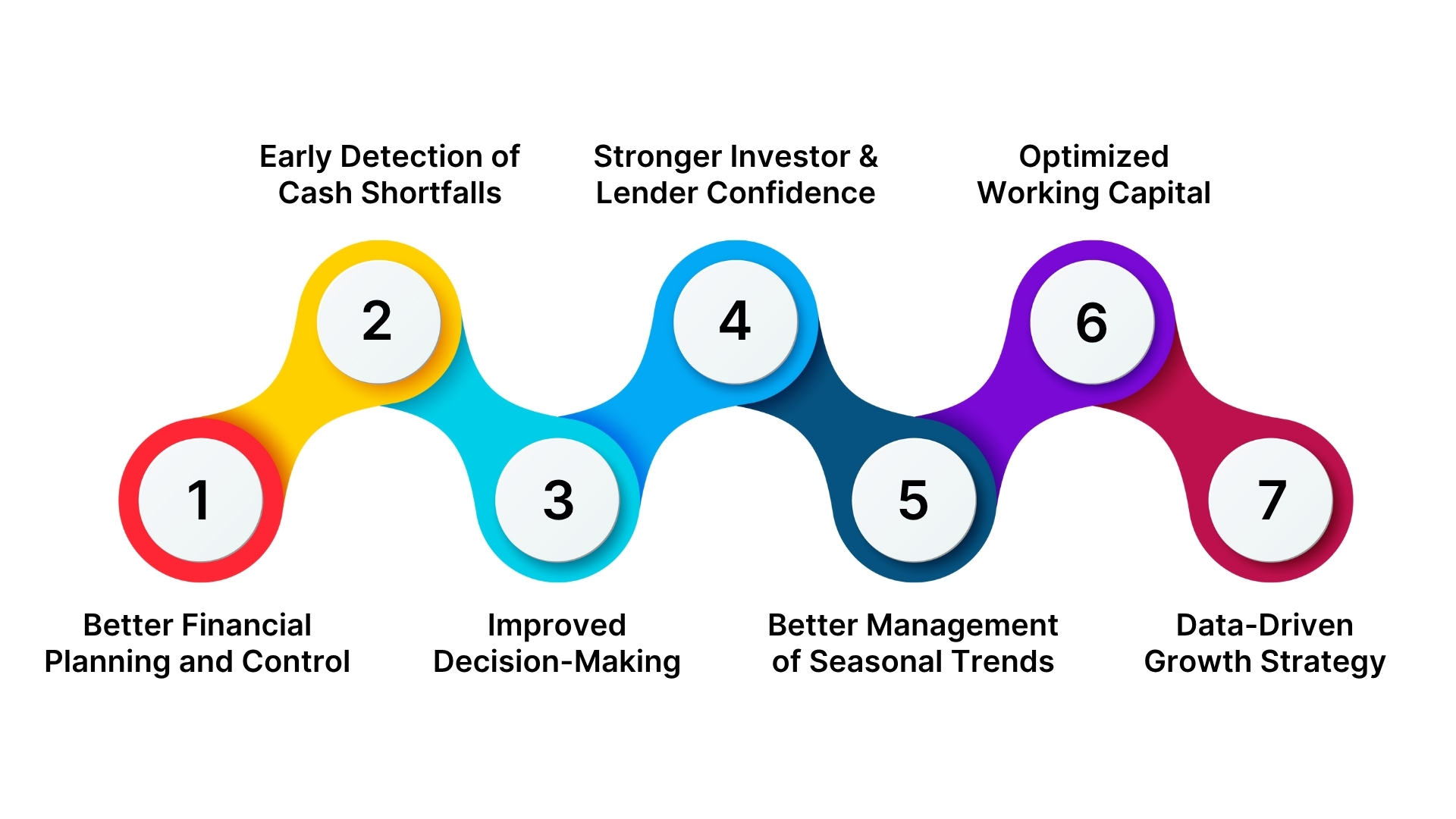
Here are the key benefits every business can gain from effective cash flow forecasting:
Cash flow forecasting allows you to plan your expenses and investments based on data, not assumptions. Knowing when cash will be available helps you schedule payments, plan purchases, and allocate budgets more effectively. It also helps you identify when to delay or accelerate spending, ensuring that operations continue smoothly even during lean months.
A well-made forecast is like an early warning system. It lets you know about possible cash flow problems before they become big issues.
This gives you time to fix the problem, whether that means lowering costs, speeding up collections, or getting short-term loans. This proactive approach helps prevent liquidity crises and keeps your business financially stable.
With a clear view of future inflows and outflows, decision-makers can evaluate options with greater accuracy.
Whether you’re considering a new hire, equipment purchase, or expansion plan, the forecast shows how each choice impacts available cash. This ensures that growth decisions are sustainable and financially sound.
Businesses that are good with money are valued by investors and financial institutions. A well-documented cash flow forecast shows that you are honest and in charge, which boosts your credibility and makes it easier to get money. It gives people confidence that you can keep your promises and handle resources properly.
For industries like retail, manufacturing, or contracting, cash flow often fluctuates with seasonal demand. Forecasting helps you plan for these cycles by predicting when income will peak and when expenses will rise. This makes it easier to manage working capital and maintain stability throughout the year.
Cash flow forecasting makes sure that money isn't just sitting there or being held up for no reason. It shows where money can be put to better use, like paying off debt, investing in growth again, or making deals with suppliers better. In the long run, this makes operations leaner and improves the way cash is managed.
When real-time data and automation are added to forecasting, it turns into a long-term growth strategy tool. Leadership teams can test how changes in sales, prices, or costs affect future cash flow by modeling "what-if" scenarios that are based on accurate information. Businesses can confidently plan, make smart investments, and quickly adjust to changes in the market when they have this kind of foresight.
Even though the benefits are clear, a lot of businesses still have trouble making accurate predictions. Let's talk about the most common mistakes that can throw off your cash flow forecasts and how to avoid them.

Must Read: Retail Inventory: Methods, Steps and Best Practices
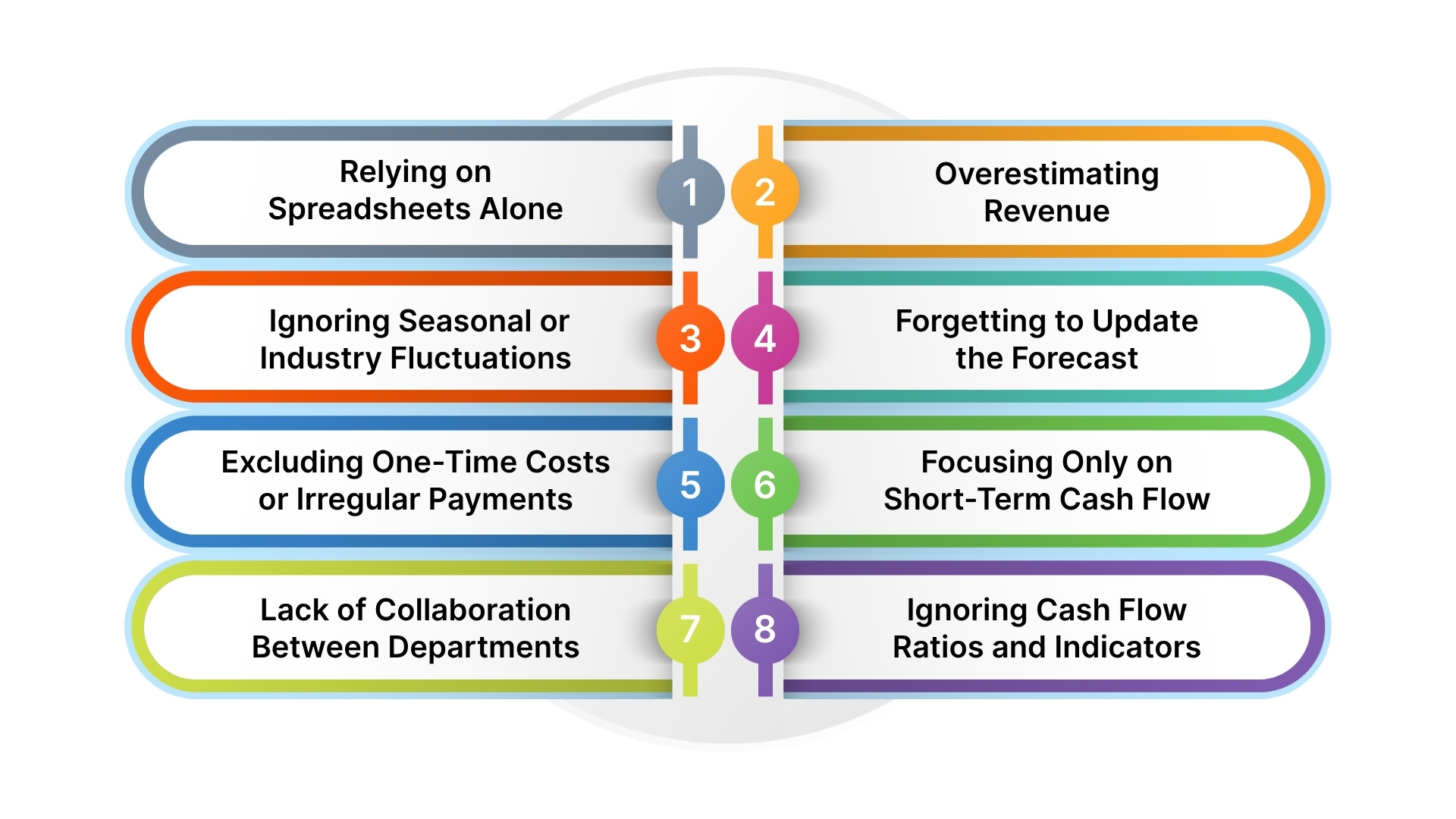
Even the most experienced finance teams can make errors when forecasting cash flow. These mistakes can distort financial planning, affect liquidity, and create unnecessary risk.
Recognizing them early helps businesses improve accuracy and maintain control over their finances.
Many companies still use old, static spreadsheets to keep track of their forecasts. Spreadsheets are easy to use, but they can easily cause formula mistakes, version conflicts, and data that is no longer valid. Also, they don't have real-time updates, so your forecast might not include recent purchases, bills, or payments.
How to avoid it:
Use integrated accounting or ERP tools that automatically update financial data, ensuring your forecast stays accurate and current.
Optimism is good for business growth, but overestimating sales or receivables can create unrealistic forecasts. Predicting income that doesn’t materialize leads to cash shortages and missed obligations.
How to avoid it:
Base forecasts on actual historical performance, payment timelines, and market trends. Always include a conservative estimate or buffer to account for delayed payments.
Cash flow patterns vary across industries. Retailers experience sales peaks during holidays, while construction firms see higher activity in specific seasons. Ignoring these cycles can distort projections and cause cash mismatches.
How to avoid it:
Review past trends to identify recurring patterns and adjust forecasts to reflect seasonal shifts or project timelines.
There is no such thing as a one-time cash flow forecast. It is an ongoing financial plan. If a business doesn't keep it up to date, it might rely on old numbers that don't reflect reality anymore.
How to avoid it:
Review and adjust forecasts monthly or quarterly. Incorporate actual results, new contracts, or cost changes to maintain accuracy.
If you don't plan, unplanned costs like buying equipment, paying off debts, or fixing things that break down can throw off your cash flow.
How to avoid it:
Include both fixed and variable costs, along with any known one-time or annual payments. Set aside contingency funds for unforeseen expenses.
Short-term visibility helps manage daily operations, but it doesn’t prepare the business for future growth or market downturns. Limiting forecasts to one or two months can leave you unprepared for long-term challenges.
How to avoid it:
Create both short-term (weekly/monthly) and long-term (quarterly/annual) forecasts. This dual approach balances immediate control with strategic foresight.
When the finance, operations, and sales teams don't work together, the forecast might not include important information, like deliveries being late or project costs changing.
How to avoid it:
Encourage people from different departments to work together so that all of the data that goes into things like project budgets, sales projections, and payments to suppliers is up to date.
Simply tracking inflows and outflows isn’t enough. Many businesses forget to analyze ratios like operating cash flow or liquidity metrics that reveal deeper financial health.
How to avoid it:
To keep an eye on performance beyond just numbers, add analytical insights to your forecast, like cash conversion cycles or working capital ratios.
Avoiding these errors can significantly improve your forecasting reliability. But to take it a step further, automation tools like HAL ERP can help streamline and strengthen every stage of the process.
Must Read: Strategic Procurement Steps: Essential Steps and Importance
Traditional cash flow forecasting uses spreadsheets, data entry by hand, and updates that happen later than planned. This makes it easy for mistakes to happen and for decisions to be made after the fact. This process is changed by HAL ERP, which gives a single, automated platform that combines financial data, provides real-time visibility, and helps with proactive cash management.
Here’s how HAL ERP simplifies and strengthens your forecasting process:
HAL ERP combines information from all the important parts of a business, like accounting, purchasing, sales, and inventory, into a single dashboard.
This integration eliminates the need to manually compile numbers from multiple sources, ensuring your forecasts are built on accurate, real-time data.
HAL ERP also integrates seamlessly with external systems such as e-commerce, payment gateways, and custom-built business applications, ensuring that every cash transaction and order update flows automatically into your forecast.
Result: Finance teams gain instant visibility into inflows, outflows, and working capital without chasing multiple reports.
With automation, HAL ERP continuously tracks financial transactions and updates projections instantly as new data flows in.
Whether a customer makes an early payment or a supplier invoice is delayed, the system reflects changes automatically, helping teams respond quickly to shifts in cash position.
Result: Up-to-date forecasts that accurately represent your business’s financial health at any given time.
HAL ERP’s AI-powered analytics use historical data, seasonal trends, and payment behaviors to predict future cash movements.
This enables finance leaders to identify periods of potential cash shortage or surplus in advance and make informed decisions about resource allocation, investments, or funding needs.
Result: Improved accuracy and foresight, reducing surprises and improving liquidity planning.
HAL ERP has interactive dashboards that let users pretend to be in a number of different financial situations, such as having late payments, higher costs, or shorter sales cycles.
Teams can instantly visualize how these changes will impact future cash flow, helping them prepare for best-case and worst-case situations.
Result: Greater confidence in planning, with the flexibility to adapt to market changes.
HAL ERP is built to align with regional requirements, including ZATCA-compliant VAT reporting and Saudi accounting standards.
This ensures that financial forecasts remain accurate and compliant, especially when dealing with local taxes or cross-border transactions.
Result: Seamless financial management that meets both strategic and regulatory needs.
Forecasting by hand can take hours, and you have to enter the same data over and over again.
With HAL ERP, data collection, organization, and reporting are all done automatically. This means that your finance team can focus on strategy and analysis instead of numbers.
Result: Faster forecasting cycles with fewer errors and greater productivity.
HAL ERP’s intelligent alert system notifies you about upcoming payment deadlines, low balance risks, or unexpected variances in cash flow.
These timely alerts help prevent cash shortages and ensure that important financial decisions are made proactively, not reactively.
Result: Continuous control over your business’s liquidity position.
Simplify your financial planning today. Get a personalized walkthrough of HAL ERP and see how automation can transform your cash flow management. Schedule Your Free Demo.
Predicting cash flow isn't just about numbers; it's also about giving your business more control, confidence, and strength. It helps people who make decisions see where the company is now and where it's going tomorrow if it's done right.
By understanding how money flows in and out, businesses can anticipate challenges, plan growth strategically, and avoid unexpected financial strain. Automation and real-time visibility elevate this process even further, transforming forecasting from a manual task into a strategic advantage.
With tools like HAL ERP, businesses can precisely manage their cash flow, make accurate predictions, and make decisions based on solid data, all while adhering to Saudi accounting and VAT rules.
Ready to take control of your company’s cash flow? Book a free HAL ERP demo and see how automated forecasting can strengthen your financial strategy and drive sustainable growth.
1. How far ahead should a business forecast cash flow?
The best period for forecasting depends on how your business works and how long it takes to get paid. To get the best of both worlds, most companies make predictions three to six months ahead of time. But industries that need a lot of capital, like manufacturing or construction, often make 12-month forecasts to plan for big projects or investments.
2. What’s the difference between cash flow forecasting and budgeting?
A budget sets spending and revenue targets for a given period, while a cash flow forecast tracks when money actually moves in and out. In short, budgeting is about “what you plan to earn or spend,” whereas forecasting is about “when you’ll have or need the cash.”
3. How can businesses improve the accuracy of their cash flow forecasts?
Forecasts are more accurate when they are based on real-time data, are updated often, and include both one-time and recurring transactions. Including more than one department, like operations, sales, and purchasing, also makes sure that the projections are based on real business conditions and not just the finance team's guesses.
4. How do delayed customer payments affect cash flow forecasting?
Delayed payments distort expected inflows, making forecasts overly optimistic. To address this, track average payment timelines (Days Sales Outstanding) and adjust expected receipt dates accordingly. This gives a more realistic picture of cash availability.
5. How does cash flow forecasting support compliance and audits?
Keeping accurate records of cash flow makes it easier to show how money was spent and defend business decisions during audits. Forecasting also makes sure that taxes are paid on time and that rules are followed, especially when it comes to local rules like the ZATCA VAT regulations in Saudi Arabia.