
Choosing ERP software in 2026 is less about finding the system with the longest feature list and more about finding the platform that fits your business model, industry, transaction volume, integrations, reporting requirements, users, and geographic operations.
Two ERP products can both offer finance, inventory, sales, and reporting while being designed for very different companies.
A Saudi SME might prioritize local support, Arabic workflows, ZATCA e-invoicing, regional ecommerce/payment integrations, and affordable per-user pricing. A multinational manufacturer may care more about multi-country operations, production planning, global consolidation, and complex supply-chain functionality.
The market is also changing quickly. Current ERP platforms increasingly include embedded AI, configurable workflows, industry editions, mobile access, and deeper integrations.
For Saudi businesses, there is an additional 2026 consideration: ZATCA’s Phase Two e-invoicing rollout is still expanding. The latest Wave 25 announcement covers taxpayers whose VAT-subject revenues exceeded SAR 187,500 during 2022, 2023, 2024, or 2025, with affected taxpayers required to integrate their e-invoicing solutions with FATOORA by February 1, 2027.
This guide explains how to compare ERP systems using a practical evaluation matrix and reviews current options including HAL ERP, NetSuite, Microsoft Dynamics 365 Business Central, SAP Business One, Sage X3, Acumatica, Epicor Kinetic, and Odoo.
ERP, or Enterprise Resource Planning, is a type of software that helps businesses manage and organize all their core processes in one place. Instead of using separate systems for functions like accounting, sales, inventory, and human resources, ERP combines them into a single system that everyone in the company can access.
ERP adoption helps businesses save time, reduce errors, and make sure everyone is working with the same information. This makes it easier to make better decisions and run the business more smoothly.
For businesses, especially startups and small enterprises, ERP software is an investment that demands careful consideration. You can’t afford to make a hasty decision, as the wrong choice could lead to high costs, inefficient processes, and a lack of employee adoption.
As the demand for ERPs grows, more vendors offer different features, making it essential to compare systems. Using an ERP comparison matrix is a great way to evaluate features, costs, and benefits to choose the best option for your business.
Now that you understand why comparing ERP systems is important, let’s explore the key challenges you might face in the selection process.
Choosing the right ERP system is not without challenges. With so many options available, businesses often face difficulty in narrowing down which system meets their specific needs. The wrong choice can lead to:
With these challenges in mind, let’s discuss the key features to consider when choosing the software.
For Saudi companies, do not treat generic “VAT support” as proof of Phase Two readiness. ZATCA states that the Integration Phase requires connection to FATOORA, specific electronic formats, and additional invoice fields. See ZATCA’s current Phase Two rollout.
Before you start comparing ERP systems, ensure that you have a solid understanding of your business requirements. Check out this comprehensive checklist for creating your ERP business requirements document to help you get started.
To simplify the comparison process, follow these steps to create an ERP comparison matrix:
Start by listing the important criteria we’ve mentioned above that matter most to your business. Here are the core factors you should consider:
Once you’ve identified your key criteria, it's time to create an ERP comparison matrix. Here’s how to do it:
As you fill out your comparison matrix, ask yourself the following questions to help narrow down the best option:
After scoring the shortlist, investigate the highest-risk gaps rather than immediately selecting the vendor with the highest total. Run demonstrations using real business scenarios, confirm integrations, identify required customizations, review implementation responsibilities, and test whether the proposed solution can handle the workflows that received the highest weight in your matrix. HAL’s ERP Business Requirements Document guide can be used to structure those requirements before vendor evaluation.Pay special attention to areas like integration, cost, and scalability, as these will directly impact your long-term success.
Based on your evaluation, choose the ERP system that aligns with your business’s needs and future goals. Once you’ve made a decision, reach out to the vendor for a demo or a trial period to further validate your choice before committing.
With your comparison chart ready, it’s time to explore some of the top ERP solutions available in 2025.
The best ERP depends on company size, industry, geography, implementation complexity, and the processes the system must support.
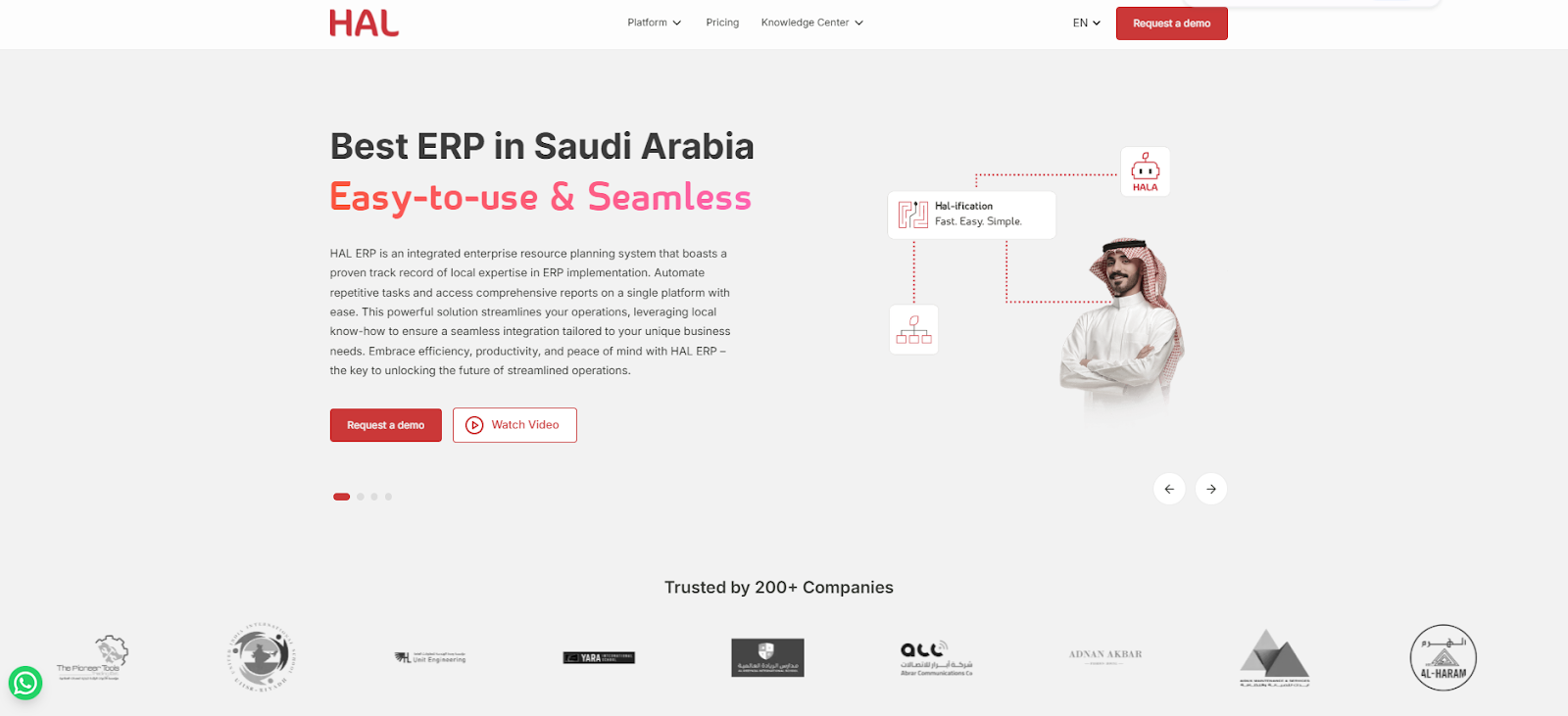
HAL ERP is a Saudi-focused ERP covering accounting, sales, procurement, inventory, HR, manufacturing, retail, and other business functions.
HAL’s current website states that it is used by 200+ companies.
Its strongest differentiator in this comparison is localization.
HAL’s current integration ecosystem includes Saudi and regional platforms such as Salla, Zid, Shopify, Magento, Foodics, Total Pay, Tabby, and Tamara, along with banking and POS connections.
HAL VAT Care supports Phase I and Phase II e-invoicing workflows, including API or Excel/CSV-based integration.
HAL also offers Conversational ERP, allowing users to access reports, approvals, claims, reminders, and other workflows through WhatsApp.
Best suited for: Saudi SMEs and mid-market businesses prioritizing local integrations, Saudi workflows, conversational access, and lower entry cost than many global enterprise systems.
Current public pricing: HAL Pricing currently lists Gold at SAR 1,999 per user/year, Platinum at SAR 4,999 per user/year, and Enterprise as quote-based.
Considerations: Companies with extensive operations outside HAL’s current core regional footprint should verify country-specific functionality and support before choosing it.
NetSuite ERP is a cloud ERP covering accounting, orders, inventory, supply chain, warehouse management, procurement, global business management, and related functions.
Its OneWorld capabilities are particularly relevant to companies managing multiple subsidiaries, currencies, tax regimes, and geographies.
Best suited for: Growing mid-market companies, multi-entity organizations, ecommerce businesses, distributors, and companies expecting significant international expansion.
Pricing: NetSuite does not publish one universal list price. Its current documentation says the annual license is based on the core platform, optional modules, and number of users, with an additional one-time implementation fee.
Considerations: Implementation and licensing can become complex as modules, subsidiaries, integrations, and users increase. Saudi localization and FATOORAH requirements should be validated for the specific implementation.
Use Dynamics 365 Business Central, not the generic “Microsoft Dynamics 365” label used in the old article.
Business Central connects finance, sales, service, and operations and is specifically positioned by Microsoft for small and midsize businesses. Microsoft currently says more than 45,000 SMBs use the product.
Copilot is now included in the Essentials and Premium plans.
Best suited for: SMEs already using Microsoft 365, Teams, Power Platform, or the wider Microsoft ecosystem.
Current public US pricing:
paid yearly. See current Business Central pricing.
Considerations: Business Central is sold and supported through Microsoft’s partner network, and Microsoft itself notes that partners provide country- and industry-specific expertise. Saudi localization, POS, payroll, and e-invoicing requirements therefore need to be validated with the selected partner.
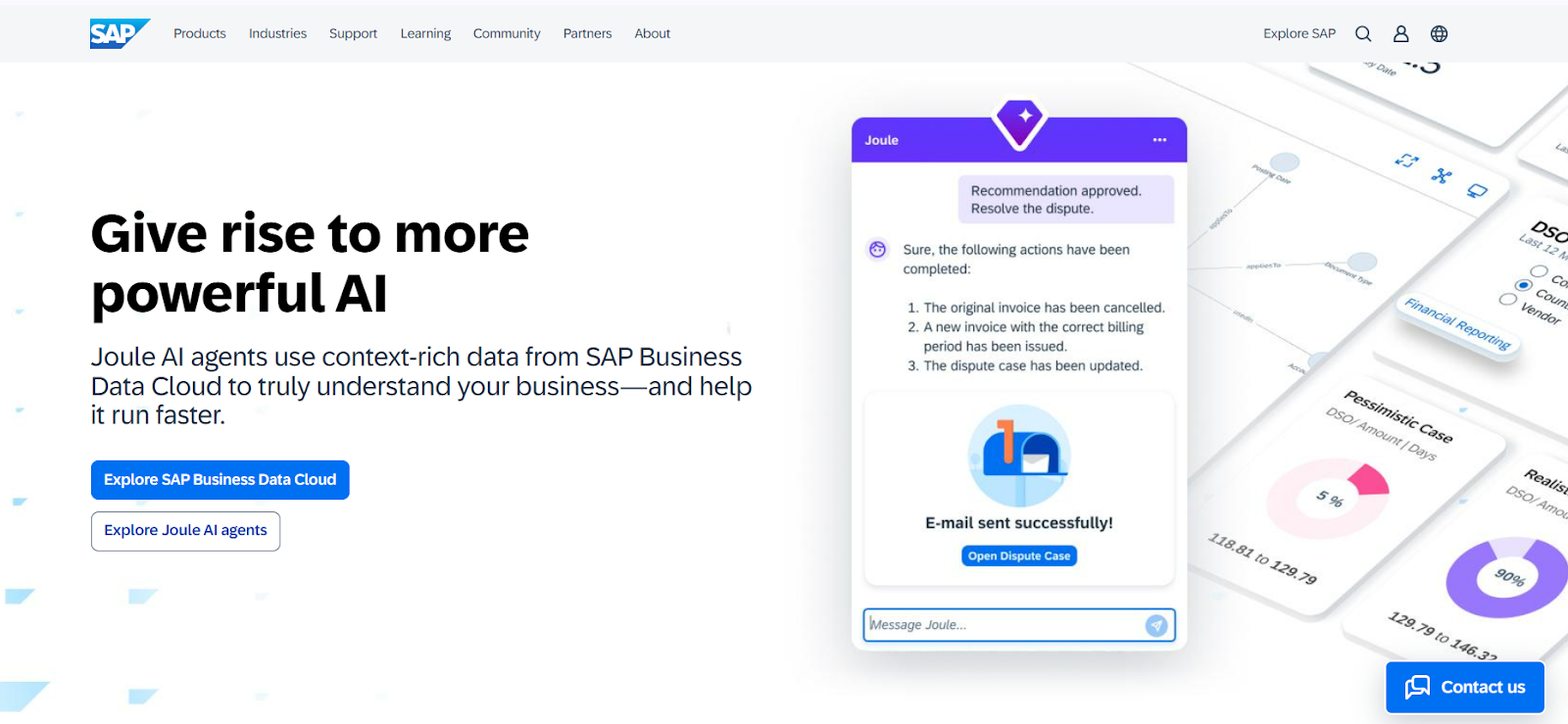
SAP Business One remains SAP’s ERP offering designed specifically for small and midsize companies.
Its core functionality includes:
Best suited for: Established SMEs that want a mature ERP backbone and access to SAP’s broader partner ecosystem.
Strengths: Broad core ERP functionality, multi-currency capability, extensibility, and established global deployment options.
Considerations: Implementation, add-ons, customization, and local requirements depend significantly on the selected SAP partner. SAP currently directs prospects to request a quote rather than publishing one standard price. See SAP Business One.
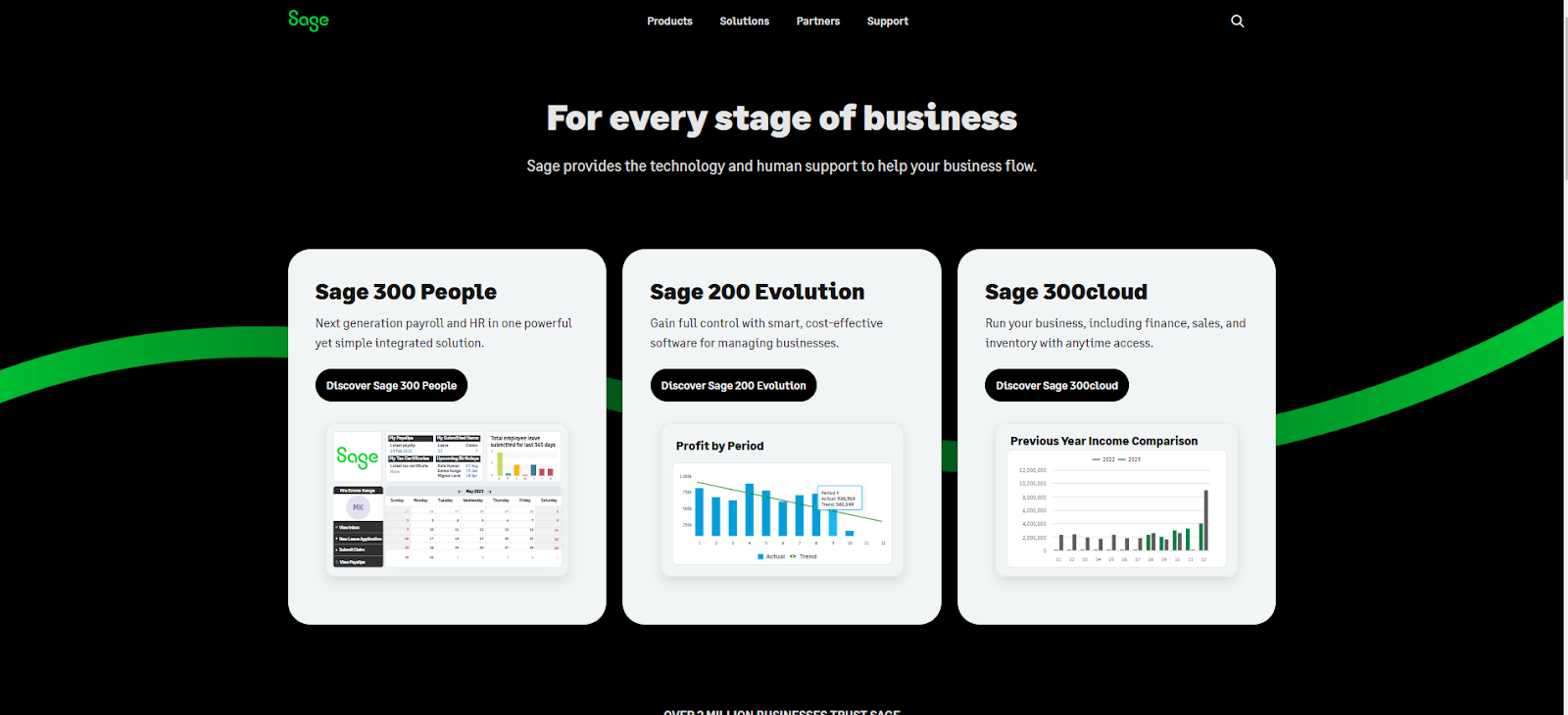
Sage currently positions Intacct primarily as cloud accounting and financial management software, while Sage X3 is the broader ERP covering finance, production, supply chain, sales, and multi-site operations.
Sage X3 includes:
Best suited for: Mid-sized manufacturing, distribution, process-manufacturing, food, chemical, and other product-centric businesses.
Considerations: It is a considerably heavier operational platform than finance-first systems such as Sage Intacct, so implementation effort and fit should be assessed accordingly.
Pricing: Quote-based.
Acumatica has evolved substantially since the original 2025 article.
Its current product editions include General Business, Distribution, Manufacturing, Retail, Construction, and Professional Services, with integrated financial management across the editions.
Its 2026 R1 release added new AI assistants, updated workflows, real-time operational visibility, and industry-specific enhancements.
Best suited for: Product-centric, manufacturing, distribution, construction, retail, and project/service businesses that want flexible industry editions.
A major commercial difference is licensing. Acumatica does not charge primarily by named user; its current pricing is based on the applications required, expected usage/resources, and deployment preferences. See Acumatica Pricing.
Considerations: Saudi tax, payroll, and FATOORAH localization should be validated with the implementation partner instead of assuming generic tax functionality equals Saudi compliance.
Epicor Kinetic is now explicitly positioned as a global cloud ERP built for manufacturers, especially discrete and make-to-order manufacturing.
Its functionality includes:
Epicor Kinetic’s latest published release referenced on its site is 2026.100.
Best suited for: Manufacturers with deeper planning, production, scheduling, costing, and supply-chain requirements.
Considerations: It should not be ranked as a generic small-business ERP primarily on price or ease of use. Saudi country-specific functionality should be verified for the proposed deployment.
Pricing: Quote-based.
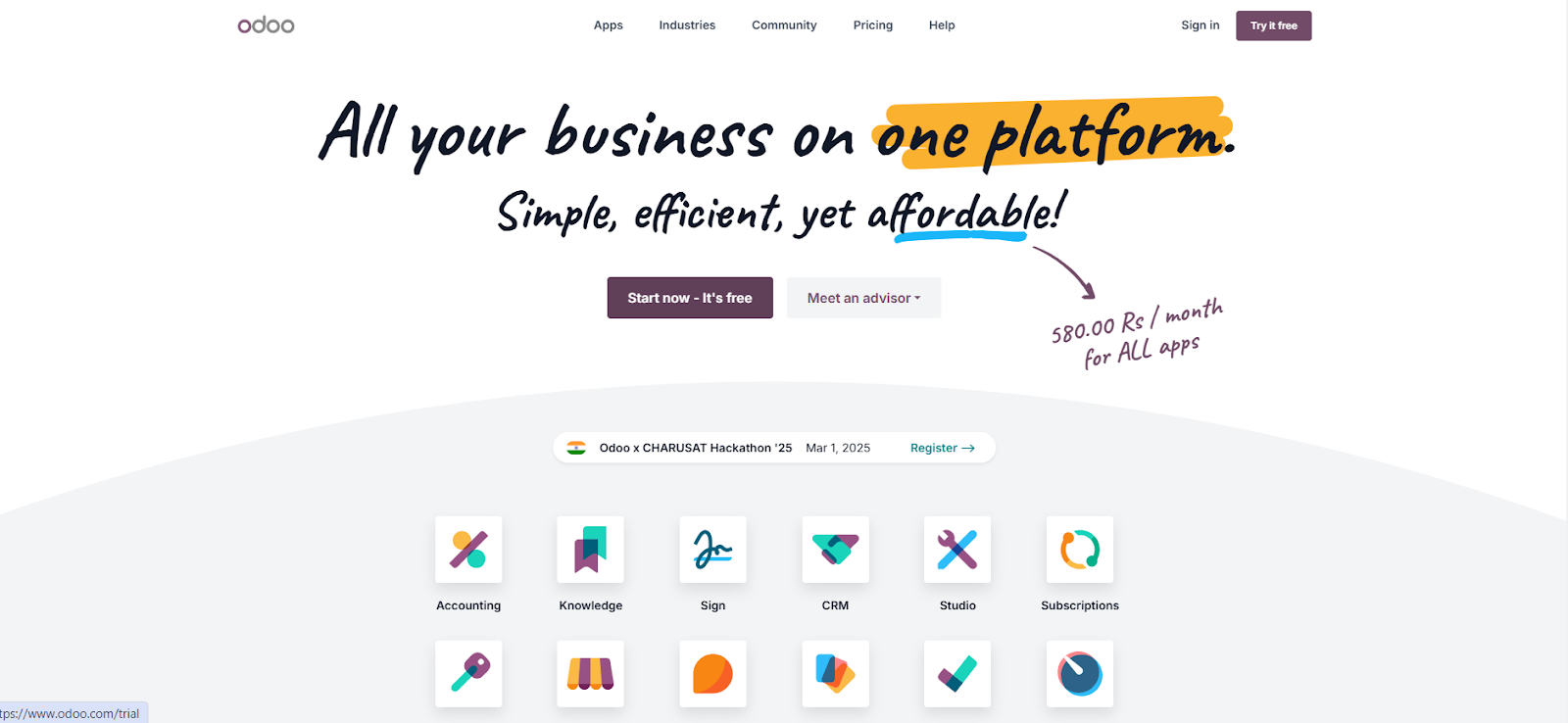
Odoo remains one of the most flexible options for small and midsize businesses because its suite covers accounting, sales, CRM, inventory, ecommerce, HR, projects, POS, and many other apps.
Odoo now has particularly strong public documentation for Saudi Arabia.
Its current Saudi localization includes:
Best suited for: SMEs and mid-sized companies wanting a broad modular suite with strong configuration flexibility and documented Saudi localization.
Current public annual-billing pricing:
The current Odoo page notes that the displayed discount applies for 12 months to initially ordered users. See Odoo Pricing.
Considerations: More customization can increase implementation and upgrade complexity. External API, multi-company, Studio, and advanced customization require the Custom plan.
ERP vendors are increasingly embedding AI directly into finance, operations, and user workflows rather than treating AI as a separate analytics layer.
Microsoft currently includes Copilot in Business Central Essentials and Premium.
Acumatica’s 2026 R1 release similarly introduced its “AI Everywhere” initiative with AI assistants working across financial and operational data.
NetSuite now describes AI as embedded throughout its ERP environment for task simplification, suggested actions, and business insights.
ERP interfaces are moving beyond menus and dashboards.
HAL Conversational ERP currently supports activities such as reports, approvals, expenses, claims, reminders, and HR interactions through WhatsApp.
The important evaluation question is no longer simply “Does this ERP have AI?” but what users can actually do with it and what approval/access controls govern those actions.
Vendors are investing more heavily in industry editions rather than offering one generic product.
Acumatica now publishes separate editions for manufacturing, distribution, retail, construction, professional services, and other segments.
Epicor Kinetic continues to deepen its manufacturing specialization.
Sage X3 similarly focuses strongly on manufacturing, distribution, process industries, and multi-site operations.
Companies increasingly operate across ecommerce, banks, payment providers, POS platforms, CRM, payroll, marketplaces, and other specialized applications.
That makes integration architecture and maintained connectors as important as native modules.
HAL’s current Integrations, for example, includes regional ecommerce, payments, banking, and POS systems including Salla, Zid, Shopify, Foodics, Tabby, Tamara, and Total Pay.
For Saudi businesses, e-invoicing is still a moving implementation requirement.
ZATCA announced Wave 25 on July 24, 2026, expanding Phase Two to taxpayers above the specified SAR 187,500 VAT-revenue threshold and setting February 1, 2027 as the integration date for affected businesses. Read the current ZATCA announcement.
The best ERP is not the system that wins the most categories in a generic comparison table.
It is the one that fits your business processes, industry, users, integrations, growth plans, budget, and regulatory environment with the least unnecessary complexity.
For Saudi businesses, ERP evaluation should also include:
HAL ERP is a particularly strong candidate for Saudi SMEs and mid-market businesses because its current offering combines broad ERP functionality with local integrations, Saudi-focused workflows, VAT Care, and Conversational ERP.
Its public pricing also gives smaller Saudi businesses a clearer starting point than many quote-only global ERP platforms, with the Gold plan currently listed at SAR 1,999 per user/year. See current HAL pricing.
That does not mean HAL is automatically the right system for every business.
A multinational organization may prefer NetSuite’s multi-entity architecture. A manufacturer may need Epicor Kinetic or Acumatica’s deeper production capabilities. A Microsoft-heavy SME may prefer Business Central, while businesses needing a highly configurable and locally documented Saudi setup may also consider Odoo.
The final decision should come from a weighted requirements matrix, realistic product demonstrations, implementation planning, and total-cost analysis rather than generic rankings.
Businesses evaluating HAL can request a HAL ERP demo.
There is no universal winner.
HAL is particularly strong for Saudi SMEs and mid-market organizations because it combines ERP functionality with Saudi-focused integrations and e-invoicing workflows. Odoo also has extensive documented Saudi localization. Larger or more specialized businesses may prefer NetSuite, Business Central, SAP Business One, Sage X3, Acumatica, or Epicor depending on their requirements.
HAL and Odoo deserve particular consideration.
HAL’s Gold plan is currently SAR 1,999 per user/year and is positioned toward small businesses.
Odoo’s current Standard plan is advertised at $24.90 per user/month for the introductory annual-billing period and includes its full application suite.
The final choice should depend on integrations, localization, workflow fit, and implementation cost rather than license price alone.
HAL publicly documents Phase I and Phase II functionality through HAL VAT Care.
Odoo’s current Saudi localization documentation also explicitly includes ZATCA Phase Two API integration, including POS/simplified e-invoicing.
For other vendors, validate the exact Saudi localization or partner solution proposed for your implementation.
Ratings can be useful as one source of user sentiment, but they should not determine ERP selection.
Reviews change continuously and may represent users with very different company sizes, industries, countries, and implementations.
Use ratings as supporting evidence—not as a substitute for requirements, demos, references, and implementation due diligence.
There is no reliable universal timeframe.
Implementation depends on scope, modules, customizations, integrations, data migration, company size, user availability, testing, and training.
Even HAL’s published Project Governance Document structures implementation around requirements, build/configuration, migration, testing, UAT, training, go-live, and hypercare rather than one fixed duration.
At minimum, compare:
Weight these according to your business rather than treating every criterion equally.