
Saudi logistics businesses often have to coordinate orders, inventory, warehouse movements, procurement, customer billing, supplier payments, multiple locations, and financial reporting across several systems.
An ERP brings those connected business processes into one shared environment so operational transactions can flow into inventory and finance without repeatedly re-entering the same data.
That matters in a Saudi logistics sector that continues to expand under the Kingdom’s National Transport and Logistics Strategy, which aims to strengthen Saudi Arabia’s position as a global logistics hub and improve the integration of transport and logistics services.
However, ERP should not be confused with every logistics technology a company may use. Advanced warehouse execution may require a Warehouse Management System (WMS), while carrier planning, freight rating, fleet dispatch, and route optimization may require a Transportation Management System (TMS) or another integrated platform.
This guide explains where ERP fits into logistics, which features matter most, how it differs from WMS and TMS software, and what Saudi logistics businesses should evaluate before implementation.

ERP for logistics is an enterprise system used to connect the commercial, inventory, procurement, and financial processes behind logistics operations.
Depending on the implementation, an ERP can connect activities such as:
Microsoft similarly describes ERP in supply-chain environments as the system that brings financial, operational, supply-chain, reporting, and other enterprise information together rather than forcing teams to reconcile several independent data sources.
For example, when inventory moves between warehouses, the operational stock record and related business data can stay connected rather than requiring separate spreadsheet updates.
HAL specifically documents inventory stock movement between company locations, while its Inventory platform supports multi-location inventory lookup, serial and lot tracking, cycle counting, replenishment, and warehouse controls.
A logistics company may use ERP alongside specialist software.
An ERP can remain the financial and commercial system of record while other applications handle more specialized execution.
That distinction is particularly important for businesses that require sophisticated warehouse automation, carrier management, GPS tracking, freight rating, or route optimization.
ERP, WMS, and TMS software solve related but different problems.
|
System |
Primary Role |
Typical Capabilities |
|
ERP |
Connect business operations and finance |
Orders, procurement, inventory, invoicing, accounting, receivables, payables, reporting, multi-company workflows |
|
WMS |
Execute and control warehouse operations |
Receiving, putaway, locations, picking, packing, cycle counting, barcode workflows, warehouse labour and movements |
|
TMS |
Plan and manage transportation |
Carrier selection, freight rating, loads, routing, transport planning, freight reconciliation and shipment execution |
A business does not always need three separate platforms.
Some ERP suites include advanced WMS or TMS capabilities, while other businesses use dedicated systems connected through APIs or other integrations.
For example, Microsoft supports a warehouse-management-only deployment that integrates with an external ERP or order-management system, showing how operational warehouse software and ERP can remain separate while exchanging data.
Its Transportation Management functionality separately covers activities such as carrier selection, freight rates, inbound/outbound transport planning, loads, routing, and freight reconciliation.
ERP may be enough where the business mainly needs:
Consider specialist software when operations require capabilities such as:
The right architecture depends on the operation rather than the label placed on the software.
But what exactly are the key features of ERP systems for logistics? Let’s explore that next.

The right feature set depends on whether the company operates warehouses, fulfillment, distribution, freight services, ecommerce logistics, or a combination of these activities.
Logistics businesses should be able to see stock by warehouse, branch, or company and record movements between locations.
HAL’s Inventory Management platform documents multi-warehouse inventory lookup, serial and lot tracking, stock counting, replenishment, and stock movements.
The ERP should connect purchase requests, supplier quotations, purchase orders, receipts, and supplier invoices.
HAL’s Procurement platform supports purchasing workflows from RFQs through orders and receipts.
Sales and fulfillment activity should connect with customer invoices and receivables so operational teams and finance are working from the same underlying transactions.
Inventory movements should feed the financial environment correctly so finance teams can reconcile inventory, receivables, supplier liabilities, revenue, and costs.
HAL’s Accounting platform documents automated journals, receivables and payables, bank reconciliation, VAT reports, and financial dashboards.
For logistics groups operating several legal entities, warehouses, or business units, the system should provide appropriate data separation and consolidated reporting.
Logistics companies rarely operate ERP in isolation.
Integration may be required with:
HAL’s current Integrations directory publicly lists integrations including Salla, Zid, Shopify, Magento, Noon, banking, payments, productivity tools, and WhatsApp.
For Saudi operations, billing workflows should support applicable VAT and FATOORAH requirements.
HAL’s Accounting platform documents ZATCA e-invoicing integration and ready-to-file VAT reports.
Finance and operations teams need appropriate reports without exposing every user to all company data.
HAL documents user-access controls, dashboards, financial reporting, and the ability to schedule reports through WhatsApp. Its Conversational ERP also supports approvals, reports, claims, and expenses through WhatsApp.
Do not assume the ERP automatically includes:
If these are important, include them explicitly in the requirements document and confirm whether the ERP provides them natively or through an integration.
ERP creates the most value when it connects transactions that would otherwise be handled in separate applications or spreadsheets.
Sales, purchasing, inventory, receivables, payables, and accounting can use the same underlying transaction data.
This reduces the need to reconcile several independent versions of the same order, stock movement, or customer balance.
Connected inventory records help teams understand:
The goal is better inventory control—not a guarantee that stockouts or excess inventory will disappear entirely.
When order, inventory, invoicing, and payment information are connected, finance teams can more easily reconcile receivables, COD collections, supplier payments, and inventory balances.
Integrated purchasing gives teams greater visibility from purchase request through supplier receipt and invoice, helping operations and finance work from a common purchasing record.
For logistics groups operating several entities or warehouses, integrated reporting can reduce the need to manually combine separate spreadsheets and subsidiary reports.
ERP can turn operational transactions into structured reports on inventory, sales, receivables, costs, and financial performance.
The benefit depends on data quality, workflow design, configuration, and user adoption. Implementing ERP does not automatically reduce costs or improve delivery performance simply because the software has been installed.
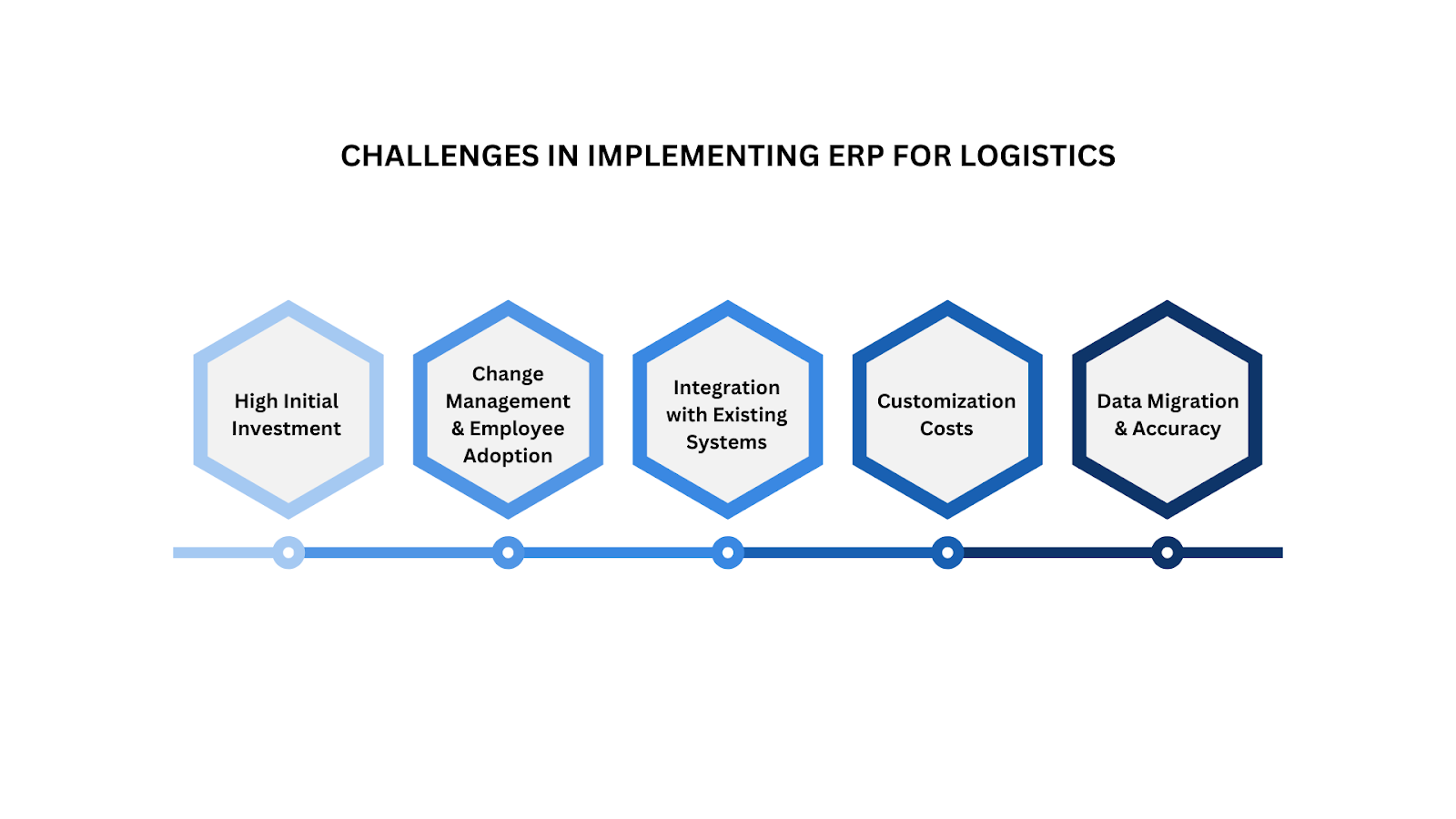
While ERP offers significant advantages, adopting it comes with its own set of challenges. Here’s what businesses need to prepare for:
Despite these challenges, implementing the right ERP system can still lead to remarkable improvements. Here's how to choose the best ERP solution for your logistics business.
Start with the logistics processes the system must support rather than comparing vendor feature lists.
Document whether you manage:
A 3PL operator may need a very different system architecture from a trading company managing two internal warehouses.
Identify which processes need to live in ERP and which may require a specialist system.
For example, accounting, inventory valuation, procurement, billing, and receivables may belong in ERP, while advanced carrier routing or warehouse automation may sit in a connected WMS or TMS.
List every system that needs to exchange data with ERP, including ecommerce stores, marketplaces, carriers, payment platforms, banks, customer portals, and existing logistics systems.
HAL’s current integration ecosystem includes ecommerce platforms such as Salla, Zid, Shopify, Magento, and Noon alongside banking, payments, POS, and productivity systems.
Verify the level of support required for:
For logistics and ecommerce businesses, verify:
Specify the reports and KPIs required by operations, warehouse teams, finance, and management rather than accepting “real-time dashboards” as a sufficient requirement.
Assess:
HAL can support logistics businesses where inventory, procurement, customer orders, billing, accounting, and multi-company data need to remain connected.
Current documented capabilities include:
For logistics businesses that require carrier routing, GPS fleet tracking, vehicle telematics, proof of delivery, or advanced transportation planning, those requirements should be verified separately during solution design to determine whether they are handled through HAL, a third-party platform, or an integration.
Let’s take a look at a real-life example to understand how HAL ERP transforms logistics businesses.
AIDUK operates in logistics and 3PL services and needed to improve financial and operational control across a multi-company environment.
According to HAL’s published ERP implementation case-study summary, the business faced issues including:
After implementing HAL, the published outcomes included:
AIDUK itself also operates fulfillment, warehouse, freight, and last-mile services, making the case relevant to logistics businesses managing inventory and financial workflows across several operational processes.
The case demonstrates HAL’s role in connecting inventory, finance, COD, reporting, and multi-company operations. It should not be used as evidence that HAL independently provides every TMS function such as fleet routing or GPS delivery optimization.
Implementing logistics ERP software can greatly improve your logistics operations by centralizing data, streamlining processes, and giving you better control over your supply chain. A well-chosen ERP system logistics helps reduce costs, boost efficiency, and keep you ahead of the competition. The cloud-based HAL ERP provides complete control over your logistics processes, making your operations more efficient and setting you up for future success.
Book a Free Appointment today! Our experts will help you customize HAL ERP for your business and ensure smooth integration for maximum value.
ERP can play a central role in logistics when the objective is to connect orders, purchasing, inventory, warehouse data, customer billing, supplier payments, VAT, and financial reporting.
But businesses should avoid treating “logistics ERP” as a replacement for every specialist logistics technology.
Advanced warehouse execution may require a WMS, while freight planning, carrier rating, routing, fleet dispatch, and delivery tracking may require a TMS or other specialized systems.
The best ERP architecture therefore starts by deciding which system owns each process and how the data will flow between them.
For Saudi logistics businesses, HAL Inventory, HAL Procurement, HAL Accounting, and HAL’s integration ecosystem can connect important inventory, purchasing, ecommerce, finance, and reporting workflows.
Businesses can request a HAL ERP demo to map their current logistics systems and confirm which requirements can be handled natively and which need integration.
ERP in logistics connects business processes such as orders, procurement, inventory, billing, receivables, supplier payments, accounting, and reporting through shared data.
ERP manages wider business and financial processes, while a WMS focuses specifically on warehouse execution such as receiving, putaway, picking, packing, stock locations, and warehouse movements.
The two systems can be part of one software suite or integrated separately.
ERP connects enterprise transactions and financial data, while a TMS focuses on transportation activities such as loads, carriers, freight rates, routing, dispatch, and freight reconciliation.
A logistics company may use both.
Some ERP suites include transportation-management functionality, but these capabilities should not be assumed.
GPS tracking, vehicle telematics, route optimization, carrier rating, and last-mile dispatch may require a dedicated TMS, fleet platform, or other integration.
Common requirements include multi-location inventory, stock transfers, procurement, order management, invoicing, receivables, COD reconciliation, financial reporting, user controls, multi-company support, VAT/e-invoicing, and integration with ecommerce or logistics systems.
HAL’s current Integrations directory lists ecommerce integrations including Salla, Zid, Shopify, Magento, and Noon, alongside banking, payment, POS, and other integrations.
ERP can maintain the product, supplier, purchasing, invoice, and accounting data used in customs workflows, but tariff classification should not be assumed to be automatically correct.
Saudi importers should confirm applicable classification using ZATCA’s current Integrated Customs Tariff.