
ERP implementation is not simply a software installation. It is a business transformation project involving processes, data, employees, controls and technology. The software may provide the required capabilities, but the organization must still define its objectives, prepare its data, test its workflows and help employees adopt the new system.
The 2026 ERP Report from Panorama Consulting Group found that more than one-quarter of surveyed organizations exceeded their project budgets, while almost one-quarter went beyond their planned schedules. Unexpected technology requirements were the most frequently reported cause of budget overruns, and organizational issues were the leading cause of schedule delays.
The same report found that fewer than one-quarter of respondents placed an intense focus on organizational change management. This matters because an ERP project can technically go live while still failing to achieve consistent adoption or the expected business results.
The success stories in this guide show what effective ERP implementation looks like at different scales—from a growing consumer-products company to multinational and Saudi organizations. Each example focuses on four questions:
An ERP system connects business functions such as finance, procurement, inventory, manufacturing, sales, projects and human resources through shared data and workflows.
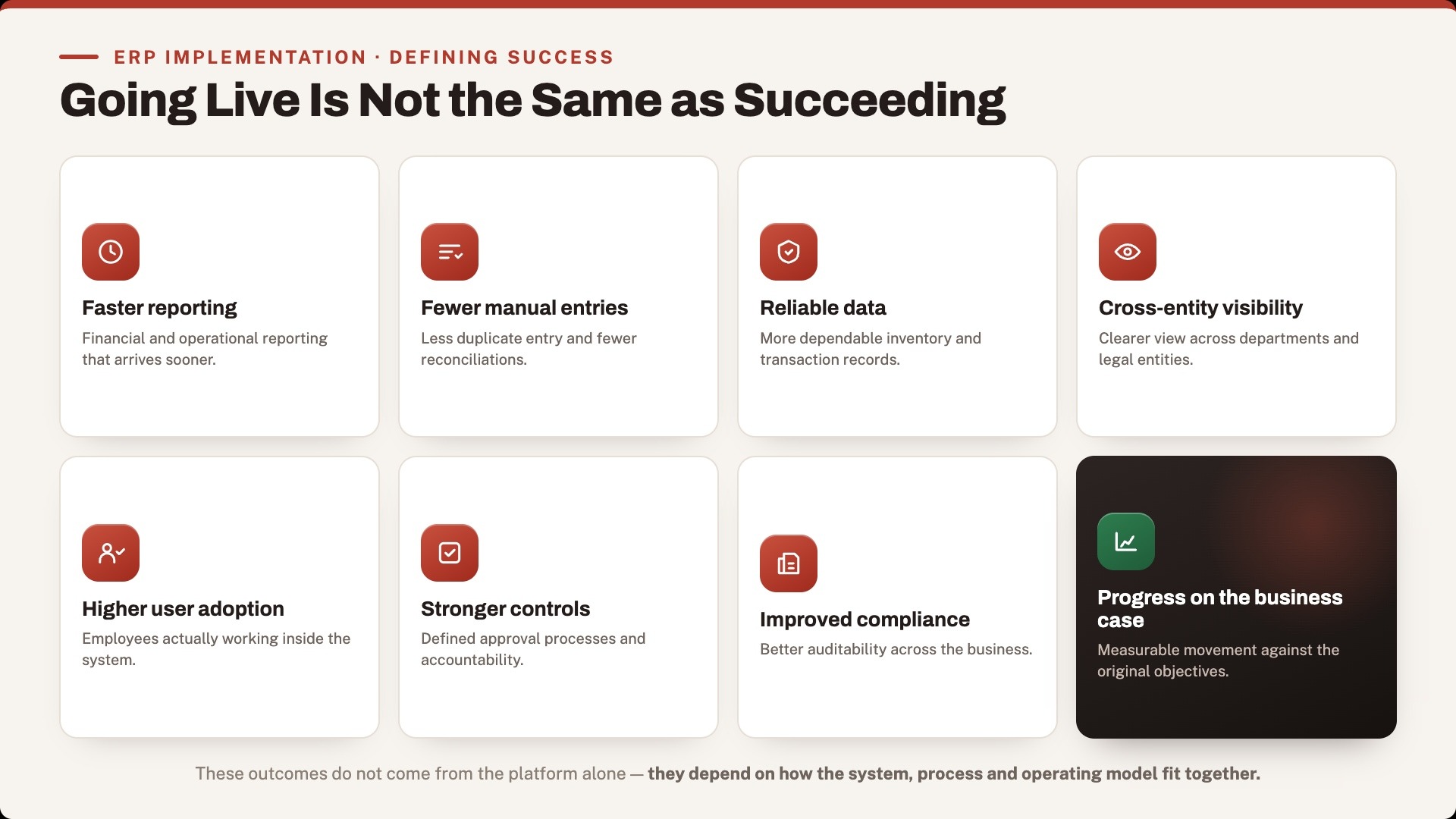
Implementation success should not be measured only by whether the software went live. A successful project should produce observable improvements such as:
Panorama’s 2026 research found that productivity and efficiency were among the benefits most commonly realized to the extent organizations expected. It also reported that the share of organizations realizing benefits from removing operational silos increased from 55.2% to 77.4% year over year.
These outcomes do not come from the ERP platform alone. They depend on how well the system, implementation process and operating model fit the organization.
The importance of successful ERP implementation cannot be overstated. If an ERP system is not implemented correctly, companies face significant risks, including:
When you start the ERP implementation journey, you likely have clear goals in mind—whether it’s improving efficiency, cutting costs, or scaling your operations. The process begins with understanding your current systems, identifying what you need, choosing the right ERP solution, and creating an implementation plan. However, the true success of an ERP system lies in how well it integrates with your existing operations.
A successful ERP implementation focuses on:
The effectiveness of your ERP system depends on how well it aligns with your company’s goals and how well your employees adapt to it. Now, let’s dive into the key factors that contribute to a smooth and effective ERP implementation.
ERP case studies should be assessed carefully. A company adopting well-known software does not automatically make the implementation successful. Look for evidence across the following five areas.
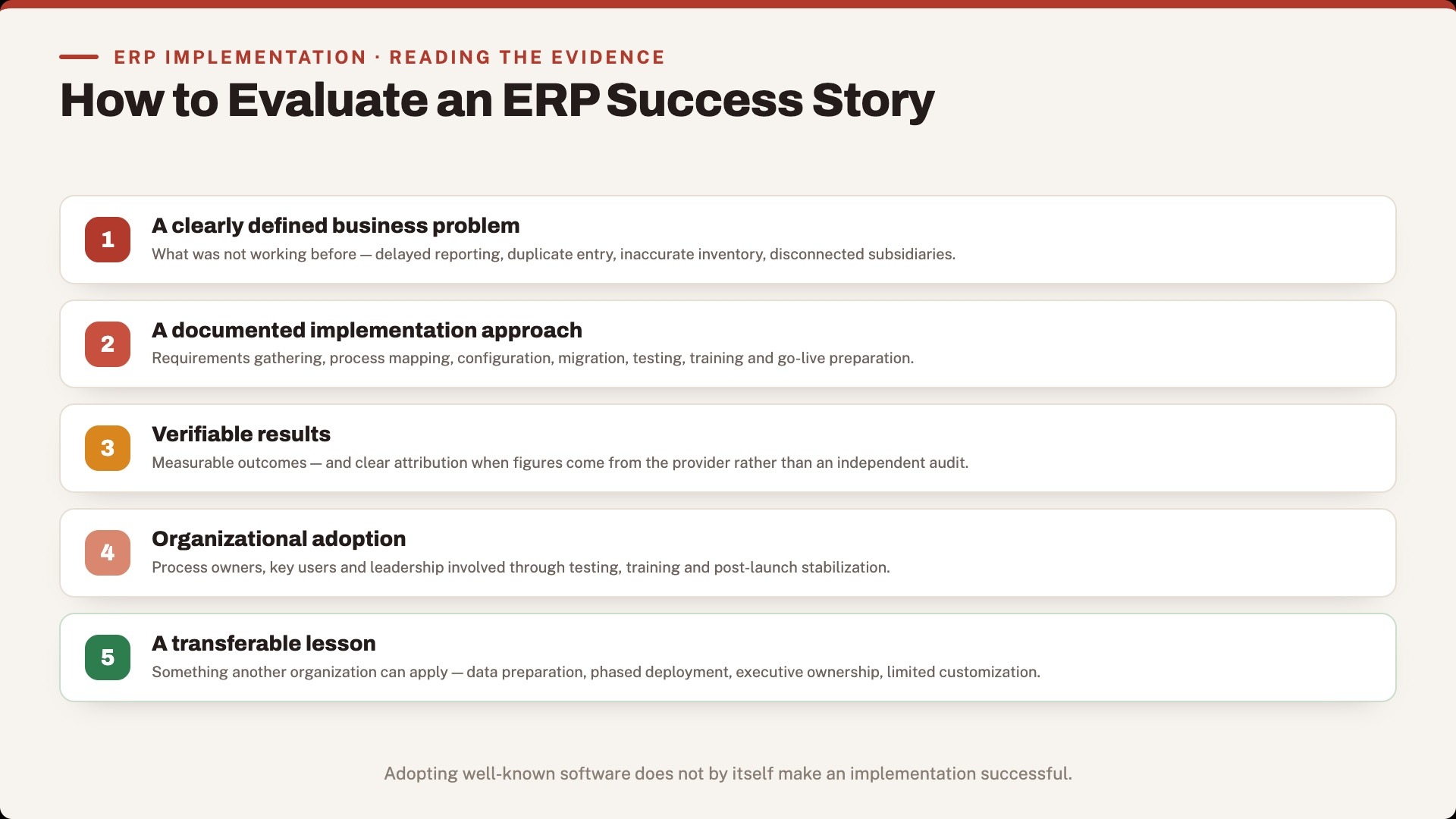
The case study should explain what was not working before implementation. Examples include delayed reporting, duplicate data entry, inaccurate inventory, disconnected subsidiaries or difficulty complying with local requirements.
Look for information about requirements gathering, process mapping, configuration, data migration, testing, user training and go-live preparation. Without these details, it is difficult to understand why the project succeeded.
Strong case studies provide measurable outcomes such as implementation time, cost savings, reduced processing time, improved availability or increased operational capacity. When figures are published by the ERP provider rather than independently audited, that attribution should be made clear.
A system can go live without becoming part of daily operations. Effective implementations involve process owners, key users and leadership throughout testing, training and post-launch stabilization.
The most useful case studies explain what another organization can apply. The lesson might involve data preparation, phased deployment, executive ownership, process standardization or limiting unnecessary customization.
For a detailed deployment framework, see HAL’s ERP implementation plan. The examples below focus specifically on what happened in real implementations and what can be learned from them.
The following case studies come from customer and ERP-provider publications. Where a result is reported by the software provider, it is identified as such.
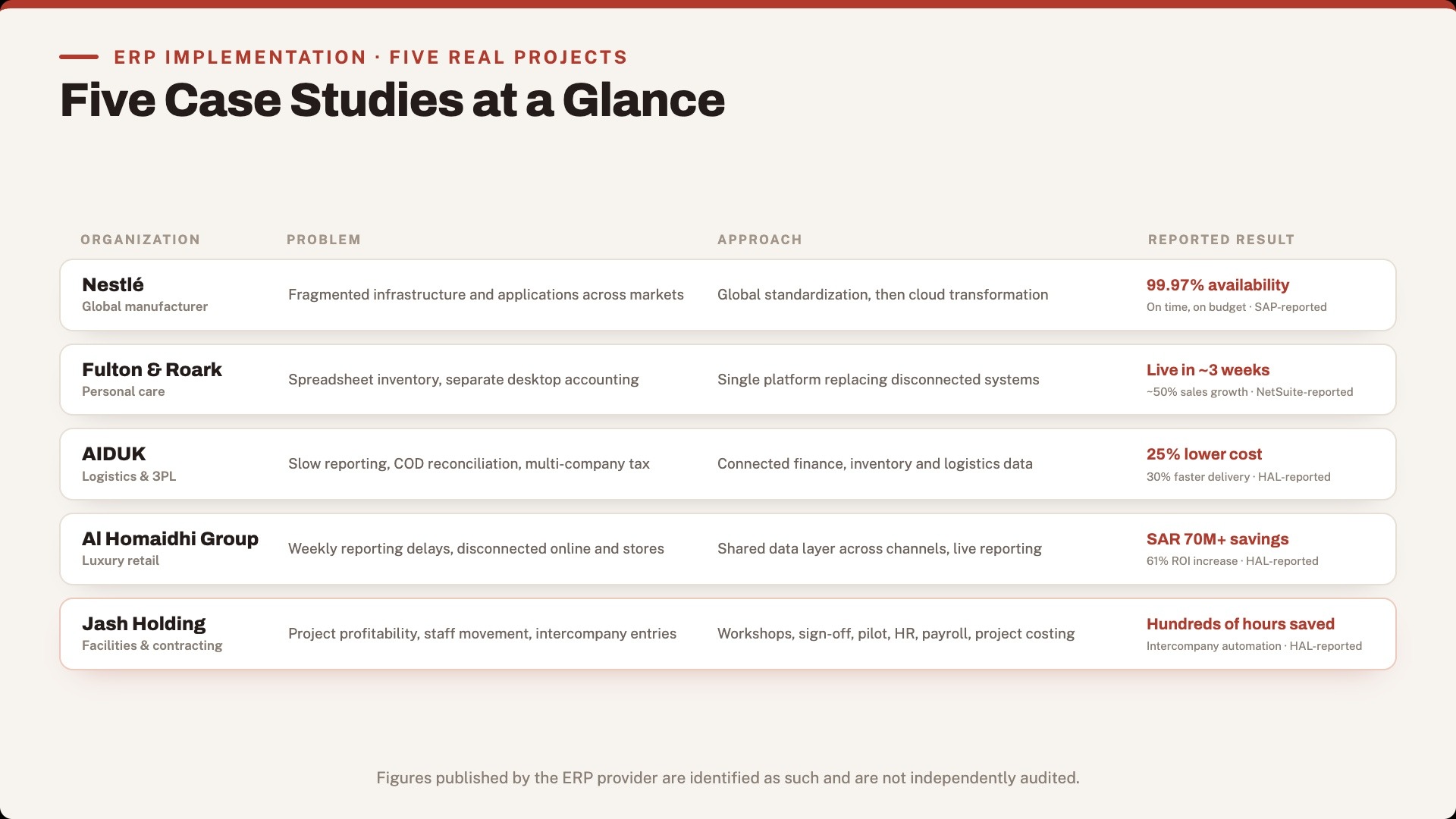
Nestlé operates thousands of brands and business activities across international markets. Its size made fragmented infrastructure, applications and access points difficult to maintain efficiently.
Implementation approach
Nestlé’s relationship with SAP began with the standardization of its global ERP environment. The company later used RISE with SAP as part of a broader cloud transformation designed to simplify infrastructure, integrate applications and improve resilience.
According to the SAP customer story, the project involved:
Results
SAP reports that the project was completed on time, within budget and without business disruption. Nestlé also achieved 99.97% system availability through its simplified global infrastructure.
Key lesson
Large ERP transformations require standardization and governance before scale becomes an advantage. Nestlé’s example also shows that ERP modernization is often an ongoing programme rather than a single implementation event.
Fulton & Roark is a growing personal-care business that previously managed inventory through spreadsheets while maintaining financial information in separate desktop accounting software.
This created duplicate data entry, limited visibility into product costs and uncertainty about inventory and margins.
Implementation approach
The company selected NetSuite to replace multiple disconnected systems with one platform. Historical data was migrated as part of the transition.
According to the official NetSuite case study, the implementation was completed in approximately three weeks.
Results
NetSuite reports that Fulton & Roark:
Key lesson
A focused implementation can move quickly when the scope is controlled, leadership is directly involved and the new platform replaces clearly identified disconnected systems. However, a three-week timeline should not be treated as a standard benchmark for more complex multi-entity implementations.
AIDUK is a logistics and third-party fulfilment business managing warehousing, delivery, customs and related supply-chain activities.
Before implementing HAL ERP, the company faced challenges involving access control, slow financial reporting, multi-company tax processes, inventory visibility, cash-on-delivery reconciliation and principal-payment calculations.
Implementation approach
HAL ERP connected financial, inventory and logistics information while introducing:
Results
According to HAL’s published AIDUK logistics case study, the implementation reduced operational costs by 25% and improved delivery speed by 30%.
Key lesson
Logistics ERP should connect operational transactions with their financial impact. Improving warehouse visibility alone is not enough when COD, principal payments and multi-company accounting remain disconnected.
Al Homaidhi Group is a Saudi luxury retailer whose legacy systems limited access to timely sales, pricing and inventory information. Weekly reporting delayed management visibility, while online and physical-store operations were not fully connected.
Implementation approach
HAL ERP connected the retailer’s online and offline operations through a shared data layer. The implementation included:
Results
HAL reports in its sales and distribution case study that the project generated more than SAR 70 million in operational-efficiency savings and increased ROI by 61%. Real-time information also replaced weekly reporting cycles.
These figures are HAL’s first-party reported results and should be presented as such unless additional customer verification is published.
Key lesson
Retail ERP creates greater value when it connects sales, pricing, inventory, ecommerce and finance rather than optimizing each channel separately.
Jash Holding is a Saudi facilities-management and contracting group operating across subsidiaries, customer locations and large project teams.
Its legacy environment created difficulties in scaling operations, monitoring project profitability, moving employees between projects and processing intercompany transactions.
Implementation approach
HAL’s published Jash Holding case study describes an implementation covering:
HAL ERP also enabled employee movement between projects, project-level tracking of manpower and material costs, and automated intercompany entries.
Results
HAL reports that intercompany automation saved hundreds of data-entry and reconciliation hours. The centralized system also gave management clearer information about project costs, employee utilization and profitability.
Key lesson
For project-based and multi-company businesses, implementation success depends on mapping the relationships between employees, projects, costs, legal entities and internal transactions before the system is configured.
Although these organizations differ significantly in size and industry, their implementations share several characteristics:
ERP projects do not always fail through a complete system breakdown. A project may go live but still exceed its budget, miss its schedule, experience weak adoption or fail to produce the expected business benefits.
The 2026 ERP Report found that the most commonly reported reason for budget overruns was the unexpected need for additional technology. Other frequently reported causes included expanded scope, technical problems, organizational issues and underestimated staffing or consulting requirements.
Among organizations whose projects exceeded schedule, organizational issues were the most commonly reported reason. These can include:
These findings show why system selection and implementation planning cannot be separated. A poor functional fit discovered late in the project may require new tools, custom development or a wider scope, increasing both cost and risk.
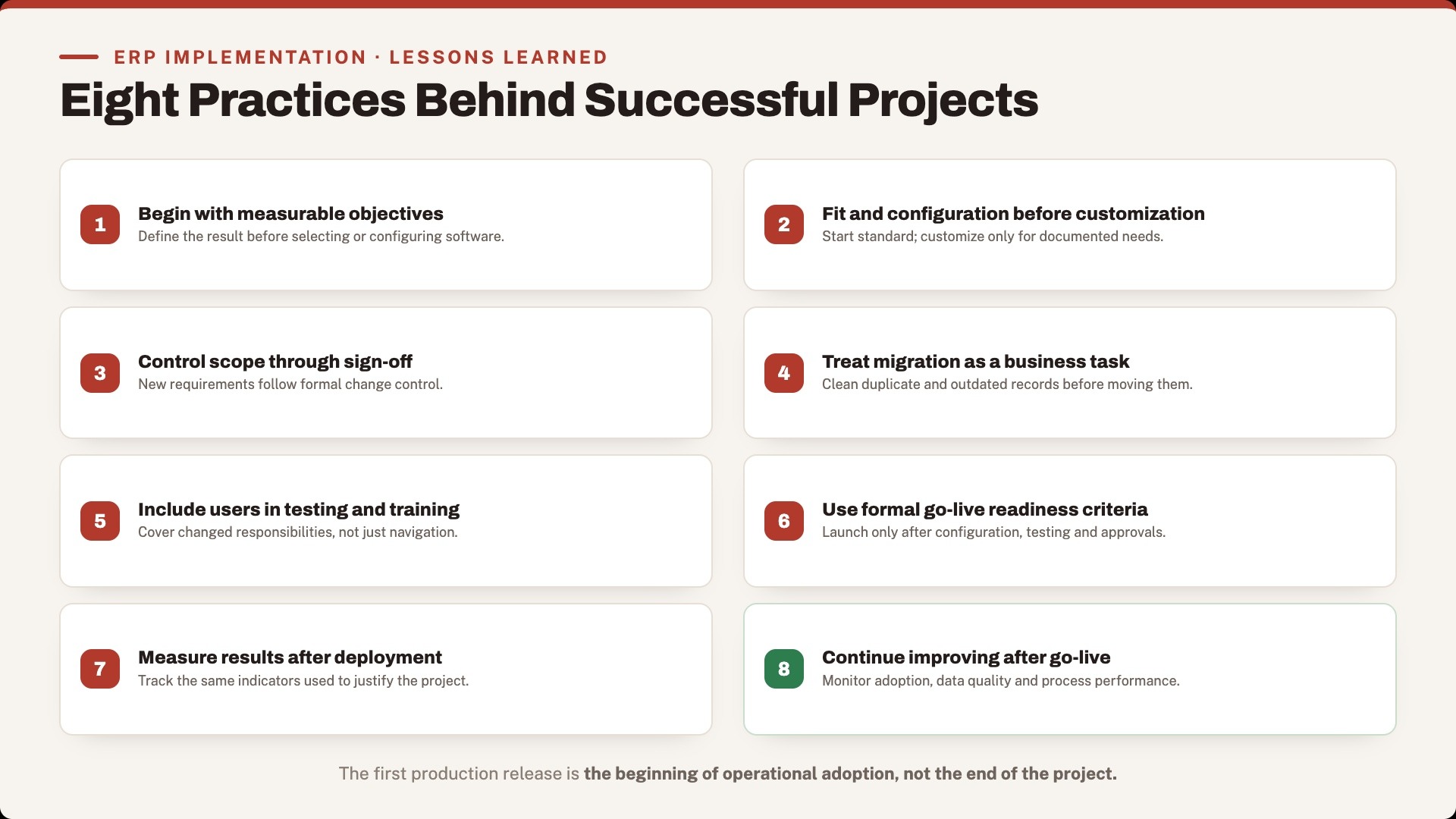
Define the result the project must achieve before selecting or configuring the software. Examples include shortening month-end close, reducing reconciliation work, improving inventory accuracy or obtaining project-level profitability.
The system should support the organization’s essential workflows, but every existing process should not automatically be recreated. Begin with standard functionality and configuration. Approve custom development only when it addresses a documented requirement that cannot be met appropriately through the standard platform.
Requirements, integrations, reports, migration responsibilities and success criteria should be documented and approved. New requirements should follow a formal change-control process so their effects on cost and schedule can be assessed.
The customer and implementation team should agree on data templates, mapping, validation and cut-off procedures. Duplicate, outdated or incomplete records should be addressed before migration rather than transferred into the new ERP.
User acceptance testing should be completed by people who understand the real workflows. Training must cover more than navigation—it should explain changed responsibilities, approvals and controls.
Go-live should occur only after the required configuration, migration, testing, training and approvals are complete. The business should also have a plan for transactions occurring between final migration and launch.
Track the same indicators used to justify the project. A technically stable platform is not enough if employees continue using spreadsheets or the expected reporting, efficiency and control improvements do not materialize.
The first production release is the beginning of operational adoption. Monitor user behaviour, support requests, data quality and process performance, then prioritize improvements based on business value.
Read HAL’s ERP implementation plan for the complete planning, testing and deployment sequence, or explore whether your company needs an ERP system.
The success stories above demonstrate that ERP value comes from combining suitable technology with clear objectives, prepared data, accountable process owners and sustained user adoption.
HAL ERP supports Saudi SMEs and enterprises through a structured implementation process that includes:
The platform connects finance, inventory, procurement, sales, HR, projects and manufacturing through shared data and workflows. Businesses can also use HAL VAT Care for ZATCA Phase II e-invoicing and connect supported ecommerce, payment and business applications through HAL integrations.
HAL’s conversational ERP also allows authorized users to complete selected approvals, retrieve reports, receive reminders and submit expenses through WhatsApp.
The appropriate implementation scope, timeline and integration design will depend on the number of modules, entities, users, locations, data sources and required customizations.
Request a HAL ERP demo to discuss your current processes and define a practical implementation path.
A successful ERP implementation goes live with reliable data, functioning workflows and trained users, then achieves the business outcomes defined at the beginning of the project. Success may include faster reporting, lower manual effort, better inventory accuracy or stronger financial controls.
Measure implementation against baseline and post-launch indicators such as:
There is no universal timeline. A focused single-module implementation with clean data may take several weeks, while multi-module, multi-entity or highly customized projects may take several months or longer. Scope, integrations, data quality and decision speed all affect duration.
There is no single cause. Common problems include poor system fit, unclear scope, weak governance, incomplete data preparation, delayed approvals, limited user involvement and insufficient change management.
Customization may be appropriate when a documented critical requirement cannot be met through standard functionality or configuration. Unnecessary customization should be avoided because it can increase implementation time, cost, testing requirements and future upgrade complexity.
Key users execute realistic business scenarios to confirm that workflows, calculations, permissions, reports and migrated data operate as required. Any critical issues should be resolved and retested before go-live approval.
The organization should provide user support, monitor system and data performance, resolve adoption issues, confirm that reconciliations remain accurate and compare realized benefits with the original project objectives.
HAL offers HAL VAT Care, an integration-ready solution designed for ZATCA Phase I and Phase II e-invoicing requirements. The precise configuration depends on the organization’s invoicing environment and applicable ZATCA wave requirements.