

Every business uses resources to generate revenue and maintain its operations. Some of those resources are recognized as expenses immediately, while others are initially recorded as assets and become expenses only when they are consumed, sold or depreciated.
An expense does not always involve an immediate cash payment. A company may recognize an electricity expense before paying the supplier, pay insurance in advance and recognize the expense over several months, or record depreciation without making a cash payment during the period.
Understanding these differences helps finance teams calculate profit correctly, prepare reliable financial statements, control spending and distinguish operational costs from asset purchases.
This guide explains what an expense means in accounting, how expenses differ from costs and expenditures, the main ways businesses classify them and the journal entries used to record common examples.
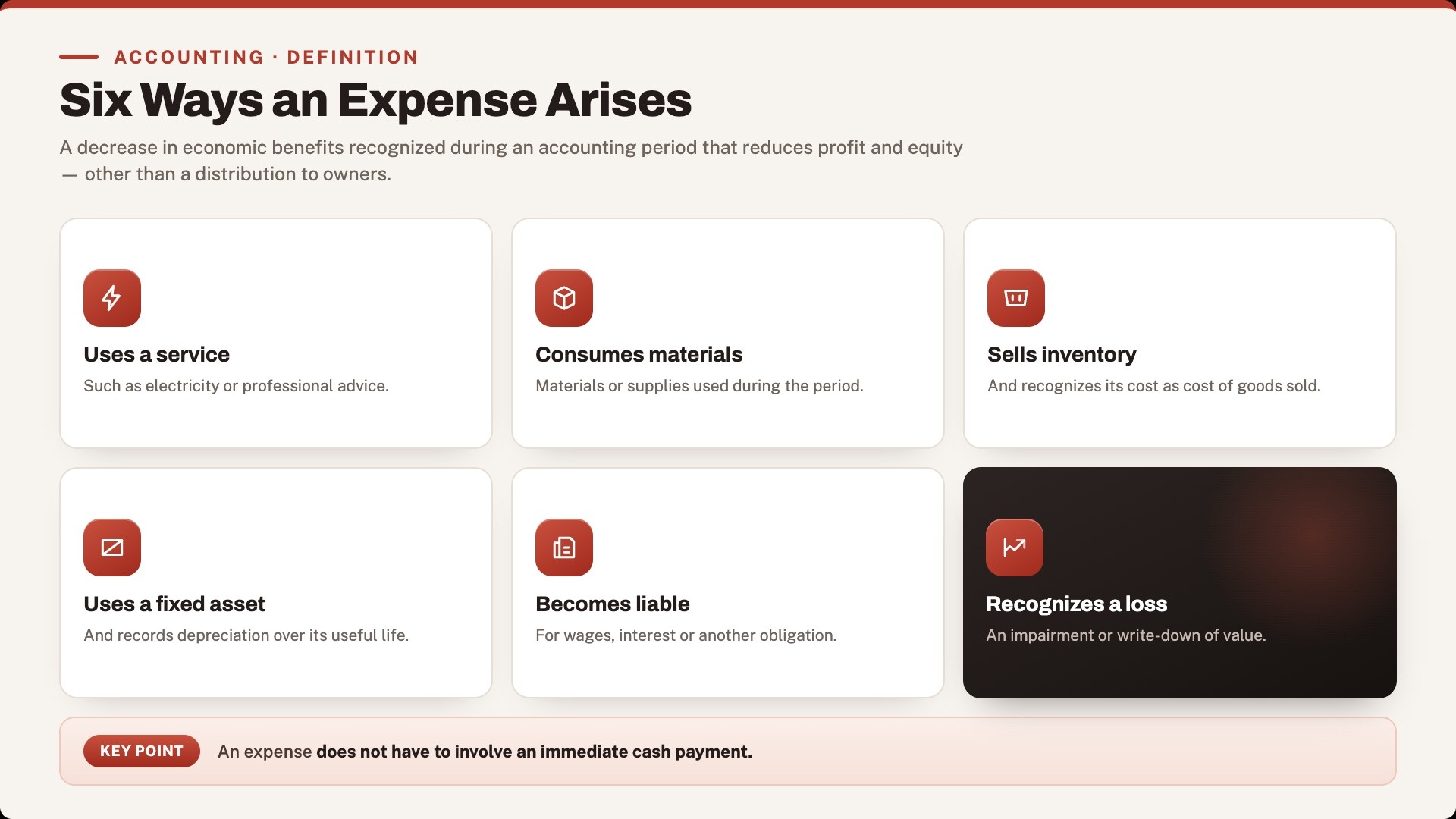
An expense is a decrease in economic benefits recognized during an accounting period that reduces the business’s profit and equity, other than a distribution to owners.
An expense can arise when a business:
An expense does not have to involve an immediate cash payment.
For example, suppose a business uses SAR 3,000 of electricity during June but pays the supplier in July. Under accrual accounting, it records the expense in June:
Debit: Utilities Expense — SAR 3,000
Credit: Accrued Expenses or Accounts Payable — SAR 3,000
When the amount is paid in July, the business removes the liability:
Debit: Accrued Expenses or Accounts Payable — SAR 3,000
Credit: Cash — SAR 3,000
The July payment does not create a second expense because the expense was already recognized in June.
Also Read: Understanding Accounts Payable: Definition, Process and Examples
The three terms are related, but they do not describe the same accounting event.
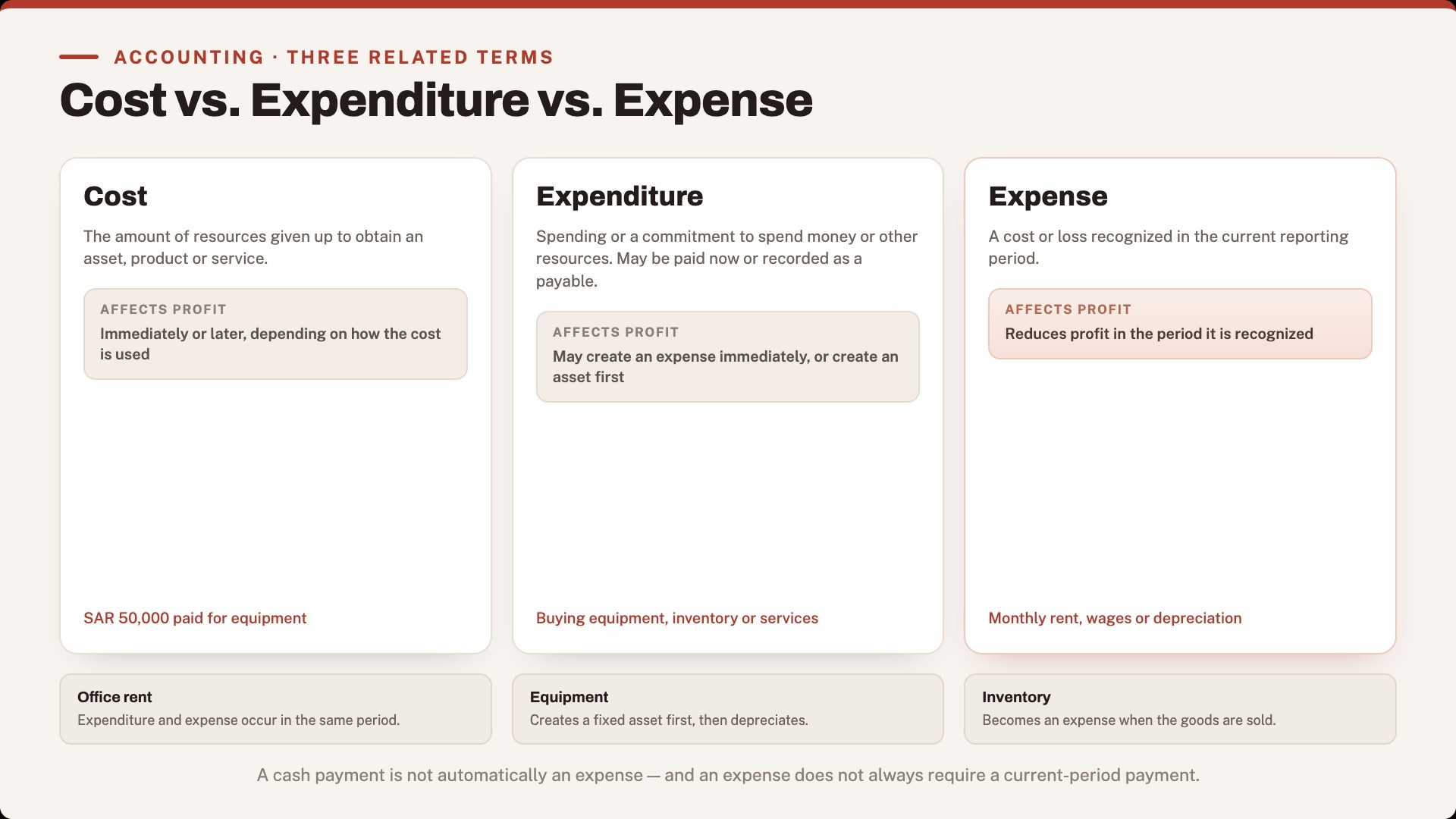
Consider three examples:
A cash payment is therefore not automatically an expense, and an expense does not always require a current-period cash payment.
Also Read: How to Calculate Marginal Cost: Formula and Examples
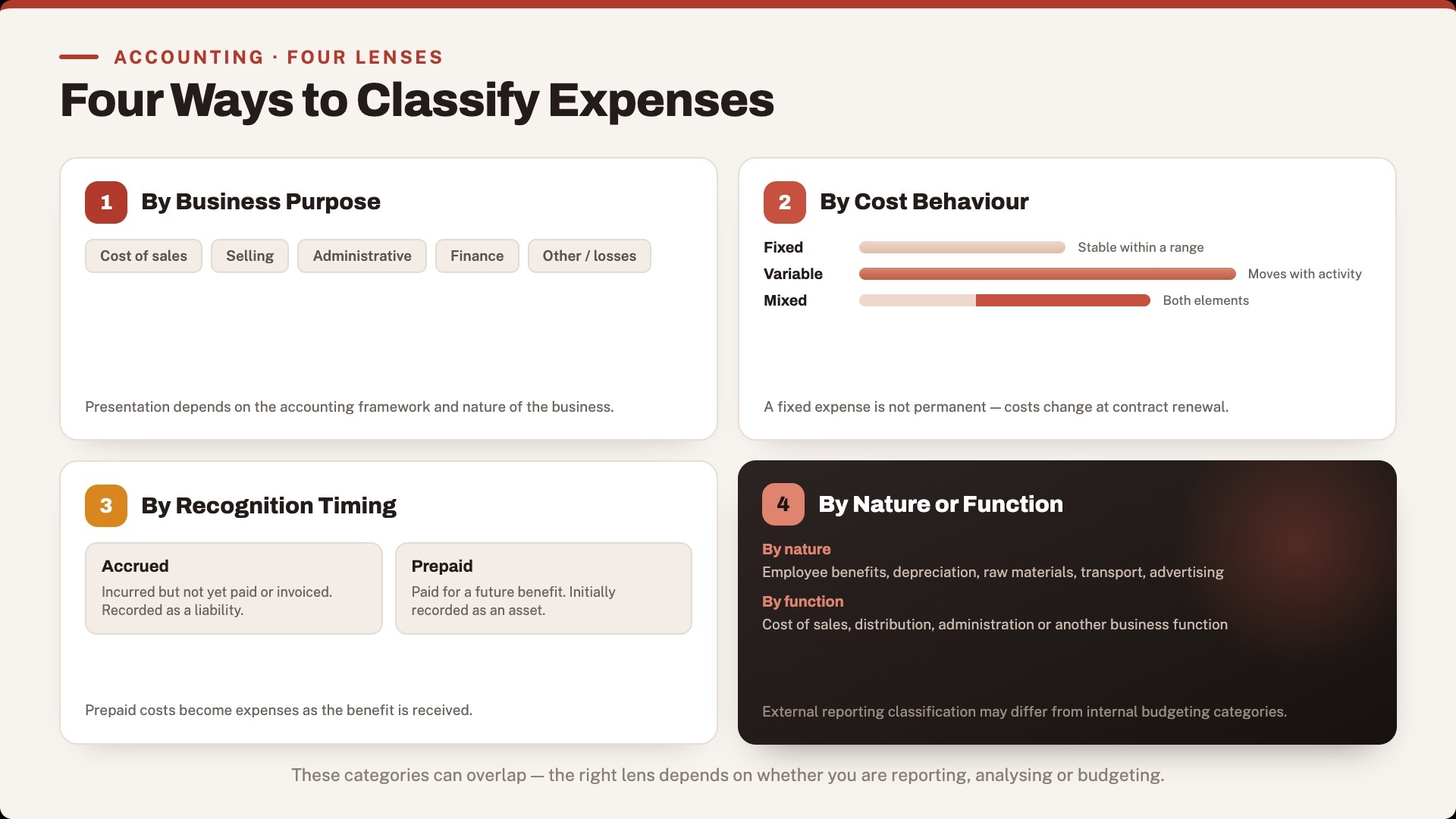
Expenses can be classified in several ways depending on whether the business is preparing financial statements, analysing profitability or planning a budget. These categories can overlap.
The precise presentation depends on the accounting framework and the nature of the business.
Fixed Expenses
Fixed expenses remain broadly stable within a relevant activity range for a defined period.
Examples may include:
A fixed expense is not necessarily permanent. Rent or subscription costs can change when a contract is renewed.
Variable Expenses
Variable expenses change with sales, production or another activity driver.
Examples may include:
Materials purchased for future production may first be recorded as inventory rather than an immediate expense.
Mixed Expenses
Mixed expenses contain both fixed and variable elements.
Examples include a utility bill with a fixed monthly charge plus usage-based charges or an employee package containing a fixed salary and sales commission.
Accrued Expenses
Accrued expenses have been incurred but have not yet been paid or invoiced.
Examples include:
The corresponding amount is recorded as a liability.
Prepaid Expenses
A prepaid expense is a payment for a future benefit. Despite its name, it is initially recorded as an asset rather than an expense.
Examples include:
The cost becomes an expense as the business receives the service or benefit.
For a detailed explanation, read Understanding Prepaid Expenses: Definition and Accounting Examples and Types of Accrued Expenses and How to Manage Them.
Under current IFRS presentation requirements, businesses may analyse expenses according to their nature or function, depending on which approach provides more relevant and reliable information.
The classification used for external financial reporting may therefore differ from the fixed-versus-variable categories used for internal budgeting.
Businesses preparing IFRS financial statements should also prepare for IFRS 18, Presentation and Disclosure in Financial Statements.
IFRS 18 replaces IAS 1 for annual reporting periods beginning on or after January 1, 2027, although earlier application is permitted. Among other changes, it:
Businesses applying IFRS should assess the effect on account mapping, reporting formats and comparative information before the effective date.

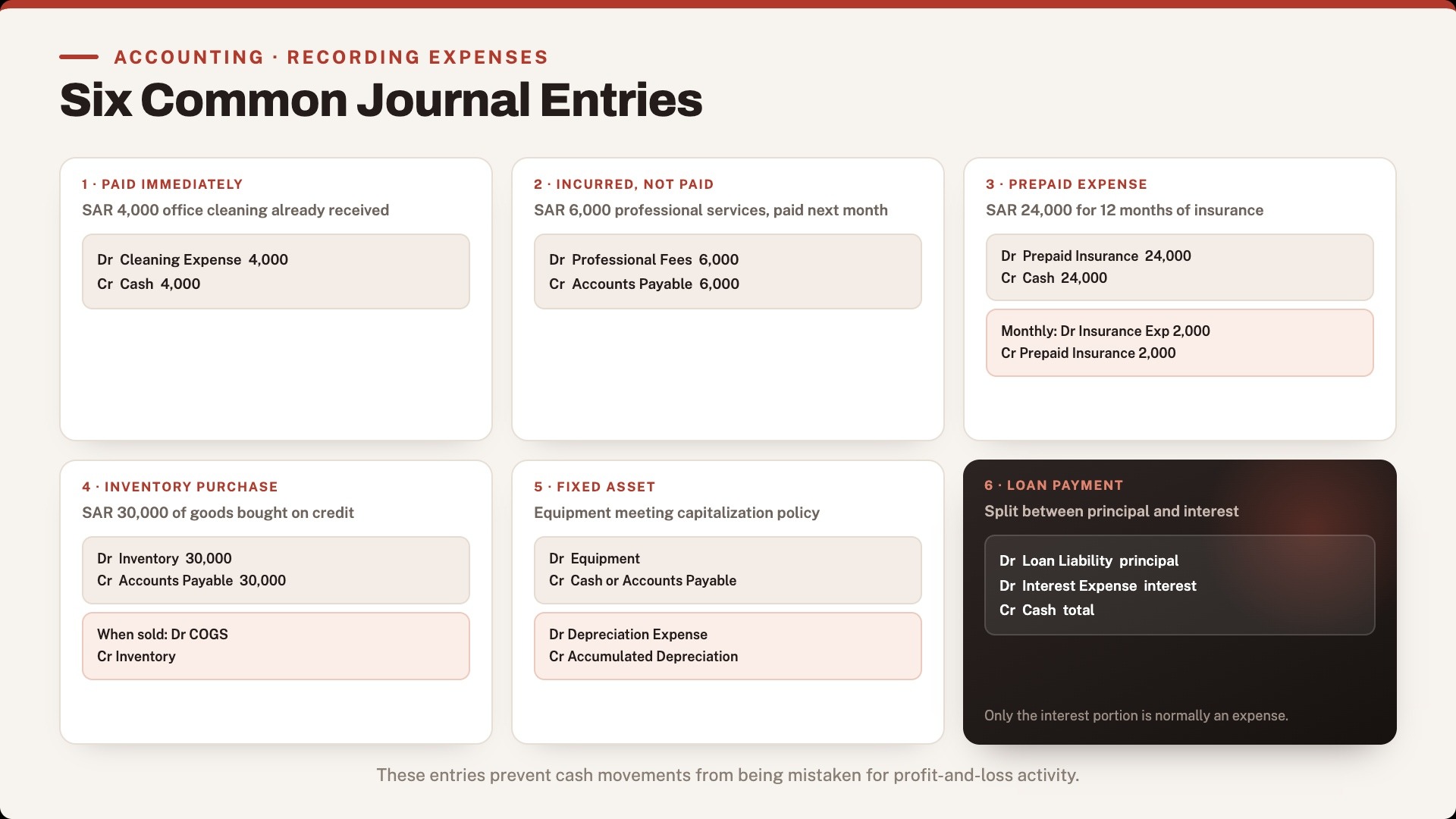
Under accrual accounting, an expense is recognized in the period in which the related resource is consumed or the obligation arises—not simply when cash is paid.
The correct journal entry depends on the transaction.
Suppose a business pays SAR 4,000 for office cleaning already received:
Debit: Cleaning Expense — SAR 4,000
Credit: Cash — SAR 4,000
Suppose the business receives SAR 6,000 of professional services in June and will pay in July:
Debit: Professional Fees Expense — SAR 6,000
Credit: Accounts Payable — SAR 6,000
Suppose the business pays SAR 24,000 for 12 months of insurance:
At payment:
Debit: Prepaid Insurance — SAR 24,000
Credit: Cash — SAR 24,000
Monthly adjustment:
Debit: Insurance Expense — SAR 2,000
Credit: Prepaid Insurance — SAR 2,000
Suppose a retailer purchases goods costing SAR 30,000 on credit:
At purchase:
Debit: Inventory — SAR 30,000
Credit: Accounts Payable — SAR 30,000
The inventory cost is generally recognized as an expense when the goods are sold:
Debit: Cost of Goods Sold
Credit: Inventory
Suppose equipment meets the company’s asset-recognition and capitalization-policy requirements:
At purchase:
Debit: Equipment
Credit: Cash or Accounts Payable
Depreciation is subsequently recorded through:
Debit: Depreciation Expense
Credit: Accumulated Depreciation
Whether an item is capitalized depends on the applicable accounting requirements, the nature of the expected future benefit and the company’s consistently applied materiality or capitalization policy. Price alone should not be presented as the only consideration.
A loan payment may contain both principal and interest:
Debit: Loan Liability — principal amount
Debit: Interest Expense — interest amount
Credit: Cash — total payment
Only the interest portion is normally recorded as an expense at payment, unless another accounting treatment applies.
These entries help maintain the distinction between expenses, assets and liabilities and prevent cash movements from being mistaken for profit-and-loss activity.
Also Read: Understanding Debits and Credits in Accounting
With a clearer understanding of how expenses are recorded, let’s explore a practical example to see how these principles are applied in a real-world setting.
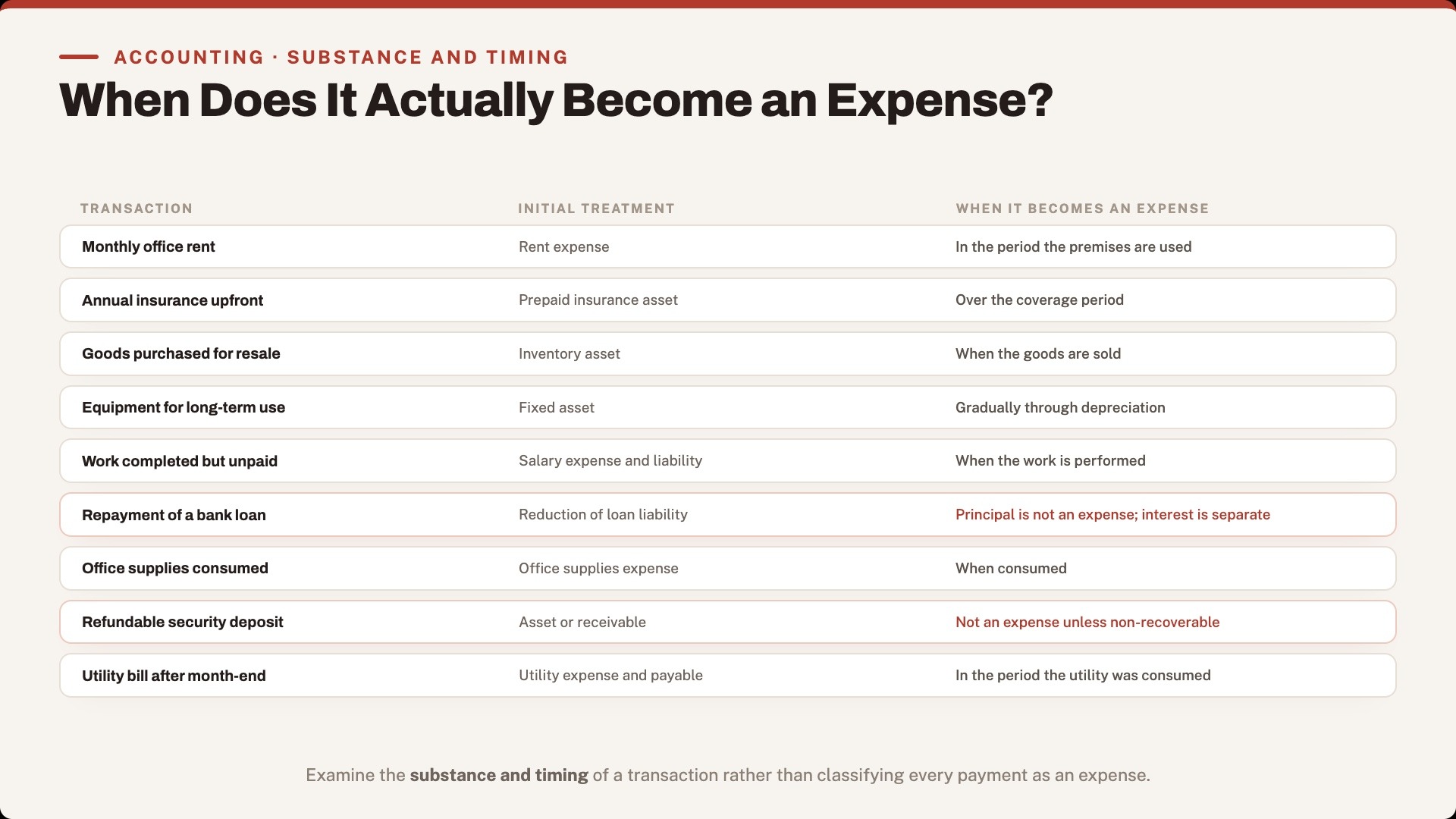
The table shows why accounting teams must examine the substance and timing of a transaction rather than classify every payment as an expense.
Saudi Aramco’s 2025 Annual Report illustrates how a major Saudi company reports expenses of different types. The report presents its figures in millions of Saudi Riyals.
Aramco reported total employee benefit expense of SAR 71.141 billion in 2025, compared with SAR 67.401 billion in 2024.
The total included:
Employee costs may be allocated across production, manufacturing, selling, administrative and other functions depending on where employees work.
Aramco reported SAR 5.443 billion of research and development costs within operating costs in 2025, compared with SAR 5.816 billion in 2024.
However, not every development cost is automatically expensed. Aramco’s stated accounting policy says development costs expected to generate probable future economic benefits are capitalized as intangible assets and amortized over their estimated useful lives. Other research and development costs are recognized in net income as incurred.
Aramco reported SAR 93.091 billion of depreciation and amortization in 2025, compared with SAR 91.679 billion in 2024.
Depreciation and amortization demonstrate that an expense can reduce profit without creating an equivalent cash outflow in the same period. The related cash expenditure may have occurred when the underlying asset was originally acquired or developed.
These examples also show why expenses should be analysed according to their economic substance rather than simply by the date on which payment occurs.
Understanding expense classification is only one part of the process. Businesses must also collect receipts, apply company policies, route claims for approval and transfer accepted transactions into the accounting records.
HAL ERP’s expense-management solution supports this workflow through:
These capabilities help reduce lost receipts, manual re-entry and disconnected approval records. The business must still define its expense policy, account mapping, approval limits and applicable accounting, Zakat, tax and VAT treatment.
For step-by-step product guidance, see how to record an expense in HAL.
An expense is not simply money leaving a bank account. It is a cost or loss recognized in the period in which the related economic benefit is consumed or the obligation arises.
The key distinctions are:
Reliable expense management therefore requires both correct accounting treatment and a controlled operational process for receipts, claims, approvals and supporting documents.
Request a HAL ERP demo to explore how HAL can connect employee-expense workflows with your accounting system.

An item qualifies as an expense when it represents a decrease in economic benefits recognized during the reporting period. This may occur through the consumption of a service, sale of inventory, depreciation of an asset or recognition of a liability.
No. A cash payment may purchase an asset, repay a liability or pay an expense.
For example:
Not necessarily. Raw materials intended for future production are generally recorded as inventory. Their cost becomes an expense when they are consumed in production and the related inventory is sold, subject to the applicable accounting treatment.
It is initially an asset. The amount becomes an expense as the business receives the related service or benefit.
For example, annual insurance paid in advance is recorded as prepaid insurance and then recognized as insurance expense over the coverage period.
Both represent unpaid obligations. An accrued expense is commonly recorded when a cost has been incurred but an invoice has not yet been received or processed. Accounts payable normally represents an amount supported by a supplier invoice or other established payable document.
No. Recognition as an expense in the financial statements does not automatically make the amount deductible for income-tax or Zakat purposes.
Treatment depends on factors such as:
Businesses should reconcile book expenses with their applicable Zakat and tax calculations and obtain professional advice where necessary.
No. Input VAT recovery depends on whether the purchase relates to the taxable business activity, whether the required documentation is available and whether the cost falls within a restricted category under Saudi VAT rules.
The accounting expense and the recoverable VAT should therefore be assessed separately.
Accurate tracking helps businesses: