Accounting standards determine how transactions and economic events are recognized, measured, presented, and disclosed in financial statements.
But businesses do not all use the same framework.
For Saudi companies, the most important distinction is between full IFRS Accounting Standards endorsed in Saudi Arabia and the IFRS for SMEs Accounting Standard endorsed in Saudi Arabia.
According to the IFRS Foundation’s Saudi Arabia jurisdiction profile:
Saudi Arabia’s framework also includes additional standards, disclosures, and pronouncements endorsed by the Saudi Organization for Chartered and Professional Accountants (SOCPA) for matters not fully addressed by IFRS, including certain Saudi-specific issues.
This guide explains the main types of accounting standards, how IFRS differs from IFRS for SMEs and US GAAP, which framework Saudi businesses generally use, and the accounting-standard changes finance teams should prepare for in 2026 and 2027.
Accounting standards are authoritative requirements that determine how financial information should be recognized, measured, presented, and disclosed.
They create a common reporting framework so investors, lenders, owners, regulators, and other users can understand what financial-statement amounts represent and make more meaningful comparisons.
For companies applying IFRS, the Conceptual Framework for Financial Reporting sets out the underlying concepts used in developing and interpreting IFRS Accounting Standards, including the objective of general-purpose financial reporting and the characteristics of useful financial information.
Accounting standards support:
However, accounting-standard compliance is not the same as tax compliance.
IFRS or IFRS for SMEs determines the financial-reporting treatment of transactions. Saudi VAT, Zakat, corporate income tax, and ZATCA e-invoicing are governed by separate tax rules and can require different calculations or treatments.
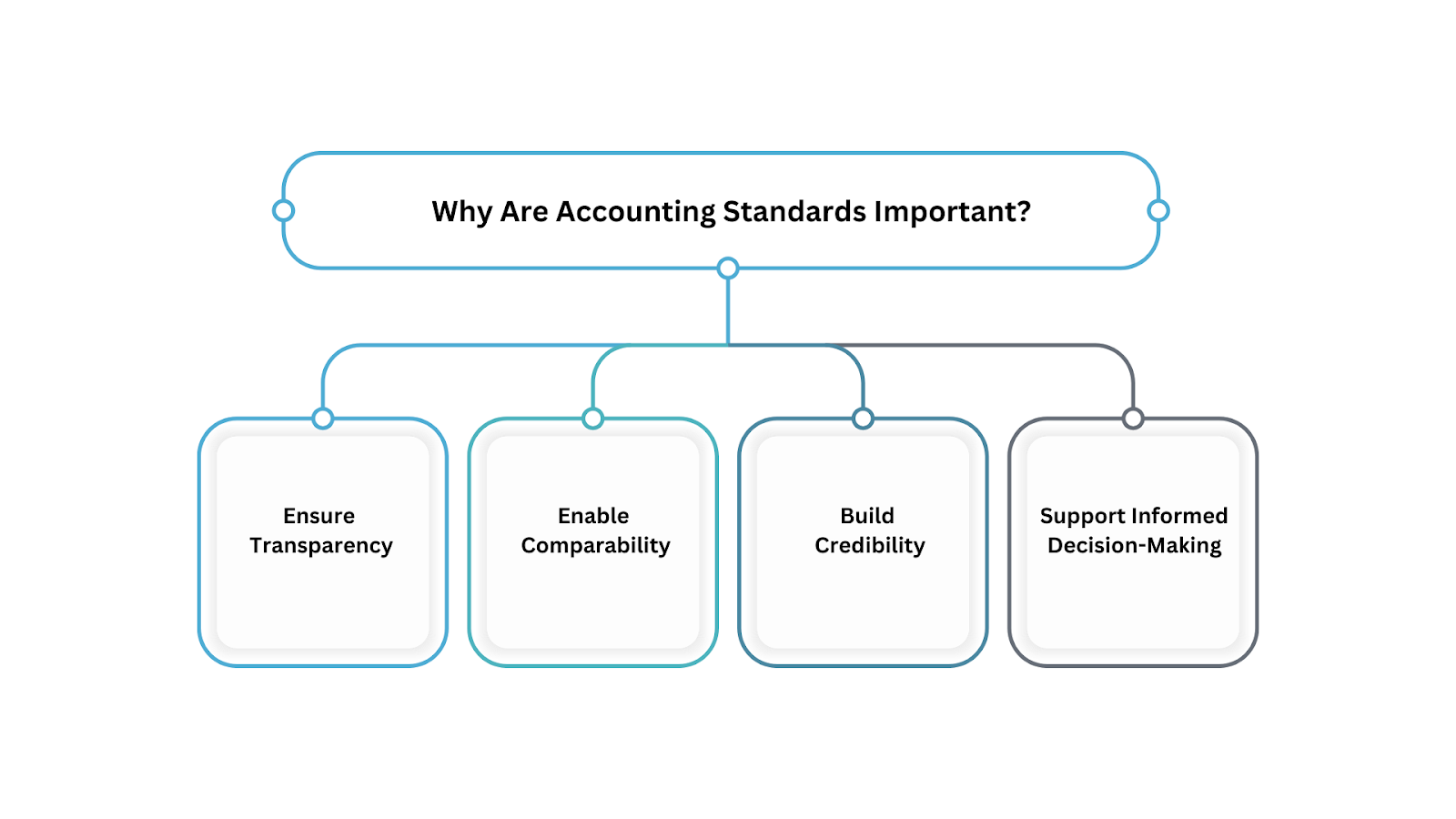
Accounting standards play an important role in building trust and ensuring reliability in financial reporting. By adhering to these standards, your businesses can:
For businesses in Saudi Arabia, following accounting standards ensures accurate financial reports and compliance with local rules like VAT filing and Zakat payments. It also helps meet ZATCArequirements, avoiding penalties and building trust. Let’s now look at the types of accounting standards used globally.
Businesses may encounter several financial-reporting frameworks depending on their jurisdiction, public-accountability status, ownership, and reporting requirements.
IFRS Accounting Standards are developed by the International Accounting Standards Board (IASB) and are widely used for general-purpose financial reporting around the world.
Full IFRS includes standards covering areas such as:
In Saudi Arabia, publicly accountable entities are required to apply IFRS Accounting Standards endorsed in Saudi Arabia.
SOCPA’s endorsement process may also introduce additional disclosure requirements or Saudi-specific pronouncements where necessary.
The IFRS for SMEs Accounting Standard is a separate, self-contained framework designed for eligible entities without public accountability.
It simplifies full IFRS in several areas and requires substantially fewer disclosures.
This is particularly important for HAL’s audience because qualifying Saudi SMEs are generally required to use the IFRS for SMEs Accounting Standard endorsed in Saudi Arabia, although eligible SMEs may elect full IFRS subject to the Saudi framework’s conditions.
The IASB issued the third edition of IFRS for SMEs in February 2025, effective for annual periods beginning on or after January 1, 2027, with early application permitted at the international-standard level.
Saudi businesses should check SOCPA’s current endorsement documents before applying a newly issued edition or amendment locally.
US Generally Accepted Accounting Principles (US GAAP) are the primary accounting framework for nongovernmental financial reporting in the United States.
The Financial Accounting Standards Board (FASB) develops and issues US financial-accounting standards, while the FASB Accounting Standards Codification is the official authoritative source of nongovernmental US GAAP.
US GAAP is not the primary reporting framework for Saudi businesses, but it can become relevant for:
Avoid reducing the difference to:
IFRS = principles-based
GAAP = rules-based.
That can be useful shorthand, but both are extensive accounting frameworks with detailed requirements.
The important question is which framework the reporting entity is required to apply.
Some jurisdictions maintain national GAAP frameworks, while others adopt or endorse IFRS with local modifications, additional disclosures, or separate pronouncements.
Saudi Arabia follows an endorsement model.
SOCPA endorses IFRS Accounting Standards for Saudi application and can issue or endorse additional requirements for matters not fully addressed by IFRS.
This is why Saudi financial statements commonly refer to:
“IFRS Accounting Standards that are endorsed in Saudi Arabia and other standards and pronouncements that are endorsed by SOCPA.”
rather than simply stating that the entity uses an unrelated national Saudi GAAP.

Accounting standards do much more than establish general “principles.” Individual standards provide requirements for how specific transactions and balances are accounted for.
The main areas include:
Recognition determines whether and when an item belongs in the financial statements.
For example, IFRS 15 establishes requirements for recognizing revenue from customer contracts rather than relying on the simple rule that revenue is recorded whenever it is “earned.”
Standards determine how recognized assets, liabilities, income, and expenses should be measured.
Depending on the applicable standard, measurement may involve concepts such as:
There is no universal rule requiring every asset to remain at its original cost.
Accounting standards determine how information is organized and presented in the financial statements.
This area is receiving an important update through IFRS 18 Presentation and Disclosure in Financial Statements, which replaces IAS 1 from annual reporting periods beginning on or after January 1, 2027. (IFRS 18)
Financial statements contain more than headline numbers.
Accounting standards can require disclosures about matters such as:
Individual IFRS Standards govern areas such as revenue, leases, inventories, financial instruments, business combinations, property and equipment, and intangible assets.
For example, lease accounting should be based on IFRS 16 rather than the older general rule that every lease is simply classified as either an operating expense or a finance lease by the lessee.
Different organizations play different roles in developing, endorsing, or regulating financial reporting.
The IASB develops and publishes IFRS Accounting Standards, including the IFRS for SMEs Accounting Standard.
The FASB develops financial-accounting standards for nongovernmental entities applying US GAAP.
For Saudi Arabia, SOCPA is central to the accounting-standard framework.
SOCPA reviews, develops, and approves accounting and auditing standards and operates the process through which IFRS Accounting Standards are endorsed for Saudi application.
That endorsement process includes technical, legal, and Sharia review and can result in additional disclosures or separate Saudi pronouncements.
Other Saudi regulators can impose reporting requirements within their areas of responsibility.
For example, the Capital Market Authority has issued requirements affecting accounting-policy choices for listed companies, while Saudi Central Bank rules require banks, insurance companies, and finance companies within its scope to prepare financial statements using IFRS subject to specified Saudi/SAMA treatments.
ZATCA administers Saudi Zakat, tax, customs, VAT, and e-invoicing requirements.
It should not be described as the organization that develops or enforces IFRS accounting standards.
Financial-reporting compliance and tax compliance can interact, but they remain separate areas.
A widely recognized accounting framework can make financial information easier to interpret across companies and jurisdictions.
Potential benefits include:
The IFRS Foundation describes IFRS as a common international reporting language used extensively across more than 140 jurisdictions.
These benefits do not mean IFRS automatically lowers a company’s costs, attracts investors, prevents errors, or simplifies tax reporting. Outcomes depend on implementation quality, business circumstances, internal controls, and the requirements of each jurisdiction.
The difficulty is usually not deciding that standards are useful. It is applying them correctly to real transactions.
Many accounting areas require estimates and judgement rather than one automatic calculation.
Examples include:
New accounting requirements can require changes to:
Finance teams need time to understand new recognition, measurement, presentation, or disclosure requirements before an effective date.
Groups operating under more than one accounting framework may need reconciliation between IFRS, US GAAP, or another local framework.
Accounting standards continue to change.
Businesses need a process for evaluating new standards, identifying affected transactions, updating accounting policies, modifying systems, training users, testing reports, and preparing new disclosures.
This is especially relevant in 2026 because several important changes become effective from January 1, 2027.
Saudi finance teams should already be preparing for changes that become effective in 2027.
IFRS 18 replaces IAS 1 for annual periods beginning on or after January 1, 2027.
The new standard introduces changes including:
SOCPA has already adopted IFRS 18 for implementation in Saudi Arabia, with early adoption permitted.
SOCPA has also adopted IFRS 19 for Saudi implementation.
The standard allows eligible subsidiaries without public accountability to apply full IFRS recognition and measurement requirements while using reduced disclosure requirements.
The IASB issued the third edition of the IFRS for SMEs Accounting Standard in February 2025.
Internationally, it becomes effective for annual periods beginning on or after January 1, 2027, with early application permitted. Major updates include changes to areas such as revenue, financial instruments, business combinations, consolidation, and fair-value measurement. (IFRS for SMEs supporting materials)
Saudi SMEs should confirm the applicable SOCPA-endorsed edition and transition requirements before implementation rather than assuming an IASB publication automatically becomes effective locally on the same date.
There is no single accounting framework used by every company worldwide.
For Saudi businesses, the first question should be:
Which financial-reporting framework applies to this entity?
Publicly accountable entities generally use IFRS Accounting Standards endorsed in Saudi Arabia, while qualifying SMEs generally use the IFRS for SMEs Accounting Standard endorsed in Saudi Arabia, subject to the applicable Saudi rules and available elections.
Finance teams should then monitor new standards and amendments that may affect accounting policies, systems, financial statements, and disclosures—including IFRS 18 and other changes approaching in 2027.
HAL Accounting supports the underlying accounting workflow through automated journal entries, bank reconciliation, financial dashboards, user-access controls, VAT reports, and other financial-processing capabilities.
These capabilities can help maintain structured financial records, but software does not independently determine whether a transaction complies with IFRS or the applicable SOCPA-endorsed framework. Accounting policies, estimates, judgements, disclosures, and financial-statement compliance remain the responsibility of management and qualified accounting professionals.
Businesses evaluating their finance workflows can request a HAL ERP demo.
Major frameworks include IFRS Accounting Standards, the IFRS for SMEs Accounting Standard, US GAAP, and jurisdiction-specific accounting frameworks or pronouncements.
Which one applies depends on the entity, jurisdiction, and reporting requirements.
Publicly accountable entities generally apply IFRS Accounting Standards endorsed in Saudi Arabia.
Qualifying SMEs generally apply the IFRS for SMEs Accounting Standard endorsed in Saudi Arabia, although eligible SMEs may elect full IFRS subject to applicable conditions.
Full IFRS is designed primarily for entities with public accountability and contains more extensive recognition, measurement, presentation, and disclosure requirements.
IFRS for SMEs is a separate, simplified framework for eligible entities without public accountability.
US GAAP is not the primary Saudi financial-reporting framework.
However, Saudi businesses may encounter US GAAP when reporting to a US parent, preparing group reporting packages, working with US investors, or dealing with certain cross-border requirements.
SOCPA reviews and endorses accounting standards for application in Saudi Arabia.
The IASB develops IFRS Accounting Standards internationally, while Saudi regulators may impose additional reporting requirements within their respective areas.
No.
ZATCA administers areas such as VAT, Zakat, income tax, customs, and e-invoicing.
Financial-reporting standards and tax rules are separate frameworks, although the same transaction may affect both accounting and tax reporting.
IFRS 18 is the new standard for presentation and disclosure in financial statements.
It replaces IAS 1 and becomes effective for annual periods beginning on or after January 1, 2027, with early application permitted. SOCPA has adopted IFRS 18 for Saudi implementation.
The IASB issued the third edition of IFRS for SMEs in 2025.
It becomes effective internationally from January 1, 2027, with early application permitted. Saudi SMEs should check the current SOCPA endorsement and transition requirements before applying the new edition.