

Have you sent your invoices and follow-ups, but your receivables still don’t match at the end of the month? You're not alone.
Over 8.2 billion e-invoices were processed in Saudi Arabia in 2025, yet late payments and reconciliation disputes remain one of the top cash flow challenges for Saudi SMEs and enterprises alike. The root cause, more often than not, is simple: businesses send invoices but never send a statement of account.
Without a clear, consolidated view of what's been invoiced, paid, and still outstanding, collections stall and disputes multiply.
This blog will explore exactly what a statement of account is, how it works, and how Saudi businesses can use it to close that gap.
A statement of account is a period-based summary document issued by a seller to a buyer. It captures every financial interaction between the two parties over a defined timeframe, typically a calendar month, a quarter, or a project phase. It is not a payment demand. It is a reconciliation tool.
A well-structured SOA always contains the following:
Now that you know what an SOA contains, there’s one distinction that trips up even experienced finance teams, which is the difference between an SOA and an invoice. Let’s clear that up.

This is one of the most common questions finance and operations teams ask. And confusing the two causes real problems, delayed collections, client disputes, and gaps in your audit trail.
An invoice asks for payment for one transaction. A statement of account summarizes all transactions over a period.
Use an SOA in the following situations:
With that distinction clear, let’s look at why statements of account carry extra weight for businesses operating in Saudi Arabia specifically.
Also Read: Understanding and Preparing an Income Statement
The KSA business environment has specific regulatory requirements that make clean receivables documentation more than just good practice. It’s a compliance requirement.
Under ZATCA’s Phase 2 Fatoorah mandate, all B2B invoices must be electronically reported and validated. But compliance doesn’t end at the invoice stage. You also need to reconcile what was invoiced against what was actually paid.
SOAs bridge that gap.
If a client delays payment, your VAT liability doesn’t wait. An accurate, up-to-date SOA makes sure your VAT reconciliation reflects the right numbers every reporting cycle.
SOCPA-compliant accounting requires clear, traceable audit trails for both receivables and payables. SOAs provide supporting documentation for your accounts receivable aging report, a key input when preparing financial statements under SOCPA standards.
Without SOAs, aging reports become harder to verify, and your external auditors will flag the gaps.
Saudi Arabia’s Vision 2030 agenda is pushing companies, especially SMEs, toward stronger financial governance and greater transparency. Businesses that use systematic SOA processes signal process maturity to banks, investors, and auditors. That matters more as KSA companies pursue growth financing and regional expansion.
Now that you understand why SOAs matter in the KSA context, let’s look at what an actual best-in-class statement of account should include.

A generic SOA gets the job done. A well-structured SOA prevents disputes before they happen. Here’s what every field should include, and why it matters.
Standard fields every statement of account should include:
When generating a statement of account, the method you use makes a significant difference. Manual preparation in Excel is still common, but it's built row by row from invoices and payment records, making it slow, error-prone, and unautomatable.
Accounting software improves on that by pulling data from your ledger, but it's often disconnected from your sales and operations data, so the numbers don't always tell the full story.
HAL takes a different approach entirely. It pulls SOAs live from your accounts receivable ledger, captures your complete invoice and payment history automatically, and lets you schedule dispatch for every credit customer, no manual work, no missing entries, no delays.
Also Read: A Complete Guide to Cash Flow Forecasting for Saudi Businesses in 2026
However, even the best-designed SOA can fail if it’s built on bad data. Let’s look at the most common mistakes businesses make, and how to fix them.
Your finance teams work with several documents that look similar on the surface. Here’s how the SOA fits into the broader picture.
The SOA connects your internal accounting, aging reports, trial balance, and ledger entries with your external client-facing one. It’s the bridge between what your system knows and what your client sees.
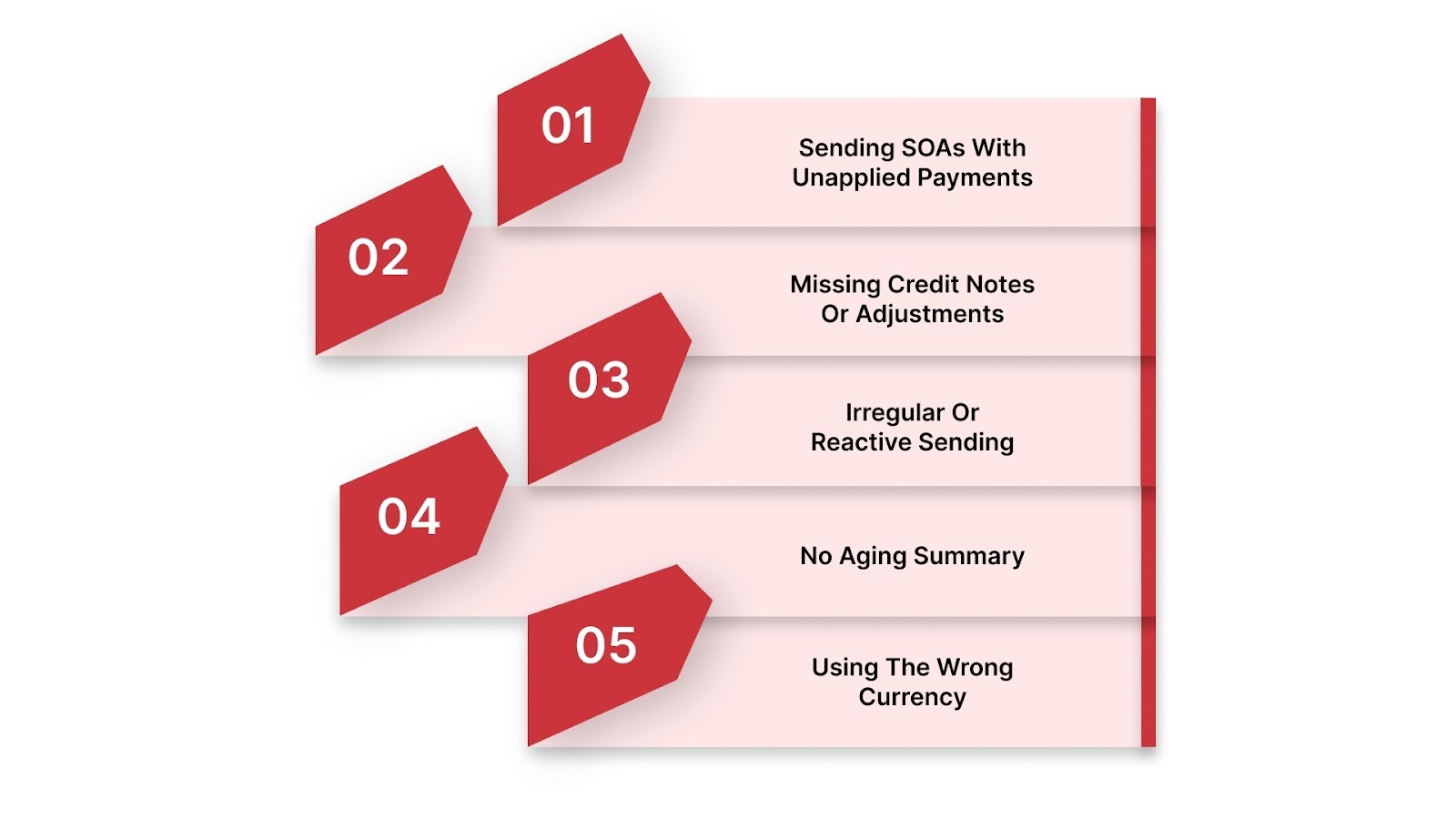
A well-formatted SOA with bad data is worse than no SOA at all. It creates disputes, erodes trust, and slows down collections. Here are the most common errors Saudi businesses make when preparing SOAs.
A payment was received, but it wasn't allocated to a specific invoice yet in your system. The SOA shows the payment, but the invoice still appears as open. Your client sees a balance they believe they've already cleared.
Fix: Always allocate incoming payments to specific invoices in HAL ERP before generating your SOA. A real-time ledger means you can post a payment and run an accurate SOA within minutes.
If a return, discount, or credit note was issued but hasn't been reflected in the SOA, clients will dispute the balance. They have every right to.
Fix: Reconcile all credits and adjustments before SOA generation. In HAL ERP, credit notes post directly to the client account in real time, so they're always captured.
Businesses that only send SOAs when chasing overdue accounts create a tense, adversarial dynamic. Clients feel the SOA is a threat, not a service.
Fix: Automate monthly SOA dispatch for all credit customers, regardless of whether they have an outstanding balance. Consistency builds professionalism and makes collections feel routine rather than confrontational.
An SOA without an aging breakdown hides the true risk profile of your receivables from your own management team and from your client. A client with SAR 200,000 outstanding doesn't know if that's all current or all 90 days overdue unless you show them.
Fix: Include a standard 0–30 / 31–60 / 61–90 / 90+ aging block on every SOA, every time.
This mistake is especially common in trading and contracting businesses that deal with international suppliers or clients. An SOA issued in SAR when the original invoice was in USD, or vice versa, without clearly stating the exchange rate and conversion date, creates immediate confusion.
Clients can't reconcile the figures against their own records, and your finance team can't defend the numbers under audit.
Fix: Always match the SOA currency to the original invoice currency. If a conversion is necessary, state the exchange rate, the source, and the date it was applied — clearly, on the face of the document. HAL ERP's multi-currency account management handles this automatically, so the right currency and rate are applied every time without manual intervention.
HAL ERP auto-generates SOAs from live ledger data, applies payments in real time, and flags aging buckets automatically. Let’s discover how HAL can simplify your SOA workflow.
Also Read: 10 Advantages of Invoice Approval Automation for Businesses
Building an SOA manually takes time, introduces errors, and depends entirely on your finance team remembering to do it on time every month. HAL ERP removes that dependency entirely.
Instead of building SOAs manually, HAL pulls everything directly from your live accounts receivable ledger, invoices, payments, credit notes, and adjustments, and generates a complete, accurate SOA in real time. Here's what that looks like in practice:
When your SOA process runs on live data, consistent schedules, and built-in compliance, your finance team spends less time fixing errors and more time managing what actually matters.
Masaahaat, a leading marketing and FMCG events agency in Saudi Arabia, was running its finance operations across disconnected systems. Data lived in silos across sales, finance, and procurement, and that fragmentation directly impacted collections. As a result, their collections stalled. Vendor relationships suffered. And finance had no clear, real-time view of what was outstanding and for how long.
After implementing HAL ERP, Masaahaat replaced every disconnected manual process with a single, integrated platform. Invoice generation, financial postings, and multi-currency transactions were automated end-to-end, including the visibility into outstanding accounts that an accurate SOA depends on.
The results were measurable and significant:
For a business managing complex client billing across dozens of accounts, that clarity isn't just an operational improvement. It's the difference between a collection process that works and one that constantly falls behind.

A statement of account is one of the simplest tools in finance, yet most businesses either underuse it or get it wrong. In KSA's compliance-driven environment, where ZATCA mandates clean audit trails and clients expect professional, accurate billing, an SOA is a core part of how you manage cash flow, build client trust, and stay audit-ready.
The businesses that send accurate, consistent, timely SOAs collect faster, dispute less, and close their books cleaner. HAL ERP makes that the default.
Ready to put your statement of account process on autopilot? Book your free HAL ERP demo today.
A statement of account summarizes all financial transactions between a seller and a buyer over a set period, including invoices raised, payments received, and adjustments made, to show the current outstanding balance. It supports reconciliation, collections, and dispute resolution between both parties.
A statement of account is not a legally binding payment demand, but it is an important supporting document for audits, dispute resolution, and receivables management. In Saudi Arabia, SOAs that reference ZATCA-registered invoice numbers carry strong audit-trail value and are useful in any ZATCA or SOCPA review.
Best practice is monthly. Sent at the end of the billing cycle or the start of the new month. High-volume businesses or those with long project cycles may also send SOAs at project milestones or upon client request. The key is consistency: sporadic SOAs create confusion.
Yes. ERP systems like HAL ERP auto-generate SOAs directly from the accounts receivable ledger, reflect real-time payment data, and can be scheduled to send to all credit customers on a set date each month, no manual preparation required.
Under ZATCA’s e-invoicing mandate (Fatoorah), all B2B invoices are electronically reported. An SOA referencing ZATCA-compliant invoice numbers allows businesses to reconcile their reported transactions against client payment records, supporting accurate VAT filing and full audit readiness.




%20in%202026.png)