.jpg)

Saudi businesses that make certain payments to non-residents may be required to deduct withholding tax (WHT) and remit it to the Zakat, Tax and Customs Authority (ZATCA).
The key question is not simply whether a payment crosses a border. Under Saudi Arabia’s Income Tax Law and Implementing Regulations, WHT generally applies when a qualifying payment from a Saudi source is made to a non-resident that does not have a permanent establishment in the Kingdom to which the income is attributable.
The applicable domestic rate depends on the type of income. Common rates include 5% for dividends, rent, loan charges, insurance/reinsurance, technical and consulting services, and certain transport payments; 15% for royalties and certain other payments; and 20% for management fees.
Pure purchases of goods are not automatically subject to WHT, and classification can become more complex where a contract combines goods, software rights, support, consulting, freight, or other services.
This guide explains the current Saudi withholding-tax rules, rates, calculation process, filing deadlines, treaty relief, recordkeeping requirements, penalties, and the financial data businesses should maintain to support compliance.
Withholding tax is a mechanism used to collect Saudi income tax on certain income earned by non-residents from sources within the Kingdom.
Rather than requiring the non-resident recipient to make the initial payment directly to ZATCA, the person making the qualifying payment withholds the applicable percentage from the gross amount and remits it to ZATCA.
WHT generally requires three questions to be answered:
For business transactions, the withholding obligation commonly rests with the Saudi resident entity making the qualifying payment.
This can include companies and other Saudi-established legal persons, as well as a permanent establishment of a non-resident when it makes relevant Saudi-source payments to another non-resident.
The obligation is based on the transaction and source rules—not simply the size or industry of the payer.
A payment to a foreign supplier for a pure purchase of goods, for example, is not automatically subject to WHT. However, installation, maintenance, consulting, or other services bundled into the contract may require separate analysis.
Businesses should use ZATCA’s current guidance and the underlying contract to determine the appropriate classification before withholding tax.
Not every payment is subject to withholding tax, but a wide range of cross-border transactions fall within its scope. Common examples include:
Key takeaway: By understanding this scope, you can avoid penalties and strengthen your company’s tax compliance framework. For businesses that frequently handle international payments, automation through ERP tools such as HAL ERP can ensure calculations and filings are handled accurately and on time.

The classification of the payment determines the applicable domestic rate.
Common categories include:
A contract described simply as a “software licence” should not automatically be assigned a 15% royalty rate.
ZATCA’s current guidance distinguishes between:
The rights granted under the agreement and the substance of the payment should therefore be reviewed before selecting the WHT category.

Withholding tax in Saudi Arabia applies at fixed percentages depending on the type of payment made to non-residents. These rates must be applied at the time of payment and remitted to ZATCA. Using the correct rate ensures compliance and avoids penalties.
The domestic WHT rate depends on how the payment is classified.
These are domestic-law rates. An applicable double-tax treaty may reduce or eliminate Saudi WHT when the treaty conditions and ZATCA procedures are satisfied.
ZATCA’s May 2026 English General WHT Guideline displays a 15% rate for international telecommunications services, while ZATCA’s more recent DTA circular displays 5% for that category.
Because the two current English-language ZATCA documents are not consistent on this point, businesses with international telecommunications payments should confirm the applicable treatment against the latest Arabic regulation/guidance or directly with ZATCA rather than relying on a generic online rate table.
Source: Income Tax Law PDF, WTO
Note: Saudi Arabia also applies withholding tax on dividends and interest (commonly 5%) through regulations and treaties, though these are not explicitly listed in Article 68. The exact rate may change under double taxation agreements, which can reduce or eliminate withholding in certain cases.
Once the rates are set, ensure you have a clear process to calculate withholding tax correctly for every payment type.
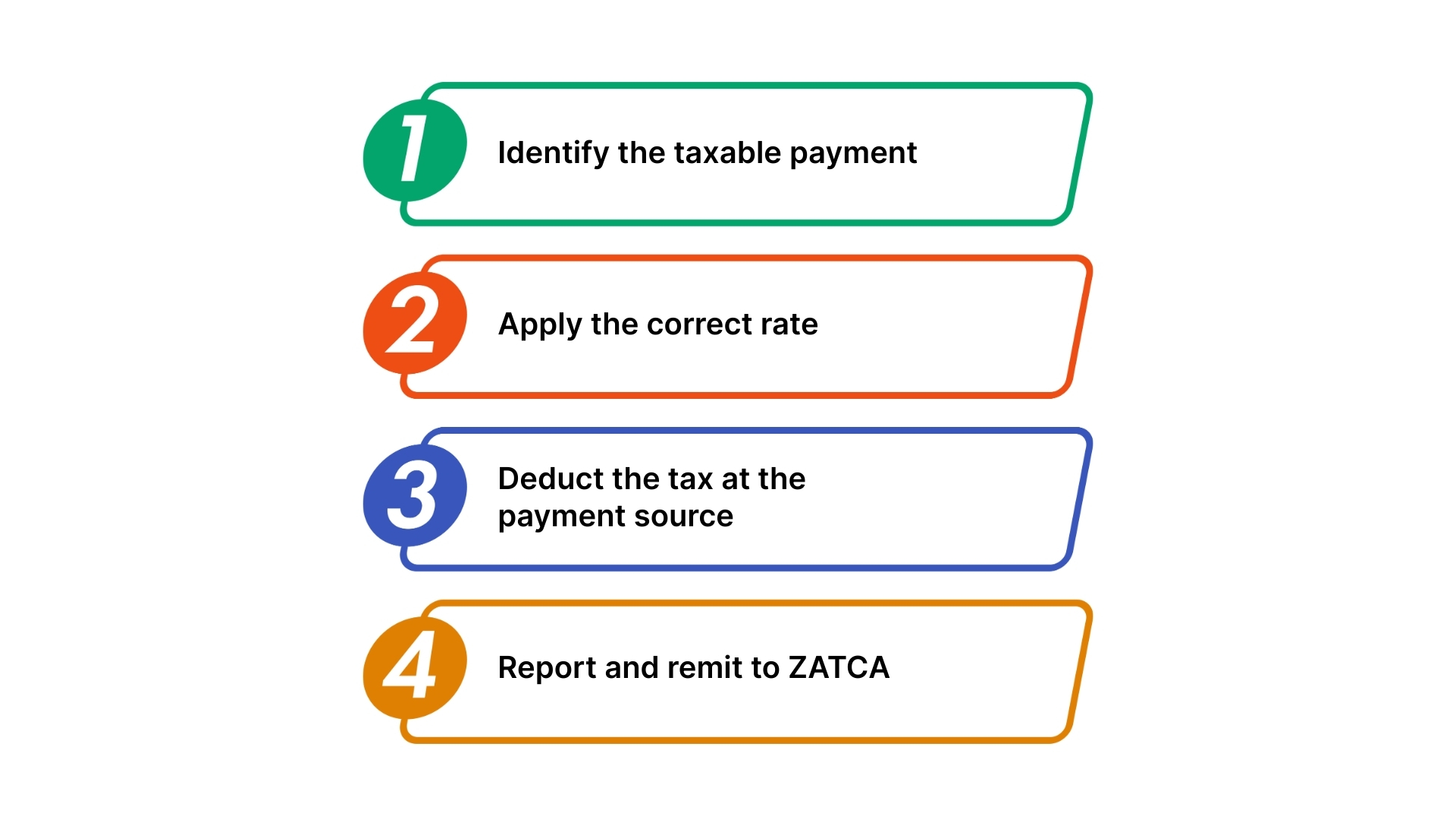
Calculating withholding tax in Saudi Arabia requires accuracy because any mistake in rates or reporting leads to penalties. The process is straightforward, but you must follow the official ZATCA requirements at each stage.
Here is the step-by-step process you should follow:
Suppose a Saudi company owes SAR 100,000 to a non-resident consultant for services that qualify as technical and consulting services.
Assuming the domestic WHT rate applies and no treaty reduction is used:
WHT = SAR 100,000 × 5% = SAR 5,000
The payer would therefore:
The tax is generally calculated on the gross qualifying payment, not the non-resident’s profit from providing the service.
Before performing the calculation, confirm that the transaction is correctly classified. A payment described commercially as “consulting,” “software,” “support,” or “licensing” may receive different WHT treatment depending on what the contract actually provides.
Even when the steps are clear, businesses often face issues during calculation. The most frequent challenges include:
HAL ERP can help you reduce these risks by applying correct rates, tracking deadlines, and generating ZATCA-compliant reports without manual intervention. Beyond calculation, compliance also requires following the official process of deduction, filing, and remittance with ZATCA.

Once a payment is identified as subject to WHT, the payer should complete the following steps.
Review the contract, invoice, and actual service or right being supplied.
The classification determines the domestic WHT rate.
Confirm whether the recipient is non-resident and whether it has a permanent establishment in Saudi Arabia to which the income is attributable.
Where income belongs to a Saudi permanent establishment, normal income-tax treatment may apply instead of WHT.
Before applying a reduced treaty rate, determine whether an effective double-tax agreement applies and whether the beneficiary satisfies its conditions.
Apply the appropriate rate to the gross qualifying amount and deduct the tax from the payment to the non-resident.
ZATCA requires the monthly WHT statement and related tax payment within the first 10 days of the month following the month in which payment was made to the beneficiary.
ZATCA’s online service allows taxpayers to submit the monthly WHT return through its portal.
ZATCA’s current guideline requires the beneficiary to receive a certificate showing the amount paid and the tax withheld.
ZATCA also provides an electronic service for requesting a formal withholding-tax certificate after the relevant return and payment have been completed.
In addition to monthly statements, the withholding person must submit an annual WHT statement.
ZATCA’s current guideline states that it is generally due:
The annual statement summarizes WHT activity already reported during the year.
WHT records should be maintained for at least 10 years after payment.
At a minimum, records should support:
ZATCA may require records to be kept longer when a matter remains under review.
Check the Sample Checklist Here and stay on top of your tax compliance responsibilities.
Saudi Arabia has entered into double-tax agreements with numerous jurisdictions.
Depending on the relevant treaty and type of income, Saudi Arabia’s taxing right may be reduced or eliminated.
A reduced treaty rate should not be applied solely because the recipient is located in a treaty country. The specific treaty article, residency status, beneficial entitlement, permanent-establishment position, and ZATCA procedural requirements must be considered.
ZATCA’s current WHT treaty guidance provides two approaches.
The Saudi withholding person can apply through ZATCA for approval to use a reduced treaty rate or exemption directly.
ZATCA currently requires supporting documents including:
ZATCA reviews the application before approving the claimed treaty benefit.
Where the benefit-at-source requirements cannot be satisfied, the payer can:
The refund process requires additional documentation, including evidence of the WHT return and payment and authorization from the non-resident beneficiary.
ZATCA’s June 2026 treaty application service provides the current electronic process for requesting DTA treatment.
Businesses should distinguish an ordinary late-payment penalty from penalties involving fraud or intentional tax evasion.
Under ZATCA’s current WHT guidance, a delay penalty of:
1% of the unpaid tax for every 30 days of delay
can apply where the tax required to be withheld is not paid by the statutory deadline.
ZATCA reiterated this rate in its 2026 monthly WHT filing notices. For example, the May 2026 WHT return was due by June 10, 2026, with the same 1%-per-30-days late-payment rule.
A different penalty regime can apply where the withholding person conceals information or provides incorrect information with an intention to evade tax.
ZATCA’s May 2026 guideline states that such conduct can lead to a financial penalty of 25% of the tax difference in relevant fraud cases. Examples include:
This 25% fraud-related penalty should not be presented as a normal escalating late-payment surcharge.

Withholding-tax compliance depends on having accurate supplier, invoice, payment, currency, and accounting records.
HAL Accounting provides a centralized financial environment that can support this underlying process through capabilities such as:
These capabilities can reduce the need to reconstruct payment information from disconnected spreadsheets when finance teams prepare WHT calculations and returns.
For international vendors, the accounting system can also help maintain the transaction and supporting records needed to review:
However, the publicly available HAL documentation I reviewed does not provide enough support to claim that HAL automatically determines the correct Saudi WHT classification, independently selects the applicable tax rate, applies treaty relief, or submits the monthly WHT return to ZATCA.
Those decisions should remain subject to the business’s configured workflow and review by its tax or finance professionals.
Request a HAL ERP demo to confirm how your specific WHT accounting, reporting, and approval workflow can be configured.

Saudi withholding tax depends on more than choosing a percentage from a rate table.
Before making a payment to a non-resident, businesses may need to determine:
ZATCA’s May 2026 withholding-tax guideline provides significantly more detail on these issues than older summaries, making current transaction-level classification particularly important.
A connected accounting system can help finance teams maintain supplier, payment, ledger, and supporting data in one place, but the correct WHT treatment still depends on the tax rules and facts of each transaction.
HAL Accounting can support the accounting and reporting workflow around cross-border supplier payments.
Book a HAL ERP demo to discuss how your finance and international-payment workflows can be configured.
No.
The payment must fall within Saudi WHT source and classification rules. Pure purchases of goods generally fall outside WHT, although services associated with a supply contract may be taxable separately.
The current domestic rate is generally 5%.
ZATCA states that qualifying technical and consulting services provided to a Saudi resident can be subject to WHT regardless of whether the services are performed inside or outside Saudi Arabia.
Not automatically.
Classification depends on the rights and services supplied. Payments for intellectual-property exploitation or qualifying proprietary rights can fall within royalties, while separately supplied support, maintenance, development, or other services may receive different treatment.
ZATCA’s current WHT guideline contains specific examples for software and knowledge-transfer arrangements.
The monthly WHT statement and related payment are generally due within the first 10 days of the month following the payment to the non-resident beneficiary.
Yes.
ZATCA’s current guideline requires an annual WHT statement in addition to monthly statements. It is generally due within 120 days after fiscal year-end, or 60 days for partnerships.
ZATCA requires relevant records to be retained for at least 10 years after payment, with possible extension where a matter remains under review.
Potentially, but the required treaty conditions and ZATCA procedure must be satisfied.
ZATCA currently provides both a benefit-at-source approach and a refund approach.
No.
WHT and VAT are separate tax regimes with different bases, rules, returns, and compliance requirements. A cross-border transaction may require separate consideration under both regimes.