

Most construction projects do not lose profitability because of one major mistake. Costs usually slip through smaller issues that build up over time, delayed procurement approvals, inaccurate estimates, untracked change orders, rising material prices, and poor visibility across sites.
According to Digital Construction Week, global construction inefficiencies are estimated to cost the industry $1.6 trillion annually, with project overruns commonly ranging between 20% and 45% due to delays, rework, poor coordination, and weak cost control visibility.
As construction projects become more complex, managing costs through spreadsheets and disconnected reporting processes creates even greater financial risk. Contractors now need real-time visibility into labor, procurement, subcontractors, budgets, and project performance to maintain profitability and avoid overruns.
In this blog, you will learn what construction cost management is, why it matters, the biggest challenges contractors face, the core components involved, and the best practices businesses can use to improve financial control across projects.
Construction cost management is the process of planning, estimating, budgeting, and controlling project costs throughout the construction lifecycle. Its purpose is to help projects stay within budget while ensuring resources are used efficiently and project goals are achieved.
It involves monitoring all major project expenses, including labor, materials, equipment, subcontractors, and operational costs. Construction teams use cost management to track spending, compare actual costs against planned budgets, and identify financial issues before they become larger problems.
Unlike basic accounting, construction cost management is an ongoing process that starts before construction begins and continues until project closeout. It helps businesses maintain better financial visibility, manage risks more effectively, and improve overall project profitability.
Modern construction businesses are therefore moving toward integrated systems that connect project costing, procurement, budgeting, and financial reporting in one platform. Solutions like HAL ERP help contractors track budgets against actual costs in real time, manage procurement workflows, monitor subcontractor expenses, and improve visibility across active projects, making cost control more accurate and operationally practical.

Construction projects today operate under constant financial pressure. Material prices fluctuate, subcontractor costs change unexpectedly, project timelines shift, and scope changes can happen at any stage of execution. Without proper cost control, even well-planned projects can quickly exceed their original budgets.
This is why construction cost management has become essential for modern contracting businesses. It helps project teams maintain financial visibility throughout the project instead of discovering problems only after costs have already escalated.
Strong cost management supports projects in several important ways:
For contracting businesses managing multiple sites and suppliers simultaneously, cost management also improves coordination between procurement, finance, and project operations.
Also read: Understanding the Contract Lifecycle Management Process
To maintain financial control throughout a project, construction businesses rely on several core cost management processes working together.

Construction cost management is built around several connected processes that help businesses plan, monitor, and control project expenses from start to finish. Each component plays a different role in maintaining financial stability and ensuring projects remain aligned with approved budgets.
Cost estimation is the process of forecasting the total cost of a construction project before work begins. This includes estimating expenses related to labor, materials, equipment, subcontractors, permits, and operational overhead.
Accurate estimation is important because it forms the financial foundation of the project. Poor estimates can lead to unrealistic budgets, delayed procurement decisions, and unexpected cost overruns during execution.
Once estimates are finalized, businesses create a project budget by allocating projected costs across different project phases and activities. This establishes a financial baseline that teams use to measure actual spending throughout the project.
Budgeting helps project managers understand how much can be spent on procurement, labor, subcontractors, and site operations while maintaining profitability targets.
Cost control focuses on monitoring actual project expenses against the approved budget during construction. This is one of the most important parts of construction cost management because it provides ongoing visibility into project financial performance.
It involves tracking procurement costs, subcontractor payments, labor usage, equipment expenses, and committed versus actual spending. Effective cost control helps teams identify financial risks early and make adjustments before overruns become difficult to manage.
Construction projects frequently experience scope changes, design revisions, or additional work requests. Change order management ensures that these variations are documented, approved, and reflected in updated project budgets.
Without proper tracking, change orders can quietly increase project costs and reduce profitability over time.
The final stage of construction cost management involves reviewing project financial performance after completion. This includes reconciling accounts, finalizing subcontractor payments, reviewing budget performance, and identifying lessons that can improve future projects.
Closeout reviews help businesses evaluate profitability, improve forecasting accuracy, and strengthen financial planning for upcoming projects.

Managing construction costs becomes more difficult as projects involve more vendors, subcontractors, procurement activities, and moving timelines. Even well-planned projects can experience financial pressure when cost visibility is delayed or operational coordination breaks down.
Some of the biggest challenges businesses face include:
Also read: Comprehensive Guide to Construction Project Management
The good news is that many of these issues can be reduced significantly with better processes, centralized visibility, and more proactive financial control.
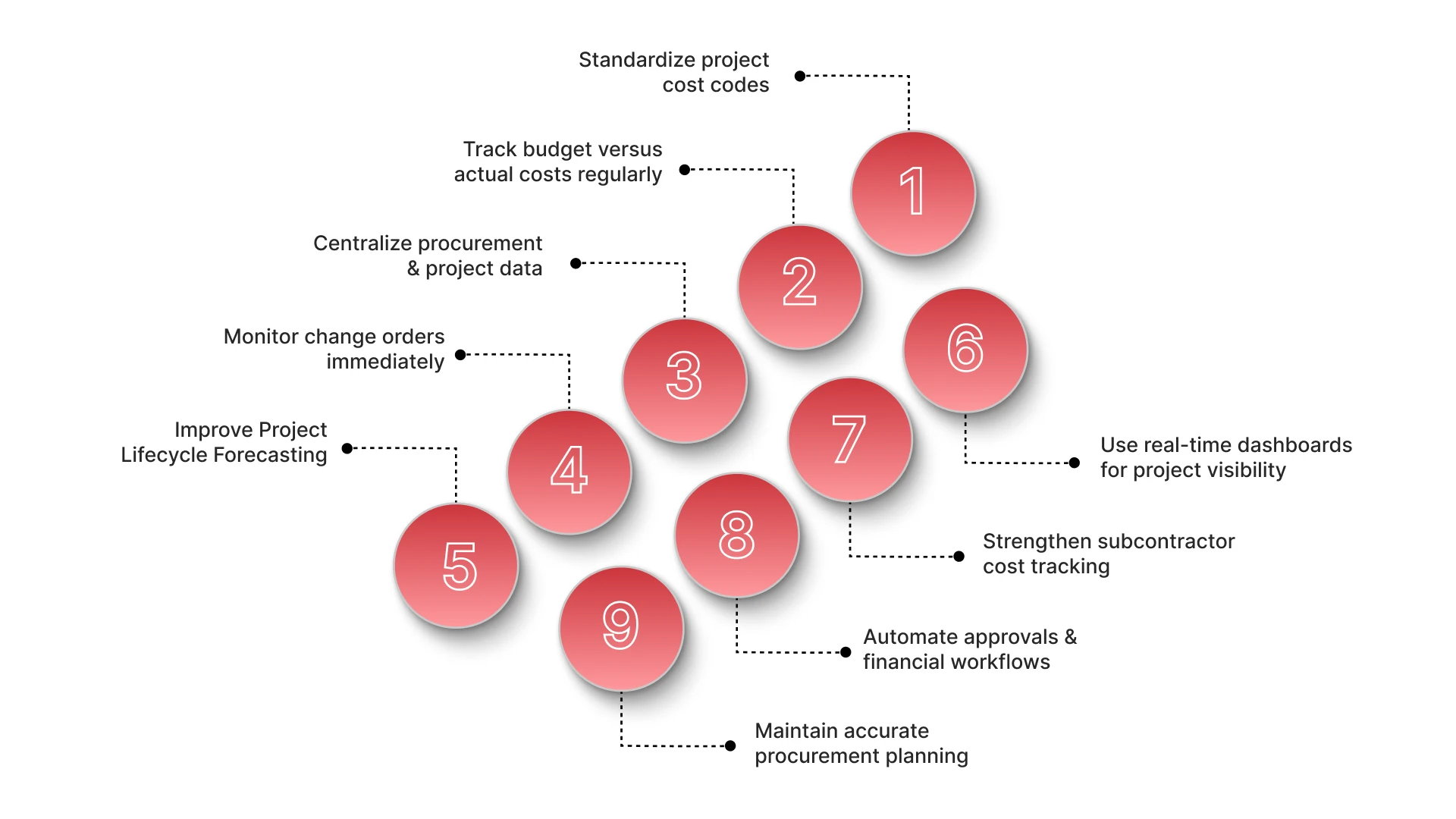
Effective construction cost management requires more than creating a project budget at the beginning of a project. Businesses need consistent processes, real-time visibility, and ongoing financial monitoring to keep projects under control as conditions change during execution.
Below are some practical strategies that help contractors improve cost control and reduce financial risk across projects.
These practices improve visibility across active projects and reduce dependence on disconnected spreadsheets and manual reconciliation.
As projects scale across multiple sites, suppliers, and subcontractors, managing these practices manually becomes increasingly difficult without connected systems.
Managing construction costs through spreadsheets and disconnected systems makes it difficult to track procurement, subcontractors, approvals, and project profitability accurately, especially across multiple sites and ongoing projects. HAL ERP helps contracting businesses bring financial control, project visibility, and operational coordination into one connected platform.
With HAL ERP, construction companies can:
HAL ERP is built for Saudi contracting and project-based businesses managing complex procurement cycles, multi-site execution, subcontractor-heavy operations, and growing compliance requirements.
Construction cost management is no longer just about tracking expenses after they happen. Modern contractors need real-time visibility into budgets, procurement, subcontractors, and project performance to keep projects financially controlled from start to finish.
Without structured cost management, delays, scope changes, and disconnected reporting can quickly reduce profitability across projects.
HAL ERP helps construction businesses centralize project costing, procurement, approvals, subcontractor management, and financial tracking in one connected platform, giving teams better control over costs and project execution.
Book a demo with HAL ERP to simplify construction cost management and improve profitability across your projects.
Many contractors remain operationally busy but lose profitability because procurement overruns, subcontractor costs, delays, and scope changes are not tracked in real time.
Delayed visibility into actual project spending is often the first warning sign. By the time month-end reports arrive, cost overruns may already be difficult to recover.
Spreadsheets create version mismatches, delayed reporting, approval gaps, and fragmented visibility across procurement, finance, subcontractors, and project teams.
Untracked or delayed change orders quietly increase labor, procurement, equipment, and subcontractor costs, reducing project margins over time.
Procurement directly affects material costs, project timelines, supplier coordination, and cash flow, making it one of the biggest drivers of project profitability.
Contractors should review committed and actual spending continuously or at least weekly to identify budget risks before they escalate across the project.
Multiple subcontractors, staggered billing cycles, retention amounts, milestone payments, and site-based execution make manual tracking difficult without centralized systems.
Many businesses operate through disconnected procurement, accounting, and project management systems, which delays financial reporting and cost visibility.
Yes. ERP systems improve visibility across procurement, approvals, subcontractor billing, project budgets, and financial reporting, helping teams identify risks earlier.
Businesses should also monitor procurement commitments, subcontractor liabilities, approved variations, retention amounts, cash flow exposure, and projected final costs throughout execution.