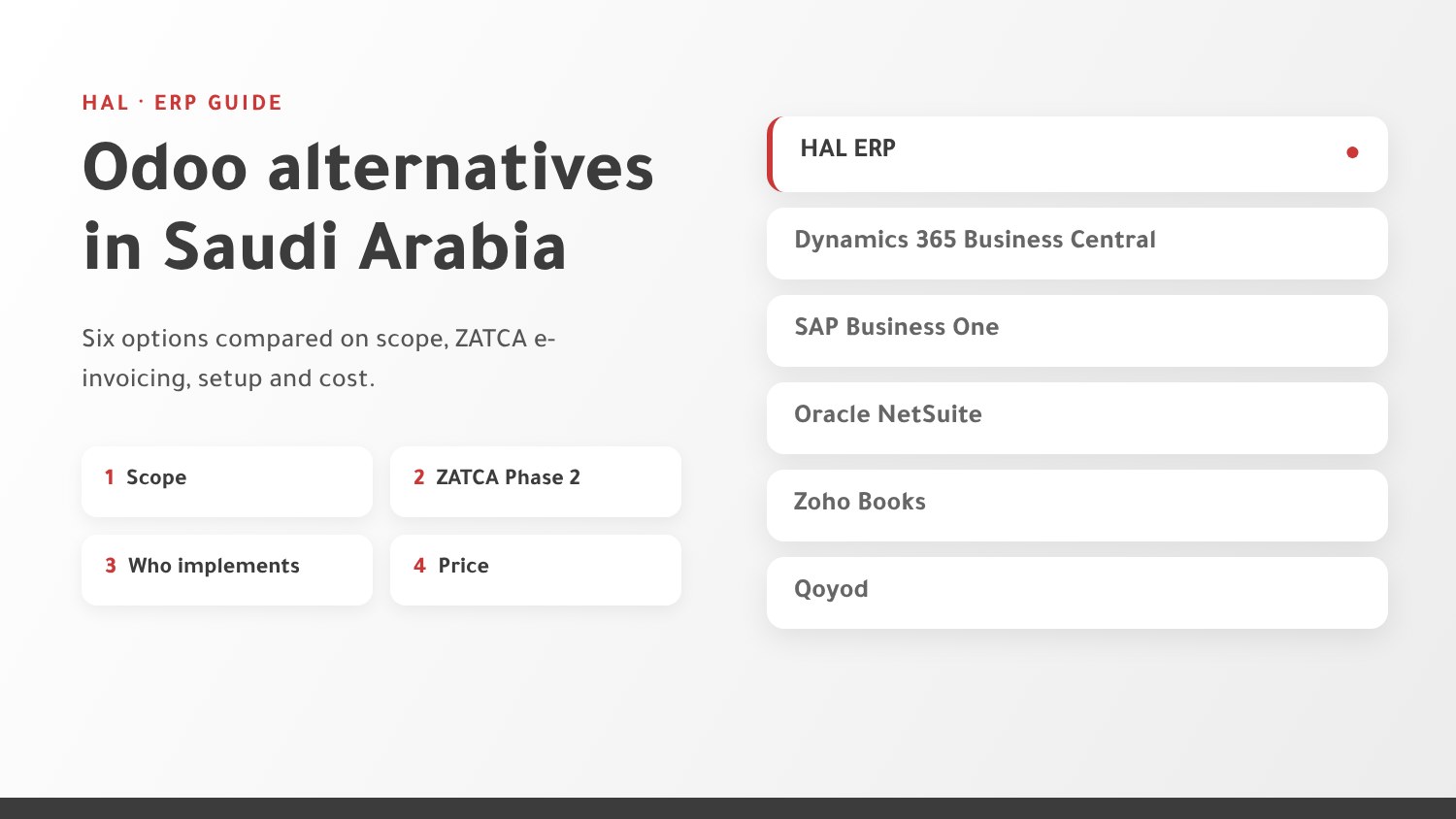
In short: The main Odoo alternatives for Saudi businesses are HAL ERP (a Saudi-focused cloud ERP run by one vendor), Microsoft Dynamics 365 Business Central, SAP Business One, Oracle NetSuite, Zoho Books and Qoyod. Pick by what you need: one accountable vendor and Saudi payroll and e-invoicing out of the box (HAL ERP), the Microsoft ecosystem (Business Central), a large partner network (SAP Business One), multi-country groups (NetSuite), or low-cost accounting only (Zoho Books, Qoyod).
Odoo is popular in Saudi Arabia because its apps are cheap to start with and cover almost everything. Businesses usually look for an alternative for three reasons: they depend on one implementation partner for every change, customisations turn every upgrade into a project and leave them behind on new features, and Saudi requirements such as ZATCA Phase 2, GOSI and Mudad need extra modules and work. This guide compares six alternatives and says when staying on Odoo is the right call.
Odoo's public price list (checked 31 October 2026) starts at about US$25 per user per month on the Standard plan and about US$49 on the Custom plan, billed yearly, with a free plan for a single app. Implementation, Saudi localisation, customisation and support come from an Odoo partner and are quoted separately. That partner cost is usually larger than the licence.
Odoo releases a new major version every year. Odoo 20, released in September 2026, added AI agents that can create and update records. Getting them is simple on a standard database. It is not simple on a customised one.
Most Saudi Odoo projects add custom modules written by the partner: extra fields, approval steps, reports, Saudi payroll rules. Each one becomes a liability at upgrade time. Odoo's own upgrade documentation says a database with custom modules cannot be upgraded until a version of those modules exists for the new release, and that upgrading modules built in-house or by partners is not included in Odoo's upgrade service unless they are under a maintenance contract.
In practice every upgrade becomes a managed project: the partner rewrites and retests the customisations, then moves the data. Many businesses postpone it, so they stay on an older version and miss the new features, including the latest AI.
| At upgrade time | Customised Odoo | HAL ERP |
|---|---|---|
| Who upgrades | Your partner, as a separate project | HAL, as part of the subscription |
| Your customisations | Must be rewritten and retested for each new version | Carried forward by HAL without breaking them |
| New AI features | Available after the partner finishes the upgrade | Available by default with each release, even on customised setups |
| Cost | Partner days for every upgrade | Included; fully managed on the Enterprise plan |
Odoo has one mobile app, called Odoo, on the App Store and Google Play. It opens every module of your database in a single app.
HAL ERP takes the opposite approach: one native app for each job. Today that means HAL CRM, HAL Projects, HAL Subscriptions and HAL Support, with more on the way. A salesperson opens an app built for selling, a project manager one built for projects, and a support agent one built for tickets, instead of the full ERP squeezed onto a phone screen.
| Option | Best for | Who implements | ZATCA Phase 2 | Pricing |
|---|---|---|---|---|
| HAL ERP | Saudi SMEs and mid-sized firms that want one vendor for software, setup and support | HAL's own team | Built in; HAL is listed in ZATCA's Solution Providers Directory | Gold SAR 1,999 per user per year; Platinum from SAR 4,999 a year; HR per employee; Enterprise a bundle of users, so the per-user cost falls as you grow. Support, upgrades and backups included |
| Microsoft Dynamics 365 Business Central | Companies standardised on Microsoft 365 | Microsoft partners | Through a partner's Saudi localisation | Per-user licence plus partner services |
| SAP Business One | Trading and distribution firms that want the SAP name | SAP partners | Through a partner's Saudi localisation | Licence or subscription plus partner services |
| Oracle NetSuite | Groups operating in several countries | Oracle or NetSuite partners | Through localisation or a partner add-on | Annual subscription, quoted per company |
| Zoho Books | Small businesses that need accounting only | Self-service | Included from the Standard plan | From SAR 60 per organisation per month, billed yearly |
| Qoyod | Small Saudi businesses that need accounting and invoicing | Self-service | Included from the Pro plan | About SAR 120 to 330 a month before VAT |
Prices from each vendor's public pricing page or published price lists, checked 1 November 2026. Partner-led products are quoted per project.
HAL ERP is a cloud ERP built for Saudi businesses. One vendor builds the software, implements it and supports it, so there is no partner in the middle. It covers accounting, procurement, inventory, sales, core HR and payroll, POS, projects and CRM, with ZATCA Phase 2 e-invoicing built in. Hala, the AI agent inside HAL ERP, works alongside your team: it answers questions about your numbers, builds reports in Arabic or English and helps you uncover what the data is telling you. HAL looks after every update itself and carries your customisations forward without breaking them, so new features, including the latest AI updates, reach customised setups by default. Its mobile apps are built one per job: HAL CRM, HAL Projects, HAL Subscriptions and HAL Support. The Gold plan is SAR 1,999 per user per year, and Platinum starts from SAR 4,999 a year. The Enterprise plan is a bundle of users rather than a per-user price, and HAL manages your customisations, infrastructure, backups and ZATCA compliance changes for you.
Choose it if you want Saudi payroll, e-invoicing and operations in one system with one accountable team, and upgrades you never have to manage. Look elsewhere if you need a global brand mandated by a parent company abroad.
Business Central is Microsoft's ERP for small and mid-sized companies, sold and implemented through partners. It fits naturally if your company already runs on Microsoft 365, Teams and Power BI.
Choose it if Microsoft is your standard. Watch for partner-dependent Saudi localisation and the cost of add-ons for payroll and e-invoicing.
SAP Business One is SAP's ERP for smaller companies, with a large partner network in the Kingdom. It is strong in trading, distribution and inventory.
Choose it if you want the SAP name and a mature partner. Watch for implementation and add-on costs, and dependence on one partner.
NetSuite is a cloud ERP suited to groups with entities in several countries and consolidated reporting.
Choose it if you run a multi-country group. Watch for annual subscription costs that are high for a single Saudi company.
Zoho Books is low-cost cloud accounting with ZATCA Phase 2 e-invoicing included from its Standard plan. It is accounting, not a full ERP.
Choose it if you are small and need the books only. Look elsewhere if you need payroll, manufacturing, projects or POS in the same system.
Qoyod is a Riyadh-based accounting and invoicing platform with Phase 2 e-invoicing from its Pro plan and a POS add-on. See our Qoyod vs HAL ERP comparison.
If that describes you, switching costs more than it saves. If you are waiting weeks for partner changes or stuck on an old version, it is worth comparing.
It depends on what you need. HAL ERP fits Saudi SMEs that want one vendor and Saudi payroll and e-invoicing built in; Business Central fits Microsoft-centred companies; NetSuite fits multi-country groups; Zoho Books and Qoyod fit small businesses that need accounting only.
Odoo supports Saudi e-invoicing through its Saudi localisation, usually configured by a partner. Check that Phase 2 integration is set up and tested in ZATCA's simulation environment before go-live.
Not automatically. Odoo's documentation says a database with custom modules cannot be upgraded until those modules have a version for the new release, and upgrading modules built by partners is not part of Odoo's upgrade service unless they are under a maintenance contract. Your partner has to rewrite and test them for each new version.
Master data and opening balances move as of a cut-over date, usually the start of a month or quarter. Plan for one parallel closing before switching off Odoo.