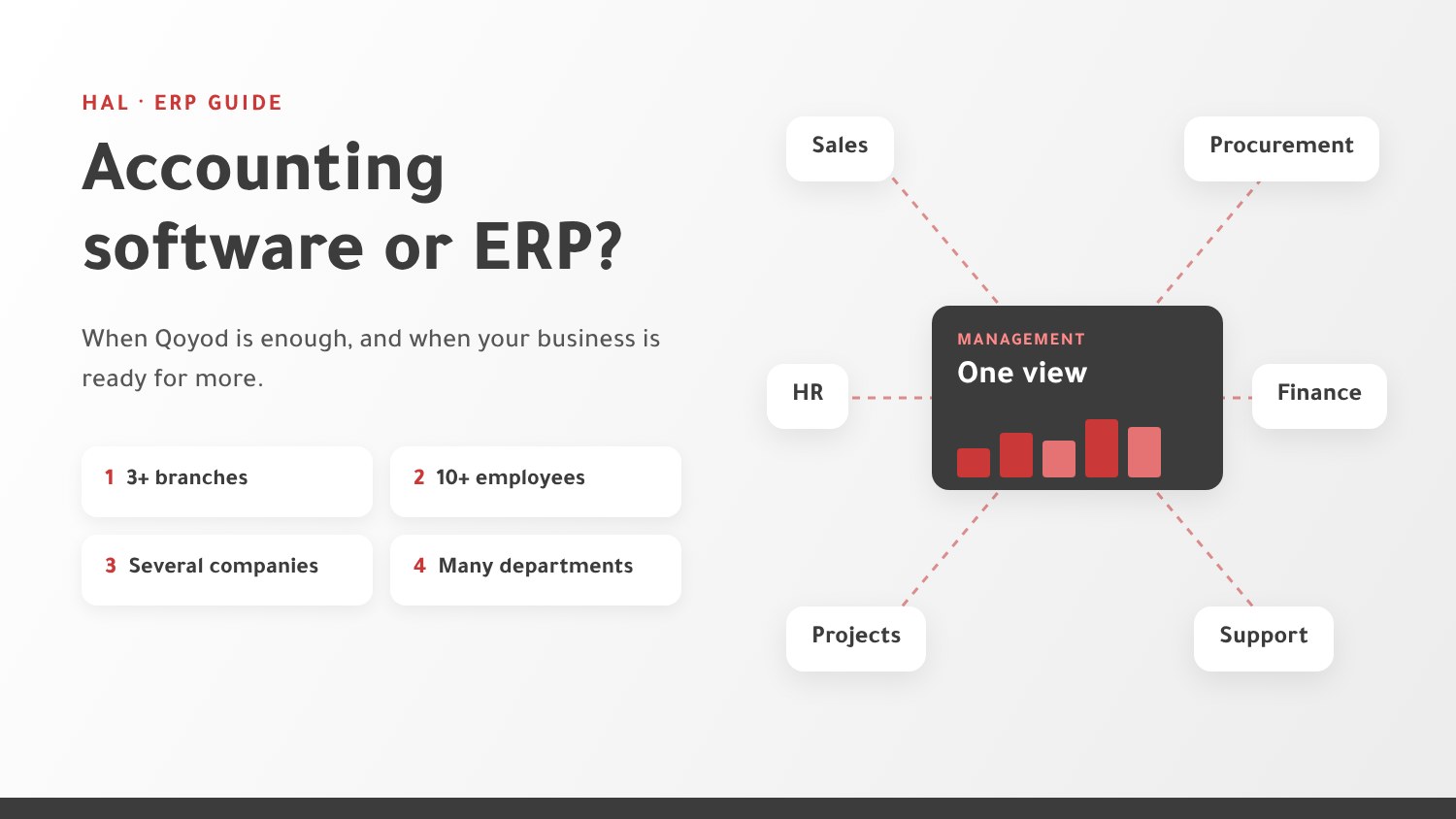

In short: Qoyod is cloud accounting software. It is a good fit for freelancers, solopreneurs and very small businesses that need ZATCA-compliant invoices and simple bookkeeping, often with an external bookkeeper keeping the books. An ERP such as HAL ERP is what a business needs once different teams run different departments and management needs to see all the numbers together. That point usually comes at 3 or more branches, 10 or more employees, more than one company, or projects and budgets to control.
Many Saudi businesses start on accounting software, and that is the right choice at the start. The question is when it stops being enough. This guide explains the difference between accounting software and an ERP, the signs your business is ready for one, and how Qoyod and HAL ERP compare.
Qoyod is accounting software. It is built for invoicing, expenses, VAT, basic inventory and ZATCA e-invoicing, with a POS add-on. Its users are usually the owner and a bookkeeper. It is not designed to run sales, procurement, HR, projects or support as separate departments.
Accounting software records what has already happened: invoices issued, bills paid, expenses spent. Its job is to keep the books correct and compliant.
An ERP (enterprise resource planning system) runs the work that creates those numbers. Sales, procurement, inventory, HR, projects, production and support each work in their own app, and every transaction flows into one set of accounts. Management sees the whole business in one place instead of collecting spreadsheets from every department.
| Accounting software (e.g. Qoyod) | ERP (e.g. HAL ERP) | |
|---|---|---|
| Main job | Keep the books and issue compliant invoices | Run every department and give management one view of the business |
| Typical users | Owner and bookkeeper | Finance, sales, procurement, HR, projects, operations, support and management |
| Best fit | Freelancers, solopreneurs, very small businesses | Mid-market businesses with branches, departments and teams |
| Approvals | Simple | Multi-level approval workflows by amount, department and branch |
| Reporting | Standard financial reports | Department and management dashboards, consolidated across companies |
Accounting software is enough while one person can see the whole business. You are ready for an ERP when that stops being true. The usual signs:
When sales, procurement, HR, projects and support work in separate tools, every management meeting starts with "whose numbers are right?". In an ERP, each team works in its own app, and every action posts to the same accounts. Management sees revenue, costs, cash, stock and people together, by company, branch, department or project, and decides on today's numbers rather than last month's.
HAL ERP routes approvals through multi-level workflows: a purchase request can go to the department head, then finance, then the general manager, depending on amount, department or branch. Approvers act in HAL ERP on the web or mobile, or with one tap on WhatsApp. Every approval is recorded with who approved, when and why.
A department raises a purchase request; it moves through approvals; procurement converts it into a purchase order; the warehouse records the goods receipt; the vendor's purchase invoice is matched and paid. Each step is linked, so you can trace any payment back to the request that started it.
Sales tracks every lead in the CRM, moves it through the pipeline to a closed deal, then to quotation, sales order, delivery and invoice. Finance follows up collections with customer statements and receivables ageing. Hala, the AI agent in HAL ERP, scores deal health and suggests next steps.
Accounting software treats every business the same. HAL ERP comes with workflows for each industry, so operations run the way the business actually works:
With every department in one system, HAL ERP's dashboards and Hala, its AI agent, answer the questions management actually asks, in Arabic or English:
| Qoyod | HAL ERP | |
|---|---|---|
| Category | Accounting and invoicing software | Mid-market ERP |
| Best fit | Freelancers, solopreneurs and very small businesses | Businesses with 3+ branches, 10+ employees or several departments |
| Branches and companies | One business, a few locations | Multiple branches and companies, with group consolidation |
| Budgets and project costing | Not its focus | Budgets against actuals, cost centres, project and job costing |
| Department apps | Accounting, invoicing, basic inventory; POS as an add-on | CRM, procurement, inventory, HR and payroll, project management, support desk, maintenance, POS, fleet and facilities |
| Industry workflows | General | Contracting, retail, manufacturing, education, services and more |
| Approvals | Simple | Multi-level workflows, approved on web, mobile or WhatsApp |
| Reporting and AI | Standard financial reports | Department and management dashboards; Hala AI insights in Arabic and English |
| ZATCA e-invoicing | Phase 1 on Basic; Phase 2 from the Pro plan | Phase 2 built in; HAL is listed in ZATCA's Solution Providers Directory |
| Price | About SAR 120 (Basic), 180 (Pro) and 330 (Advanced) a month before VAT | Gold: SAR 1,999 per user per year. Platinum: from SAR 4,999 a year. HR: per employee, by headcount. Enterprise: a bundle of users quoted on requirements, so the per-user cost falls as you grow |
| Setup | Self-service sign-up | Guided implementation by HAL's team, with weekly progress showcases |
Qoyod prices are list prices published in third-party pricing guides in September 2026 and can change; check qoyod.com for current offers. HAL ERP prices from HAL's pricing page. Last checked: 1 November 2026.
Most businesses move when they open a third branch, pass ten employees or start running projects. A typical move takes these steps:
No. Qoyod is accounting and invoicing software for freelancers and very small businesses. An ERP such as HAL ERP runs every department, from sales and procurement to HR, projects and support, on one set of numbers.
Accounting software keeps the books and issues compliant invoices. An ERP runs the departments that create those numbers and gives management one view of the whole business.
Usually when it has 3 or more branches, 10 or more employees, more than one company to consolidate, budgets to control, projects to cost, or departments that need their own apps and approvals.
When a business outgrows accounting software, the next step is an ERP. HAL ERP is built for Saudi mid-market businesses, with industry workflows, multi-level approvals, dashboards and ZATCA Phase 2 e-invoicing.
Yes. On Qoyod, Phase 2 e-invoicing is included from the Pro plan. HAL ERP includes it, and HAL is listed in ZATCA's Solution Providers Directory as a Phase 2 qualified provider.