

In short: A valid promissory note template for Saudi Arabia contains the seven elements required by Article 87 of the Commercial Papers Law: the words "promissory note" (سند لأمر) in the body, an unconditional promise to pay a fixed sum, the maturity date, the place of payment, the payee's name, the date and place of issue, and the maker's signature. Since the new Enforcement Law took effect on 28 October 2026, a promissory note is an enforcement instrument only if it is registered on a national electronic platform such as Nafith. Below: the format, how to fill each field, the accounting entries with a food distributor example, and a free kit with the template in Word and PDF and an Excel register to track your notes.
Thursday, month-end. The credit manager of a food distributor in Jeddah approves a shipment to a new restaurant group on 90-day terms, on one condition: the group signs a promissory note for the invoice value. The accountant goes looking for a template and finds dozens of versions. Some have no place of payment, some add a late-payment interest clause, and some make payment conditional on "goods received in good condition". Three months later everyone discovers that the note in the drawer is not enough, on its own, for direct enforcement.
This guide answers the questions a finance team asks in that situation. What makes a document a promissory note under Saudi law? How should each field be filled? When is a paper template enough, and when must the note be issued through Nafith? How is the note booked and followed up until it is collected?
> This is general information, not legal advice; consult a lawyer before relying on any note in a dispute.
A promissory note (سند لأمر) is a commercial paper in which one party (the maker, or debtor) promises to pay a fixed sum of money to another party (the payee, or creditor) or to their order, on a set date or on sight. It is governed by Part Two of the Commercial Papers Law, issued by Royal Decree No. 37 dated 11/10/1383H (Articles 87 to 90). The rules on bills of exchange apply to it as far as they fit its nature (Article 89), and the maker is bound in the same way as the acceptor of a bill of exchange (Article 90).
In companies, promissory notes come up in three recurring situations:
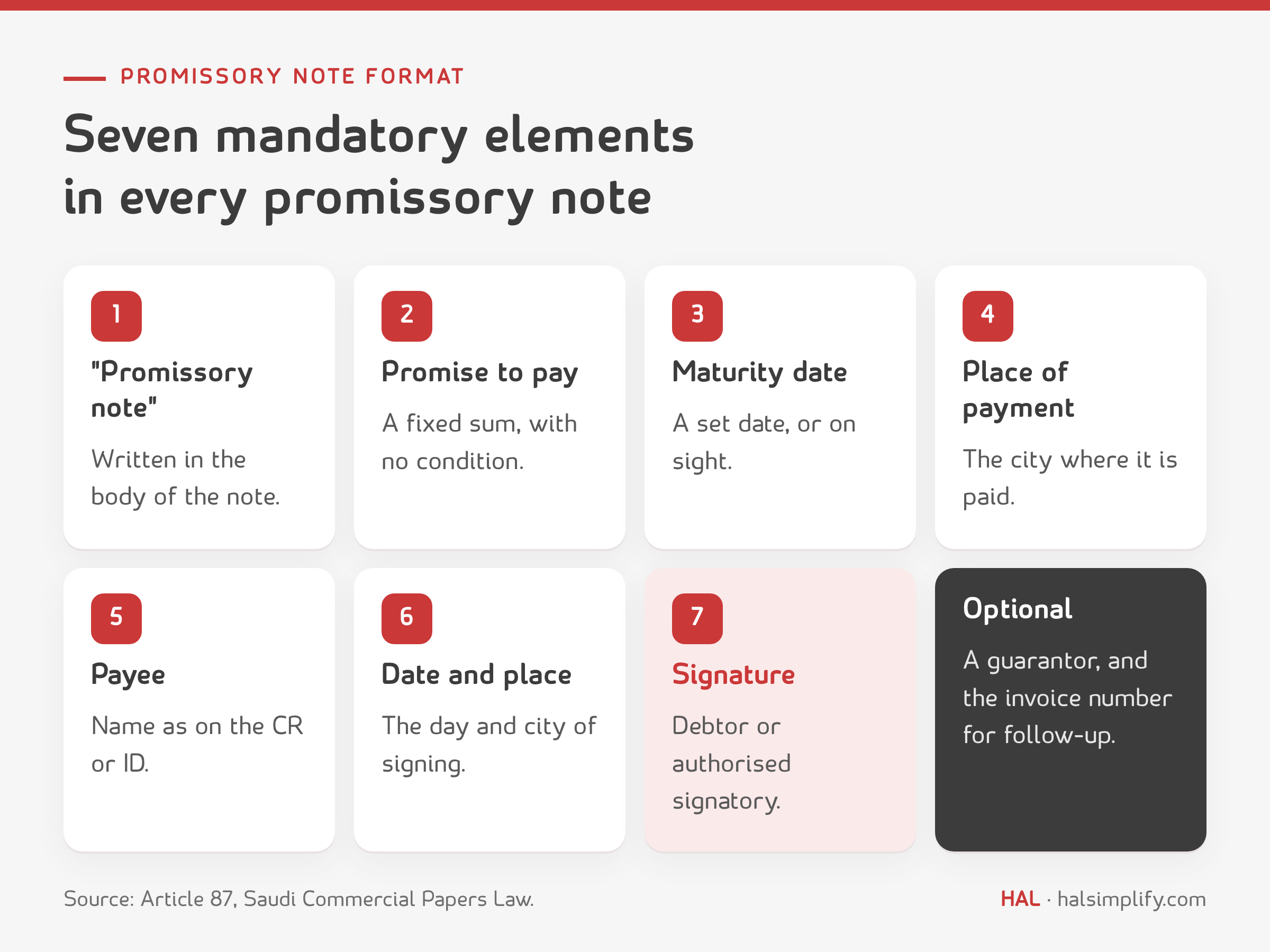
Article 87 of the Commercial Papers Law lists seven elements a promissory note must contain:
| # | Element | What it means in practice |
|---|---|---|
| a | The order clause or the words "promissory note" | Written in the body of the note, in the language of the note, not only in the heading. |
| b | An unconditional promise to pay a fixed sum of money | "I promise to pay", with no "if" or "provided that". |
| c | Maturity date | A specific date, or "on sight". |
| d | Place of payment | The city where the sum is to be paid. |
| e | Name of the person to whom, or to whose order, payment is made | The payee's name as on their commercial registration or ID. |
| f | Date and place of issue | The day and the city where it was signed. |
| g | Signature of the maker | The debtor, or the authorised signatory for a company. |
Article 88 says a note missing any of these elements is not a promissory note, except in three cases where the law fills the gap itself:
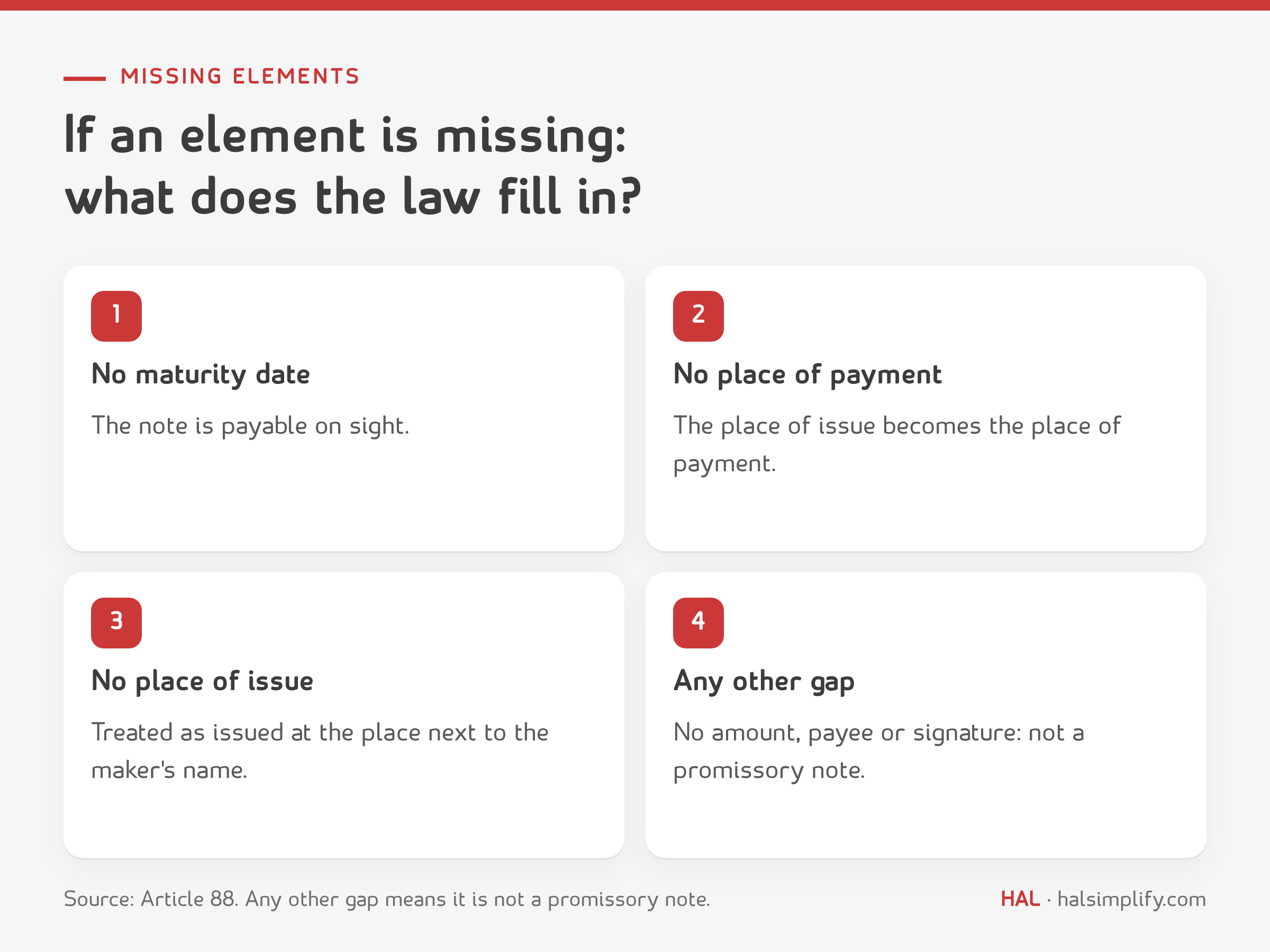
Leaving out the words "promissory note", the amount, the payee's name or the signature, or making payment conditional, means the document is not a promissory note. It may still be evidence of a debt, but it is not treated as a commercial paper.
This is the core wording the template in the kit uses:
> Promissory note — I, the undersigned, promise to pay under this promissory note, without any restriction or condition, to the order of (payee name) the sum of (amount in figures) Saudi riyals (amount in words) on (maturity date) in the city of (place of payment). Issued in the city of (place of issue) on (date of issue).
| Field | How to fill it | Common mistake |
|---|---|---|
| Note number | An internal serial number that links it to the notes register | Using the same number twice |
| Amount in figures and words | The same amount both ways; if they differ, the amount in words prevails (Article 5, applied to notes by Article 89) | "115 thousand" in words and 115,500 in figures |
| Maturity date | A specific Gregorian or Hijri date, or "on sight" | "Within three months" with no date |
| Place of payment | The city | Leaving it blank |
| Payee | The name as on the commercial registration, with the unified national number | A short trading name |
| Maker (debtor) | Name, ID or CR number, and address | First name only |
| Signature | The debtor, or the authorised signatory with the company stamp and title | Signed by an employee without authority |
| Guarantor (aval, optional) | Name, ID number and signature under "guarantor" | Not stating who is guaranteed; the guarantee is then for the maker (Article 89(b)) |
| Invoice reference (optional) | Invoice or contract number for internal follow-up | Wording that ties payment to contract performance and makes the promise conditional |
Do not add an interest clause. Article 89 applies the bill-of-exchange rule that an interest clause is void. Keep a copy of the signed note and enter it in the notes register the same day.
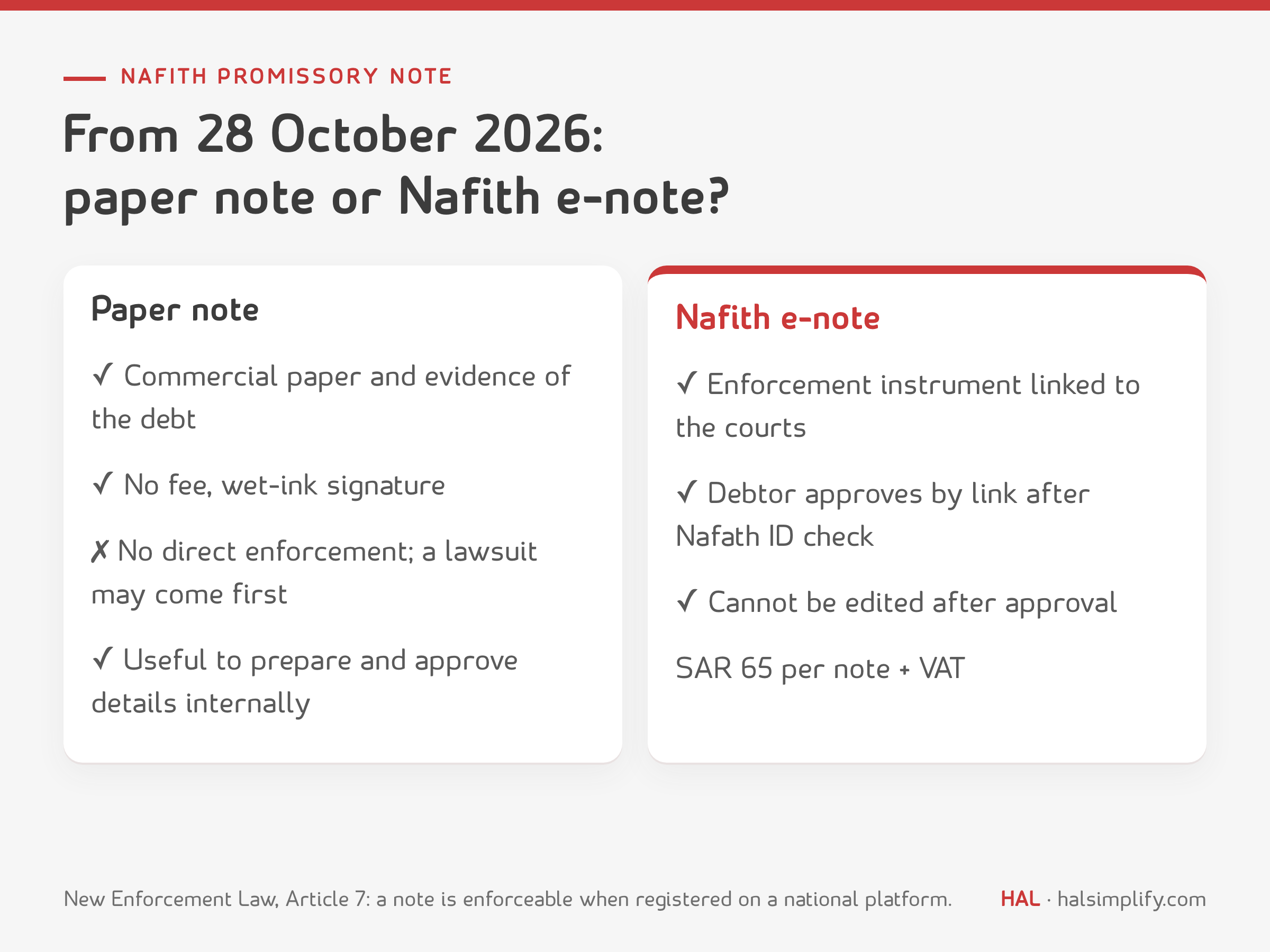
This is the most important change in 2026. The new Enforcement Law was issued by Royal Decree No. M/237 dated 3/11/1447H and takes effect 180 days after publication (Article 65), that is from 28 October 2026. Article 7 says bills of exchange and promissory notes are enforcement instruments "when registered on the national electronic platforms", while cheques remain enforcement instruments without that condition.
| Paper note | Nafith e-note | |
|---|---|---|
| Status | Commercial paper and evidence of the debt | Promissory note registered on a national platform |
| Enforcement | Not accepted for direct enforcement under the new law; the creditor may first need a lawsuit | Enforcement instrument presented to the Enforcement Court |
| Signature | Wet ink | Electronic approval after identity verification through Nafath |
| Changes | Possible, and they weaken the note | Not possible after approval; only the creditor can cancel |
| Cost | No fee | SAR 65 per note + VAT (published platform fee) |
Published legal analyses say paper notes issued before 28 October 2026 are expected to remain directly enforceable for a one-year transitional period, and that they are best replaced with electronic notes when renewed. Ask your lawyer about your existing notes.
Nafith is a government platform of the Ministry of Justice for issuing and documenting promissory notes and linking them electronically to the enforcement courts. According to its FAQ:
Nafith also offers a "multiple note": a set of notes with different maturity dates, each enforceable separately, which suits debt rescheduling.
So when is the paper template useful? To prepare, review and approve the note's details internally before issuing it on Nafith, to document small or internal obligations you do not intend to enforce directly, and when one of the parties cannot use the platform. It does not replace Nafith if you want an enforcement instrument.
| Promissory note | Bill of exchange | Cheque | |
|---|---|---|---|
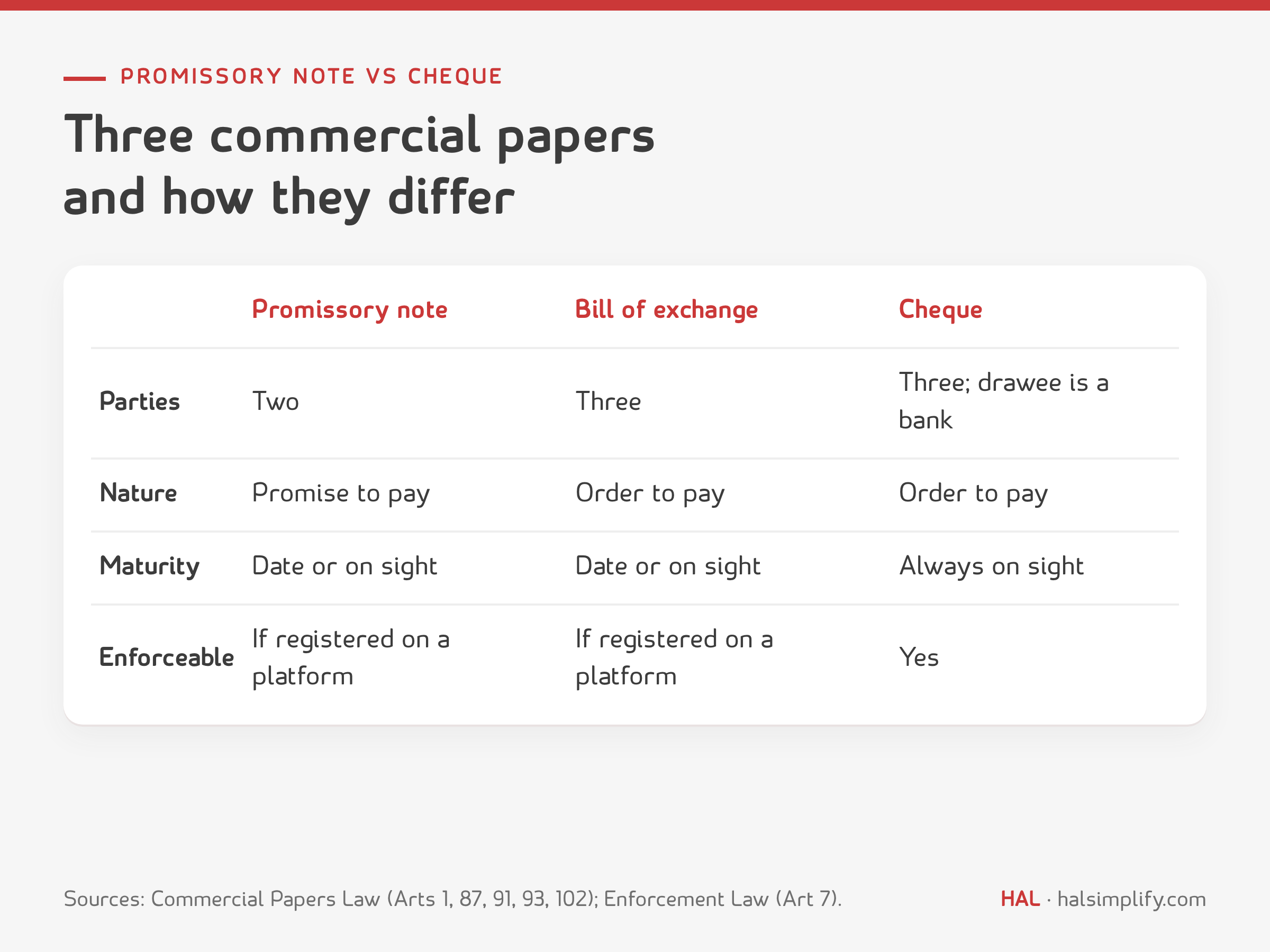
| Parties | Two: maker and payee | Three: drawer, drawee and payee | Three, and the drawee must be a bank (Article 93) |
| Nature | A promise to pay | An order to pay | An order to pay |
| Maturity | A date or on sight | A date or on sight | Always on sight (Article 102) |
| Mandatory elements | Article 87 | Article 1 | Article 91 |
| Enforcement after 28 October 2026 | Enforcement instrument if registered on a national platform | Enforcement instrument if registered on a national platform | Enforcement instrument |
| Common use | Credit sales, rescheduling, security | Trade between companies, letters of credit | Immediate payment |
Because a cheque is payable on sight, a "post-dated cheque" is paid if presented before its date (Article 102), and the law penalises issuing a cheque without funds in bad faith (Article 118). That is why many suppliers prefer a promissory note for credit sales.
A promissory note does not create a new debt. It changes the form of the existing debt from "accounts receivable" to "notes receivable" for the creditor, and from "accounts payable" to "notes payable" for the debtor. Keeping the accounts separate lets the aging report show debts secured by notes apart from the rest.
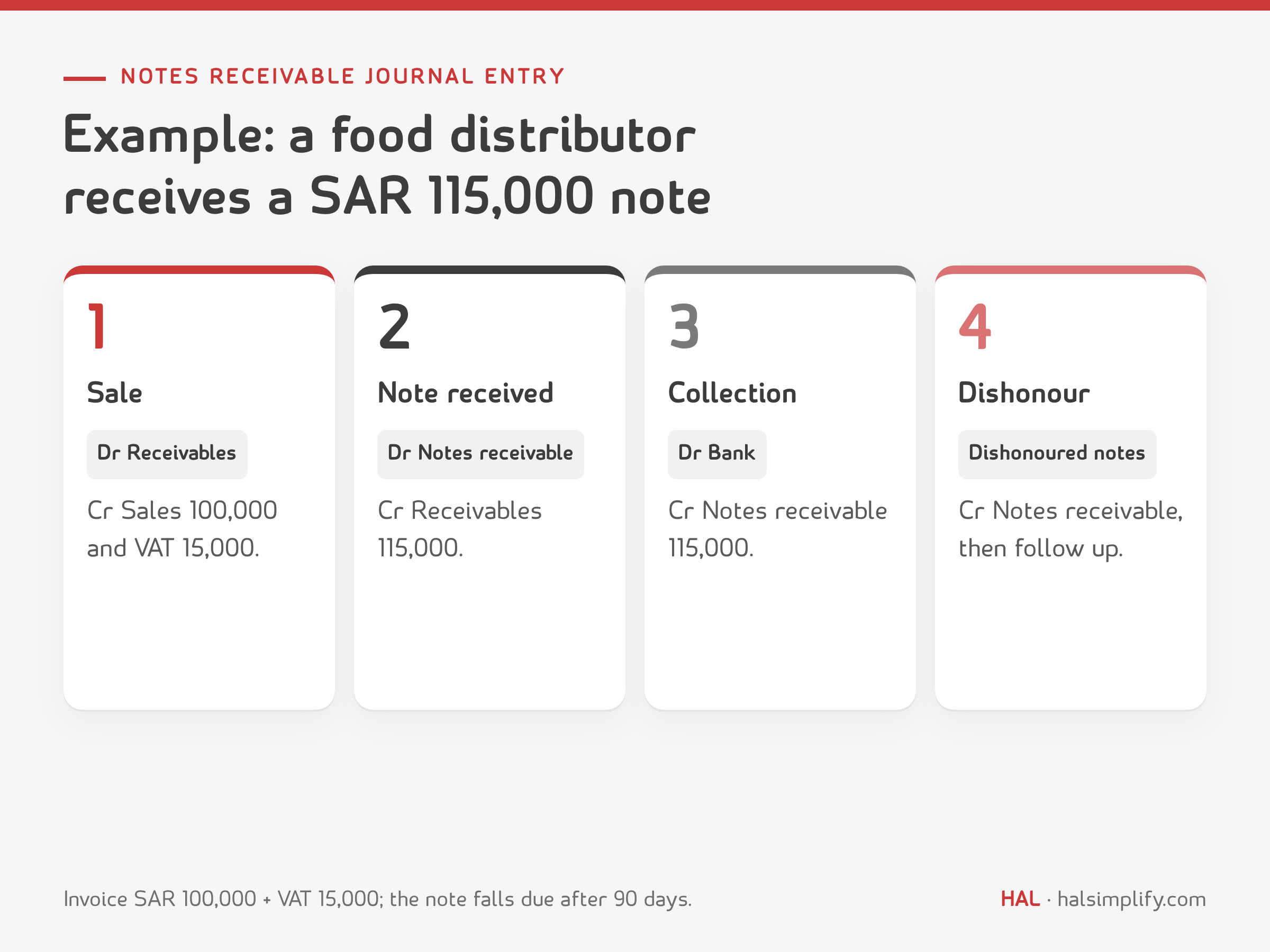
A food distributor in Jeddah sells a shipment to a restaurant group in Riyadh on 10 November 2026 for SAR 100,000, plus 15% VAT (SAR 15,000), so the invoice is SAR 115,000. The group signs a promissory note through Nafith for SAR 115,000, due on 8 February 2027 (90 days later).
At the distributor (creditor, holder of the note):
| Date | Entry | Debit (SAR) | Credit (SAR) |
|---|---|---|---|
| 10 Nov 2026 | Credit sale: Dr Accounts receivable; Cr Sales and Cr VAT payable | 115,000 | 100,000 + 15,000 |
| 10 Nov 2026 | Note received: Dr Notes receivable; Cr Accounts receivable | 115,000 | 115,000 |
| 10 Nov 2026 | Nafith fee: Dr Bank and admin charges 65 and Dr Input VAT 9.75; Cr Bank | 74.75 | 74.75 |
| 8 Feb 2027 | Collection: Dr Bank; Cr Notes receivable | 115,000 | 115,000 |
| If unpaid | Dishonour: Dr Dishonoured notes receivable (or Accounts receivable); Cr Notes receivable | 115,000 | 115,000 |
At the restaurant group (debtor, maker of the note):
| Date | Entry | Debit (SAR) | Credit (SAR) |
|---|---|---|---|
| 10 Nov 2026 | Purchase: Dr Inventory 100,000 and Dr Input VAT 15,000; Cr Accounts payable | 115,000 | 115,000 |
| 10 Nov 2026 | Note issued: Dr Accounts payable; Cr Notes payable | 115,000 | 115,000 |
| 8 Feb 2027 | Payment: Dr Notes payable; Cr Bank | 115,000 | 115,000 |
VAT is recorded with the invoice, not with the note, and the note covers the gross amount including VAT because that is the amount actually owed. The notes receivable balance (SAR 115,000) sits in current assets until it is collected.
If your company tracks dozens of notes like this in spreadsheets, compare that effort with a system that produces aging reports automatically: see HAL ERP plans and pricing.
A note nobody follows up ages in the drawer. Article 84 says a claim against the acceptor of a bill of exchange is not heard after three years from maturity, and the maker of a promissory note is bound as an acceptor (Article 90). Nafith states that a dated note is valid for three years from its maturity date. A credit team therefore needs a fixed routine:
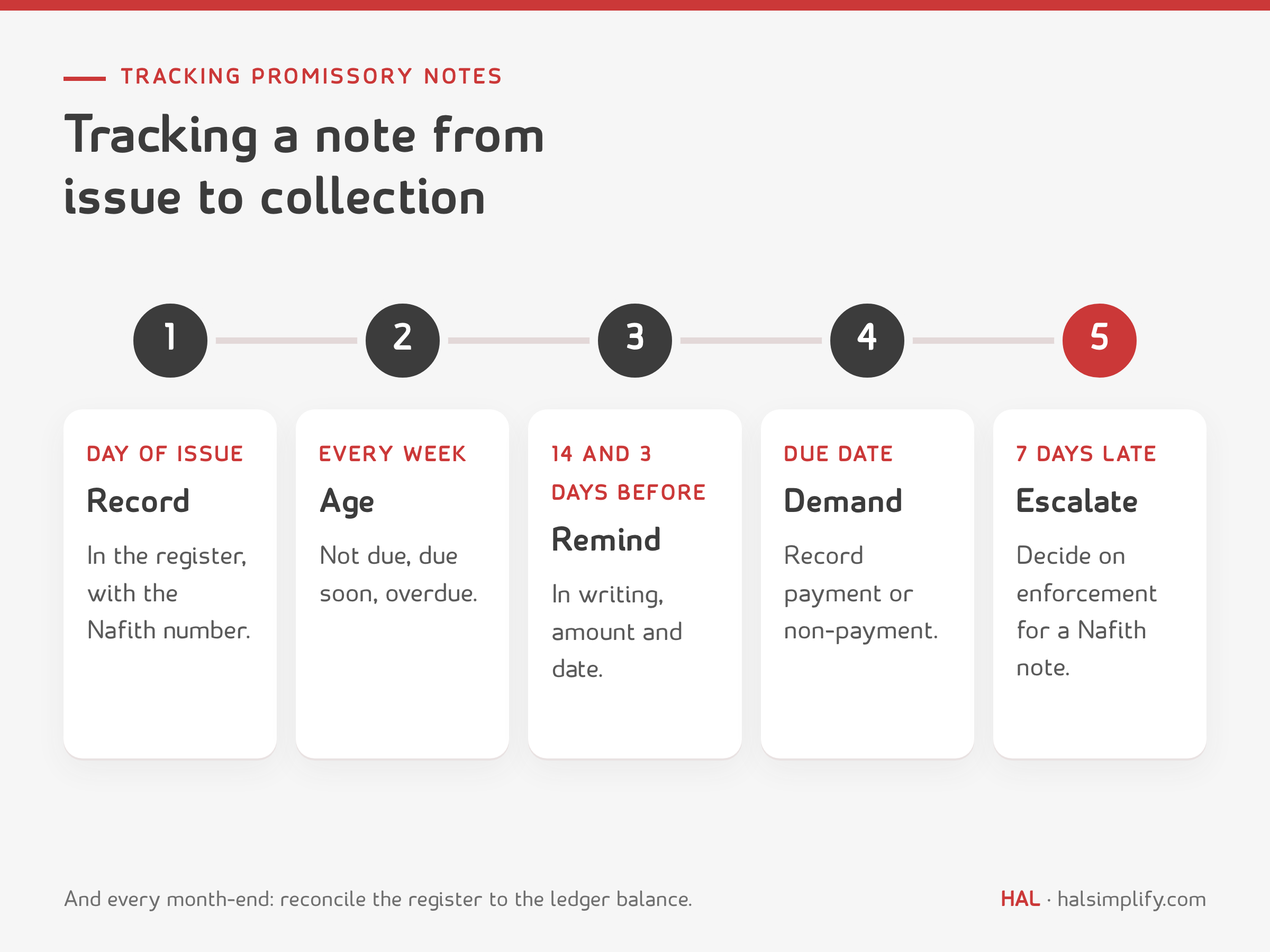
The debtor runs the same routine on notes payable so that a maturity never arrives unplanned in the cash flow.
The kit gives a finance team what it needs to use this article tomorrow:
An Excel register is a good start. But once notes are part of dozens of credit invoices each month, the slowest part is matching the register to customer accounts and reminding each customer on time. In HAL ERP an AI agent follows up invoices on your behalf so you never miss a due date, and payments are linked to your bank accounts by importing bank statements. The plans include customer receivables age analysis, vendor payables age analysis and customer and vendor statements of account, as listed on the pricing page. For more on managing balances, read our guides to accounts receivable and accounts payable.
Seven elements under Article 87 of the Commercial Papers Law: the words "promissory note" in the body, an unconditional promise to pay a fixed sum, the maturity date, the place of payment, the payee's name, the date and place of issue, and the maker's signature.
A paper note remains a commercial paper and evidence of the debt, but the Enforcement Law in force from 28 October 2026 makes a promissory note an enforcement instrument only when it is registered on a national electronic platform such as Nafith. Legal analyses describe a transitional period for earlier paper notes; check it with your lawyer.
According to Nafith's FAQ: SAR 65 per note, SAR 25 for each guarantor or signatory added, plus VAT. Company registration costs SAR 2,000 a year. Fees may change, so check the platform before issuing.
Article 89 of the Commercial Papers Law applies the bill-of-exchange rule that an interest clause is void, so the template contains no interest clause. Write the amount actually owed, including VAT if the note covers an invoice.
Debit notes receivable and credit accounts receivable for the note amount; on collection, debit bank and credit notes receivable. At the debtor: debit accounts payable and credit notes payable, then debit notes payable and credit bank on payment.
Yes. Enter your name and work email in the form above to receive the kit: an English Word template, a PDF guide with two printable notes and a filled example, and an Excel register to track your notes.
