

Saudi Arabia does not impose individual income tax on employment earnings, but that does not mean the Kingdom is tax-free.
Businesses operating in Saudi Arabia may need to account for several different regimes, including corporate income tax, Zakat, VAT, withholding tax, excise tax, Real Estate Transaction Tax (RETT), customs duties, and e-invoicing requirements.
Which rules apply depends on factors such as ownership, residency, business activity, transaction type, annual taxable supplies, and whether payments are made to non-residents.
Saudi Arabia’s tax framework also continues to evolve. In 2026, businesses are dealing with further expansion of ZATCA’s FATOORAH Phase Two rollout, a new excise-tax methodology for sweetened beverages, and revised White Land Fee rules.
This guide provides a practical overview of the main Saudi tax regimes and explains which businesses and transactions they generally affect.
For current tax laws, regulations and guidance, businesses should refer directly to the Zakat, Tax and Customs Authority (ZATCA).
In Saudi Arabia’s changing business world, tax is no longer just something your accountant handles; it's something every business leader must understand. Here's why:
Understanding and following Saudi tax rules helps you avoid penalties and access opportunities like tax incentives for businesses in manufacturing, tech, and logistics. Compliance builds trust with regulators and your industry, while non-compliance can lead to fines and legal issues.
Now, let’s explore the various types of taxes in Saudi Arabia one by one. We'll start by focusing on personal taxes, which play a key role for both citizens and expatriates.
Saudi Arabia currently has no individual income-tax regime.
Employment income such as salaries and wages earned by individuals in Saudi Arabia is therefore not subject to personal income tax. Non-employment or business income can, however, fall within Saudi tax rules depending on how the activity is structured and the person’s residency or permanent-establishment status.
Employers should distinguish income tax from social-insurance obligations administered by the General Organization for Social Insurance (GOSI).
Applicable contribution rates depend on factors including:
For example, GOSI’s new system applies to new entrants who had no prior contribution periods before July 3, 2024. Under that framework, pension contribution rates are being increased progressively, while occupational-hazard and SANED contributions have their own rates and allocation between employer and employee.
Businesses should therefore use the current GOSI contribution schedule rather than relying on one blanket payroll percentage.
There is no separate Saudi personal income-tax rate simply because someone works as a freelancer.
However, the tax treatment depends on how the activity is legally structured, residency, source of income and whether the activity creates a taxable business or permanent establishment.
Non-residents receiving qualifying Saudi-source income without a Saudi permanent establishment may instead fall within the Saudi [withholding-tax rules.
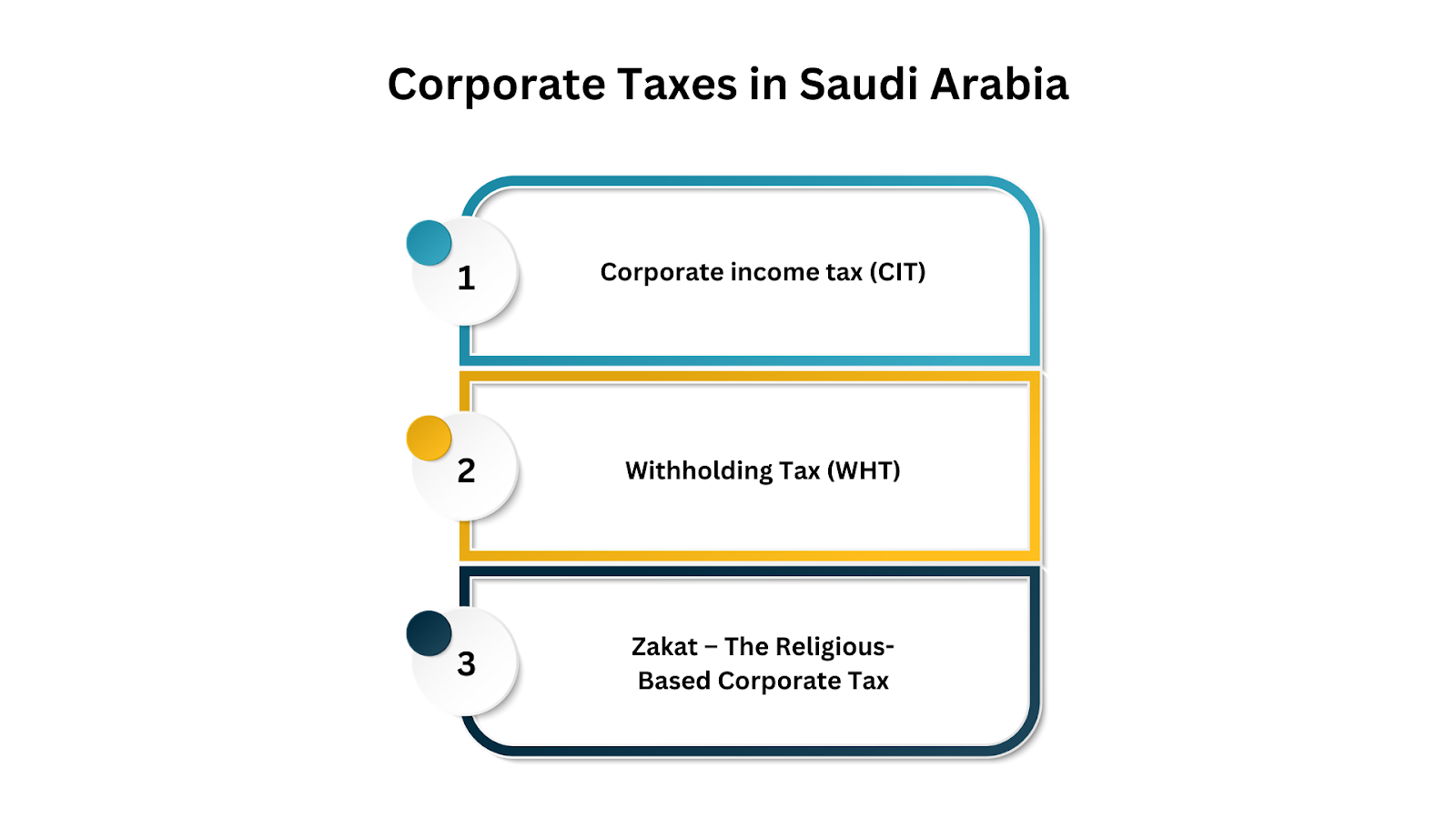
Corporate tax rates in Saudi Arabia are generally straightforward, with a flat tax rate applied to most businesses. However, there are variations depending on the type of business and ownership.
Saudi corporate taxation depends heavily on ownership.
In general:
The standard corporate income-tax rate is generally 20% of the relevant tax base. Different rates apply to oil and hydrocarbon production activities, while natural-gas investment is generally taxed at 20%.
Suppose a Saudi company is:
The company should not simply calculate:
2.5% Zakat × 60% of net profit.
Instead:
The two regimes have different bases and therefore cannot be calculated by simply applying two percentages to the same accounting profit. ZATCA confirms that mixed establishments apply Zakat to the qualifying Saudi ownership portion and income tax to the non-Saudi portion.
Saudi Arabia offers specific tax incentives under certain approved programs and structures, but businesses should not assume that an industry automatically qualifies for a lower tax rate.
For example, qualifying entities licensed under Saudi Arabia’s Regional Headquarters (RHQ) program may receive specific corporate income-tax and withholding-tax incentives for eligible activities, subject to the conditions of the RHQ Tax Rules.
Businesses considering an incentive should review the relevant program rules and obtain advice based on the proposed investment structure rather than relying on a general industry exemption.
Saudi withholding tax generally applies when qualifying Saudi-source amounts are paid to a non-resident that does not have a Saudi permanent establishment to which the income is attributable.
The classification of the payment determines the domestic rate.
ZATCA’s current guideline also gives specific treatment for software, telecommunications, freight, services and other categories, so the commercial name written on an invoice should not be used as the only basis for selecting the WHT rate.
An applicable double-tax treaty may reduce or eliminate the domestic rate when the treaty conditions and ZATCA procedures are satisfied.
For a detailed explanation, see [Understanding Withholding Tax in Saudi Arabia]()
Zakat is administered by ZATCA under the Saudi Zakat regulations and generally applies to qualifying Saudi/GCC ownership interests.
For an account-based Zakat payer, the standard rate is generally 2.5% of the applicable Zakat base, subject to the detailed rules in the current Implementing Regulation for Zakat Collection.
The Zakat base is not simply total current assets or a percentage of accounting profit.
The calculation requires determining the amounts that must be added to and deducted from the base under the Zakat regulations. The rules address items such as financing sources, fixed assets and equivalents, investments, liabilities, adjusted profit and other specific treatments.
ZATCA’s current rules also provide that the calculated Zakat base generally cannot be lower than the adjusted profit used for Zakat purposes.
Because the calculation depends on the company’s balance sheet, ownership and specific adjustments, businesses should prepare the Zakat return using the current Implementing Regulation for Zakat Collection rather than applying 2.5% directly to net income.

In addition to corporate and income taxes, Saudi Arabia imposes several other taxes that you need to be aware of. These taxes impact everything from your pricing to property deals and imports. Let’s explore them:
Saudi Arabia applies a standard VAT rate of 15% to taxable supplies unless a specific zero-rate, exemption, or out-of-scope treatment applies.
Businesses and individuals carrying on an economic activity generally must register when annual taxable supplies exceed SAR 375,000.
Voluntary registration can generally be available from SAR 187,500, subject to the applicable requirements.
ZATCA currently requires:
Avoid describing whole industries such as healthcare, education, or financial services as simply “VAT exempt.”
Treatment depends on the specific supply.
For example:
Businesses should therefore classify the transaction rather than assigning VAT treatment solely from the industry name.
Saudi Arabia imposes excise tax on specified goods such as tobacco products, energy drinks, electronic-smoking products and sweetened beverages.
A major change took effect on January 1, 2026.
Saudi Arabia replaced the previous fixed 50% methodology for sweetened beverages with a tiered volumetric system based on the total sugar content in the drink.
The applicable amount now depends on which sugar-content tier the product falls into rather than simply applying a flat 50% percentage to the retail price.
Businesses producing or importing excisable goods should therefore use ZATCA’s current excise-tax rules and sweetened-beverage guidance instead of older rate tables.
Other excisable product categories continue to be governed by their applicable product-specific rules.
Saudi Arabia imposes Real Estate Transaction Tax at 5% on qualifying real-estate transactions, subject to the exemptions and detailed rules in the RETT Law. The current RETT Law came into effect on April 10, 2025.
The application can extend beyond a straightforward property sale to other qualifying forms of real-estate disposal, so businesses should review the current law when restructuring, transferring or disposing of property.
Do not use the former blanket 2.5% description. Under the revised White Land Fees framework, targeted geographical areas can be divided into development-priority tiers, with annual fees reaching up to 10% of the land value for the highest-priority tier.
The scope and applicable phase can differ by city, land size, development status and designated geographical area.
Property owners should therefore check the current Ministry of Municipalities and Housing rules for the specific land rather than applying one national percentage.
Customs duties on imports into Saudi Arabia depend on the exact product classification rather than one standard 5%–15% range.
Saudi Arabia applies the GCC Integrated Customs Tariff at the 12-digit level. Each imported item should be classified under the correct tariff code to determine:
ZATCA maintains an online Integrated Customs Tariff Inquiry for checking current classifications and duty treatment.
Using the correct HS/tariff classification is therefore more reliable than applying a generic customs-duty percentage.
The Zakat, Tax and Customs Authority (ZATCA) administers Saudi Arabia’s Zakat, tax, customs and e-invoicing requirements.
Phase One became effective on December 4, 2021.
It requires taxpayers within scope to generate and store invoices electronically using a compliant electronic solution rather than handwritten invoices or manually created invoices using basic text-editing tools.
Phase Two began on January 1, 2023 and is being rolled out gradually in waves.
It introduces requirements including:
The rollout did not end in 2025.
On July 24, 2026, ZATCA announced Wave 25, covering taxpayers whose VAT-subject revenues exceeded SAR 187,500 in 2022, 2023, 2024 or 2025. Those taxpayers are to integrate by no later than February 1, 2027.
Because ZATCA continues to announce new waves, businesses should check the latest FATOORAH guidance and their direct ZATCA notifications instead of relying on an old revenue threshold or cutoff date.
The required registration depends on the business structure and tax obligation.
A company may need separate or related registrations for matters such as:
For VAT, businesses whose annual taxable supplies exceed SAR 375,000 generally must register. Voluntary registration may be available above SAR 187,500 where the relevant conditions are met.
Businesses should therefore first identify which tax regimes apply and then use the corresponding ZATCA e-service rather than treating “tax registration” as one universal application.
The ZATCA e-services portal provides the current registration and filing services for each applicable regime.
Instead of speculating about possible future taxes, businesses should focus on changes that are already in force or officially announced.
ZATCA continues to bring smaller taxpayers into Phase Two.
Wave 25, announced in July 2026, reaches taxpayers with VAT-subject revenue above SAR 187,500 during any of 2022–2025, with integration due by February 1, 2027.
From January 1, 2026, Saudi Arabia replaced the former fixed-rate methodology for sweetened beverages with a tiered volumetric model based on sugar content.
The revised White Land Fee regulations allow annual fees of up to 10% of land value in the highest-priority development tiers.
On June 29, 2026, ZATCA announced an extension of its cancellation-of-fines and exemption-from-financial-penalties initiative from July 1 through December 31, 2026, subject to eligibility conditions.
Because this is a temporary initiative, businesses should check ZATCA directly before relying on it.
These developments demonstrate why tax guidance should be reviewed periodically rather than treated as static.
Saudi Arabia’s tax system includes several distinct regimes, and businesses should avoid treating them as one set of rules.
Depending on the business and transaction, finance teams may need to manage:
Each regime has its own taxable base, rates, registration requirements and filing deadlines.
This makes accurate accounting records particularly important. Businesses need reliable sales, purchases, supplier, invoice and ledger data before they can prepare tax calculations and returns correctly.
HAL Accounting supports automated journal entries, financial reporting, transaction analytics and ready-to-file VAT reports.
For Saudi e-invoicing, HAL VATCare is specifically designed for ZATCA Phase One and Phase Two workflows, including integration with existing ERP/accounting systems, electronic invoice processing and ZATCA submission.
These systems can support the financial records and VAT/e-invoicing workflows used in tax compliance, but they do not replace professional judgement for matters such as Zakat calculations, income-tax treatment, withholding-tax classification, customs classification or RETT.
Request a HAL ERP demo to explore the accounting and ZATCA e-invoicing workflows relevant to your business.
Saudi Arabia currently does not impose personal income tax on salaries and wages earned by individuals.
However, business income, investment structures, permanent establishments, and other activities can fall under separate Saudi tax rules depending on the facts.
The standard corporate income tax rate is generally 20% for income falling within the Saudi corporate income-tax regime.
For mixed-ownership Saudi companies, the foreign-owned portion is generally subject to corporate income tax, while qualifying Saudi/GCC ownership is generally subject to Zakat.
Different tax rates apply to certain oil and hydrocarbon activities.
For qualifying account-based Zakat payers, the standard rate is generally 2.5% of the applicable Zakat base.
The Zakat base is calculated under ZATCA’s regulations and should not be confused with accounting net profit.
The standard VAT rate is 15%.
Businesses whose annual taxable supplies exceed SAR 375,000 generally must register for VAT, while voluntary registration may be available from SAR 187,500 where the applicable conditions are met.
Businesses with annual taxable supplies above SAR 40 million generally file VAT returns monthly.
Businesses at or below that threshold generally file quarterly returns.
Not automatically.
VAT treatment depends on the exact supply. Some healthcare goods may be zero-rated, some healthcare services may be standard-rated, and specific education arrangements may be subject to special government-supported treatment.
Businesses should classify the transaction rather than the industry as a whole.
Withholding tax generally applies to qualifying Saudi-source payments made to non-residents without a relevant Saudi permanent establishment.
Common categories include dividends, royalties, management fees, technical and consulting services, rent, loan charges, and certain transport payments.
The applicable domestic rate depends on the payment type.
Common domestic rates include:
An applicable double-tax treaty may reduce the domestic rate where the required conditions and procedures are satisfied.
Real Estate Transaction Tax, or RETT, generally applies at 5% to qualifying real-estate transactions, subject to specific exemptions and rules.
It is separate from VAT and from the White Land Fee regime.
The revised framework no longer supports describing White Land Fees as one flat 2.5% rate nationwide.
Depending on the designated development-priority tier, annual fees can reach up to 10% of land value in certain areas.
Customs duty depends on the exact product classification under Saudi Arabia’s 12-digit Integrated Customs Tariff.
Businesses should identify the correct tariff code instead of relying on a general duty range.
From January 1, 2026, Saudi Arabia changed the excise-tax methodology for sweetened beverages.
Instead of the former blanket percentage approach, the calculation now uses a tiered system based on the drink’s total sugar content.
The rollout is still continuing.
Phase One has been mandatory since December 2021, while Phase Two is being introduced in waves. ZATCA continued announcing new integration waves during 2026, with some taxpayers required to integrate during 2027.
Businesses should check the latest FATOORAH guidance and their ZATCA notifications.
Not completely.
ERP and accounting systems can support transaction records, journal entries, VAT reporting, invoice data, e-invoicing, and other financial workflows.
However, decisions involving Zakat bases, withholding-tax classification, corporate income-tax treatment, RETT, customs classification, and other tax matters still require the appropriate tax analysis.
HAL Accounting supports financial reporting and accounting workflows, while HAL VATCare supports Saudi VAT and ZATCA e-invoicing processes.