

In many organizations, AI still behaves like a tool that responds only when someone asks for something. It retrieves information, summarizes documents, or generates reports. The system remains passive. Teams still monitor operations, detect problems, and decide what action should happen next.
Meanwhile, the direction of enterprise AI is changing. According to McKinsey, 62% of organizations are already experimenting with AI agents, and 23% have begun scaling agentic systems in at least one business function. These systems do more than automate tasks. They observe activity, interpret context, and initiate actions across workflows.
This shift requires a different way of structuring AI inside business operations. An agentic framework provides that structure. It defines how AI agents interact with data, systems, and workflows so they can monitor activity, reason with operational information, and take actions within defined processes.
This guide explains how agentic frameworks work, the technologies behind them, and how organizations apply them to operational environments.
An agentic framework is a structured approach that aligns AI capabilities directly with business objectives and workflows. It ensures that intelligent agents are integrated into operational systems in a way that their analysis, reasoning, and actions produce tangible outcomes, rather than generating disconnected outputs that require manual interpretation.
For business leaders, this framework transforms AI from a passive tool into an operational asset. By connecting AI components to real workflows, whether in procurement, production, or inventory management, organizations gain the ability to anticipate disruptions, optimize processes, and make decisions faster, improving efficiency, continuity, and measurable performance across the enterprise.

Alternate Graphic
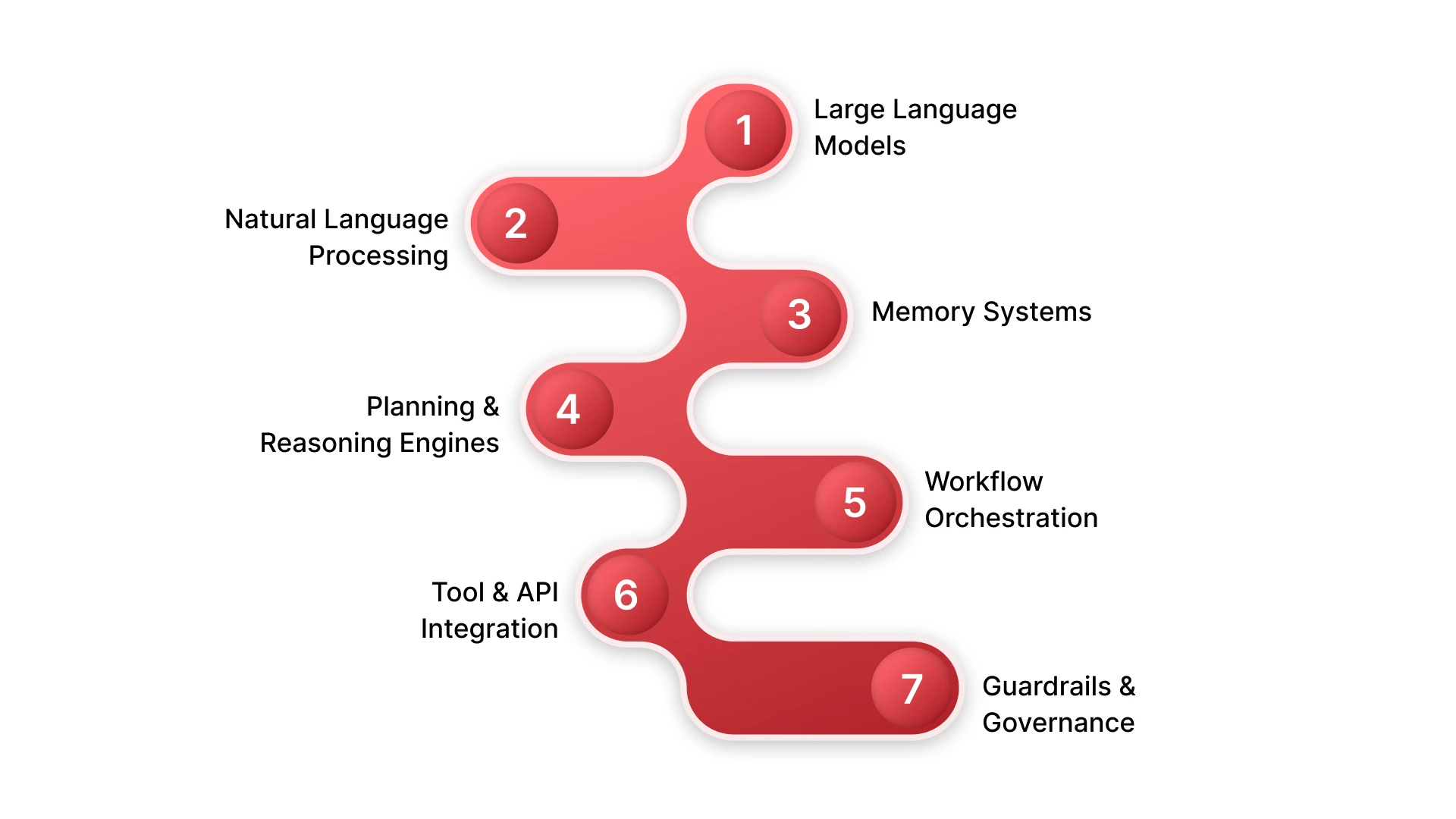
Agentic frameworks in business rely on multiple integrated layers that enable AI agents to act autonomously while remaining aligned with organizational workflows and objectives.
LLMs serve as the “brain” of the system, evaluating operational context and translating high-level objectives into actionable decisions. In enterprise settings, frameworks often leverage a mix of high-capacity models for complex reasoning and smaller, efficient models for routine tasks, ensuring speed, scalability, and cost-effectiveness.
NLP enables agents to interpret both human and system communication. Beyond emails or messages, it processes structured operational data from APIs, logs, and database sensors, creating situational awareness across inventory, procurement, or production workflows.
Agents need memory to operate across time and multi-step processes. Agentic frameworks use two types:
Planning engines convert high-level business objectives into a series of executable steps. Instead of simple if/then logic, techniques like Chain-of-Thought (CoT) or ReAct allow agents to break complex operations like fulfilling a multi-stage order into reliable sequences while accounting for dependencies and exceptions.
The orchestrator ensures that actions triggered by AI agents execute in the correct sequence, preserving state in multi-step operations. If a workflow is interrupted, it resumes precisely where it left off, maintaining operational continuity.
Agents achieve real impact only when they can act. Integration with external APIs, databases, or enterprise software (ERP, supply chain, HR systems) allows agents to trigger procurement orders, update production schedules, or initiate approvals directly within existing operational platforms.
Enterprise frameworks include built-in safety and compliance mechanisms. Human-in-the-loop checkpoints, access controls, and security protocols prevent errors or unauthorized actions, ensuring that AI-driven operations adhere to corporate policies and regulatory requirements.
HAL Agentic AI is at the forefront of the shift. By embedding intelligent AI agents into your ERP system, HAL helps automate not just tasks but entire workflows, allowing businesses to stay proactive, not reactive.

Agentic frameworks support several operational scenarios across business operations. The following examples illustrate how they are applied in enterprise environments.
Inventory movement often fluctuates due to seasonal demand, supplier lead times, or production requirements.
AI agents can track stock levels continuously and compare current consumption patterns with historical data. When materials approach critical thresholds, the system can initiate procurement workflows or notify operations managers.
This approach reduces the risk of sudden shortages that interrupt production or order fulfillment.
Manufacturing operations depend on synchronized schedules between materials, labor, and equipment.
AI agents can observe production progress and identify situations where delays may affect downstream stages. By analyzing scheduling dependencies, the system can suggest adjustments to maintain workflow continuity.
Procurement teams manage supplier relationships, delivery timelines, and order approvals.
Agentic systems can evaluate supplier performance metrics such as delivery reliability and order accuracy. When disruptions appear, the system can recommend alternative sourcing strategies or escalate issues to procurement managers.
Order fulfillment often involves coordination between internal operations and external logistics providers.
AI agents can monitor shipment activity, delivery confirmations, and fulfillment status updates. When delays occur, the system can alert relevant teams and trigger adjustments to delivery plans.
Also read: Best Agentic ERP Solutions Providers for Scalable, Intelligent Enterprises
%201.webp)
Alternate Graphic
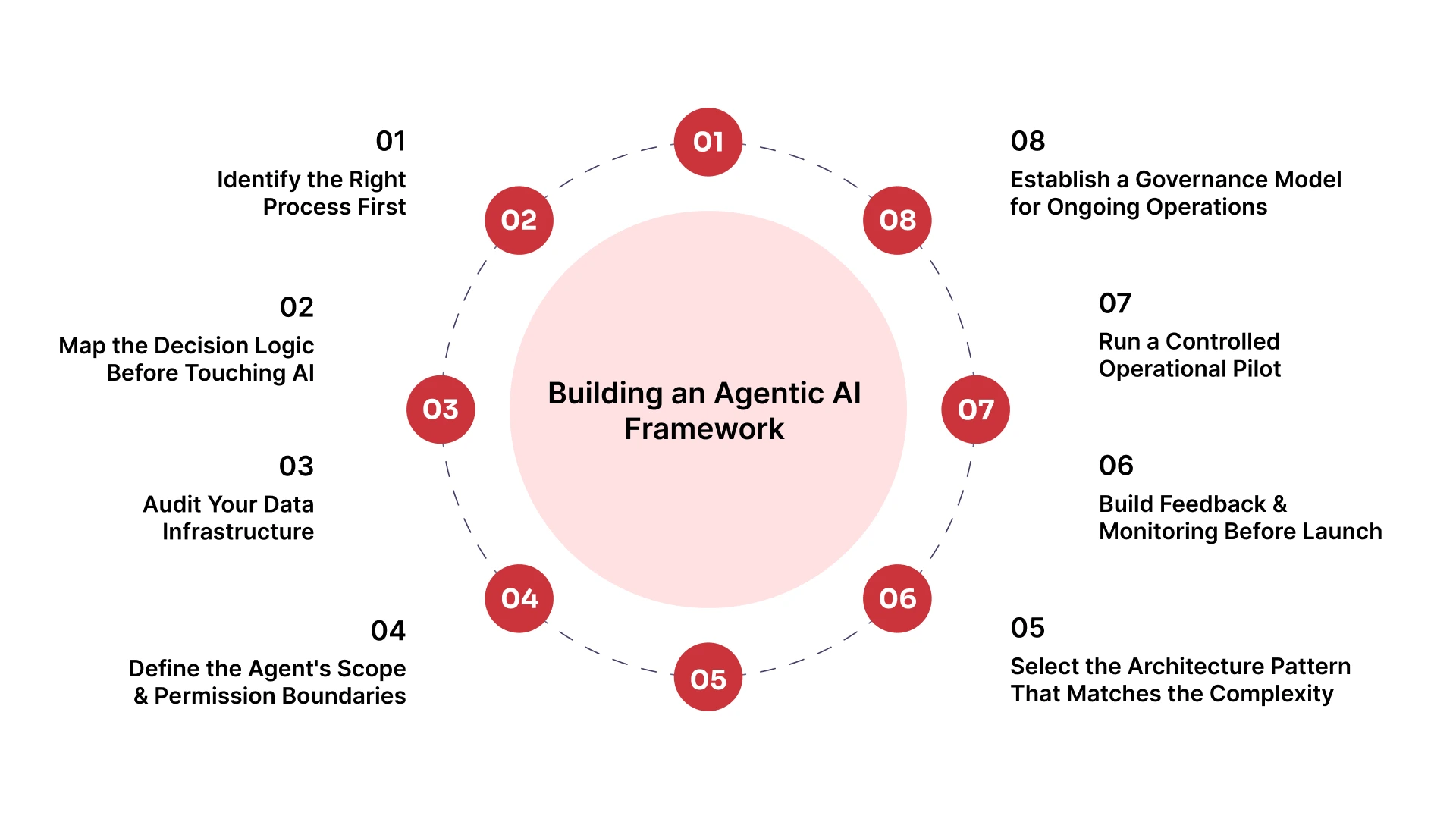
Most implementations fail not because the technology is wrong, but because organizations treat agentic AI like a software deployment. In reality, agentic AI functions more like hiring a new class of operational decision-makers, requiring changes in management approaches.
The preparation, scoping, and governance work you do before writing a single line of configuration will determine whether the system creates value or creates liability.
Here is how to approach it correctly.
Do not start with the technology. Start with a process that has three specific characteristics: it generates frequent, repetitive decisions; it relies on data that already exists in your systems; and errors in that process are recoverable.
Inventory reorder triggers, supplier escalation routing, and production exception handling are good starting points. Customer-facing credit approvals or regulatory filings are not, at least not initially.
The mistake most organizations make is selecting a high-visibility process to prove ROI quickly. That pressure leads to rushed governance and agents operating in environments they are not yet ready for.
Before any agent can act, you need a written map of how a human currently makes the same decision. What data do they look at? What threshold prompts action? Who do they escalate to, and under what conditions?
This exercise consistently reveals two things: that existing processes have undocumented exceptions, and that teams disagree on what the correct action actually is in edge cases. Both need to be resolved before an agent inherits that ambiguity.
Agentic systems are only as reliable as the data they operate on. Before deployment, audit three things specifically:
Data consistency is the most underestimated problem in enterprise agentic deployments. An agent that sees a supplier listed differently across two systems will either make the wrong call or stall waiting for a resolution.
Every agent needs a clearly defined operational boundary before it goes live. This means specifying exactly which systems it can read from, which it can write to, and which actions require human confirmation before execution.
A useful frame here is to think in terms of consequence severity. Low-consequence actions, like flagging a record or generating a draft recommendation, can be fully autonomous. Medium-consequence actions, like sending an external communication or adjusting a schedule, should include a review step. High-consequence actions, like committing budget or modifying a contract, stay with a human until the agent has earned a track record.
Scope creep kills enterprise AI programs. Start narrow and expand based on demonstrated performance, not based on what the technology is theoretically capable of.
Not every process needs a multi-agent system. Deploying one when a single agent would suffice adds coordination overhead and introduces failure points that are harder to diagnose.
Use a single-agent architecture for linear, well-defined workflows where steps are sequential, and context remains consistent throughout. Move to a multi-agent architecture when the task genuinely requires parallel processing, when different steps demand different domain knowledge, or when the workflow spans multiple departments with distinct data access requirements.
The orchestration layer you build here is what scales. Getting this decision right early avoids expensive rearchitecting later.
This step is almost always deprioritized and almost always causes problems. Before an agent handles live operations, you need visibility into what it is doing and why.
Logging every agent decision with the inputs it received, the reasoning it applied, and the action it took is not optional in an enterprise environment. This serves three purposes: it lets you catch drift early when agent behavior starts diverging from expectations; it gives compliance and audit teams the documentation they need; and it creates the dataset you will use to improve the system over time.
Run the first pilot in a controlled segment of the actual environment. A specific warehouse location, a single supplier category, or one production line. Keep the scope small enough that errors are contained, but real enough that the system encounters the edge cases it will face at full scale.
During this phase, assign someone to shadow the agent's decision log daily. The goal is not to catch every mistake. The goal is to understand the pattern of mistakes before they compound.
Once live, agentic systems require active governance. This means defining who owns the agent's performance, who has authority to modify its scope or permissions, and what triggers a review or rollback.
In practice, the most effective governance structure pairs a technical owner who monitors system behavior with an operational owner who understands the business process the agent is managing. Neither alone has the full picture. Together, they can catch the cases where the system is technically functioning but producing operationally wrong outcomes, which is the most dangerous failure mode because it is the hardest to detect.
Agentic frameworks require an operational environment where AI agents can access reliable data, interact with workflows, and trigger actions within business systems.
HAL Agentic ERP integrates AI agents directly into operational workflows, making it a cohesive part of your business ecosystem. These agents not only monitor activity but also initiate actions when necessary, providing contextual suggestions and automating everyday tasks.
Key capabilities of HAL Agentic ERP include:
HAL ERP connects data from inventory, procurement, finance, production, and sales into a unified operational environment. This integrated structure allows AI agents to interpret business conditions using real operational context rather than isolated datasets.
Organizations gain visibility into operational dependencies, such as supply delays affecting production schedules or order demand influencing procurement activity.
Operational workflows in HAL ERP define how approvals, escalations, and task assignments move across departments. AI agents operate within these defined governance structures, ensuring automated actions respect organizational policies and approval hierarchies.
Instead of replacing operational oversight, AI supports teams by surfacing insights and recommending actions while decisions remain aligned with business rules.
HAL ERP includes specialized modules designed for industries such as manufacturing, contracting, retail, trading, and services. These modules structure operational workflows according to sector-specific requirements.
This industry alignment allows agentic systems to operate within processes already tailored to the organization's operational model.
Enterprises rely on multiple external platforms, including logistics systems, payment gateways, and e-commerce platforms. HAL ERP integrates these systems into a unified operational environment.
AI agents can therefore interpret signals across the entire operational ecosystem rather than acting within a single application.
AI capabilities within HAL ERP analyze operational activity and identify emerging patterns that may affect business continuity. By interpreting data across workflows, AI agents support faster responses to operational changes while maintaining visibility across enterprise processes.

Artificial intelligence is evolving from a collection of isolated tools into systems that participate directly in business operations. Agentic frameworks represent a shift toward structured AI participation inside workflows, allowing intelligent agents to monitor activity, evaluate context, and initiate actions when conditions change.
For organizations managing complex operational environments, this approach offers a way to reduce coordination delays and improve visibility across processes. Operational platforms play a critical role in enabling this transformation.
HAL Agentic ERP is built for this operational reality. As Saudi Arabia’s first agentic and conversational ERP platform, it provides the structure enterprises need to apply AI within real business processes while maintaining visibility and control.
Organizations exploring agentic operations can begin by evaluating how AI integrates with their existing workflows and operational systems.
Book a demo of HAL Agentic ERP to see how agentic execution supports everyday business operations.
Yes. Agentic systems typically interact with existing platforms through APIs, databases, and workflow integrations. This allows AI agents to read operational data, trigger workflows, or update records without replacing core systems.
Many enterprises introduce agentic capabilities gradually, integrating them with existing ERP, CRM, and supply chain platforms.
No. Most enterprise implementations use AI agents to handle repetitive coordination tasks while human teams focus on strategic decisions, exception handling, and oversight.
This collaboration model allows organizations to improve operational efficiency without removing human accountability.
Security depends on how the system manages access to tools, data, and workflows. Modern frameworks enforce permission boundaries, policy controls, and monitoring mechanisms to prevent unauthorized actions or misuse.
These controls ensure that autonomous systems operate within defined organizational policies.
Implementation timelines vary depending on process complexity and system integration. Many organizations begin with a limited operational pilot that focuses on a specific workflow.
Once the system demonstrates reliability, additional processes can be introduced incrementally.
Enterprise agentic systems operate within governance frameworks that define data access, system permissions, and approval thresholds. Monitoring, logging, and human oversight ensure actions remain auditable and compliant.
This governance layer is essential because autonomous systems can interact with multiple operational systems simultaneously.