

For many Saudi businesses, a high gross sales figure can create a false sense of financial strength, even when cash flow and profitability are weak. That’s because gross sales only represent the total value of goods or services sold before accounting for returns, discounts, and allowances, a number that doesn’t reflect what the business actually retains.
In fact, 45% of sales leaders lack strong confidence in their ability to forecast revenue accurately, including understanding the difference between gross and net figures, a shortfall that can lead to poor pricing, misaligned inventory plans, and unexpected cash flow pressure.
This gap isn’t just a bookkeeping detail; it’s a strategic blind spot that can erode profitability, especially for Saudi SMEs and mid‑market companies navigating multi‑channel sales, delayed receivables, and VAT‑compliant reporting.
In this guide, we’ll break down what gross sales really mean, why net revenue matters more for profit visibility, and how tracking both accurately can help you make better operational and financial decisions.
Gross sales refer to the total value of all sales transactions a business records over a specific period, before any deductions are applied. This includes every invoice raised for goods or services, whether the payment is received in cash or on credit.
In 2026, the way businesses generate and track sales has changed. Sales no longer come from a single source. They flow in from POS systems, e-commerce platforms, marketplaces, field sales teams, and subscription models, often all at once.
For mid-sized businesses in Saudi Arabia, especially those operating across multiple branches, sales channels, or projects, gross sales often appear as a large top-line number. But in practice, this number can become misleading when:
This is why gross sales should be seen as a starting point, not the final indicator of performance.
The primary purpose of gross sales is to measure total sales activity and demand, not actual profitability or retained revenue.
At a business level, gross sales help answer a very specific question: “How much are we selling before adjustments?”
For Saudi mid-sized businesses, this becomes useful in several operational ways:
However, gross sales also come with a clear limitation. It does not reflect the actual revenue retained by the business, because it ignores deductions like returns, discounts, and allowances.

That is why most financial reporting, especially in structured environments like Saudi compliance and ZATCA reporting, focuses more on net sales, while gross sales remain a supporting revenue metric.
To interpret gross sales correctly, you need clarity on what goes into this number and what does not.
Gross sales often look straightforward, but in real business operations, especially across multi-branch or multi-channel setups, confusion usually comes from what gets counted and what does not.
For mid-sized Saudi businesses managing POS systems, invoices, and ZATCA-compliant transactions, this clarity becomes critical. Without it, reported sales figures can quickly become inconsistent across finance, operations, and reporting.
Gross sales include every revenue-generating transaction recorded before any deductions are applied. It reflects the full value of what has been sold, not what is ultimately retained.
This typically covers:
Also read: AI for Sales Forecasting: Everything Enterprises Need to Know
Gross sales exclude any adjustments made after the initial sale. These deductions are accounted for separately and are used to calculate net sales.
These exclusions include:

This is why gross sales should always be treated as a volume indicator, while real performance decisions should be based on adjusted figures like net sales.
Gross sales are less about calculation and more about completeness. The real question is not how to calculate it, but whether you are capturing every sale accurately across your business.
That’s why calculating gross sales today is less about applying a formula and more about ensuring every transaction flows into a single, reliable source of truth.
There are two commonly used ways to calculate gross sales, depending on how your business tracks data:
1. Based on total transactions:
Gross Sales = Total value of all sales invoices (before deductions)
2. Based on units sold:
Gross Sales = Number of units sold × Selling price per unit
Both approaches lead to the same outcome. The first is used when working with accounting records, while the second is useful for operational or product-level analysis.
For mid-sized Saudi businesses, especially those managing multiple revenue streams, the calculation typically follows this process:
The result is your gross sales figure for that period.
Consider a mid-sized retail and distribution company operating across 3 branches in Riyadh and Jeddah.
For the month of January:
Add all sales transactions.
Gross Sales = 420,000 + 180,000 + 250,000 = SAR 850,000
This SAR 850,000 represents the total sales generated before any deductions.
Assumed deductions can be:
These are not included in gross sales. They are only considered when calculating net sales.
Also read: How to Calculate Sales Journal Entries with Tax and Analyze Them
For businesses running on multiple systems, this calculation becomes much easier when every invoice is captured in one place, so finance teams can total sales by period without manual reconciliation.
While gross sales provide an essential top-line figure for your business, net sales give a much clearer picture of actual revenue. After you calculate your gross sales, it’s critical to account for any deductions to determine your true earnings.
Net Sales = Gross Sales – (Returns + Discounts + Allowances)
This formula adjusts for the impact of returns, customer discounts, and allowances, which can significantly affect the revenue you actually retain.
Let’s consider a retail business that had the following sales activity in a given month:
To calculate net sales, we subtract the total deductions from the gross sales:
Net Sales = Gross Sales – (Returns + Discounts + Allowances)
Net Sales = SAR 850,000 – (SAR 50,000 + SAR 30,000 + SAR 10,000)
Net Sales = SAR 850,000 – SAR 90,000
Net Sales = SAR 760,000
So, after accounting for returns, discounts, and allowances, the net sales for the business is SAR 760,000, which is the actual revenue the business retains after all adjustments.
Gross sales and net sales are closely related, but they serve very different purposes in financial reporting.
At a basic level:
Relying only on gross sales often leads to inflated performance assumptions, while net sales reflect what the business actually earns.
In practice, the gap between gross and net sales often highlights operational issues.
For example:
This is why finance teams, especially in structured environments like Saudi Arabia, rely more on net sales for reporting and compliance, while gross sales are used as a supporting metric for tracking demand and sales activity.
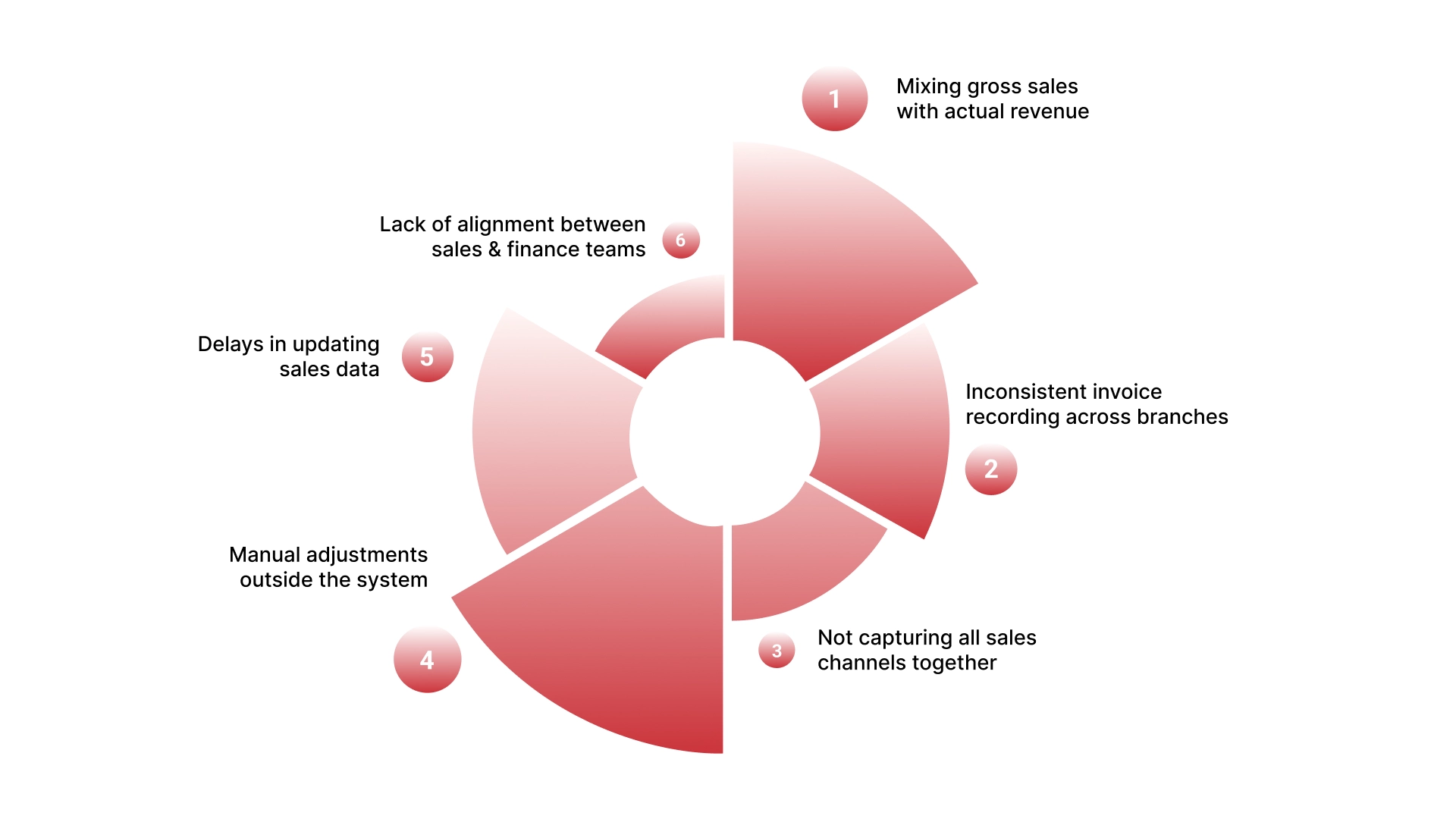
Gross sales looks simple on paper, but in real operations, it is one of the most misinterpreted metrics. Even small inconsistencies in how sales are recorded can distort the numbers quickly.
Here are some of the most common mistakes that affect how gross sales are tracked and understood:
These issues are not caused by the metric itself but by how sales data is managed across systems and teams.

This is where having a connected system makes a difference. When every invoice, across branches and channels, is captured in one place, gross sales become a reliable indicator of sales activity rather than a number that needs constant correction.
If your team is still reconciling sales data manually, HAL ERP can help centralize transactions and give you a clear, real-time view of gross sales across your entire business.
Gross sales tell you how much you’ve sold. Net revenue tells you what you actually keep. The gap between the two is where most businesses lose clarity.
In growing businesses, that gap often comes from disconnected systems. Sales happen across POS, CRM, e-commerce, and manual invoicing, but returns, discounts, and credit notes are tracked elsewhere. The result is a top-line number that looks strong, but doesn’t fully reflect reality.
HAL ERP closes this gap by connecting every part of your sales cycle into one system, from the first customer interaction to the final financial entry.
This is where the shift happens. Gross sales stop being just a number, and start becoming a reliable input for decision-making.
A multi-location F&B and leisure services company Coastline LLC struggled with disconnected systems, leading to fragmented data and manual data entry delays across its 17 outlets. On top of this, ZATCA E-Invoicing Phase II compliance was a challenge.
By implementing HAL ERP, the company integrated its POS systems, enabling real-time data synchronization and eliminating manual entry. This solution also ensured full ZATCA compliance.
As a result, the company achieved faster reporting, improved operational efficiency, and seamless regulatory compliance, leading to better decision-making and streamlined operations across all locations.
The real value of gross sales comes when it is used as part of a bigger financial picture. When you connect it with net sales, returns, discounts, and operational data, you start to see where revenue is actually coming from and where it is being lost. That is what helps businesses improve pricing, control leakage, and make smarter decisions.
For growing businesses, especially those managing multiple branches or sales channels, this becomes harder to track manually. Numbers get delayed, systems stay disconnected, and reporting turns into a monthly exercise instead of a real-time view.
That is where having a connected system changes the way you work.
Book a demo with HAL ERP to bring your sales, finance, and reporting into one place and get a clear, real-time view of your business performance.
No, gross sales and revenue are not the same. Gross sales represent the total value of all sales before any deductions, while revenue (often called net sales) is what remains after adjusting for returns, discounts, and allowances. Revenue gives a more accurate picture of what the business actually earns.
Not always as a separate line item. Most income statements report net sales or revenue instead of gross sales. However, gross sales may still be tracked internally or disclosed in detailed financial reports to understand the full sales volume before deductions.
Yes, gross sales include the full value of sales before discounts are applied. Any discounts, returns, or allowances are deducted later to arrive at net sales or revenue.
Differences usually occur due to disconnected systems, delayed data entry, or inconsistent invoice recording across branches.
Gross sales are typically more useful for sales teams to track performance and volume, while finance teams rely more on net sales for accurate reporting.