
Choosing an e-invoicing provider in Saudi Arabia is no longer just about generating a tax invoice with a QR code. Businesses entering ZATCA's Phase 2 Integration Phase may need their invoicing system to generate the required structured data, communicate with the FATOORA platform, handle clearance and reporting, process credit and debit notes, manage failures, and work with existing ERP or POS systems.
That creates several provider models. Some platforms combine accounting and e-invoicing. Others act as a compliance layer around an existing ERP, while enterprise networks support e-invoicing across Saudi Arabia and multiple other countries.
The right choice depends less on a provider's marketing label and more on how well its architecture fits your actual invoice flow.
Keeping your existing system? See how a ZATCA Phase 2 integration layer connects an ERP, POS or custom app to the Fatoora platform through one API.

An e-invoicing provider supplies software or integration infrastructure that helps a taxpayer generate, process, transmit, receive and retain electronic invoices in line with Saudi requirements.
Under Phase 2, the technical workflow can include:
The distinction between clearance and reporting is particularly important.
For Standard Tax Invoices, commonly used in B2B transactions, the invoice is submitted to ZATCA for clearance before it is shared with the customer.
Simplified Tax Invoices, commonly associated with B2C transactions, follow the reporting model and must generally be reported to FATOORA within 24 hours of issue.
ZATCA explains both workflows in its E-Invoicing Detailed Guidelines.
No.
This is one of the most persistent points of confusion when businesses compare Saudi e-invoicing providers.
ZATCA's official Solution Providers Directory states that taxpayers may use any provider as long as the e-invoicing solution they use complies with the applicable requirements.
The directory identifies providers that have passed ZATCA's qualification process for Phase 1, Phase 2 or both.
However, ZATCA also states that the list is:
That means phrases such as “ZATCA-approved software” can give the wrong impression.
A more accurate distinction is:
Provider directory qualification ≠ automatic approval of every implementation or product configuration.
The taxpayer remains responsible for using an e-invoicing solution that meets the applicable requirements.
Directory status is a due-diligence signal. Successful testing of your actual configuration is the stronger evidence.
The following platforms represent different ways to implement Saudi e-invoicing. They are not ranked from best to worst.
| Provider | Typical Fit | Solution Model | Documented Saudi Capability |
|---|---|---|---|
| HAL VAT Care | Businesses retaining an existing ERP, accounting system or POS | Integration/compliance layer | Phase 1 and 2 workflows, API/file integration, online/offline synchronisation |
| ClearTax | Higher-volume and multi-system environments | Compliance middleware | ERP/POS integration, validation, offline B2C processing, monitoring |
| Zoho Books | SMEs wanting accounting and e-invoicing together | Cloud accounting | FATOORA connection, invoice validation, status tracking, bilingual workflows |
| Wafeq | Saudi/GCC SMEs and businesses needing an API option | Accounting + API platform | Phase 2 workflows, XML/PDF-A-3, ERP integration, REST API |
| Comarch | Multinationals with multi-country compliance needs | Enterprise e-invoicing network | Saudi clearance/reporting plus broader international e-invoicing |
| ONESOURCE Pagero | Large multinational and multi-ERP businesses | Global compliance network | Saudi clearance/reporting, ERP connectivity, archiving and network services |
| SAP Document and Reporting Compliance | Businesses already standardized on SAP | ERP-native compliance | Saudi eDocument processing and Phase 2 solution-unit onboarding |
The important question is not simply which provider has more features. It is which model introduces the least unnecessary complexity into your existing finance architecture.
HAL VAT Care is designed around a common Saudi implementation problem: the business already has an ERP, accounting platform or POS system and does not want to replace it simply to meet e-invoicing requirements.
HAL currently documents support for:
This architecture can be relevant to businesses with custom systems, established ERPs or retail environments where replacing the operational platform would create more disruption than adding a dedicated e-invoicing layer.
HAL is listed in ZATCA's Solution Providers Directory as “HAL ERP”, a Phase 2 (integration) qualified provider, and VAT Care is HAL's own product. It is hosted in Saudi Arabia, and a typical implementation takes about two weeks, including certificate (CSID) onboarding and testing in ZATCA's simulation environment before production.
HAL also documents an implementation at Al Haram Retail, where VAT Care was integrated with the retailer's existing system across a multi-store, primarily B2C environment.
The relevant selection question is whether a business wants to retain its existing operational systems and connect them to an e-invoicing layer.
ClearTax takes a middleware-oriented approach to Saudi e-invoicing.
Its current Saudi product documentation includes:
This model can suit businesses where several systems generate invoice data and the company wants a separate compliance platform between those systems and FATOORA.
That can be particularly relevant for groups running different ERP or POS environments across business units.
When evaluating the platform, businesses should test its claims against their own transaction volumes, integration methods and exception scenarios rather than relying on headline throughput or compliance percentages.
Zoho Books combines accounting and Saudi e-invoicing within the same cloud platform.
Its current Saudi documentation includes:
Zoho's Phase 2 documentation also shows the workflow for connecting an organisation to FATOORA and monitoring whether transactions have been pushed successfully.
This model may be practical for SMEs that want accounting, invoicing and FATOORA processing in one application.
For a business already running a substantial ERP, however, replacing or duplicating the accounting layer purely for e-invoicing may be less attractive than integrating the existing platform with middleware.
Wafeq combines accounting capabilities with a Saudi e-invoicing offering.
The platform currently documents:
Wafeq also provides a documented FATOORA connection workflow for organisations using the platform directly.
That gives it two possible roles: an accounting environment for businesses adopting Wafeq itself, or an e-invoicing integration option where invoice data originates elsewhere.
Businesses should clarify which architecture is being proposed before comparing it with a pure middleware provider.

Comarch positions Saudi e-invoicing within a wider international e-invoicing and document-exchange platform.
Its Saudi documentation covers:
This type of architecture is more relevant when Saudi Arabia is one part of a larger compliance programme.
A multinational operating across several countries may prefer a central e-invoicing network rather than implementing a different standalone tax solution in every jurisdiction.
The trade-off is that businesses seeking primarily Saudi accounting or lightweight invoicing may not need the broader architecture of a global compliance platform.
ONESOURCE Pagero provides Saudi e-invoicing through Thomson Reuters' broader compliance network.
Its Saudi product documentation covers areas including:
Thomson Reuters also documents integration options for businesses using existing ERP environments rather than requiring invoice creation exclusively inside its own interface.
This model is most relevant when a company is looking beyond Saudi Arabia and wants e-invoicing connectivity across a wider international footprint.
As with other enterprise platforms, the business should assess the Saudi implementation itself—not assume global coverage automatically means the architecture is right for its local transaction flow.
SAP approaches Saudi e-invoicing differently from standalone providers.
Its Saudi e-invoicing functionality is built around SAP Document and Reporting Compliance and the SAP eDocument framework.
SAP's own Saudi e-invoicing documentation covers Phase 2 solution-unit onboarding for environments including SAP ERP and SAP S/4HANA.
For businesses already standardized on SAP, an ERP-native approach can reduce the need to move invoice data into an unrelated accounting platform.
The evaluation is different for companies that do not already operate SAP. An SAP-native compliance extension is naturally most relevant where the wider SAP infrastructure already exists.

Provider selection should begin with your current systems.
| Current Environment | Provider Model to Evaluate |
|---|---|
| No mature accounting system | Accounting + e-invoicing platform |
| Existing ERP you intend to keep | Integration/compliance middleware |
| Large SAP environment | SAP-native or SAP-integrated solution |
| Retail/POS network | High-volume platform with offline capability |
| Several Saudi entities or branches | Multi-entity platform with central monitoring |
| Operations across several countries | Global e-invoicing network |
| Custom or legacy ERP | API, secure-file or controlled integration layer |
This is a more useful starting point than asking:
Which Saudi e-invoicing provider has the longest feature list?
A small business using one accounting application and a retailer processing thousands of POS transactions do not have the same architecture problem.
Neither does a multinational that needs e-invoicing in ten countries.
Decide on the architecture before you compare vendors. Many businesses compare products before deciding whether they need to replace their existing system at all:
Replacing a working ERP solely for e-invoicing can create unnecessary disruption. Conversely, adding middleware to a badly fragmented environment may preserve the underlying data problems.
A provider demonstration should go beyond showing a successful invoice.
Use your own invoice scenarios and deliberately test failures.
Verify that:
Test:
Check whether the system:
Deliberately test:
A reliable integration should know the difference between “the request failed” and “the request may have reached ZATCA but the response was lost.” That distinction matters when preventing duplicate invoices.
Retries must preserve invoice sequencing and prevent duplicates. Users should not need to edit accepted invoice XML or change database records to recover from an error.
ZATCA also provides an official failure-notification service for incidents, technical errors or emergencies that prevent e-invoice generation, and taxpayers must notify the authority again once the problem is resolved. Ask the provider who monitors failures, who contacts ZATCA and what evidence is retained.
Phase 2 implementation can also involve onboarding Electronic Invoice Generation Solution units and managing Cryptographic Stamp Identifiers.
ZATCA provides technical documentation and testing resources through its Developer Portal guidance.
Businesses with many branches or devices should understand how their provider manages onboarding, renewal and operational monitoring at scale.
E-invoices contain customer names, addresses, tax identifiers and transaction details, so security deserves more scrutiny than a general claim that a platform is “cloud-based” or “encrypted.” Ask about:
Where invoice data identifies an individual, its processing may fall under Saudi Arabia's Personal Data Protection Law. SDAIA's PDPL guidance explains that storing personal data in a cloud service is itself a form of processing, and that controllers must evaluate the processors they use. ZATCA also requires e-invoicing solutions to prevent unauthorised access and to stop users deleting or changing stored invoice XML.
The advertised subscription rarely covers the full cost. Include implementation, ERP, POS or e-commerce connections, custom development, data migration, training, premium support, additional branches or legal entities, regulatory updates and exit costs. The contract should state who owns the invoice data, XML files, integration code, configuration and certificates, and how you retrieve them if the agreement ends. A low-cost provider becomes expensive if you cannot move your records or must rebuild every connection.
A weighted scorecard stops a polished presentation or a low price from outweighing compliance and operational risk. Rate each provider from 1 to 5 in every category, then calculate:
Weighted result = (provider rating ÷ 5) × category weight
|
Evaluation category |
Suggested weight |
|
Phase Two compliance capability |
25% |
|
Integration and data mapping |
20% |
|
Error handling and resilience |
15% |
|
Security and data governance |
15% |
|
Operational visibility and scalability |
10% |
|
Implementation and local support |
10% |
|
Cost, contract and exit terms |
5% |
|
Total |
100% |
Some requirements are pass-or-fail gates rather than scored preferences. Reject a provider that cannot:
A provider with the highest weighted score should still fail the evaluation if it misses a mandatory gate.
Phase 2 continues to roll out in waves.
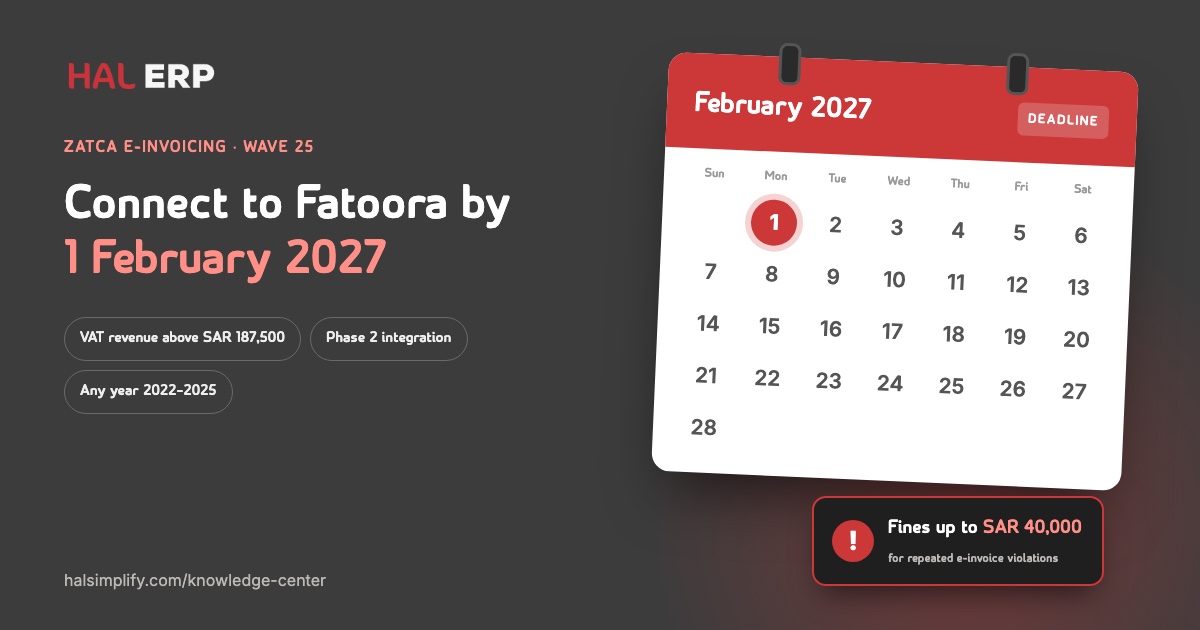
As of 29 September 2026, ZATCA's latest announced group is Wave 25.
According to ZATCA's Wave 25 announcement, the wave includes taxpayers whose revenues subject to VAT exceeded:
SAR 187,500
during 2022, 2023, 2024 or 2025.
Targeted taxpayers are required to integrate their e-invoicing solutions with FATOORA by no later than:
1 February 2027
ZATCA states that targeted taxpayers are notified directly and that subsequent groups are informed at least six months before their integration date.
That means businesses should not determine their deadline solely from a generic revenue table found online.
Check the latest ZATCA announcement and the notification issued to the taxpayer.
Our ZATCA Wave 25 guide explains who is covered and how to prepare before 1 February 2027.
A useful provider evaluation should answer questions such as:
The answers should be demonstrated against real scenarios wherever possible.
A polished slide deck does not prove that a platform can recover safely from an interrupted submission at 8 p.m. on a busy retail day.
Some claims and behaviours suggest a provider may not be ready for a tax-critical implementation. Watch for:
A provider that cannot explain its failure process should not be trusted just because its successful invoice screen looks simple.
There is no single e-invoicing provider model that fits every Saudi business.
The most useful shortlist starts with:
Existing ERP/POS → invoice volume → B2B/B2C mix → number of branches → failure scenarios → international footprint → support requirements
Businesses that want accounting and e-invoicing together can evaluate integrated accounting platforms. SAP-heavy organisations may prefer ERP-native compliance, while multinationals may need a wider global network.
Companies that want to keep their existing ERP, accounting platform or POS can evaluate HAL VAT Care as an integration layer for Saudi Phase 1 and Phase 2 workflows.
The final decision should be based on an end-to-end test using your real invoices, integrations, branches, transaction volumes and deliberate failure scenarios—not a generic feature checklist.
Book a HAL demo to review how your current invoice architecture could connect with HAL VAT Care.
No. ZATCA states that taxpayers can use any e-invoicing solution as long as it meets the applicable requirements. Its Solution Providers Directory is an indicative list rather than a mandatory shortlist.
ZATCA explicitly states that inclusion in the directory is not considered approval of the e-solutions offered by the listed providers. Phase 1 and Phase 2 labels indicate that the provider has passed the applicable qualification criteria.
It is a provider or solution capable of supporting the requirements applicable to the Integration Phase, including the relevant FATOORA integration and invoice-processing requirements.
Yes. An e-invoicing compliance layer can integrate with an existing ERP, accounting system or POS rather than requiring the business to replace its core platform.
A smaller business should first decide whether it wants accounting and e-invoicing within one platform or whether it already has accounting software it intends to retain. Implementation effort, support and usability may matter more than enterprise-scale architecture.
Retailers should pay particular attention to POS integration, high transaction volumes, offline processing, simplified-invoice reporting, branch/device onboarding, retry logic and duplicate prevention.
Businesses operating across several jurisdictions should assess multi-country coverage, ERP connectivity, central monitoring, data architecture, local regulatory support and the ability to add future mandates without rebuilding every integration.
Phase 1, in force since 4 December 2021, covers generating and storing compliant electronic invoices with a QR code. Phase 2 adds integration with Fatoora: structured XML, clearance of standard invoices, reporting of simplified invoices within 24 hours, and additional security and technical fields.
An end-to-end proof of concept using your actual invoice types and deliberate failure conditions. It should cover successful processing, rejections, retries, offline queues, credit notes, branch onboarding, audit records and data export.