

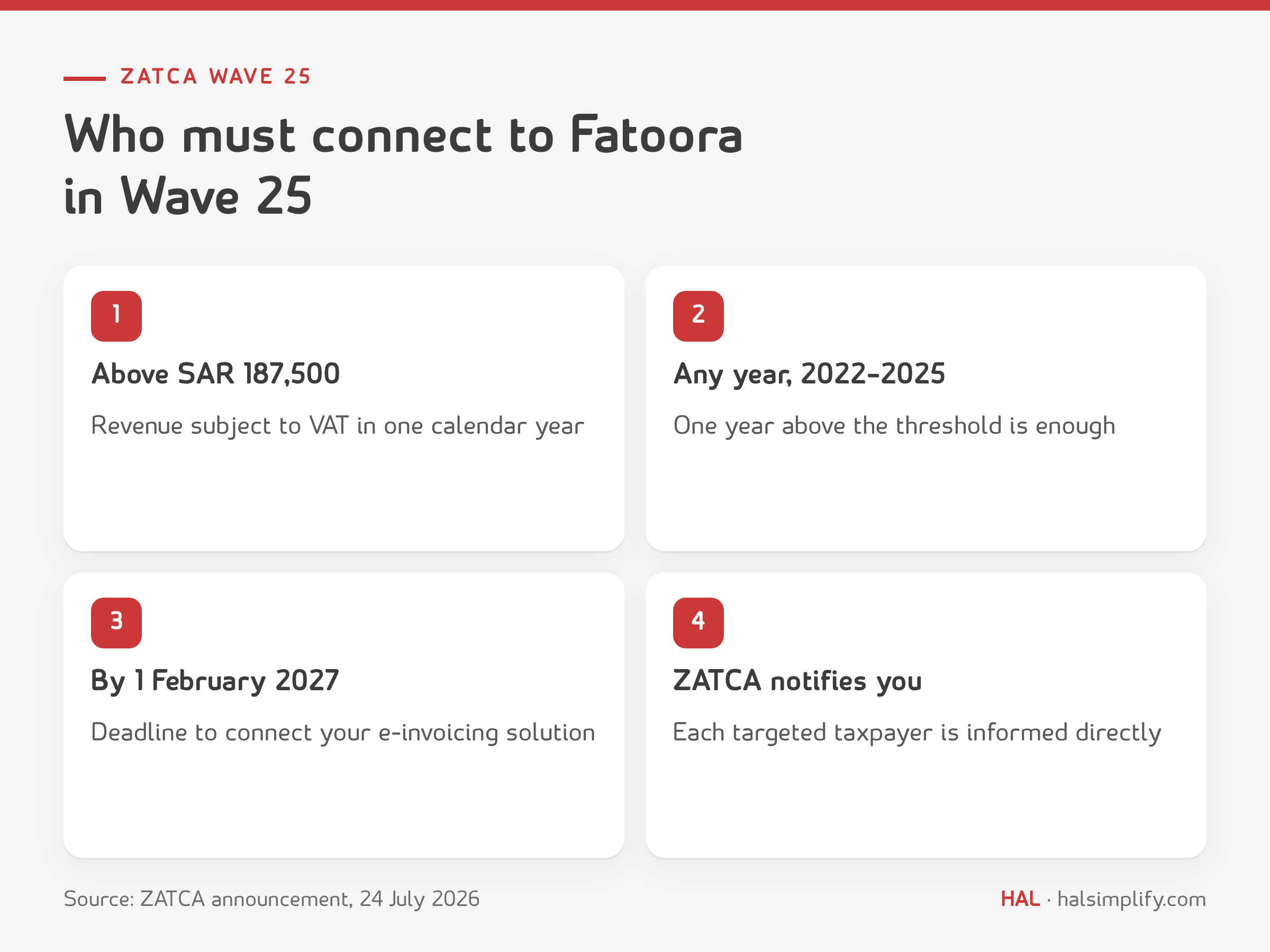
In short: ZATCA Wave 25 brings Phase 2 e-invoicing to every taxpayer whose revenue subject to VAT exceeded SAR 187,500 in 2022, 2023, 2024 or 2025. These businesses must connect their e-invoicing solution to ZATCA's Fatoora platform by 1 February 2027. Below: how to check whether you are in, what "integration" actually involves, an eight-week plan, and the mistakes that cost the most time.
ZATCA announced Wave 25 on 24 July 2026. It is the widest wave so far. Waves 22 to 24 moved the threshold from SAR 1 million down to SAR 375,000. Wave 25 halves it again, to the same figure as the voluntary VAT registration threshold. For many small shops, clinics, service firms and online sellers, this is the first time ZATCA asks them to connect, not just to print a QR code.
If you are reading this in November or December 2026, you have roughly ten weeks. That is enough time, as long as you start now.
ZATCA's announcement sets one test: your revenue subject to VAT exceeded SAR 187,500 in any one of the years 2022, 2023, 2024 or 2025. One year above the line is enough. If an earlier wave already selected you, your earlier date applies.
Phase 1 (the generation phase) has applied since 4 December 2021: invoices issued electronically, with a QR code on simplified invoices. Phase 2, the integration phase, connects your invoicing to Fatoora and has been rolled out in waves, each with a lower threshold.
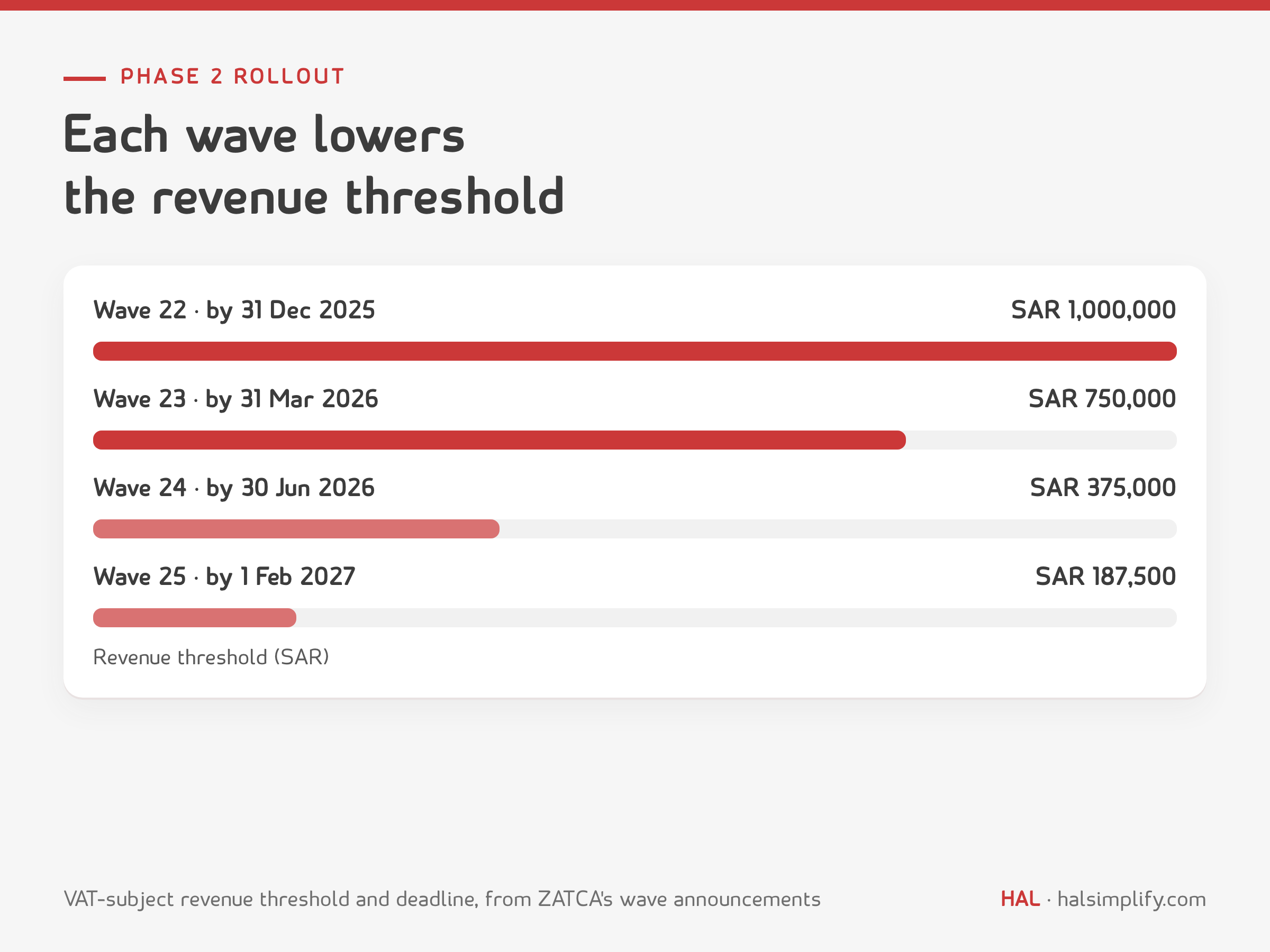
| Wave | VAT-subject revenue above | Revenue years | Connect by |
|---|---|---|---|
| 22 | SAR 1,000,000 | 2022, 2023 or 2024 | 31 December 2025 |
| 23 | SAR 750,000 | 2022, 2023 or 2024 | 31 March 2026 |
| 24 | SAR 375,000 | 2022, 2023 or 2024 | 30 June 2026 |
| 25 | SAR 187,500 | 2022, 2023, 2024 or 2025 | 1 February 2027 |
Wave 25 is also the first wave to count 2025 revenue. A business that crossed SAR 187,500 for the first time in 2025 is included.
A Phase 1 invoice with a QR code is not enough for Phase 2. Your system, or the service it connects through, has to talk to Fatoora for every invoice:
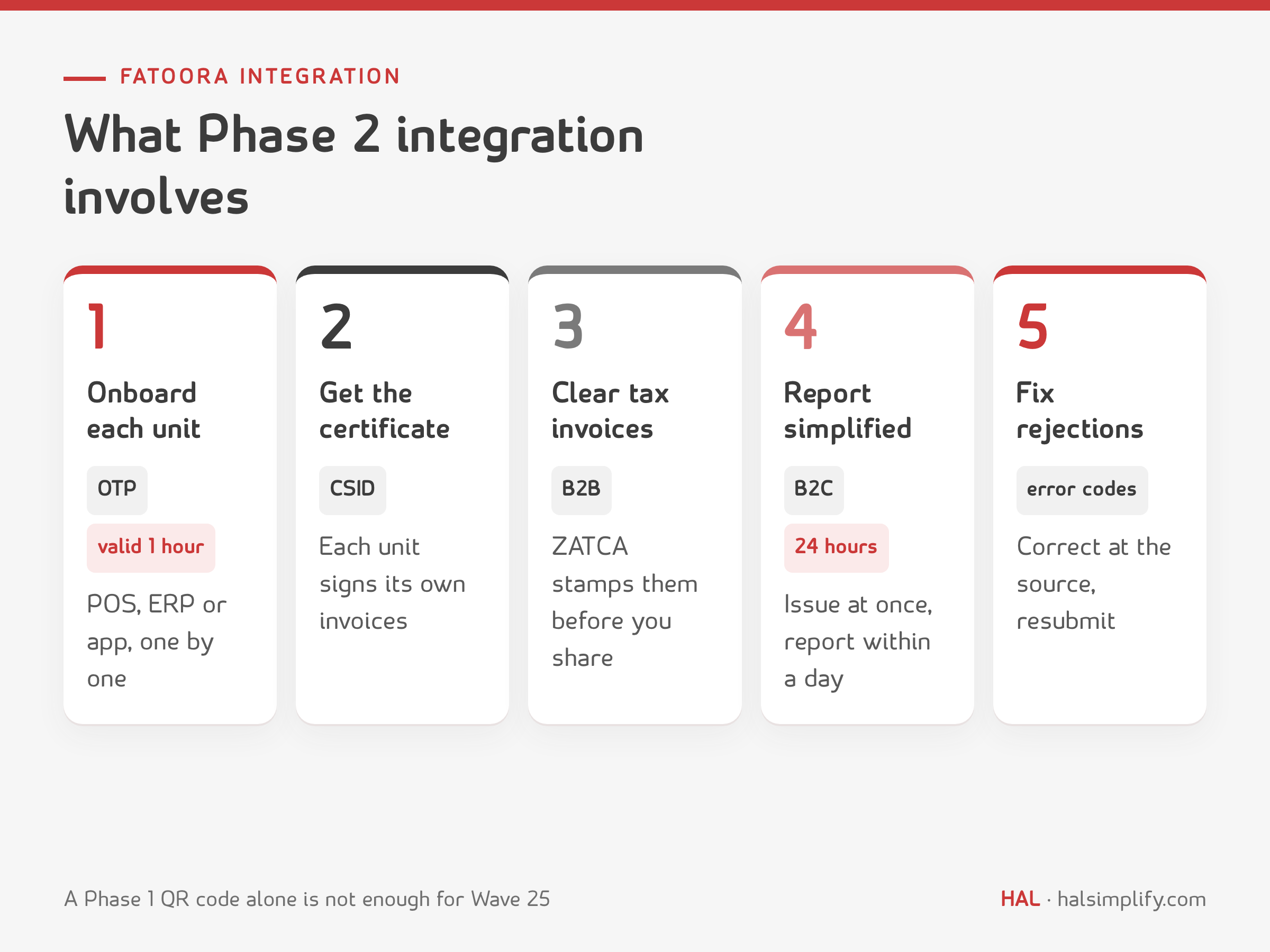
This is why "our system already prints a QR code" is the most common false sense of safety we see. For a closer look at the technical side, read our guide on keeping your business ready for ZATCA e-invoicing.
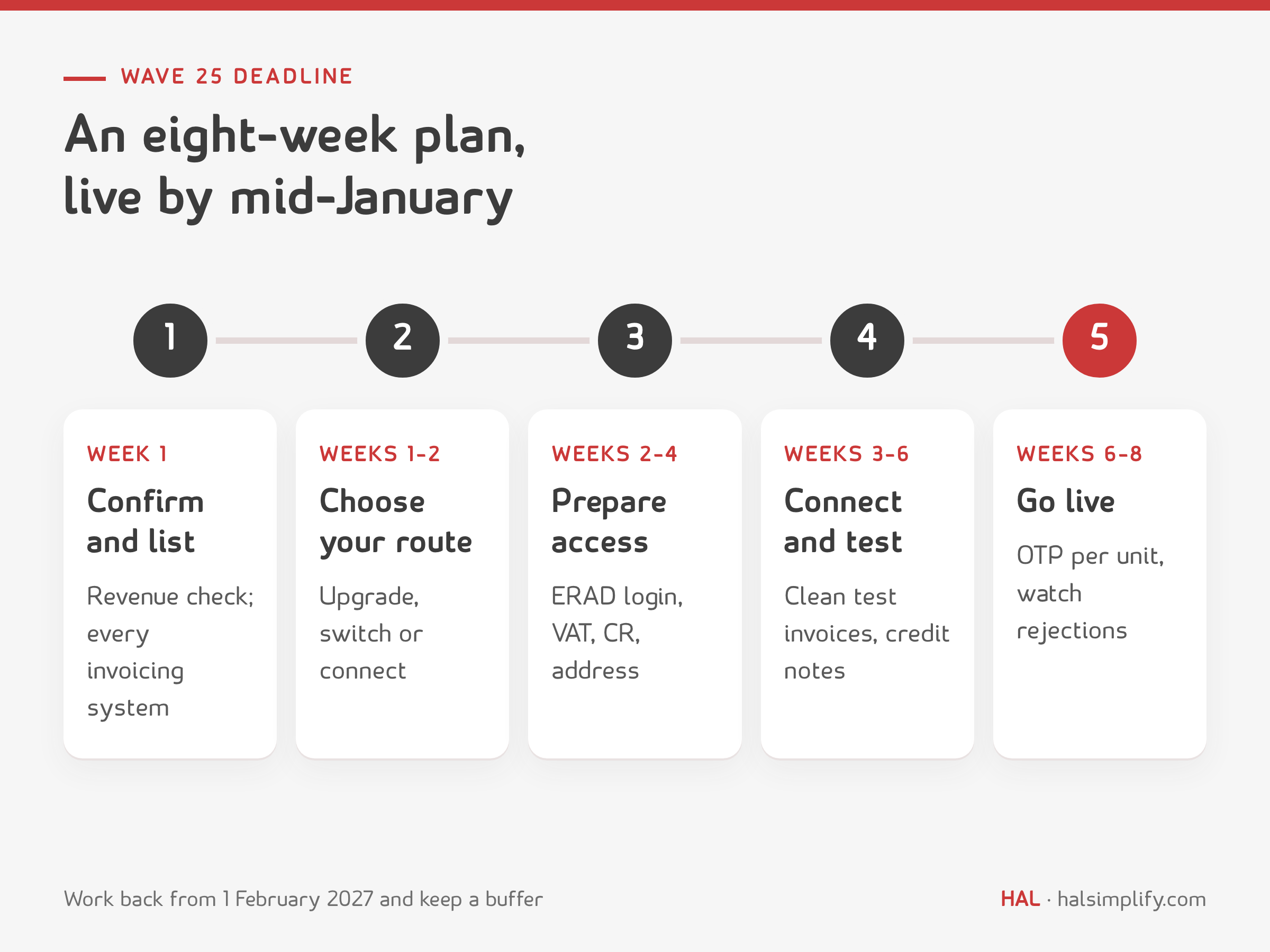
Work backwards from 1 February 2027 and aim to be live by mid-January. That leaves room for a public holiday, a slow supplier or a stubborn rejection code.
ZATCA's published penalty guide (January 2022) covers e-invoice violations such as not issuing or not saving invoices electronically, leaving out the QR code, deleting or changing an invoice after it is issued, and not telling ZATCA about a malfunction that stops you issuing invoices. The guide starts with a notice, then fines of SAR 1,000, 5,000, 10,000 and 40,000 for repeated violations. A repeat more than 12 months later starts again with a notice.
Records must be kept for at least six years from the end of the tax period they relate to, under the VAT Implementing Regulations. In practice that means your e-invoices, in the format ZATCA requires, need a home that will still be there in 2033.
You do not have to replace your system to comply. HAL VAT CARE connects any ERP, POS, billing system or app to Fatoora through one API, or through an Excel upload if your system cannot call an API. It signs, clears and reports every invoice, handles your certificates, and shows every rejection with the reason in Arabic and English. Most businesses are live in about two weeks. HAL is listed by ZATCA as a Phase 2 provider (as "HAL ERP"), and VAT CARE is hosted in Saudi Arabia.
When SISI, a UK student-information system that invoices for a school in Jeddah, struggled to integrate with another provider's API, it moved to VAT CARE and went live in under a week.
If you are weighing providers, see how the options compare in e-invoicing providers in Saudi Arabia compared.
Wave 25 is the latest group of taxpayers ZATCA has selected for Phase 2 (integration) of e-invoicing. It covers every taxpayer whose revenue subject to VAT exceeded SAR 187,500 in 2022, 2023, 2024 or 2025, unless an earlier wave already selected them.
Wave 25 taxpayers must connect their e-invoicing solution to ZATCA's Fatoora platform by 1 February 2027. ZATCA announced the wave on 24 July 2026 and notifies each targeted taxpayer.
Yes. ZATCA's criterion is revenue subject to VAT above SAR 187,500 during 2022, 2023, 2024 or 2025, so one year above the threshold is enough.
No. Phase 2 requires your system to connect to Fatoora: tax invoices are cleared by ZATCA before you share them, and simplified invoices are reported within 24 hours. Each invoicing unit is onboarded with its own OTP and certificate.
ZATCA's penalty guide (January 2022) treats e-invoicing violations with a notice first, then fines of SAR 1,000, 5,000, 10,000 and 40,000 for repeats. Missing the date also means invoicing outside the rules until you are connected.
Yes. An integration layer such as HAL VAT CARE connects your existing system to Fatoora by API or Excel upload, so you keep the software your team already uses. Most businesses are live in about two weeks.