
In short: A good lesson observation form checks whether the teacher's plan actually reaches the students. In the RISE implementation register, department heads make short unannounced drop-ins and one full observation per teacher each month, score ten areas out of 100 with the teacher's RISE note in hand, and agree one next step in a ten-minute conversation. Below: how it works, a fair scoring guide for every area, and a free kit (PDF guide and Excel tracker).
A department head walks into Grade 7 Mathematics with a clipboard. The teacher stiffens, the class goes unusually quiet, and for forty minutes everyone performs. The head writes "Good lesson, 78" and leaves. The teacher never finds out what the 78 was for, and next month the same thing happens again.
Most schools observe lessons. Fewer turn those visits into better teaching. This article explains the implementation register: the department head's record of a classroom visit, made with the teacher's RISE note in hand. You watch the lesson, score ten areas of delivery out of 100, and agree one next step with the teacher. The free observation kit at the end gives you the printable forms, a scoring guide for every area and an Excel tracker that adds it all up.
If you have not met RISE yet, start with the RISE lesson plan format. Every lesson moves through four steps: Recap the previous class, Instruction, Summarise and Evaluate. Teachers keep a one-page RISE note on the desk and teach from it.
If you supervise teachers, some of these will sound familiar.
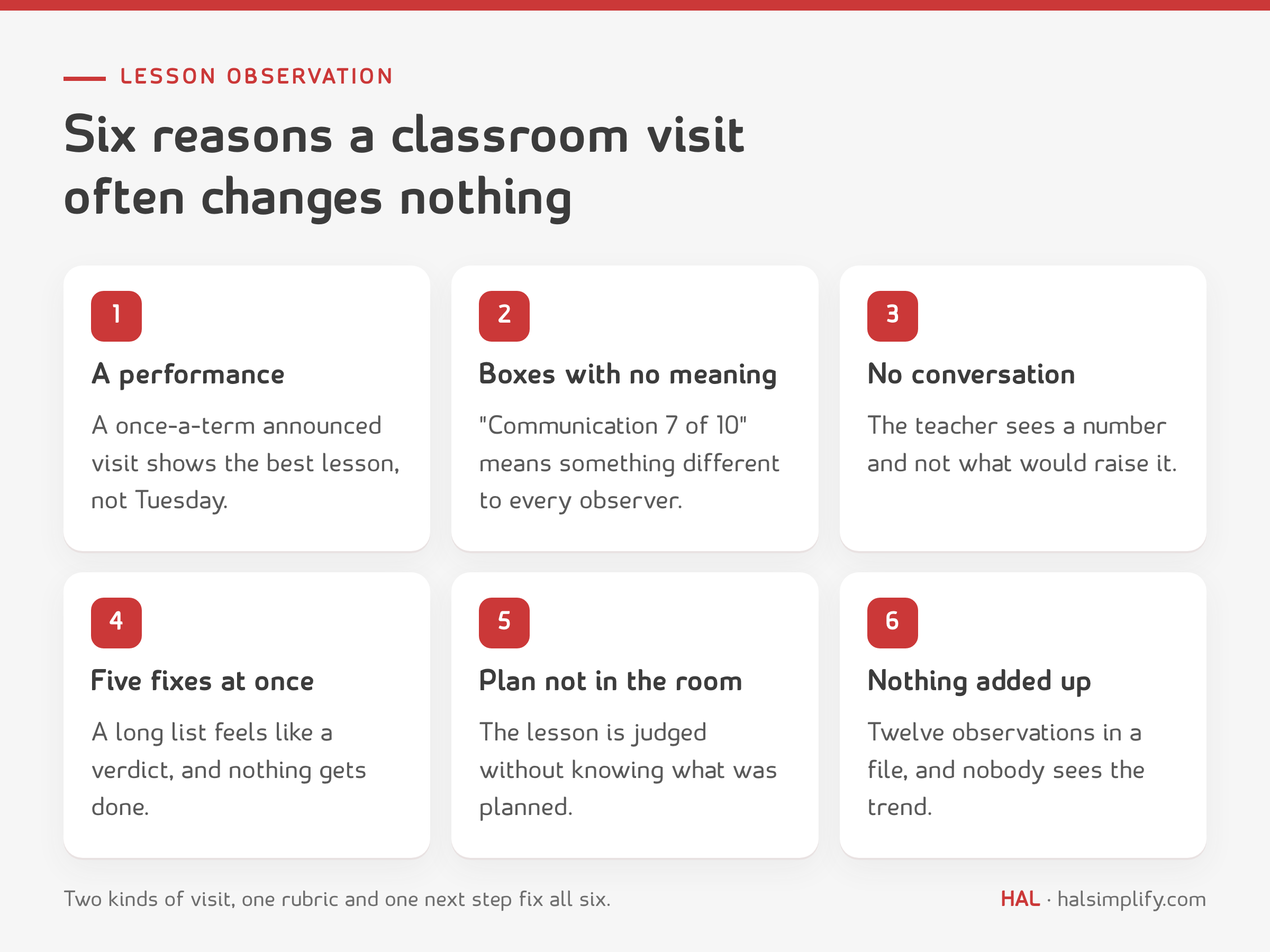
The implementation register fixes these with two kinds of visit, one scoring guide, and a short conversation after every full observation.
| Visit | How long | How often | What you record |
|---|---|---|---|
| Drop-in | 15–20 minutes, unannounced | At least two per teacher per month | Four quick checks and one line of notes. No score. |
| Full observation | The whole period, agreed with the teacher a day ahead | One per teacher per month | All ten areas, scored out of 100, then a feedback conversation |
Drop-ins show you ordinary lessons. They are short enough to do during your daily rounds, and frequent enough that teachers stop treating a visitor as an event. The full observation is where the scoring and coaching happen.
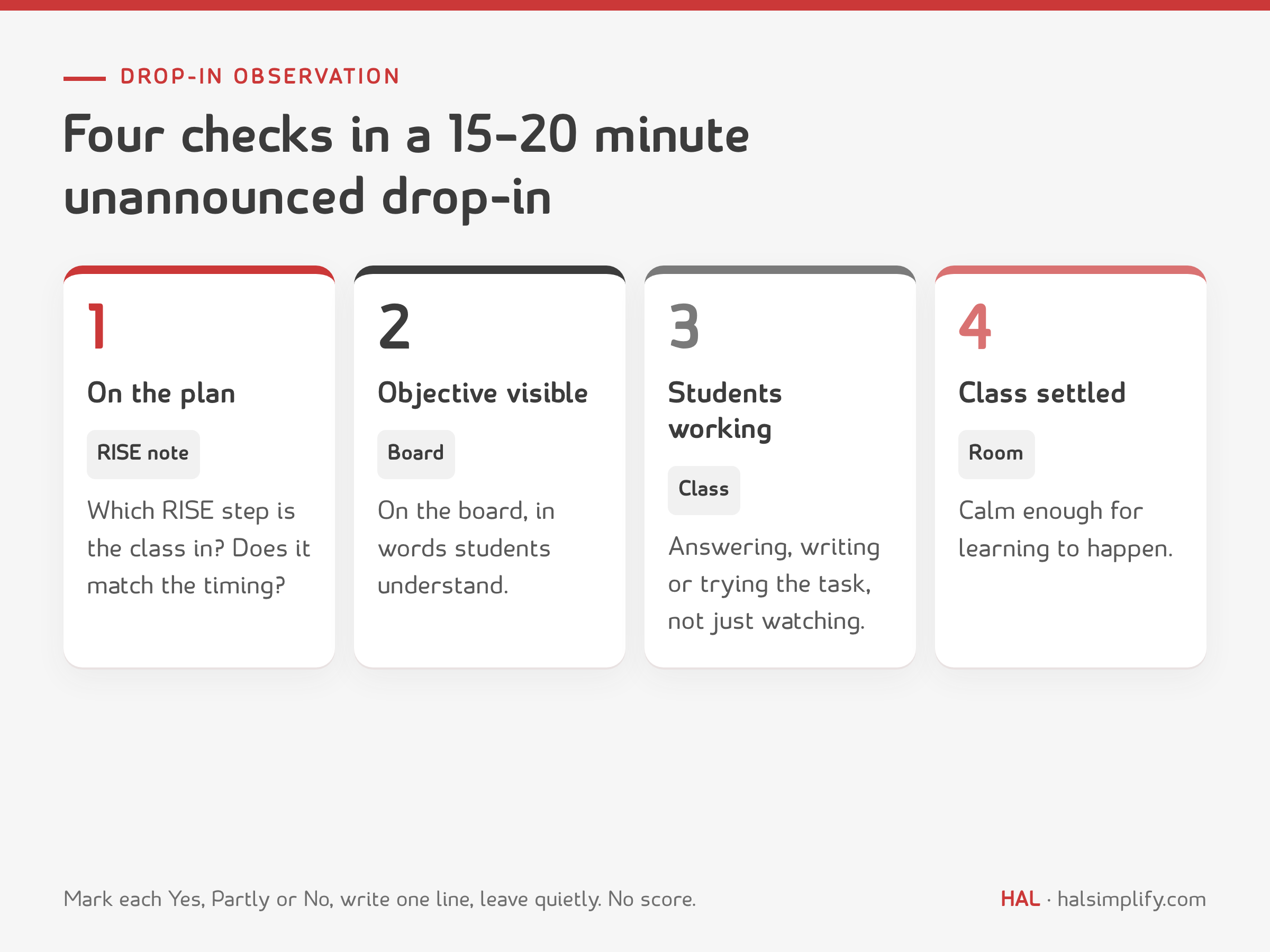
On a drop-in, check four things against the teacher's RISE note:
Mark each Yes, Partly or No. Write one line. Leave quietly.
Sit where you can see students' faces, with the RISE note in front of you. Rate each area 3 Strong, 2 Adequate, 1 Weak or 0 Missing. Points are the rating divided by 3, times the area's weight.

| Area | Points | Strong looks like |
|---|---|---|
| RISE steps in class | 20 | All four steps happen, close to the note's timing. Any change has a reason the teacher can explain. |
| Teaching aids | 10 | The aid makes the idea clearer, arrives at the right moment and every student can see or use it. |
| Communication | 10 | A clear voice, language at the class's level, instructions given once and followed. |
| Presentation | 10 | The objective is stated in student language and the lesson is organised and engaging. |
| Concept clarity | 10 | The explanation is clear and illustrated, and misconceptions are caught and corrected. |
| Questioning | 10 | Specific questions, to the whole class and not only volunteers, including some that make students think. |
| Student response | 10 | Most students answer, try the task and ask questions. |
| Board work | 5 | Neat and organised; the objective and the summary are still there at the end. |
| Time management | 5 | Starts on time, each step near its planned minutes, and Evaluate is not squeezed out. |
| Class control | 10 | Routines work and behaviour is handled without stopping the learning. |
RISE steps carry 20 points because they connect the plan to the lesson; that is the whole point of the visit. Teaching aids are judged on what they do for students. A well-chosen map that makes a river system click is worth more than a video played in the background. The kit gives full descriptions for all four levels of every area, so two observers watching the same lesson reach the same score.
The total gives a band, and each band has a next action:
The score is the least useful part of the visit. The conversation is where teaching changes. Hold it within two school days, while the lesson is still fresh.
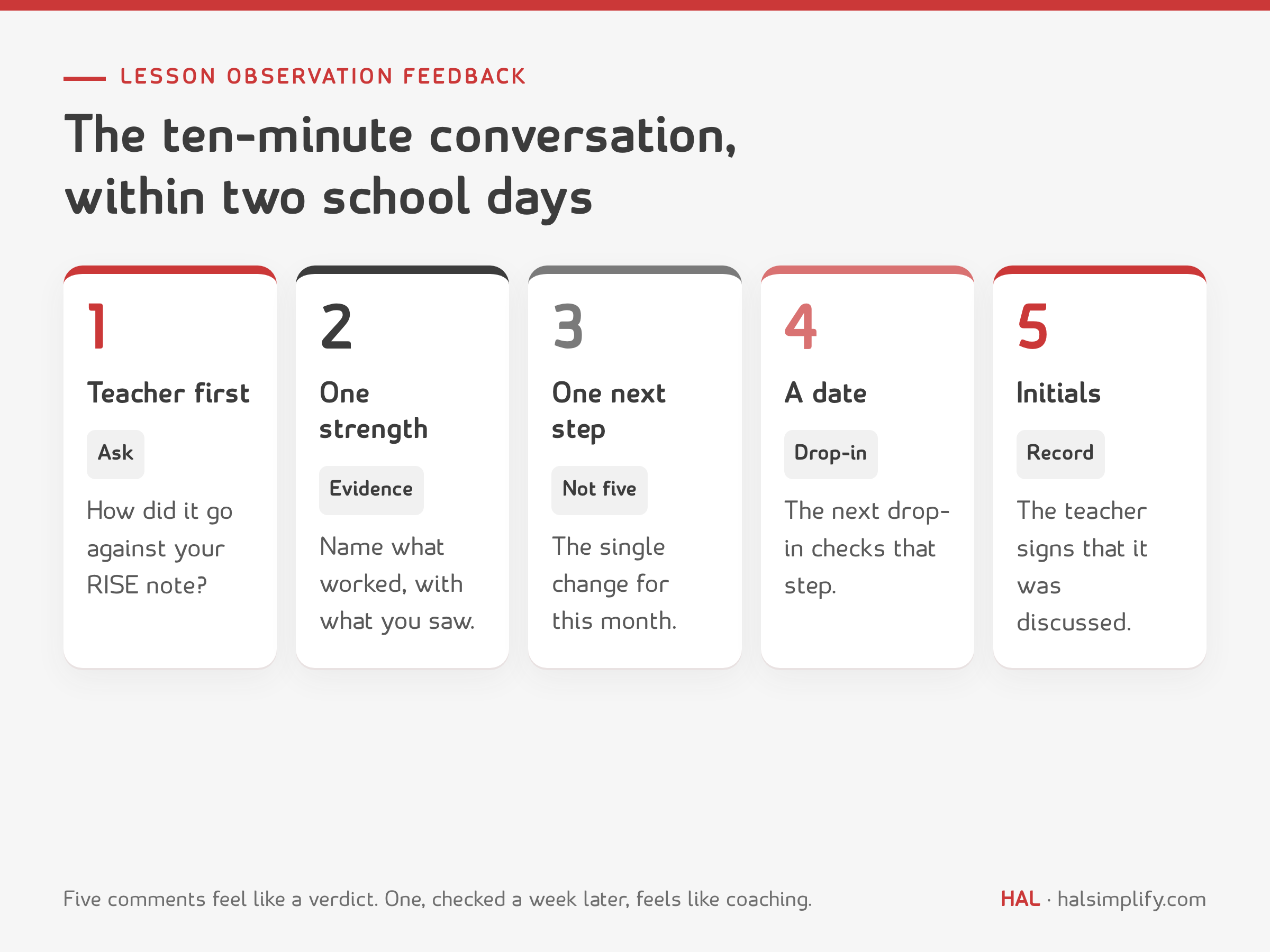
Five comments feel like a verdict. One comment, checked a week later, feels like coaching.
At the end of each month, look at every teacher's line: drop-ins done, the full observation score and band, whether feedback happened within two school days, and the next step. Put it beside the teacher's average RISE note score. A big gap either way tells you something. Strong notes with weak lessons mean the plan is written for the file. Weak notes with strong lessons mean a good teacher needs a simpler note, not a lecture.
The register was first run on paper in an international school in Riyadh, alongside the RISE lesson plan. Using it showed where it needed work:
| Original register | This edition |
|---|---|
| Six of ten areas had no descriptions | Every area described at four levels |
| Teaching aids scored by type (audio-visual 10, maps 6) | Scored by how well the aid helps students; types kept as examples |
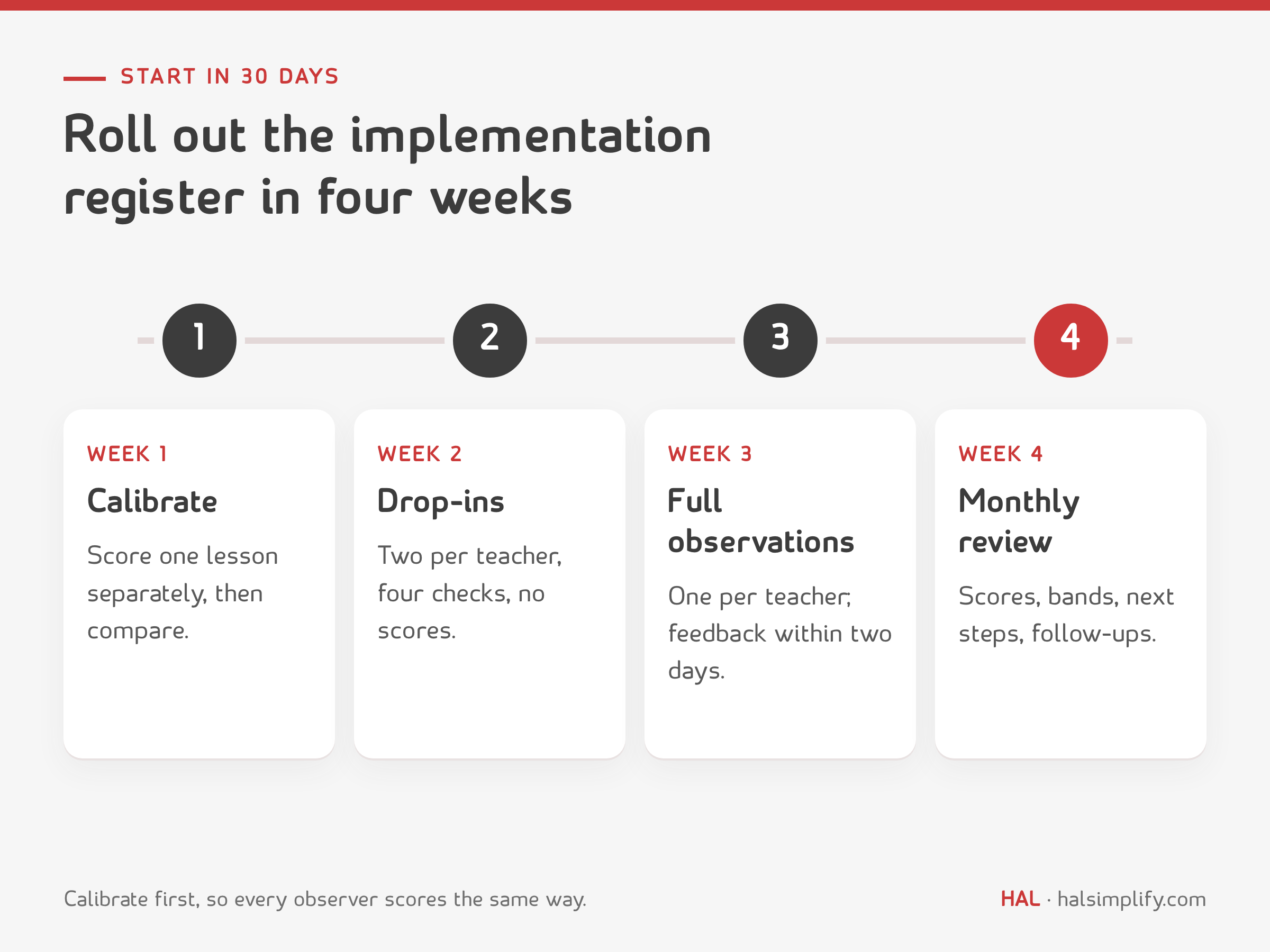
| No rule for how often or how long to visit | Two drop-ins and one full observation per teacher per month |
| No feedback or teacher sign-off | Ten-minute conversation within two school days, one next step, teacher initials |
| Month only, no date or period | Date, period and visit type for every visit |
| No meaning for the total | Four bands, each with a next action |
| "Handwriting" | Board work, including the objective and summary |
| Totals copied into the monthly report by hand | Calculated automatically in the Excel tracker |
The kit has everything in this article, ready to use:
Paper forms and a spreadsheet are the right place to start. As the school grows, the slow part becomes scheduling visits, chasing feedback and lining up observation and lesson-plan results for every teacher each month. HAL Edge, HAL's education management system for schools in Saudi Arabia, keeps admissions, student data, faculty performance, fees and school operations in one system, in Arabic and English.
This is the second article in our series on school systems that work. Next: substitutions and supervisor rounds, notebook and homework checks, class scoreboards, the monthly best classroom and exam analysis, each with its own free template.
The class, teacher, date and period, the teacher's planned timing for each RISE step, a 0–3 rating with evidence for ten areas of delivery, the total and band, one strength, one next step with a check date, and the date of the feedback conversation with the teacher's initials.
This kit suggests at least two short unannounced drop-ins and one full scored observation per teacher per month. Drop-ins show ordinary lessons; the full observation is where scoring and coaching happen.
A 15–20 minute unannounced visit with four checks made against the teacher's RISE note: whether the class is on the plan, whether the objective is visible, whether students are working and whether the class is settled. Each check is marked Yes, Partly or No, with no score.
Hold a ten-minute conversation within two school days. Let the teacher go first, name one strength with evidence, agree one next step, set a date to look again and ask the teacher to initial the record.
Use one teacher observation rubric that describes all four levels of every area, and have observers score the same lesson separately and compare before the first round of visits.
Yes. The kit is a free download: a PDF guide with printable forms and an Excel tracker that calculates scores, bands and feedback timing for every teacher.