

In short: RISE is a one-page lesson plan format built on four steps every lesson follows: Recap, Instruction, Summarise and Evaluate. Teachers keep the one-page lesson plan template on the desk while they teach; school leaders review it with one 50-point rubric and check it against the real lesson every month. Below: how RISE works, how to score it fairly, and a free kit (PDF guide and Excel register) to run it in your school.
It is Wednesday night. A Grade 6 teacher is copying last year's lesson plan into this year's template, changing the date and the class. On Sunday morning a coordinator signs a pile of forty plans in twenty minutes. On Monday the lesson goes ahead from memory, because nobody teaches from a three-page document. The plan stays in the file.
Long lesson plans have a place: they help a Head of Department review coverage and standards. But they are not a guide a teacher can follow during a 40-minute period. This article explains RISE, a simple four-step structure that teachers actually use in class, first run in an international school in Riyadh, what we learned from using it, and how to start it in your school next week. The free RISE kit at the end gives you the printable RISE note, a scoring rubric and an Excel register that does the arithmetic for you.
If you lead teachers, you will recognise at least three of these:
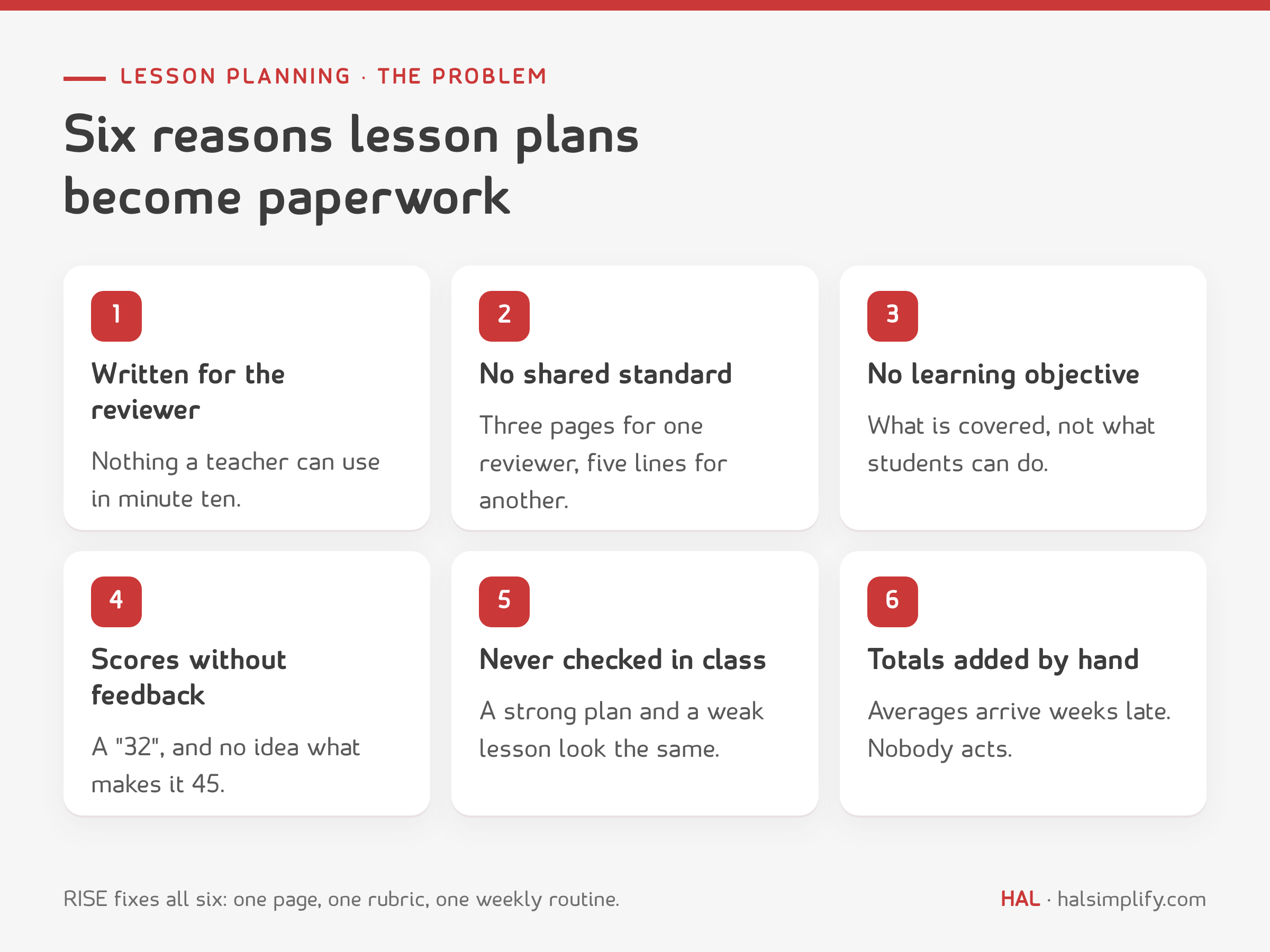
RISE fixes these with one short structure teachers keep on the desk, one rubric and a light weekly routine. These are the same problems we hear from school leaders across Saudi Arabia; we wrote about the wider list in common problems schools face and how to solve them.
Every lesson, in every subject, moves through the same four steps. The points are what each step is worth when the RISE note is reviewed, and they double as a time guide for a 40-minute period.
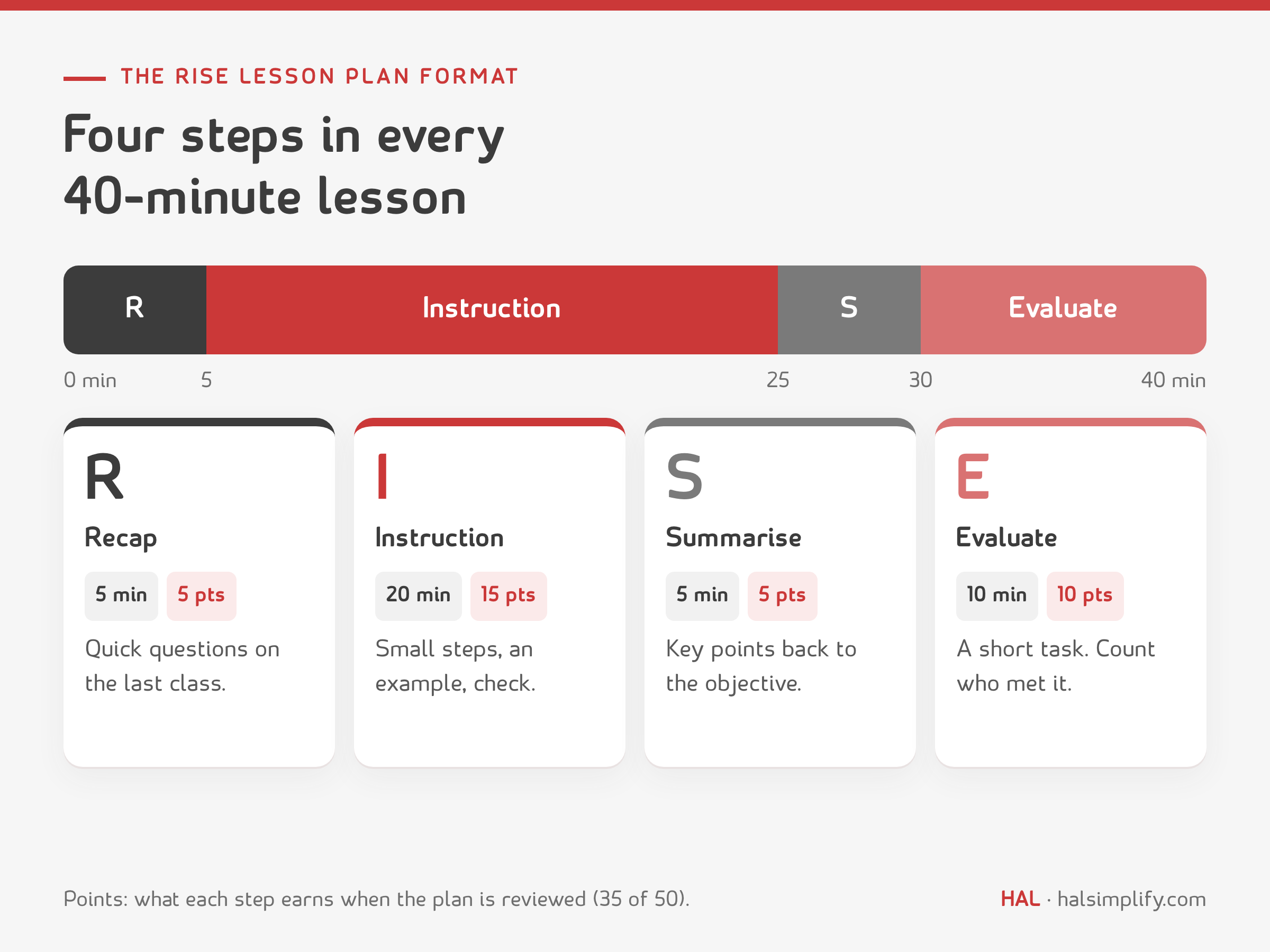
| Step | Points | Time (40 min) | What happens |
|---|---|---|---|
| R · Recap | 5 | ~5 min | Recap the previous class with three to five quick questions, so today builds on what students already have. Every student answers, not only the volunteers. |
| I · Instruction | 15 | ~20 min | The main teaching time of the class. Share the objective, teach the new idea in small steps with a worked example and a teaching aid, check understanding, practise together. Plan support for students who struggle and stretch for those who finish early. |
| S · Summarise | 5 | ~5 min | The teacher sums up the class in a few minutes: the key points and key words, tied back to the objective, left on the board. |
| E · Evaluate | 10 | ~10 min | Evaluate students' understanding with a short task tied to the objective. The teacher counts how many students met it, writes the number down, and sets homework that follows. |
Instruction carries the most points because that is where new learning happens. Evaluate is second because a lesson nobody checked is a lesson you cannot improve. Recap and Summarise are short, but skipping them is the most common reason students have forgotten a lesson by next week.
The structure is not new for its own sake. Barak Rosenshine's widely used Principles of Instruction (American Educator, Spring 2012) opens with "begin a lesson with a short review of previous learning" and asks teachers to present new material in small steps and to check for student understanding. RISE turns those habits into four boxes on one page that a teacher can glance at mid-lesson.
The RISE note is written the week before and kept on the desk during the lesson. Short lines a teacher can glance at, not paragraphs. If it needs more than one page, it is a unit plan, not a RISE note. It holds: lesson and class, a learning objective ("Students will be able to…"), success criteria ("I can…"), the four steps with minutes, resources, and one line that most plans miss: after the lesson, how many students met the objective and what to change next time.
That last line takes a minute to fill in. It is also the best evidence a coordinator will ever get about whether teaching worked, and it tells the teacher what to put in the next Recap.
The original RISE register gave points for each step but never described what earned them, so two reviewers could score the same plan very differently. This edition uses one rating for everything:
3 Strong · 2 Adequate · 1 Weak · 0 Missing. Points = rating ÷ 3 × the maximum.
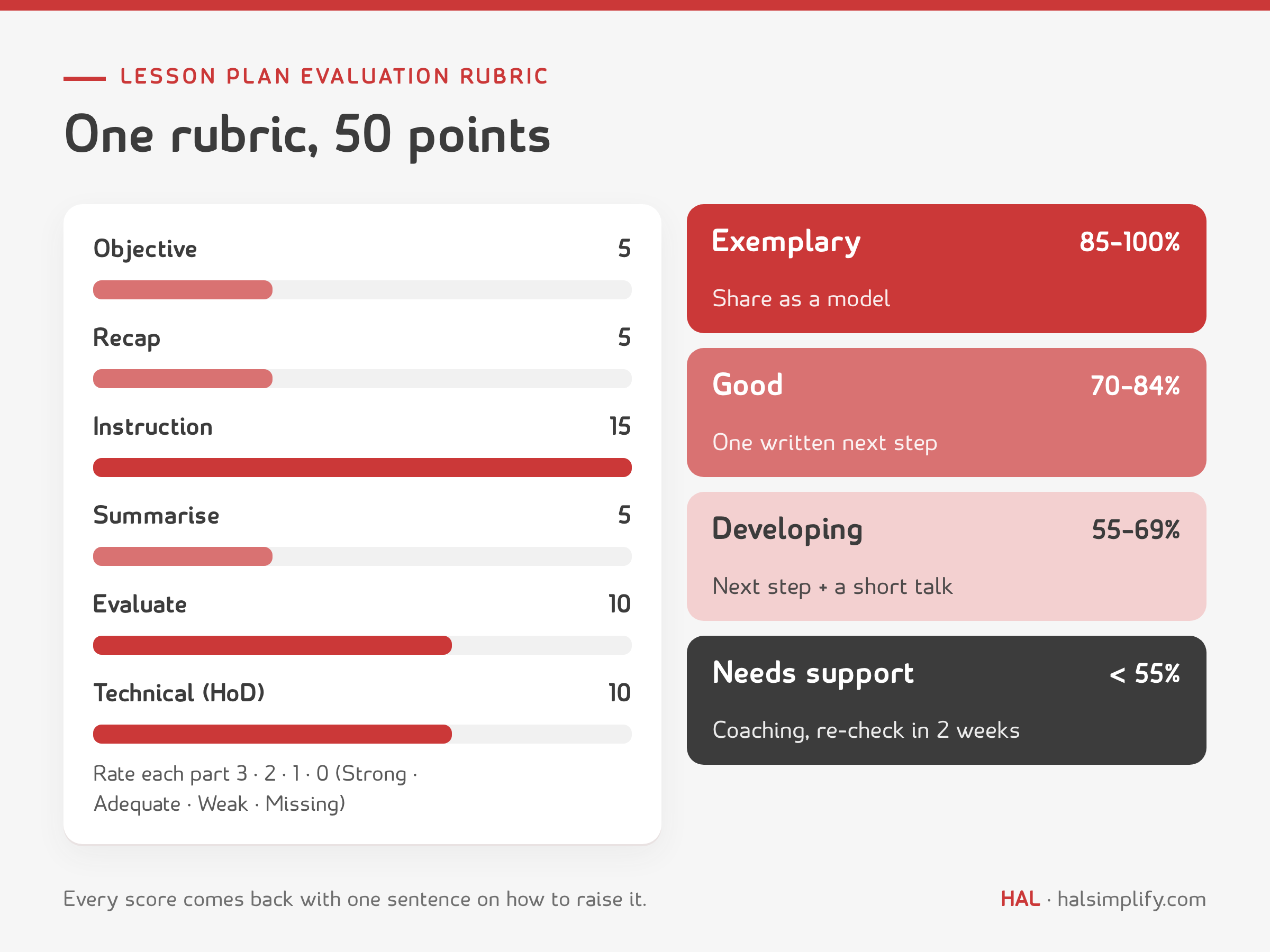
| Part | Max | Strong looks like |
|---|---|---|
| Objective and success criteria | 5 | One clear "students will be able to…", with criteria a student could check |
| R · Recap | 5 | Specific questions on the previous class that lead into this one |
| I · Instruction | 15 | Small steps, worked example, teaching aid, check for understanding, support and stretch |
| S · Summarise | 5 | Teacher sums up the key points against the objective in a few minutes |
| E · Evaluate | 10 | Task tests the objective, with a pass mark and homework that follows |
| Technical soundness | 10 | Accurate content at the right level, checked by the Head of Department |
Two deductions keep the routine honest, and both are capped so a score can never go below zero:
The net score becomes a percentage and a band, and each band has a clear next step:
Two rules matter more than the numbers: no score goes back to a teacher without one sentence on what would raise it, and length is not quality. A note a teacher can follow at a glance scores the same as, or better than, three pages saying the same thing. Reviewers should ask for clearer steps, never for more writing.
| When | Who | What |
|---|---|---|
| Thursday 12:00 | Teacher | Submits next week's RISE notes |
| Sunday | Head of Department | Scores technical soundness and corrects errors before the lesson is taught |
| By Monday | Coordinator or vice principal | Scores the other five parts and writes the next step |
| During the week | Coordinator or vice principal | Observes lessons, plan in hand: at least two per teacher per month |
| Last school day of the month | VP and principal | Monthly review |
If a coordinator needs more than five minutes to score a plan, either the plans are too long or the reviewer is rewriting them. The plan belongs to the teacher; the review is a nudge.
A plan score tells you how well a teacher plans. Only an observation tells you whether the plan reached the students. The RISE observation sheet scores ten areas out of 100 with the same 3–2–1–0 ratings: RISE steps visible in class (20), teaching aids, communication, presentation, concept clarity, questioning, student response, classroom management (10 each), board work and time management (5 each).
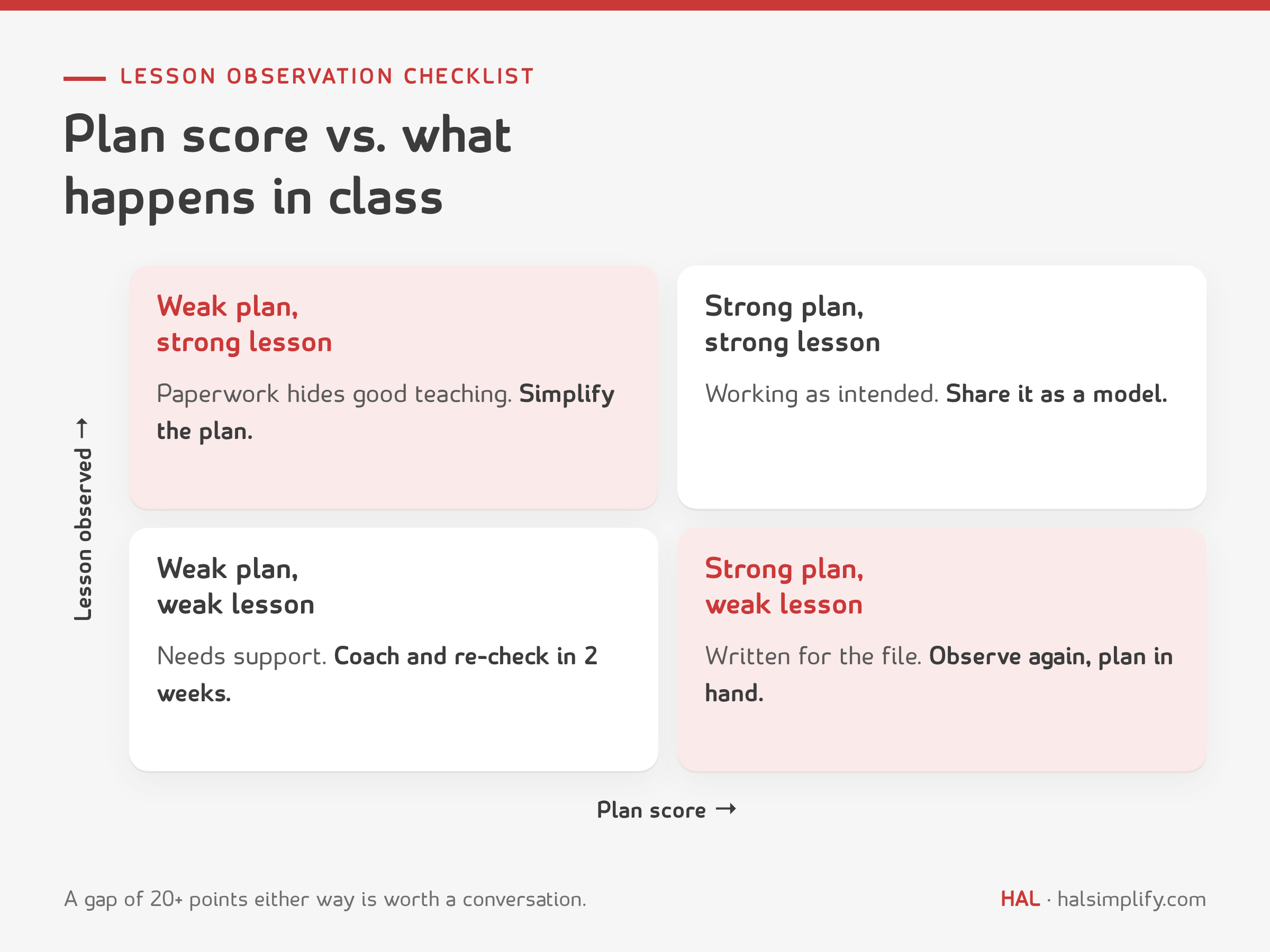
Each month, compare every teacher's average plan score with their average observation score. A gap of more than 20 points either way is worth a conversation. Strong plans with weak lessons mean the plan is written for the file. Weak plans with strong lessons mean a good teacher is spending time on paperwork that does not reflect their work, and the plan should get simpler.
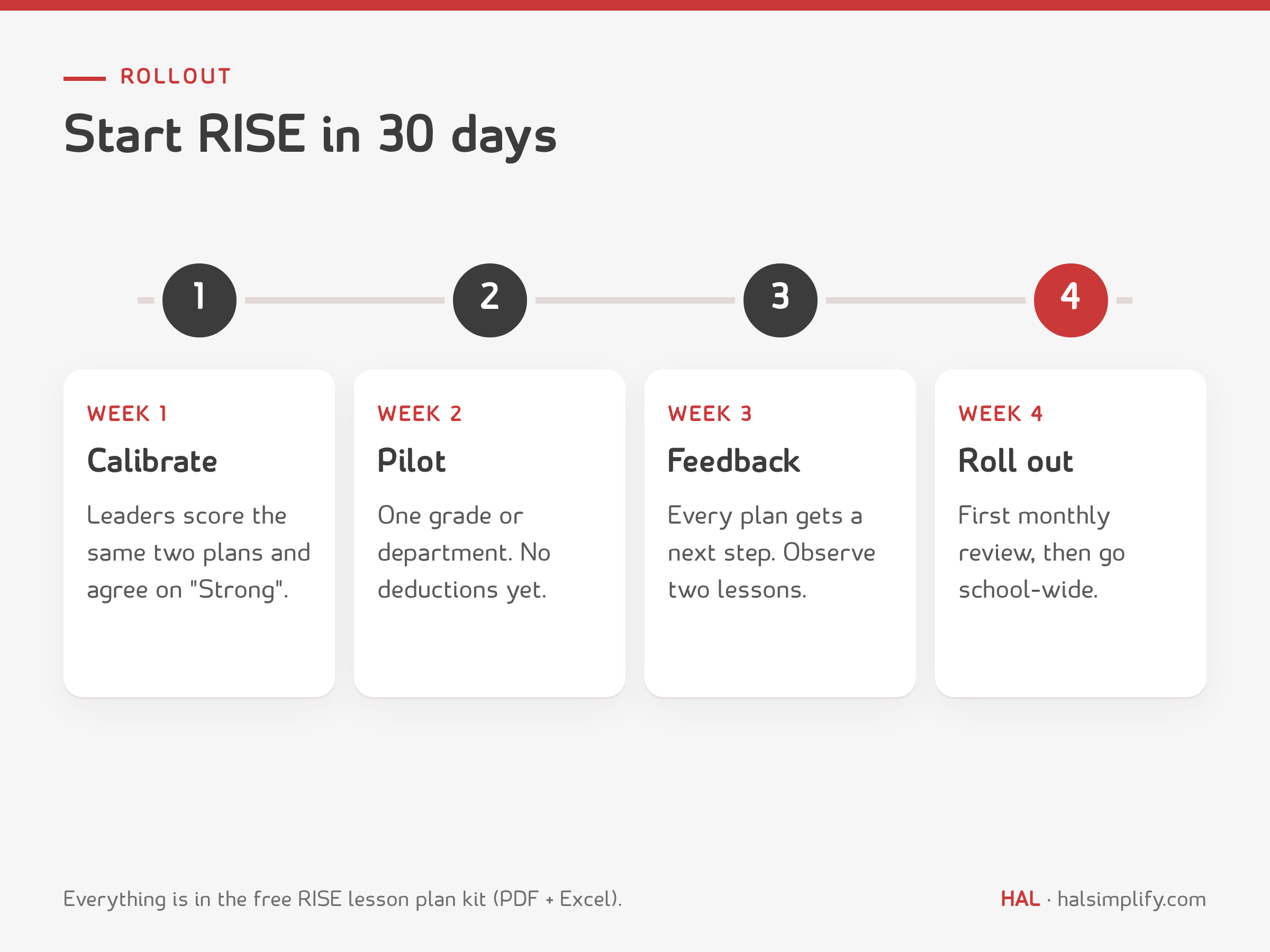
RISE ran as a paper register for several years. Running it showed where it needed work, and this edition fixes it:
The kit has everything in this article, ready to use:
Paper and spreadsheets are the right place to start. As the school grows, the slow part of RISE becomes collecting plans, chasing late ones and lining up plan and observation results every month. The bigger lesson from running RISE is that academic quality is a data problem as much as a teaching one: plan scores, observations, exam results and parent updates usually live in different files, so nobody sees the whole picture of a class until the term is over.
That is the gap HAL Edge, HAL's school management system for Saudi Arabia, is built to close. It keeps student records and academic history, exams and grade analytics, faculty performance, fees and parent communication in one system, in Arabic and English. Schools such as the Indian International School Riyadh run student management, attendance and performance analysis on HAL Edge. Start RISE on paper or in the free kit; when you want your academic routines to sit beside the rest of your school's data, see how HAL Edge would fit your school.
RISE is a one-page lesson plan format with four steps: Recap the previous class, Instruction of the new idea, Summarise the key points, and Evaluate students' understanding. In a 40-minute period that is roughly 5, 20, 5 and 10 minutes.
A good lesson plan includes one learning objective ("students will be able to…"), success criteria students can check, the steps of the lesson with timings, the resources needed, and a short note after the lesson on how many students met the objective. RISE fits all of this on one page.
Use one rubric for every reviewer and describe what each score means. RISE rates six parts (objective, Recap, Instruction, Summarise, Evaluate and technical soundness) as Strong, Adequate, Weak or Missing for a total of 50 points, and every score comes back with one sentence on what would raise it.
For daily teaching, one page. A teacher should be able to glance at it mid-lesson. Longer documents belong in the unit or term plan, and a longer plan should never score higher just for being longer.
Observe lessons with the plan in hand, at least twice per teacher per month, and score them with a lesson observation checklist. Each month compare the teacher's average plan score with their observation score; a gap of more than 20 points either way is worth a conversation.
Yes. The kit (a 12-page PDF guide and an Excel register) is free; enter your name and work email in the form above and it arrives by email.
RISE is the first article in our series on school systems that work. Next: substitutions and supervisor rounds, notebook and homework checks, class scoreboards, the monthly best classroom and exam analysis, each with its own free template.