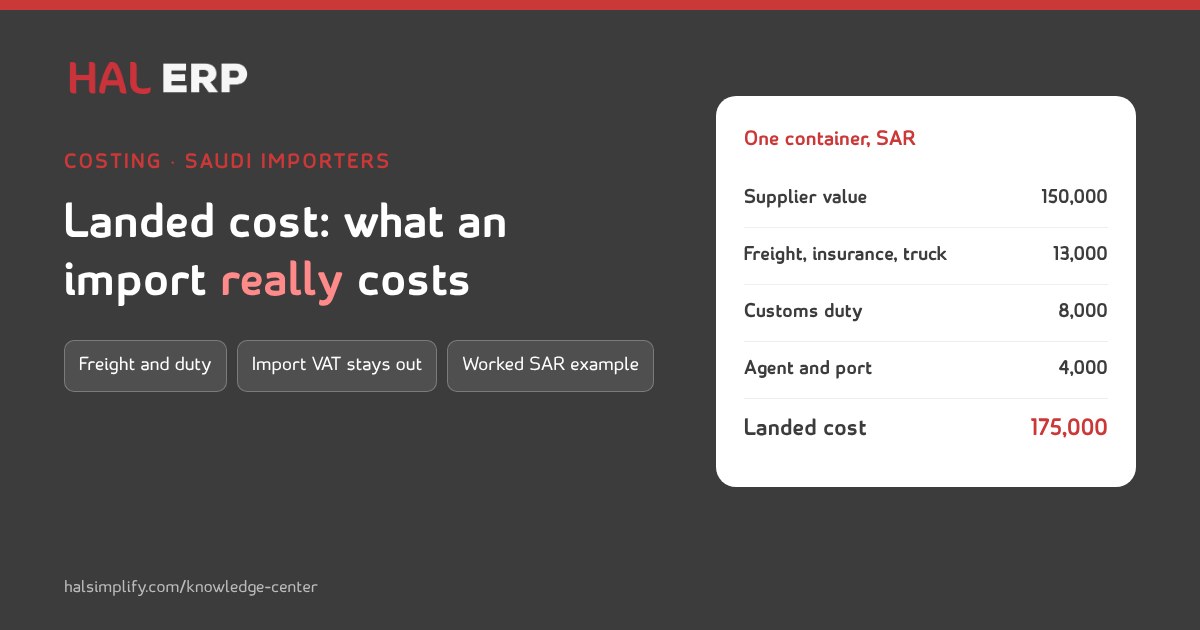
In short: Landed cost is what an imported item really costs once it is in your warehouse: the supplier price plus freight, insurance, customs duty, clearance, port and handling charges and inland transport. Import VAT paid at customs is not part of it, because a VAT-registered importer recovers it through the VAT return (it has its own line there). You share the shipment costs across items by value, weight, quantity or volume, and you finalise the figure once the bill of entry and the last cost invoice are in. Below: what goes in, how to allocate, a worked SAR example, and a free landed cost calculator (Excel and PDF guide).
The supplier invoice says USD 4 a unit. Sales prices the storage bins at SAR 22, thinking that leaves about 32%. Three months later the margin report shows 19%. Nobody made a mistake on the invoice. The freight, duty, clearance agent and truck to Riyadh were booked as monthly expenses, so they never reached the cost of the bins, and the price was set on a number that was only part of the cost.
This is the most common costing gap we see in Saudi trading and distribution companies. This guide shows how to build a landed cost that sales can price from, using one shipment from a supplier in China to a warehouse in Riyadh.
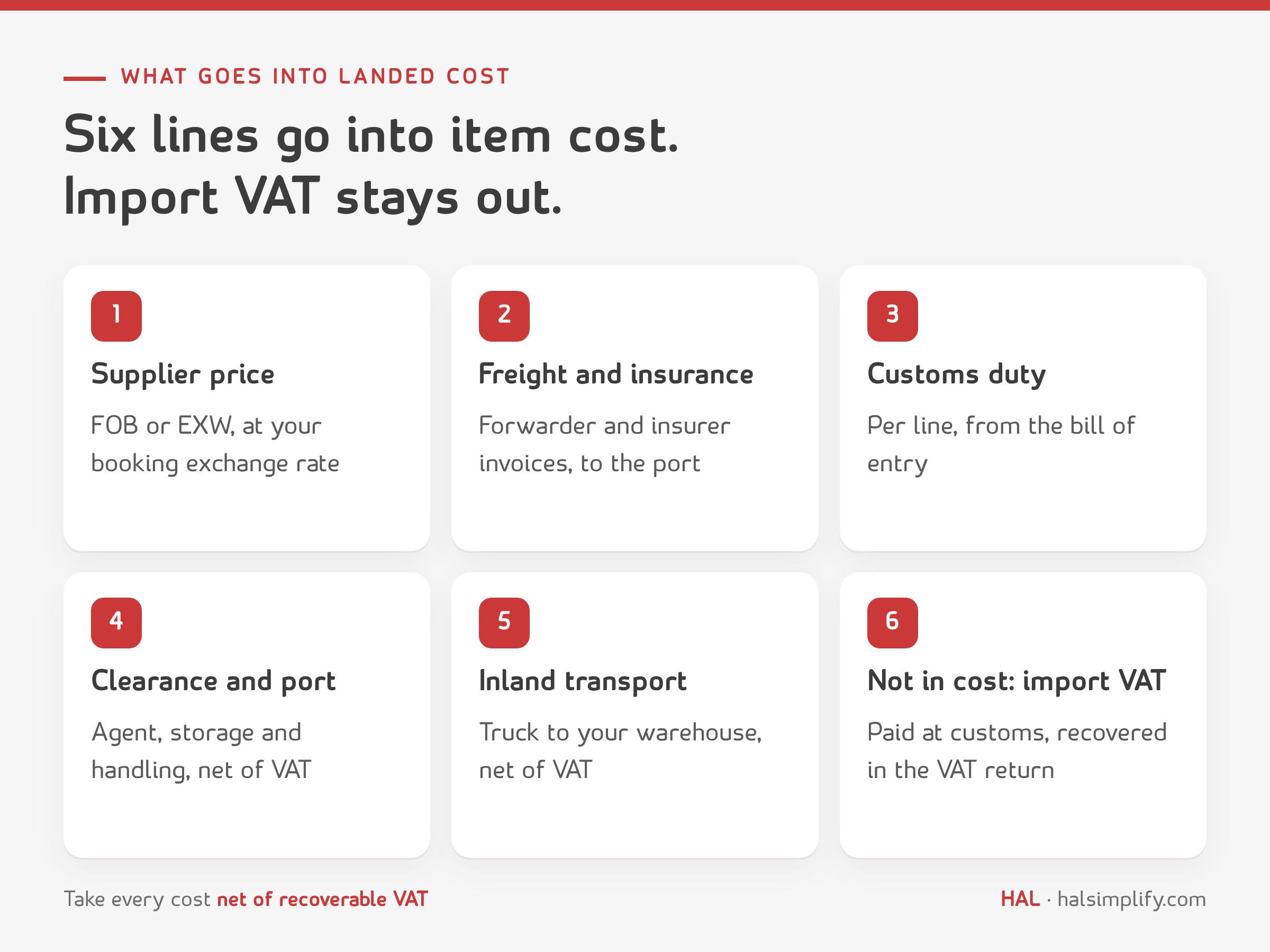
Landed cost includes every cost you pay to bring the goods to the place where you will sell or use them, and nothing you get back later.
| Cost line | In landed cost? | Where the number comes from |
|---|---|---|
| Supplier price (FOB or EXW) | Yes | Supplier invoice, converted at your booking rate |
| Sea or air freight | Yes | Forwarder invoice |
| Cargo insurance | Yes | Insurer or forwarder invoice |
| Customs duty | Yes | The bill of entry (customs declaration) |
| Clearance agent fee | Yes, net of VAT | Clearance agent invoice |
| Port, storage and handling | Yes, net of VAT | Port or agent invoice, and fees shown on the declaration |
| Inland transport to your warehouse | Yes, net of VAT | Transport company invoice |
| Import VAT paid at customs | No, if you are VAT-registered and can recover it | The bill of entry |
| VAT on local service invoices | No, if recoverable | Each local invoice |
Two rules sit behind the table. First, costs are taken net of recoverable VAT: the 15% on the clearance agent's invoice goes to input VAT, not into the item. Second, costs that are not about bringing the goods in (a sales commission, a showroom rent) stay as expenses.
ZATCA's guideline on imports explains that the customs value is the transaction value plus freight and insurance to the place of import, and that customs duty, excise and other fees on the declaration are added before VAT is worked out (ZATCA, Guideline on Imports and Exports under VAT, 2nd edition, May 2026). That is the customs side. Your landed cost goes further, because clearance, handling and the truck to your warehouse are real costs of the goods too.
One container usually carries several items, and the freight invoice does not say how much belongs to each. You choose a basis for each cost line.
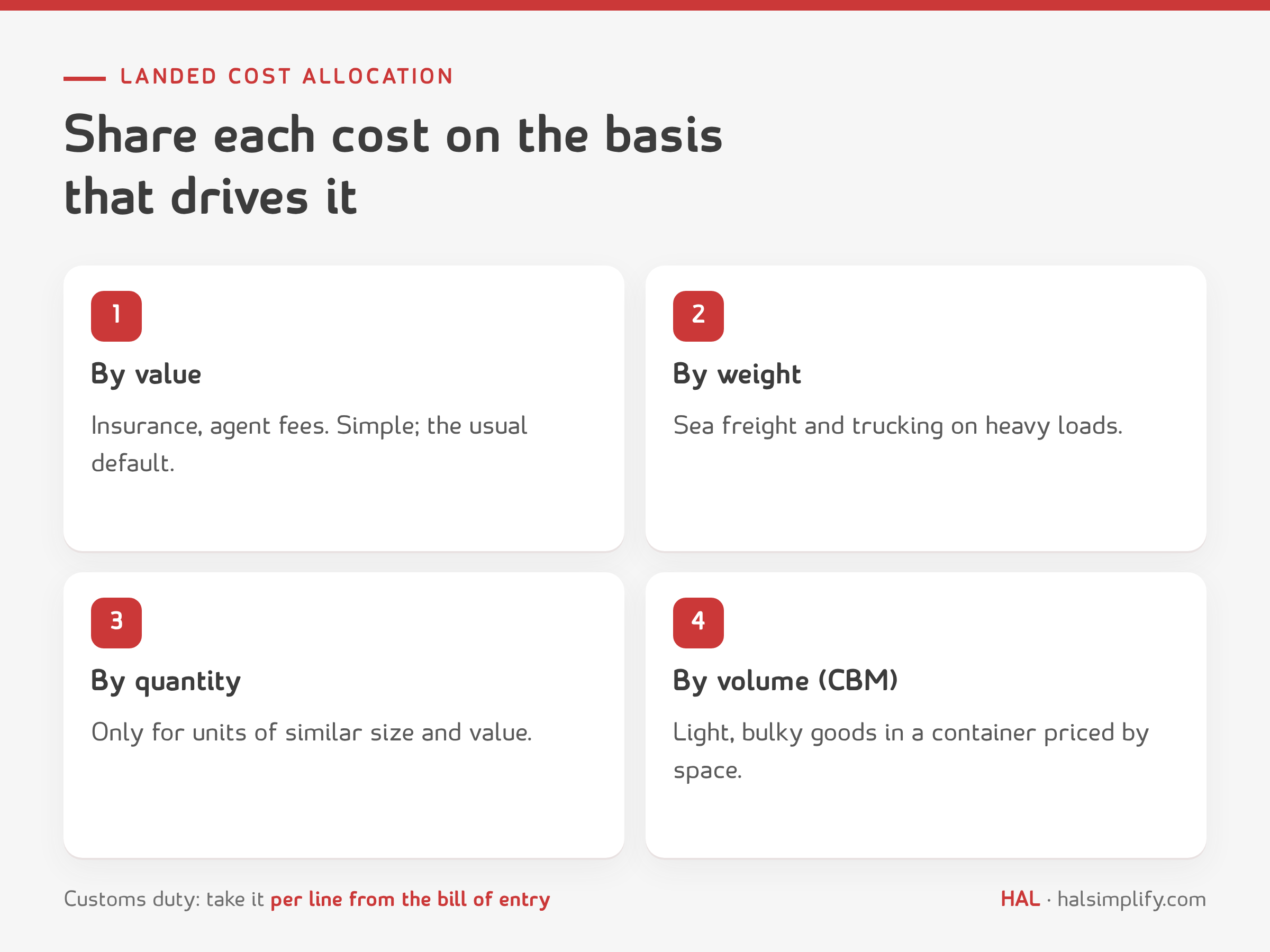
You do not need one method for everything. A common setup is freight and trucking by weight, insurance and agent fees by value, and duty from the declaration. Whatever you choose, write it down and keep it the same from shipment to shipment, so margins can be compared over time.
A Riyadh distributor imports three items from China in one container. The supplier is paid in US dollars, booked at SAR 3.75.
| Item | Quantity | Unit price | Supplier value (SAR) | Weight (kg) |
|---|---|---|---|---|
| A. Steel shelving unit | 400 | USD 50 | 75,000 | 8,000 |
| B. Plastic storage bin | 2,000 | USD 4 | 30,000 | 3,000 |
| C. LED work lamp | 1,000 | USD 12 | 45,000 | 1,000 |
| Total | 150,000 | 12,000 |
The shipment costs, all net of VAT:
| Cost line | SAR | Basis used |
|---|---|---|
| Sea freight to Jeddah | 9,000 | Weight |
| Cargo insurance | 1,000 | Value |
| Customs duty (from the bill of entry, an example rate of 5% on each line) | 8,000 | Per item from the declaration |
| Clearance agent fee | 1,500 | Value |
| Port and handling charges | 2,500 | Value |
| Truck from Jeddah to Riyadh | 3,000 | Weight |
| Total added cost | 25,000 |
The duty rate here is only an example. Your rate depends on the HS code of each item, so check it on your own declaration.
The allocation, item by item:
| A. Shelving | B. Bins | C. Lamps | Total | |
|---|---|---|---|---|
| Supplier value | 75,000 | 30,000 | 45,000 | 150,000 |
| Freight and truck by weight (12,000) | 8,000 | 3,000 | 1,000 | 12,000 |
| Insurance by value (1,000) | 500 | 200 | 300 | 1,000 |
| Duty from the bill of entry | 4,000 | 1,600 | 2,400 | 8,000 |
| Agent and port by value (4,000) | 2,000 | 800 | 1,200 | 4,000 |
| Landed cost | 89,500 | 35,600 | 49,900 | 175,000 |
| Landed cost per unit | 223.75 | 17.80 | 49.90 |
The shipment cost SAR 175,000 to land, 16.7% more than the supplier invoice. Each item carries a different share. The bins, priced at SAR 15 on the supplier invoice, cost SAR 17.80 on the shelf.
Keep the duty from the bill of entry and put the other SAR 17,000 of shipment costs on a single basis, and the unit costs move:
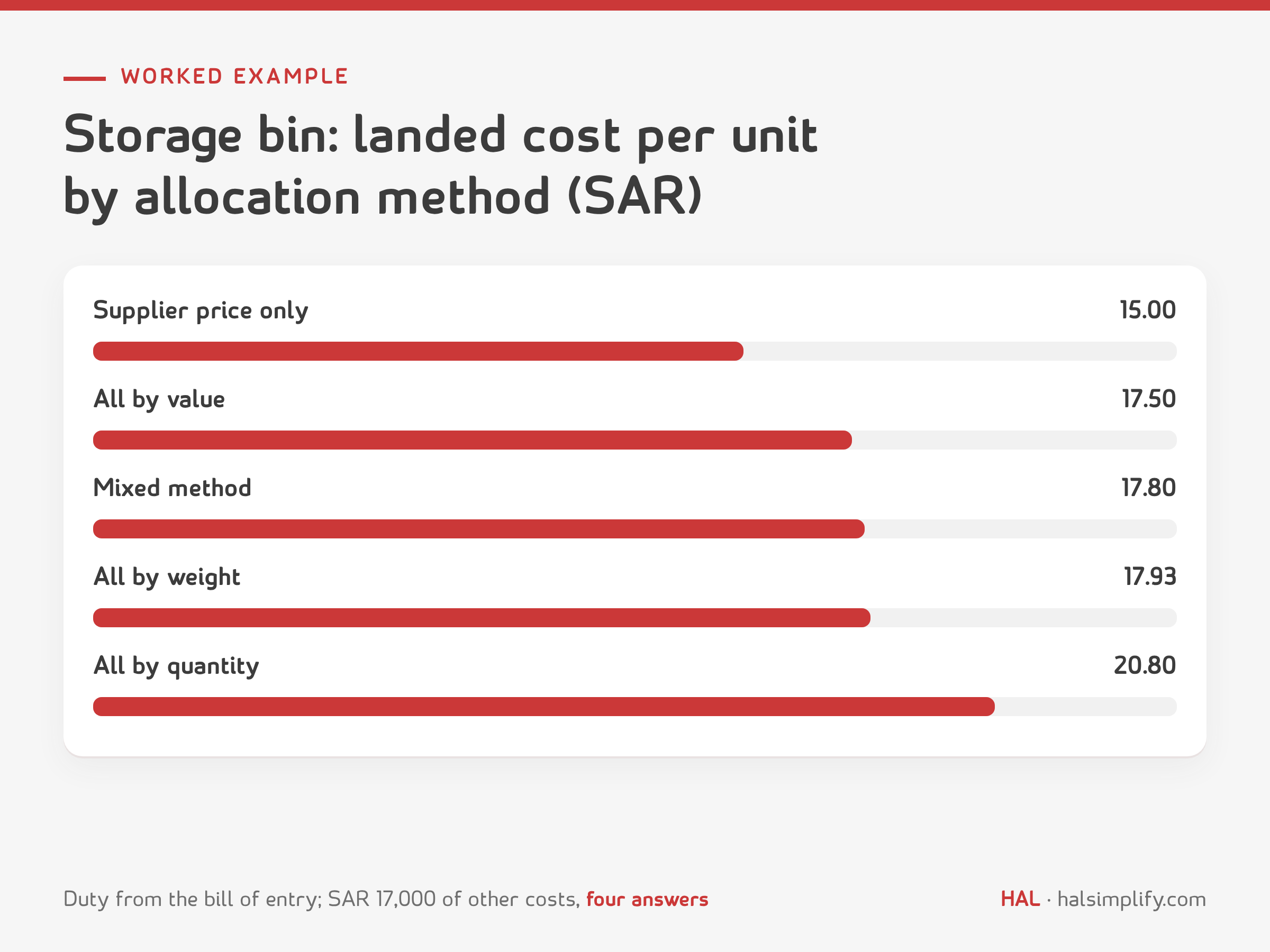
| Unit cost (SAR) | By value | By weight | By quantity | Mixed (above) |
|---|---|---|---|---|
| A. Shelving | 218.75 | 225.83 | 202.50 | 223.75 |
| B. Bins | 17.50 | 17.93 | 20.80 | 17.80 |
| C. Lamps | 52.50 | 48.82 | 52.40 | 49.90 |
By quantity, the 2,000 cheap bins would carry SAR 10,000 of the shipment costs and the heavy shelving only SAR 2,000, so the shelving would look cheaper than it is and the bins dearer. That is why a single "per unit" rule is risky on mixed containers.
VAT on imports is collected at customs with the duty, at 15%, on the customs value plus customs duty and other charges on the declaration (ZATCA guideline, section 4.4). In the example:
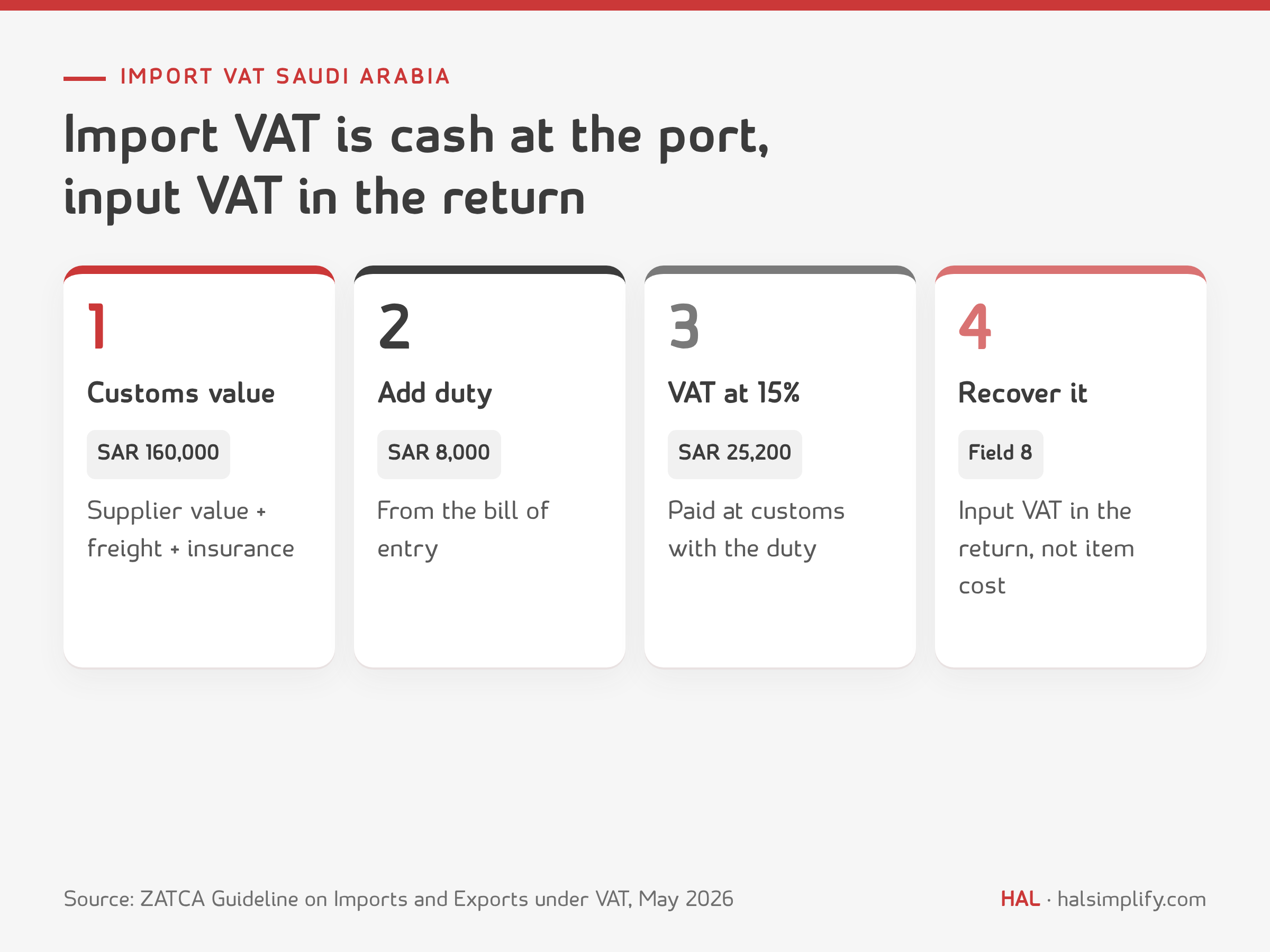
A VAT-registered importer that uses the goods for taxable sales recovers this as input tax. ZATCA's guideline says only the importer of record can deduct it, and that the customs documents proving the import are the evidence (section 10.3). Import VAT paid at customs goes on its own line of the VAT return (field 8, "imports subject to VAT paid at customs"). Businesses that ZATCA has authorised to account for import VAT through the return use field 9 instead.
So the SAR 25,200 is a cash-flow cost, not a product cost. It leaves your bank account at the port and comes back when the return is offset or refunded. Plan for it in the cash forecast, but keep it out of the item cost. If you include it, stock is overstated by SAR 25,200, the same VAT is claimed back in the return as well, and the margins look worse than they are. If you cannot recover the VAT (for example, the goods are for an exempt activity), it becomes part of the cost, and your accountant should confirm that treatment.
Prices set on the supplier invoice look healthy until the shipment costs arrive.
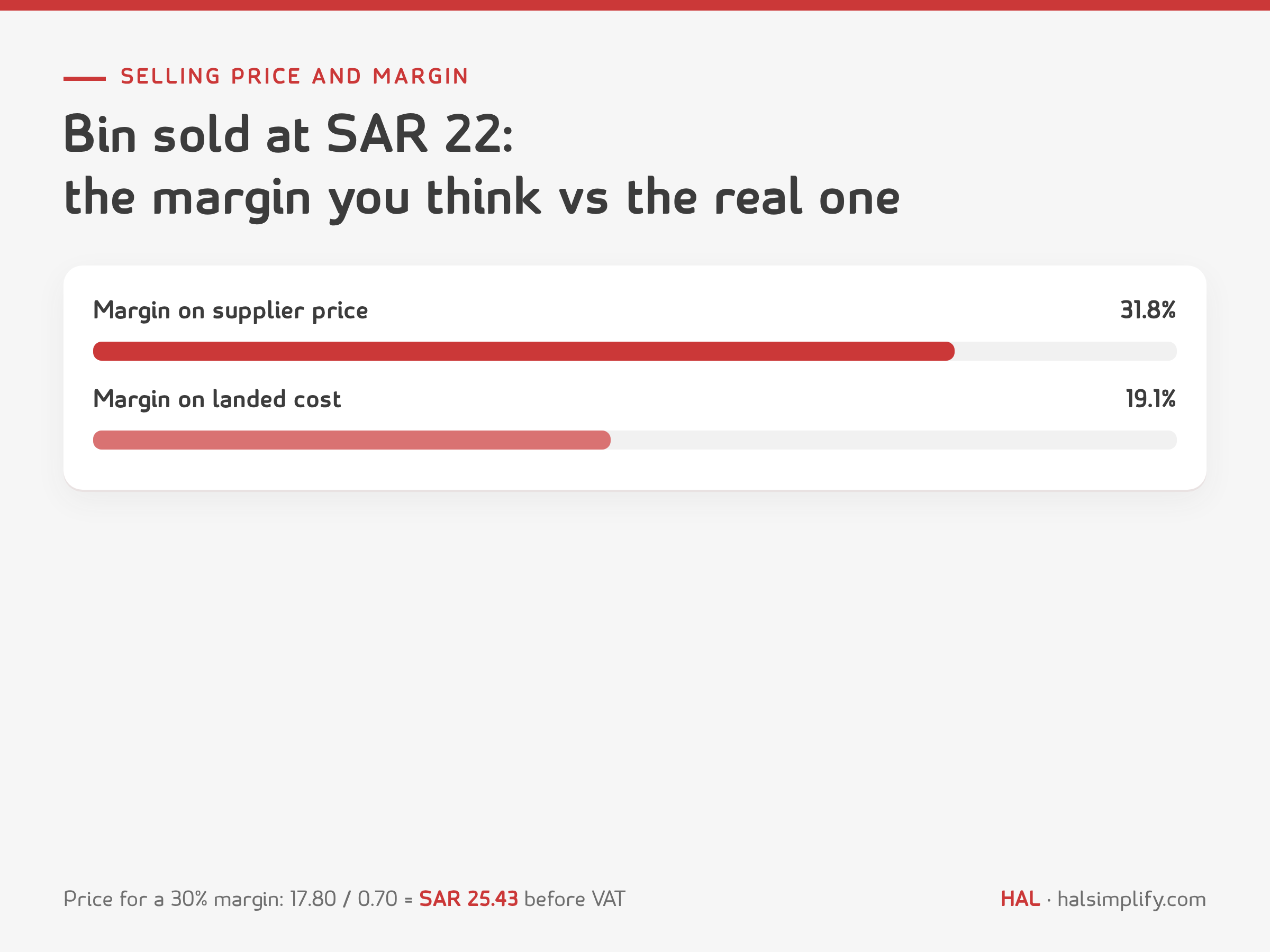
| B. Bins | C. Lamps | |
|---|---|---|
| Selling price, excluding VAT | 22.00 | 65.00 |
| Margin on supplier price only | 31.8% | 30.8% |
| Margin on landed cost | 19.1% | 23.2% |
| Price needed for a 30% margin on landed cost | 25.43 | 71.29 |
The formula for a target margin is price = landed cost ÷ (1 − target margin). For the bins: 17.80 ÷ 0.70 = SAR 25.43. Output VAT at 15% is added on top of that price on the customer invoice and is not part of the margin.
Three habits keep prices honest:
The supplier invoice arrives first. The bill of entry comes at clearance. The agent, port and trucking invoices can take weeks. Until the last one is in, the landed cost is an estimate.
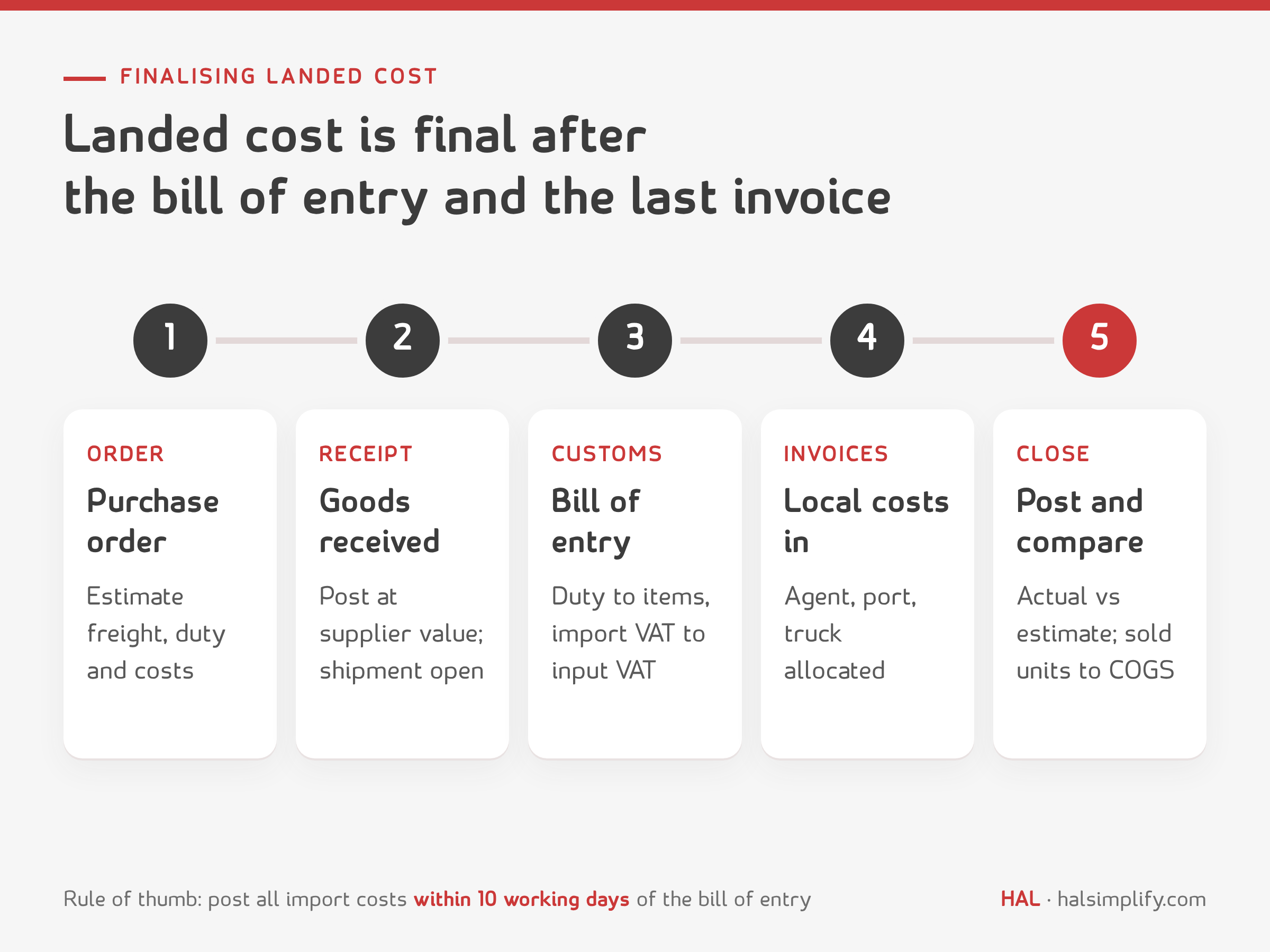
A routine that works:
A shipment left open for months is the usual reason margins swing from one quarter to the next. Set a rule, such as all import costs posted within 10 working days of the bill of entry, and review open shipments at month end.
The kit has two parts:
In HAL ERP, a purchase invoice can add stock directly, and freight, duty and clearance are then added to item cost through the Landed Cost module: you book them as non-inventory items, link the cost invoice to the goods receipt and allocate it by percentage. The screen shows the unit cost before and after, and the average cost updates. Purchases from foreign suppliers can be made in USD with a conversion rate, and the ledgers post in both currencies. See HAL inventory and landed cost and HAL Trade for trading companies, or check HAL pricing.
Related reading: how to calculate cost of goods sold and choosing an ERP for wholesale, import and export.
Landed cost includes the supplier price and every cost of bringing the goods to your warehouse: freight, insurance, customs duty, clearance agent fees, port and handling charges and inland transport. All amounts are taken net of recoverable VAT.
Not for a VAT-registered importer that can recover it. Import VAT paid at customs is input tax, reported on its own line of the VAT return (field 8), so it stays out of item cost. It only becomes a cost if it cannot be recovered.
At 15% on the customs value (supplier value plus freight and insurance to the port) plus customs duty and other charges on the declaration. In the example, 15% of SAR 168,000 is SAR 25,200.
Use the basis that drives each cost: weight for freight and trucking, value for insurance and agent fees, and the bill of entry for duty, because each HS code has its own rate. Quantity only suits units of similar size and value.
After the bill of entry is approved and the last local cost invoice has arrived. Until then the landed cost is an estimate. Extra cost on units already sold goes to cost of goods sold.
Divide the landed cost per unit by one minus your target margin. For a landed cost of SAR 17.80 and a 30% margin, the price is SAR 25.43 before VAT. Output VAT is added on the customer invoice.
This guide explains common practice and ZATCA guidance as published on 21 November 2026. It is not tax advice; confirm your duty rates and VAT position with your customs broker and tax adviser.