In short: The best ERP for wholesale and import companies in Saudi Arabia is one that calculates the landed cost of every item (freight, insurance, customs duty and clearance) before you price it, handles purchasing in several currencies, tracks batches and expiry dates across more than one warehouse, applies price lists and credit limits per customer, and issues ZATCA Phase 2 e-invoices at high volume. In this guide: a worked container that shows gross margin falling from 25% to 13% once costs are fully loaded, a weighted evaluation checklist, and a free Excel kit with a vendor scorecard and a landed-cost calculator.
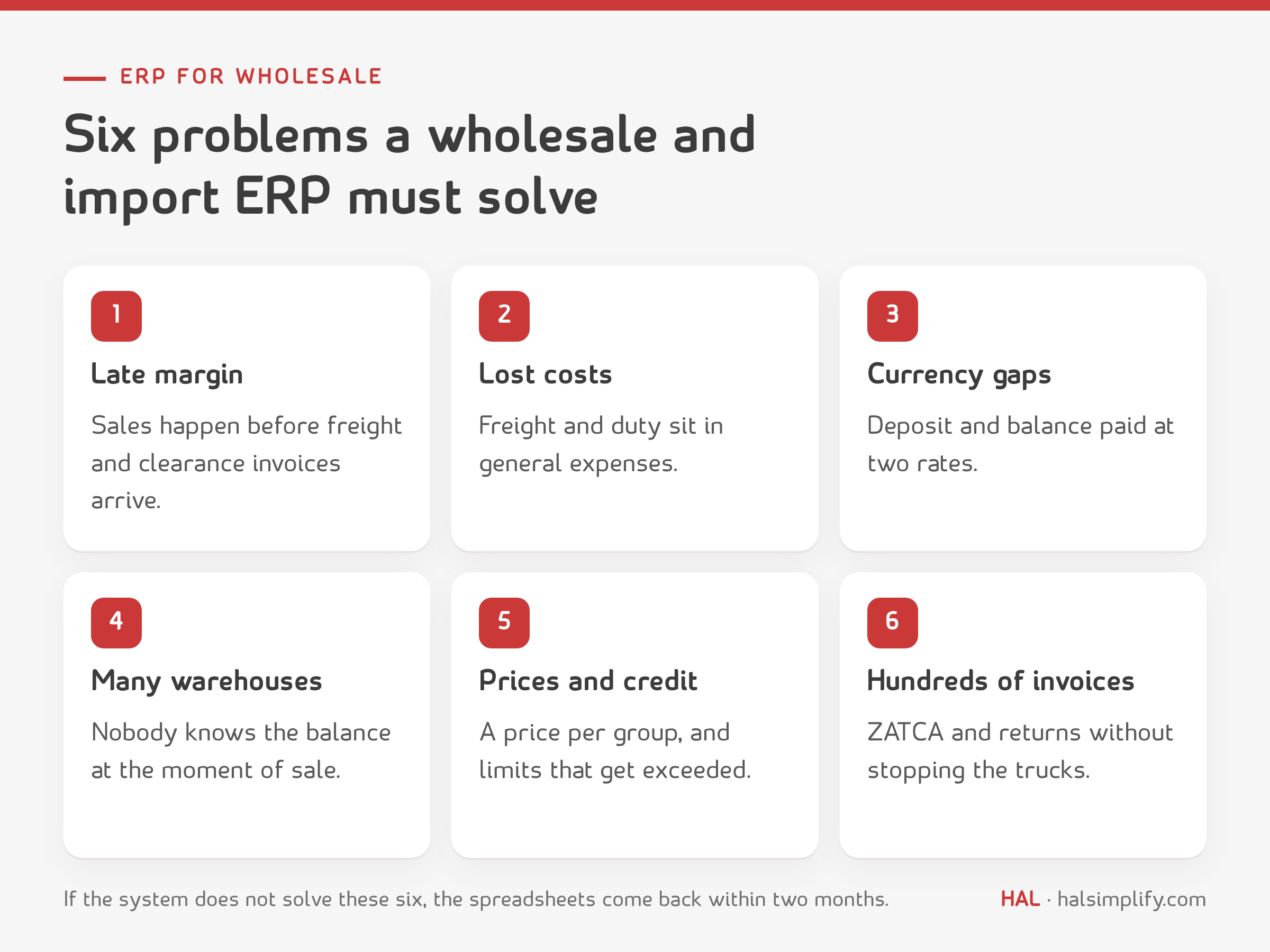
Sunday morning at a household-goods distributor in Riyadh. A container from China arrived last week, and sales are already selling its items at the usual price: supplier cost times a mark-up factor. The finance manager asks what margin the container is making. The accountant does not know yet: the freight invoice is in, but the clearing agent's invoice is not, the customs duty was paid from another account, and inland transport sits in general expenses. Two months later the income statement shows the result: margin ten points below what everyone assumed.
This is the problem an ERP has to solve in a wholesale or import business with 51 to 500 employees. An accounting package that records invoices is not enough; you need a system that connects international purchasing to inventory, pricing and collections. If you want a comparison of the systems on the market, read the best ERP systems for distribution companies in Saudi Arabia. This guide focuses on what matters to an importer and gives you a tool to evaluate any system with your own numbers.
Landed cost is everything you pay until the goods are in your warehouse, ready to sell. IAS 2, the inventory standard applied in the Kingdom, includes in inventory cost the cost of purchase and all costs incurred to bring the goods to their present location and condition; the cost of purchase includes import duties, transport and handling, and excludes taxes the business later recovers. So import VAT is not part of the cost if your business is VAT-registered and recovers it as input tax.
A household-appliance distributor imports a 40-foot container with two items from a supplier in China, priced in US dollars (the riyal is pegged to the dollar at 3.75):
| Line | Item A: electric kettle | Item B: blender | Total |
|---|---|---|---|
| Quantity | 3,000 units | 1,500 units | 4,500 |
| Supplier price (FOB) | USD 9.00 | USD 22.00 | |
| Goods value in SAR | 101,250 | 123,750 | 225,000 |
| Volume | 36 cubic metres | 24 cubic metres | 60 |
Container costs up to the warehouse:
| Line | Amount (SAR) | Allocation basis |
|---|---|---|
| Goods value (USD 60,000 × 3.75) | 225,000 | — |
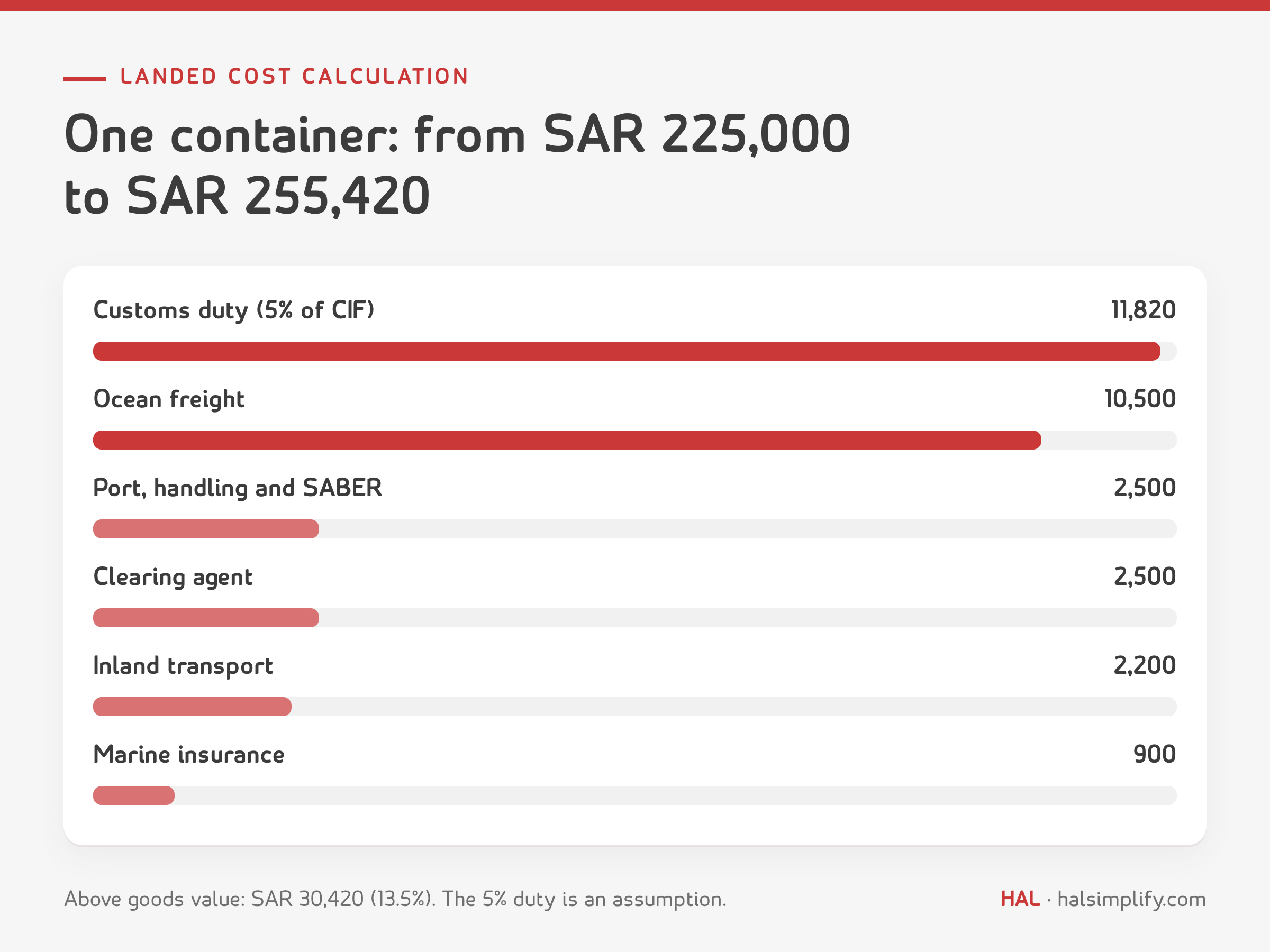
| Ocean freight (USD 2,800) | 10,500 | Volume |
| Marine insurance | 900 | Value |
| CIF value | 236,400 | |
| Customs duty (assumed 5% of CIF) | 11,820 | Value |
| Customs clearing agent fees | 2,500 | Volume |
| Port and handling charges | 1,800 | Volume |
| Two SABER shipment certificates (350 × 2) | 700 | Volume |
| Inland transport to the Riyadh warehouse | 2,200 | Volume |
| Landed cost | 255,420 | |
| Import VAT 15% on (CIF + duty) = 37,233 | Not part of cost | Recovered as input tax |
Costs above the supplier price come to SAR 30,420, or 13.5% of the goods value. The duty rate is an assumption for the example only; the actual rate depends on the HS code in the Integrated Customs Tariff of the Zakat, Tax and Customs Authority. A shipment certificate is required for products covered by technical regulations, through the SABER platform supervised by the Saudi Standards, Metrology and Quality Organization; its published fee is SAR 350 before VAT.
Allocating to the two items: insurance and customs duty (SAR 12,720) follow value: 45% to the kettle and 55% to the blender. Freight, clearance, handling, SABER and transport (SAR 17,700) follow volume: 60% to the kettle, because it takes 36 of the 60 cubic metres.
| Kettle | Blender | |
|---|---|---|
| Goods value | 101,250 | 123,750 |
| Share of value-based costs | 5,724 | 6,996 |
| Share of volume-based costs | 10,620 | 7,080 |
| Landed cost | 117,594 | 137,826 |
| Landed cost per unit | SAR 39.20 | SAR 91.88 |
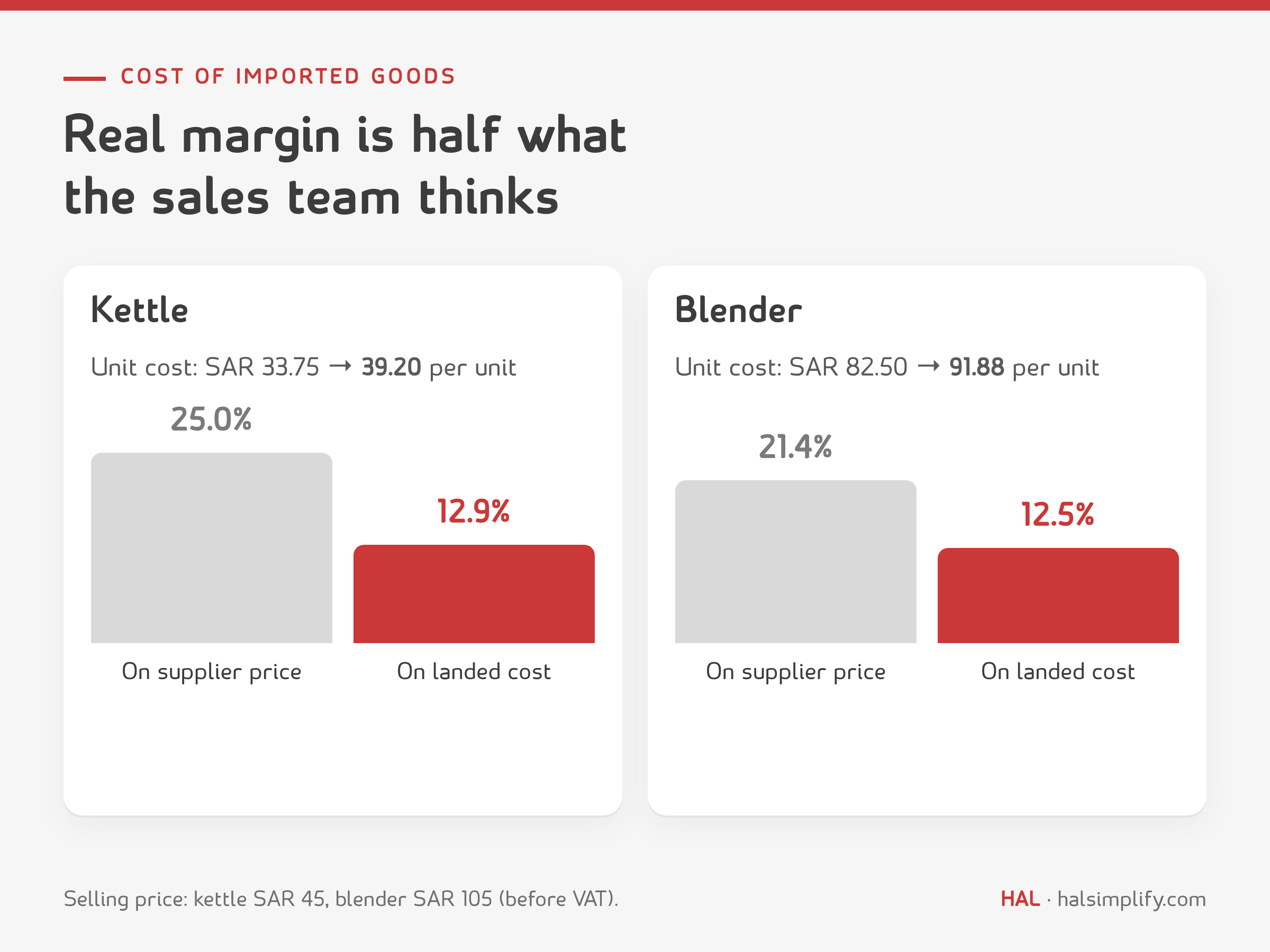
The wholesale selling price (before VAT) is SAR 45 for the kettle and SAR 105 for the blender.
| Kettle | Blender | |
|---|---|---|
| Margin on supplier price only | 25.0% | 21.4% |
| Margin on landed cost | 12.9% | 12.5% |
| Margin if every cost were allocated by value only | 14.9% | 10.8% |
Three results matter to an owner: the real margin is roughly half what the sales team believes; the low-value, bulky kettle carries a bigger share of the freight; and the allocation method alone moves two points of margin between the items. That is why the system must let you set the allocation basis for each type of cost, and recalculate the item cost when the clearing agent's invoice arrives after the goods have been sold.
The calculator for this example is in the free kit below. To see what a system that does this costs for your team, look at HAL ERP plans and pricing.
The riyal has been pegged to the dollar at 3.75 since 1986, according to the Saudi Central Bank, so a dollar invoice carries little exchange risk. A supplier invoicing in euros or yuan is different. An illustration: a European supplier's invoice for EUR 50,000 was recorded on receipt at 4.30 (SAR 215,000) and paid 60 days later at 4.38 (SAR 219,000). The difference is a SAR 4,000 exchange loss. Under IAS 21, monetary items are recorded at the rate on the transaction date and the settlement difference goes to profit or loss; it is not added to inventory cost.
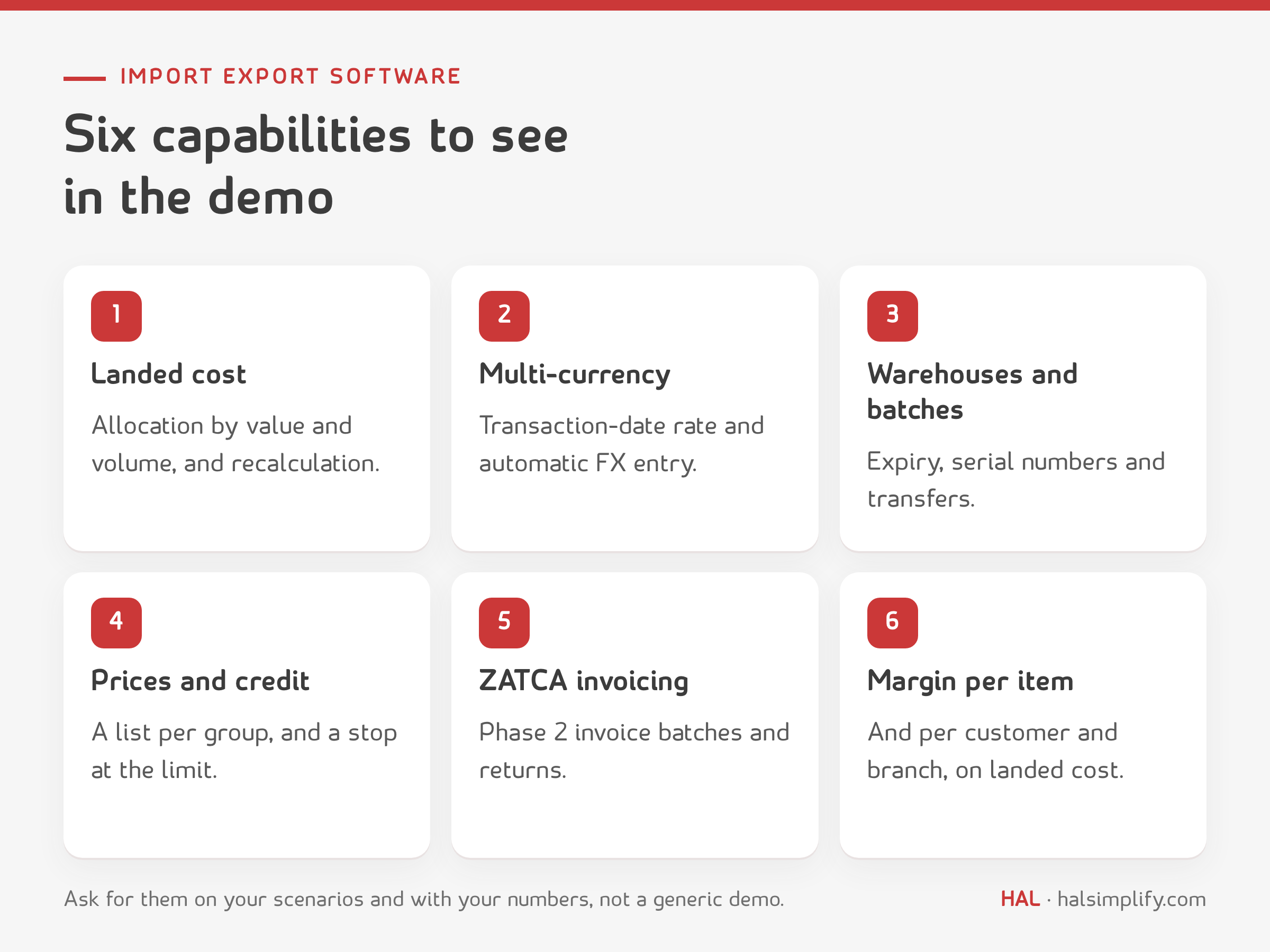
What to see in the demo:
A wholesale distributor sells the same item at different prices: supermarket chains, grocery stores, restaurants and sub-distributors. What you need:
| Control | Why it matters | How to test it |
|---|---|---|
| A price list per customer group | Stops salespeople improvising prices | Create a sales order for the same item for customers in two groups |
| Time-bound discounts and promotions | Seasonal campaigns and Ramadan | Set up a promotion that ends automatically |
| A credit limit and payment terms per customer | Receivables are the largest item on a distributor's balance sheet | Try a sale that exceeds the limit: does it stop, or ask for approval? |
| Receivables aging | Collect before the next sale | Ask for the report for a customer with overdue invoices |
| Margin per item and customer on landed cost | Shows where you really make money | Compare it with the container example above |
If you run van sales and route collections, ask to see the salesperson's app: the sales order, the tax invoice on site, the cash collection, and settling the van's stock and cash at the end of the day. This requirement varies a lot between systems, so test it with a real scenario.
Phase 2 of e-invoicing (integration) started on 1 January 2023 for targeted groups, and requires the invoicing system to integrate with the platform of the Zakat, Tax and Customs Authority and to issue invoices in the specified format. At high volume, test in the demo:
Score each system on nine criteria from 1 to 5 and multiply by the weight. A system that cannot show the container calculation above with your numbers gets no more than 2 on the first criterion.
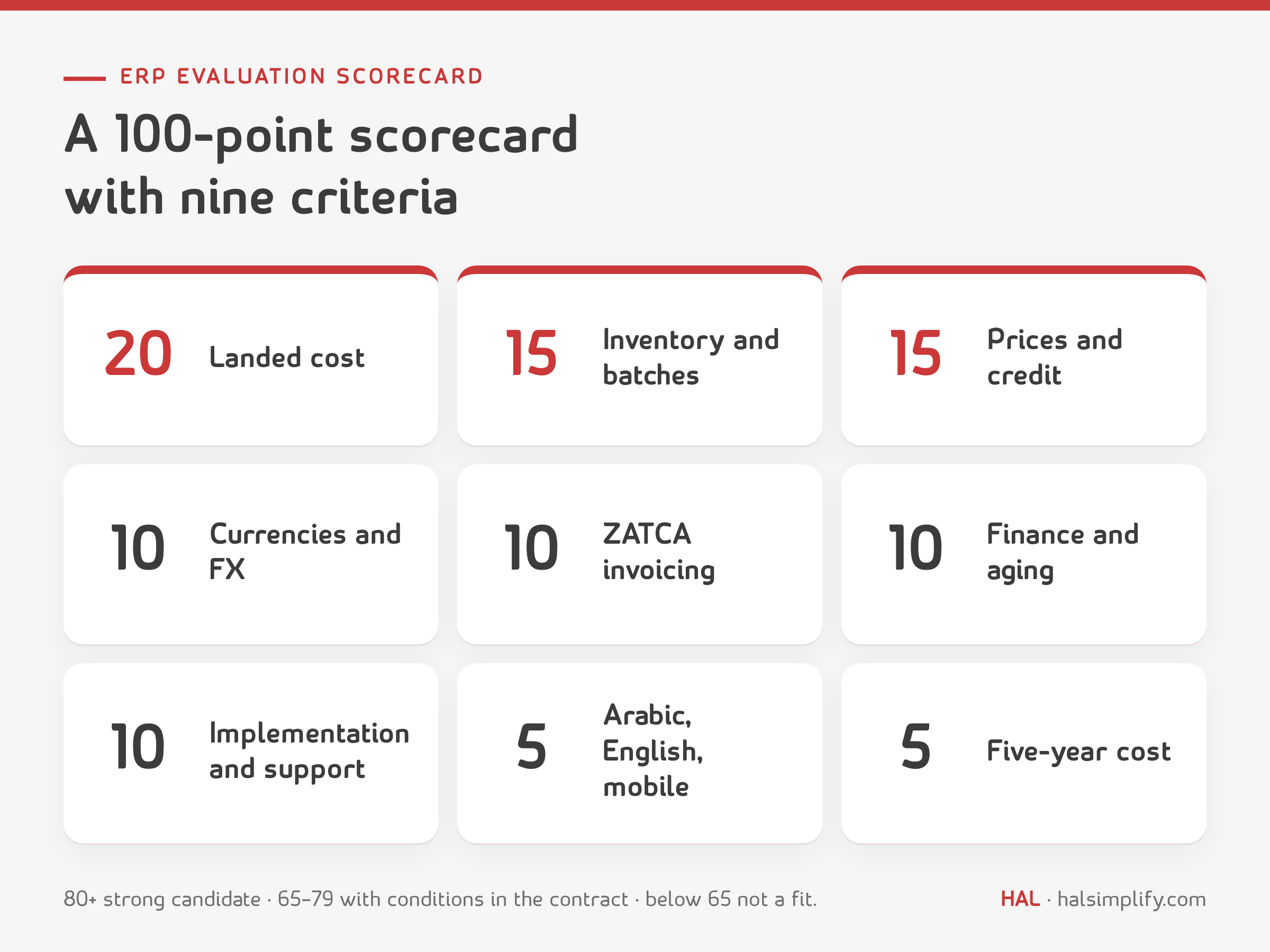
| Criterion | Weight | What the demo must prove |
|---|---|---|
| Landed cost and allocation | 20 | Your container by value and volume, and recalculation when a late invoice arrives |
| Inventory: warehouses, batches, expiry, serials | 15 | Earliest-expiry issue and a transfer between two warehouses |
| Price lists, discounts and credit limits | 15 | Blocking a sale that exceeds the limit |
| Multi-currency and exchange differences | 10 | A deposit and a balance at two rates |
| ZATCA Phase 2 e-invoicing at volume | 10 | A batch of invoices and a return |
| Finance: aging, bank reconciliation, cost centres | 10 | Profitability per branch |
| Arabic and English, mobile approvals | 5 | Approving a purchase order on a phone |
| Implementation and local support | 10 | A written timeline and data migration |
| Five-year total cost of ownership | 5 | Licences, implementation, support and customisation |
How to read the result: 80 or more is a strong candidate, 65–79 fits with conditions written into the contract, and below 65 does not fit an importer of your size.

The kit includes:
HAL Trade is HAL ERP's solution for trading companies. According to its page, it tracks inventory in real time across multiple warehouses, suggests transfers between locations and sends low-stock alerts, tracks expiry dates and serial numbers, manages accounts in multiple currencies with statements in local and foreign currency, controls item pricing, discounts and margins, reserves items for customers, and supports VAT and ZATCA e-invoicing, with approvals from a phone. In purchasing it imports supplier price lists and runs purchase tenders and blanket order agreements, and in inventory it supports GS1 codes, lots, serial numbers and cycle counting. The HAL Trade page says implementation typically takes 3 to 8 weeks, depending on the size of your operations.
Ask us in the demo to calculate your last container in front of you, and score us on the same card you use for everyone else. For more on what an ERP changes in a trading business, read how ERP software improves a trading business.
There is no single best system for everyone. For an importer with 51 to 500 employees, the right one proves in front of you that it can calculate the landed cost of your containers, purchase in several currencies, track batches and expiry dates across warehouses, apply price lists and credit limits, and issue Phase 2 e-invoices. Score each system on a weighted card using your own scenarios.
Add the supplier price in riyals, freight, insurance, customs duty, clearing agent fees, port charges, certificates and inland transport, then allocate them to items by value or volume and divide by quantity. Do not add import VAT if you recover it. In our example, cost rose 13.5% above the supplier price.
No, if the business is VAT-registered and recovers it as input tax. IAS 2 excludes recoverable taxes from the cost of purchase.
No. Under IAS 21 the invoice is recorded at the rate on the transaction date, and the difference when you pay is an exchange gain or loss in the income statement.
Accounting software records invoices and journal entries. An ERP for wholesale links the international purchase order to landed cost, stock in each warehouse, the price list, the credit limit and the e-invoice, so you know the margin of every item and customer without spreadsheets in between.
Yes. Enter your name and work email in the form above to receive the kit: a PDF guide and an Excel file with the scorecard and the landed-cost calculator.