

In short: A trial balance lists the balance of every general ledger account on one date, in two columns: debit and credit. If the two totals agree, the postings are arithmetically sound; if they don't, there is an error to find before you prepare financial statements. This guide covers how to prepare a trial balance step by step, the three types, the errors it catches and the ones it misses, a full contractor example in SAR, and a free kit (PDF guide and an Excel workbook that checks the balance for you).
It's the 3rd of November. The finance manager of a mid-size contractor is waiting for October's trial balance so he can send project profits to the board. The accountant prints it from a spreadsheet: debits SAR 39,030,000, credits SAR 38,983,000. A difference of SAR 47,000. The search starts through hundreds of entries: certified progress claims, retention, subcontractor invoices, customer advances. Two days later, the board is still waiting.
This happens in many finance teams, not because a trial balance is hard, but because it is prepared at the last minute with no fixed way to hunt for differences. This guide explains what a trial balance is, how to prepare and review it every month, and how to find a difference in minutes rather than days, with a complete example from a contracting company.
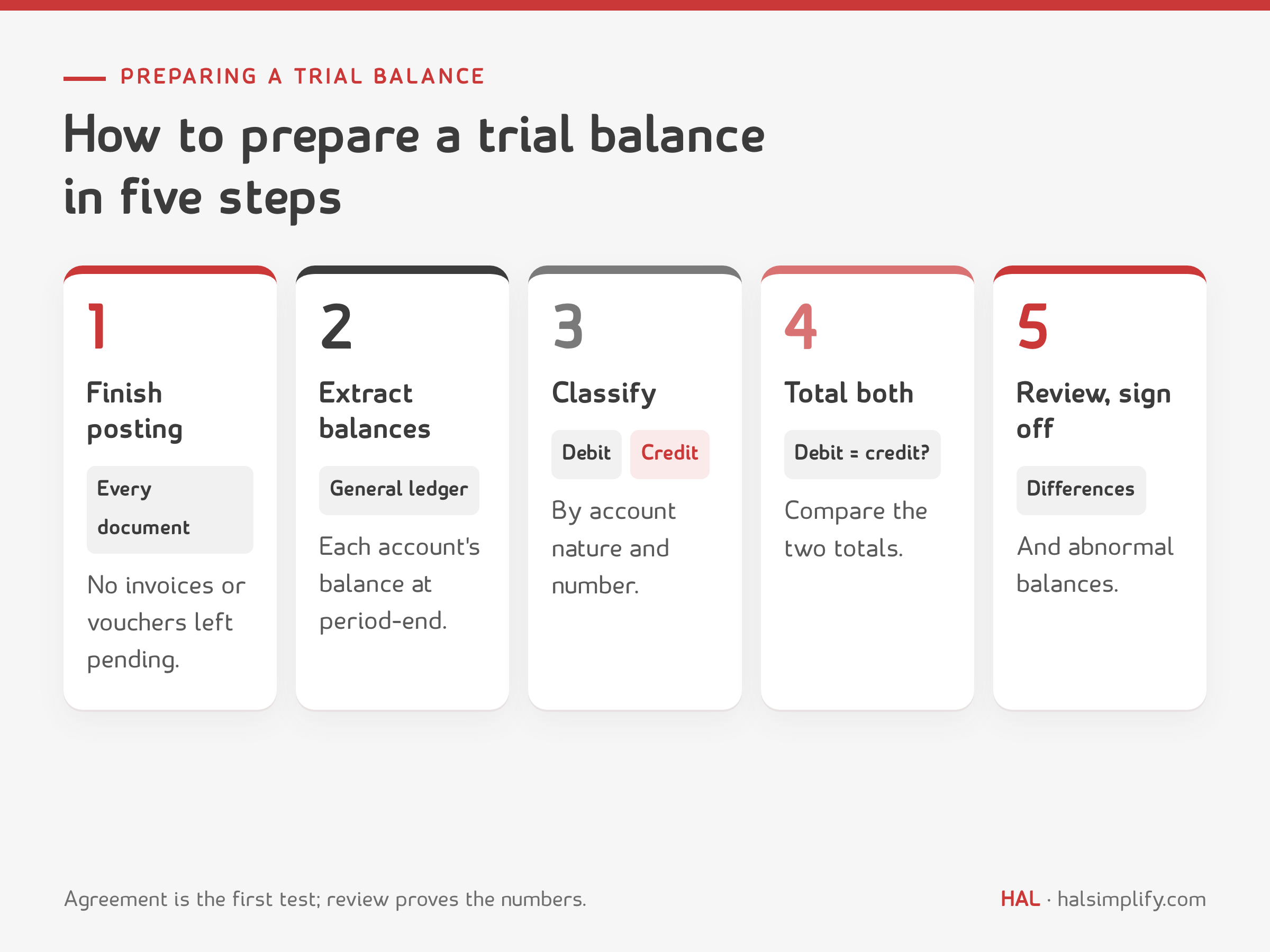
A trial balance is a list of every account in the general ledger with its balance on a given date, usually month-end or year-end. Each balance goes in the debit or the credit column according to its nature, and both columns are totalled. Because every double-entry posting has equal debit and credit sides, the totals must agree.
A trial balance is not a published financial statement. It is the working document an accountant uses before preparing the income statement and the balance sheet; if it does not balance, there is no point preparing the statements. For a short definition and a comparison with the balance sheet, read trial balance: definition, purpose and key examples.
A trial balance can be prepared in three formats:
| Format | What it shows for each account | When it helps |
|---|---|---|
| Totals | Total debit movements and total credit movements | Shows how much activity went through the account |
| Balances | The closing balance only, in the debit or credit column | The most common format, and the basis of the financial statements |
| Totals and balances | Both, side by side | Useful when tracing differences, because you see movement and balance on one line |
Example: the bank account has debit movements of SAR 18,640,000 and credit movements of SAR 17,400,000. A totals trial balance shows both figures; a balances trial balance shows one debit balance of SAR 1,240,000. The Excel workbook in the kit shows both.
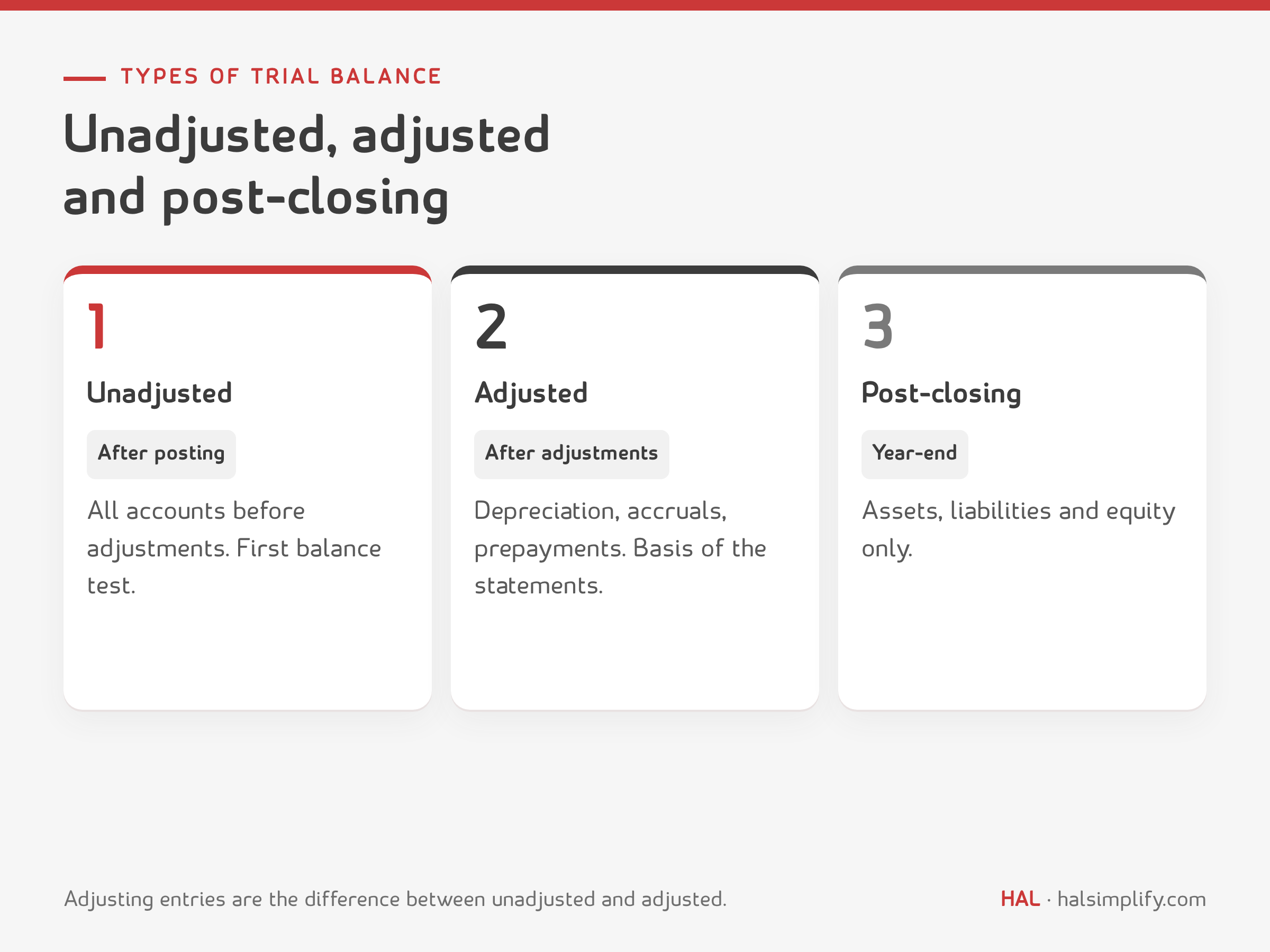
| Type | When it is prepared | What it contains | Purpose |
|---|---|---|---|
| Unadjusted | After posting the period's transactions | All accounts before adjustments | First check that debits equal credits |
| Adjusted | After period-end adjusting entries | All accounts after depreciation, accruals and prepayments | The basis of the income statement and balance sheet |
| Post-closing | After closing revenue and expenses at year-end | Assets, liabilities and equity only | Confirms the new year opens with the right balances |
Adjusting entries are what separate the adjusted from the unadjusted trial balance: depreciation for the month, the expired part of prepaid expenses such as insurance, and subcontractor work done but not yet invoiced.
A contracting company (fictitious) is running two projects; its financial year starts in January. The figures below are cumulative from January to the end of October 2026, in SAR.
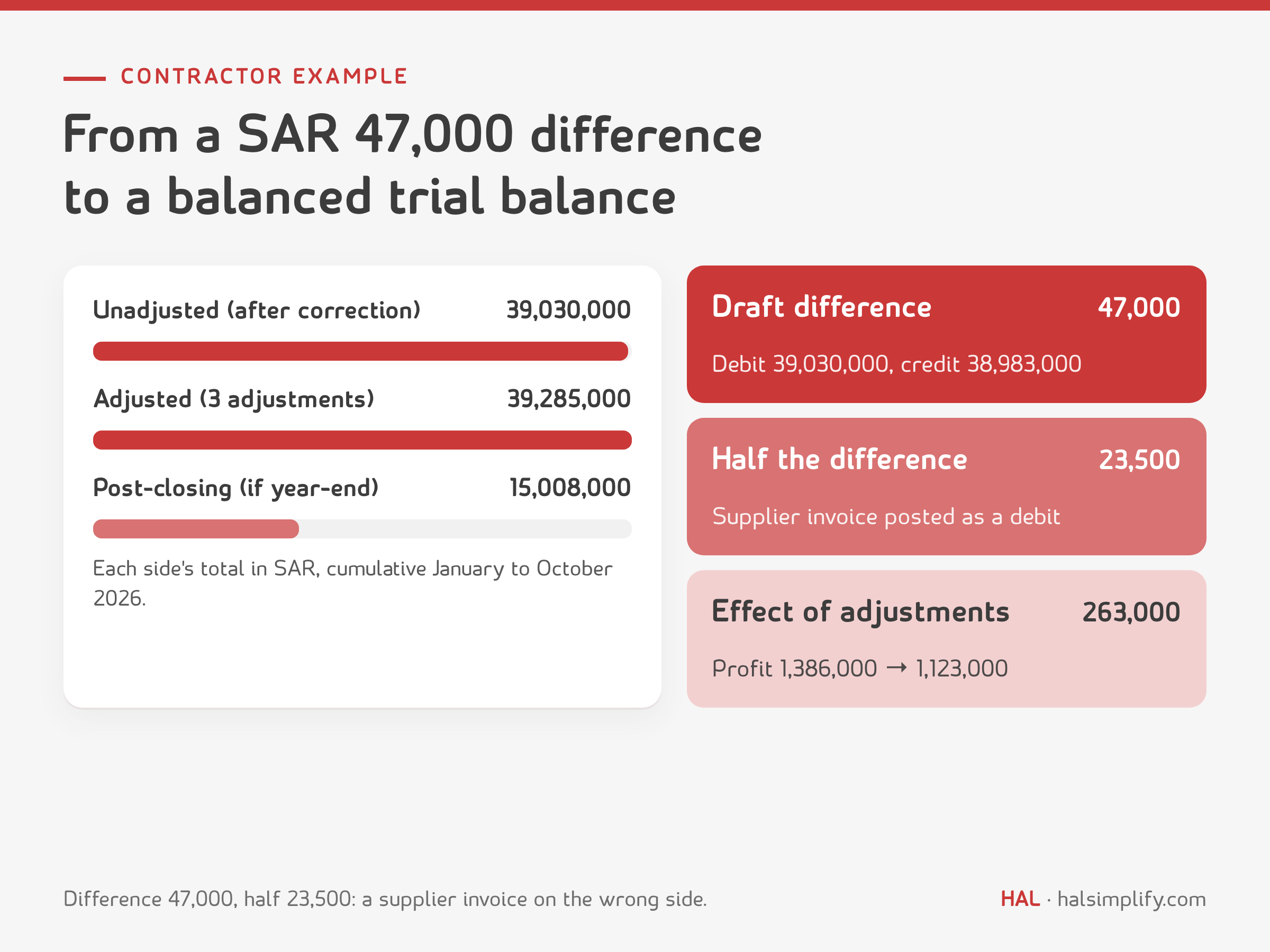
The first draft showed debits of SAR 39,030,000 and credits of SAR 38,983,000. The difference is 47,000, and half of it is 23,500. The accountant searched for an entry of SAR 23,500 and found a concrete supplier's invoice posted to the supplier account as a debit instead of a credit. Posting on the wrong side reduces one side and increases the other by the same amount, so the difference is twice the amount. After the correction, trade payables stood at SAR 2,945,000 credit and the trial balance agreed:
| No. | Account | Debit | Credit |
|---|---|---|---|
| 1100 | Cash at bank | 1,240,000 | |
| 1200 | Trade receivables (certified progress claims) | 4,460,000 | |
| 1210 | Retention receivable from customers | 1,425,000 | |
| 1300 | Materials inventory | 615,000 | |
| 1400 | Advances to subcontractors | 380,000 | |
| 1410 | Prepaid insurance | 96,000 | |
| 1500 | Plant and equipment | 6,800,000 | |
| 1510 | Accumulated depreciation | 1,890,000 | |
| 2100 | Trade payables and subcontractors | 2,945,000 | |
| 2200 | Advances from customers | 1,800,000 | |
| 2210 | Retention payable to subcontractors | 642,000 | |
| 2300 | VAT payable | 318,000 | |
| 2400 | Salaries payable | 410,000 | |
| 2600 | Bank loan | 2,000,000 | |
| 3100 | Share capital | 3,000,000 | |
| 3200 | Retained earnings | 625,000 | |
| 4100 | Contract revenue | 25,400,000 | |
| 5100 | Materials cost | 9,850,000 | |
| 5200 | Subcontractor cost | 6,420,000 | |
| 5300 | Labour and salaries | 5,980,000 | |
| 5400 | Depreciation expense | 630,000 | |
| 5600 | General and administrative expenses | 1,134,000 | |
| Total | 39,030,000 | 39,030,000 |
Three adjusting entries were recorded at the end of October:
| Entry | Debit | Credit | Amount |
|---|---|---|---|
| October depreciation on plant and equipment | Depreciation expense | Accumulated depreciation | 70,000 |
| Expired part of a SAR 96,000 annual insurance policy starting 1 October | Insurance expense | Prepaid insurance | 8,000 |
| Subcontractor work done and approved by the site engineer, not yet invoiced | Subcontractor cost | Accrued expenses | 185,000 |
After the adjustments, each side totals SAR 39,285,000. Both sides rose by 255,000 (70,000 + 185,000); the insurance entry moved 8,000 from one debit account to another, so it did not change the totals. Profit for the period fell from SAR 1,386,000 to SAR 1,123,000, by the full SAR 263,000 of the three adjustments. That is the figure the board should see, not the unadjusted one.
Revenue and expenses are not closed every month, only at the end of the financial year. If October were the last month of the year, the period's profit (SAR 1,123,000) would be closed to retained earnings, bringing them to SAR 1,748,000, and only assets, liabilities and equity would remain, totalling SAR 15,008,000 on each side.
Still building the trial balance by hand every month? See what a contractor needs from one system on HAL pricing, or book a demo with your own numbers.
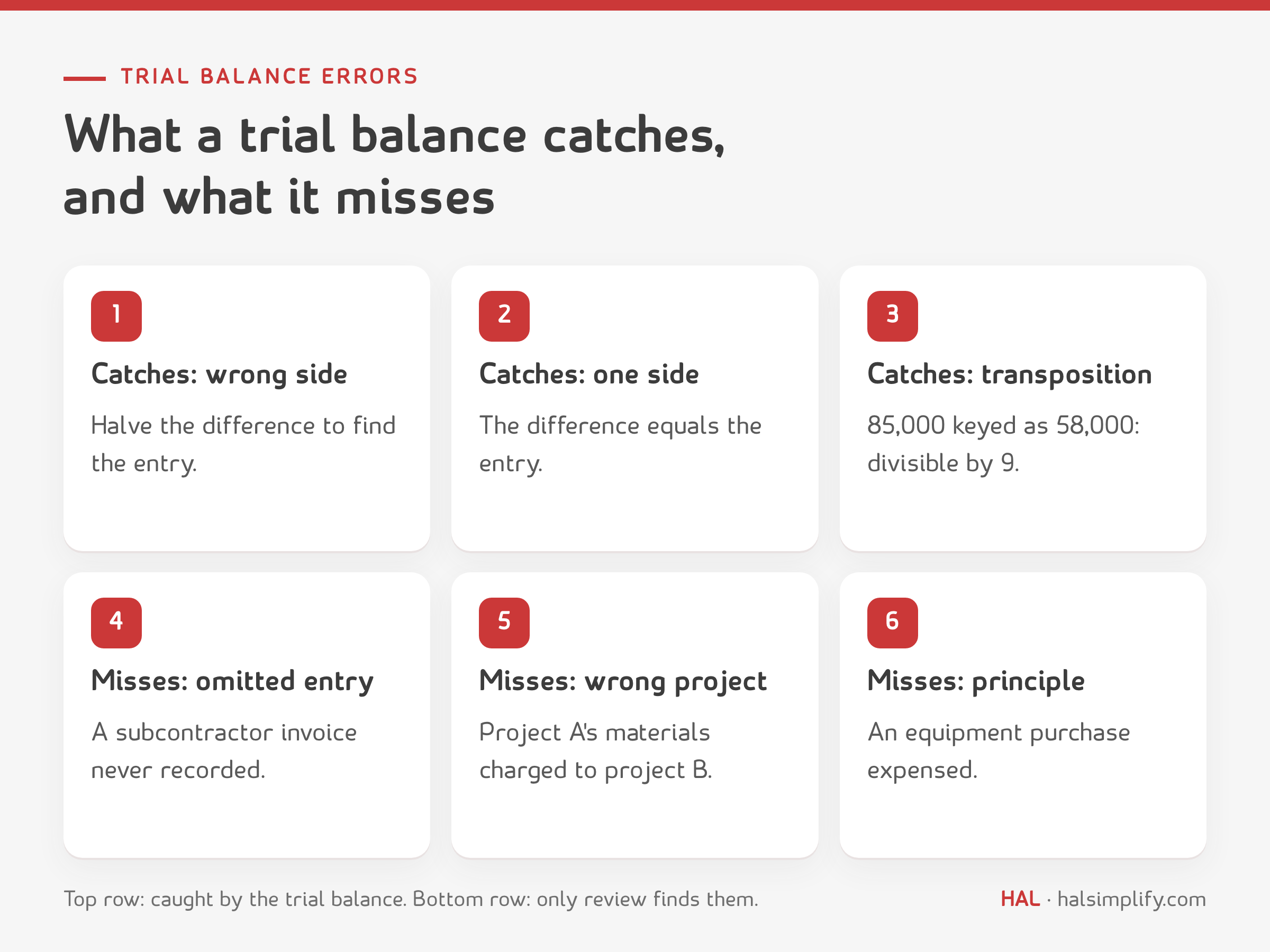
Errors the trial balance catches (because they make the totals disagree):
Errors it misses (because both sides stay equal):
So a balanced trial balance is not enough. Agreement is the first test; review is what proves the numbers.
| If the difference | Look for |
|---|---|
| Equals a known entry | An entry with only one side posted |
| Is divisible by 2 | An entry of half the difference posted on the wrong side |
| Is divisible by 9 | A transposed figure, or a figure with a digit added or dropped |
| Is a round number (1,000 or 10,000) | An addition error |
| None of the above | Compare balances with last month, then control accounts with their subledgers |

Before you send the trial balance to the board or the auditor, answer yes to every line:
If your month-end close keeps slipping, read the month-end closing process, and for contractor bookkeeping in more depth, construction accounting: process and job costing.
A ready-to-use kit with everything in this article:
A spreadsheet is a good start, but it depends on balances you copy by hand from the ledger. As the company grows and projects multiply, the time goes into copying and reconciling instead of analysis. With HAL Contracting, you bill clients at project milestones with retainers tracked, and follow profitability by customer and by project. HAL accounting automates journal entries with complete control over ledgers and makes bank reconciliation easier. The trial balance is listed among the accounting reports in the plan comparison.
A trial balance lists the balances of all general ledger accounts on one date, in a debit column and a credit column. Equal totals mean the postings are arithmetically sound; unequal totals mean there is an error to find before preparing financial statements.
A totals trial balance shows each account's total debit and total credit movements; a balances trial balance shows only the closing balance in one column. A totals-and-balances trial balance shows both and is useful when tracing differences.
The unadjusted trial balance is prepared after posting the period's transactions and before adjusting entries. The adjusted trial balance comes after adjustments such as depreciation, prepayments and accruals, and is the basis of the income statement and balance sheet.
No. Agreement only proves that every entry has equal sides. It does not reveal an omitted entry, a posting to the wrong account of the same type, an error of principle or a wrong original document. That is why the balances are reviewed against a checklist after they agree.
Start with the difference itself: if it equals an entry, look for a side that was not posted; if it is divisible by 2, look for an entry of half the difference on the wrong side; if it is divisible by 9, look for a transposed figure.
Yes. The kit is free: a PDF guide with printable forms and an Excel workbook that builds the trial balance, checks that it agrees and prepares the adjusted and post-closing trial balance.