In short: The best ERP for MEP contractors and civil subcontractors is not the best-known one. It is the one that holds the places where a subcontractor's margin leaks: unapproved variations, idle crews on site, the site store, progress certificates and retention, and the cost of each bill-of-quantities item. This guide walks through a SAR example of a 150-person MEP contractor whose margin fell from 12% to 8.2% on one project, what to look for in a system, the types of system available (described fairly), and a free scorecard with an Excel workbook.
The weekly site meeting on a hospital project in Riyadh. The main contractor's engineer asks for the chilled-water route on level three to be moved "today if possible". Your electrical supervisor has been waiting a week for the work area to be handed over, with thirty-five workers. Back in the office, the accountant is preparing the fifth progress certificate from an Excel file and does not know that half the extra work was done on verbal instructions. At month-end the finance manager asks: why do the numbers say the project is profitable when the bank says the account is overdrawn?
This guide is for owners, finance managers and project heads of MEP and civil contracting companies with 51 to 500 staff, who usually work as subcontractors to a main contractor. If you want a general list of construction systems, see our comparison of construction ERP systems. Here we focus on what matters to a subcontractor and on how to choose.
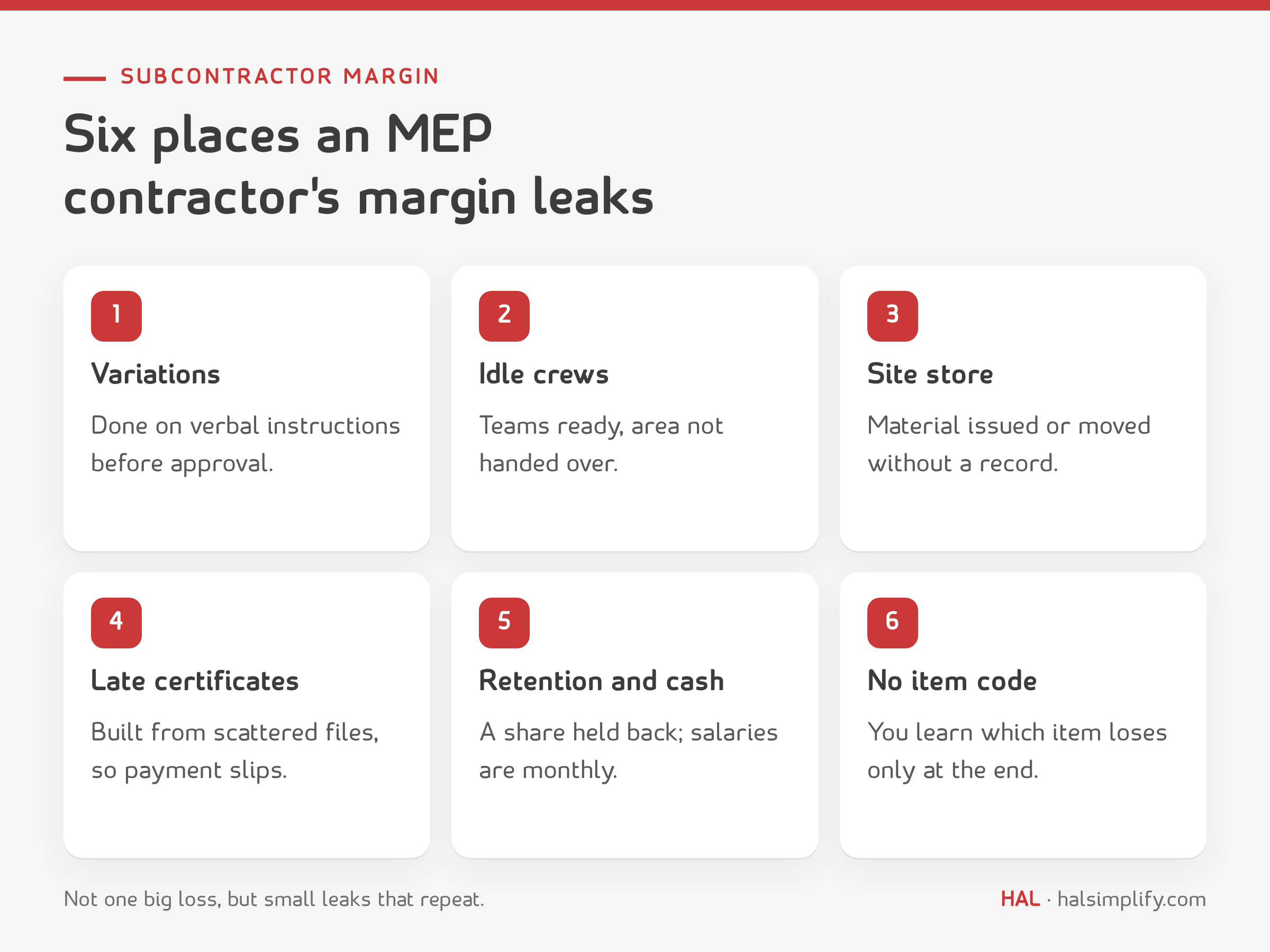
An MEP or civil subcontractor works between two parties: a main contractor who sets the pace, certifies the progress claims and holds back part of each one, and a site that rarely runs exactly to programme. So the margin is not lost on one big item. It leaks in small, repeated ways:
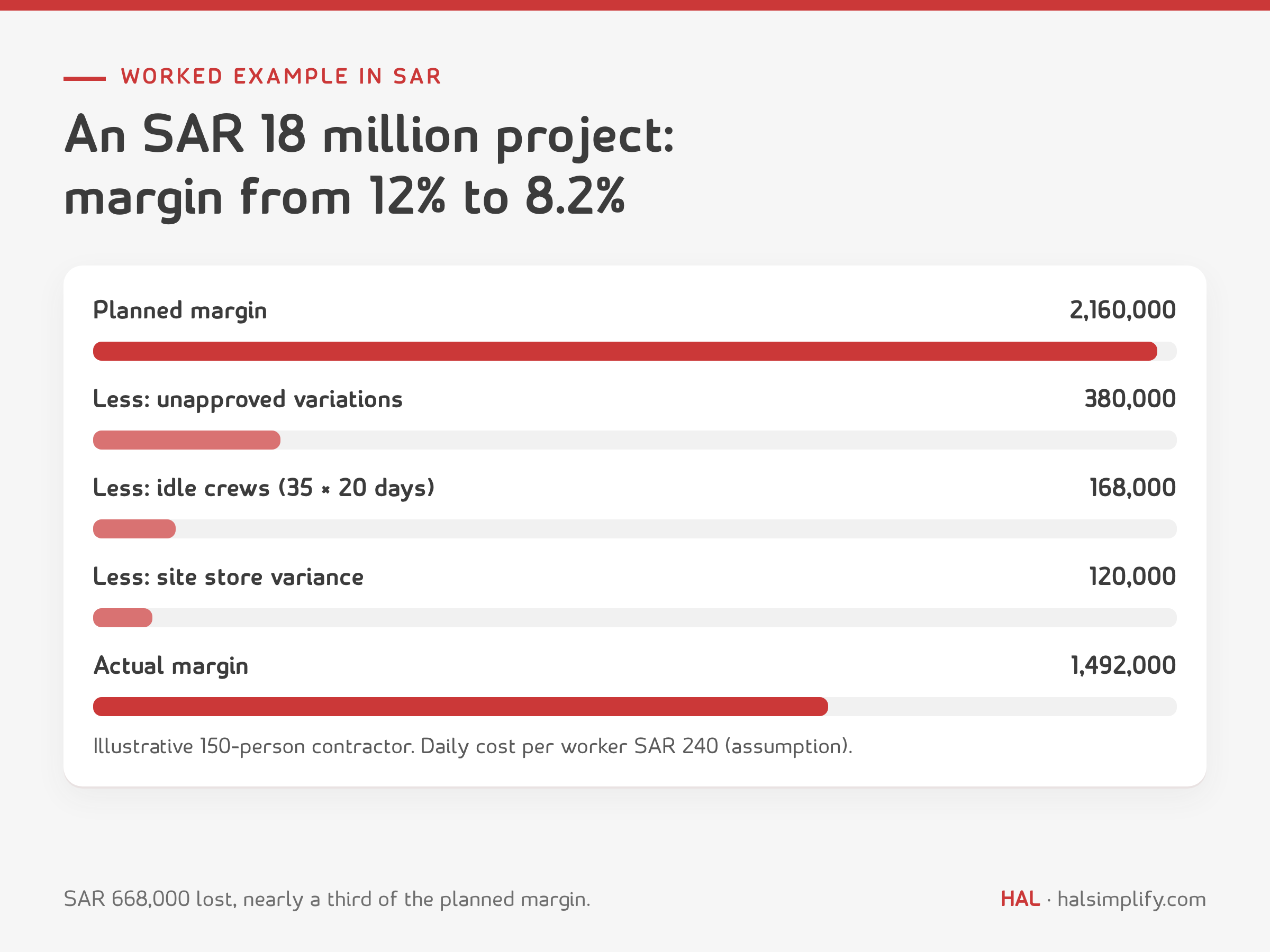
Assumptions (an illustrative example, not customer data): a Riyadh MEP contractor with 150 staff is a subcontractor on a project worth SAR 18,000,000, with an estimated cost of SAR 15,840,000, a planned margin of SAR 2,160,000 (12%). During the work, three very ordinary things happened:
| Item | Revenue (SAR) | Cost (SAR) | Effect on margin (SAR) |
|---|---|---|---|
| Original contract as planned | 18,000,000 | 15,840,000 | 2,160,000 (12%) |
| Variations: cost incurred vs value approved | +260,000 | +640,000 | −380,000 |
| Idle crews | +168,000 | −168,000 | |
| Site store variance | +120,000 | −120,000 | |
| Actual result | 18,260,000 | 16,768,000 | 1,492,000 (8.2%) |
SAR 668,000, nearly a third of the planned margin, was lost without a single big mistake. Worse, the finance manager only found out at project close, because costs were not booked to BOQ items and variations had no register.
And the cash? Assume the project runs for 12 months with a monthly certificate of SAR 1,500,000. The main contractor retains 10% and pays the rest 60 days after month-end. Salaries for the 150 staff are about SAR 720,000 a month, and materials and other costs SAR 600,000, paid at 30 days.
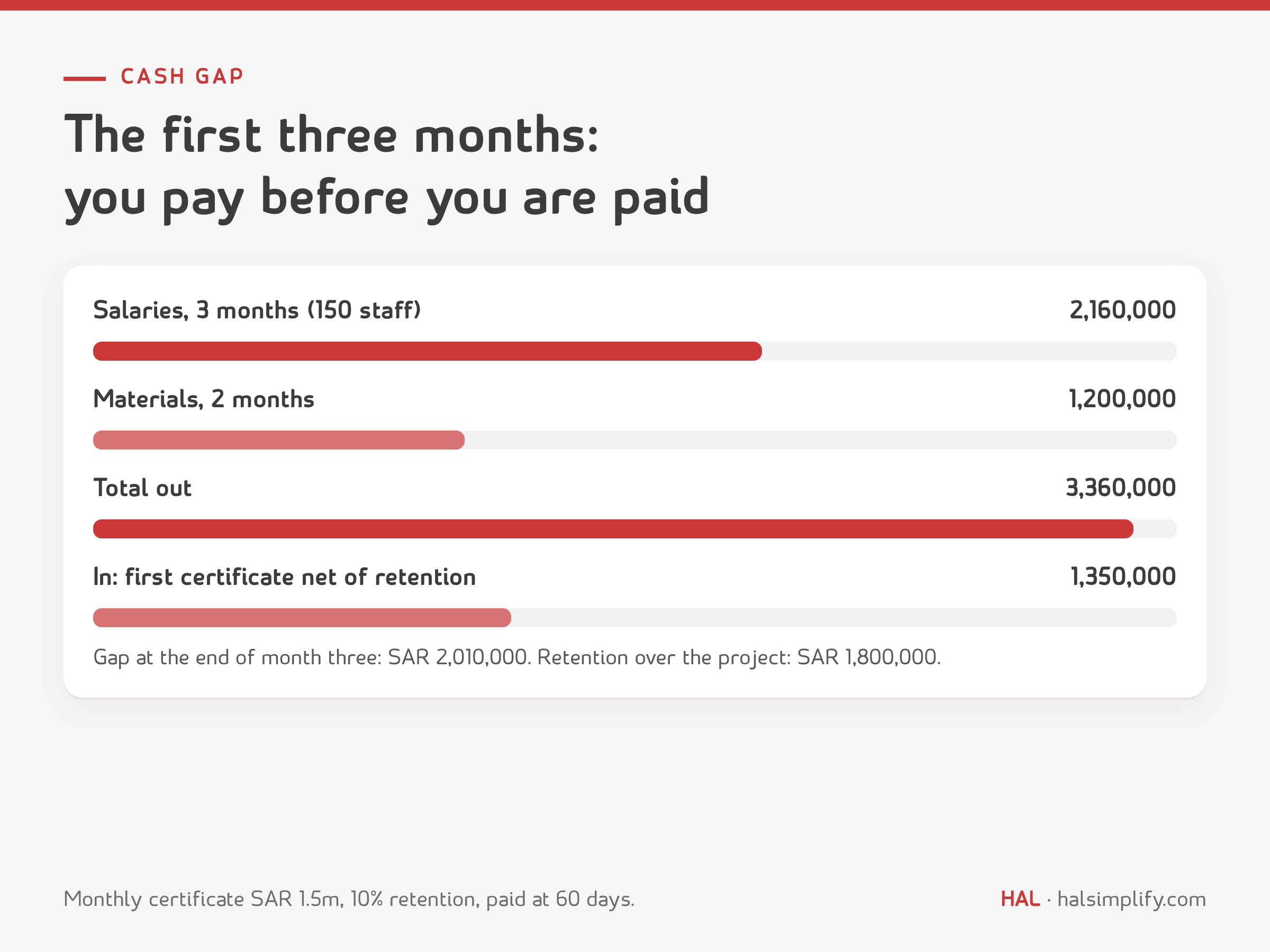
By the end of month three you have paid 3 × 720,000 in salaries + 2 × 600,000 in materials = SAR 3,360,000, and only the first certificate has arrived, net of retention: 1,500,000 − 150,000 = SAR 1,350,000. You fund the SAR 2,010,000 gap from capital or bank facilities. Over the project, SAR 1,800,000 of retention builds up that you only receive after handover. That is why you need a system that ties certificates, retention, payroll and purchasing into one cash forecast, not three files.
If you want to see how these numbers look in one system alongside your accounts, look at HAL plans and pricing.
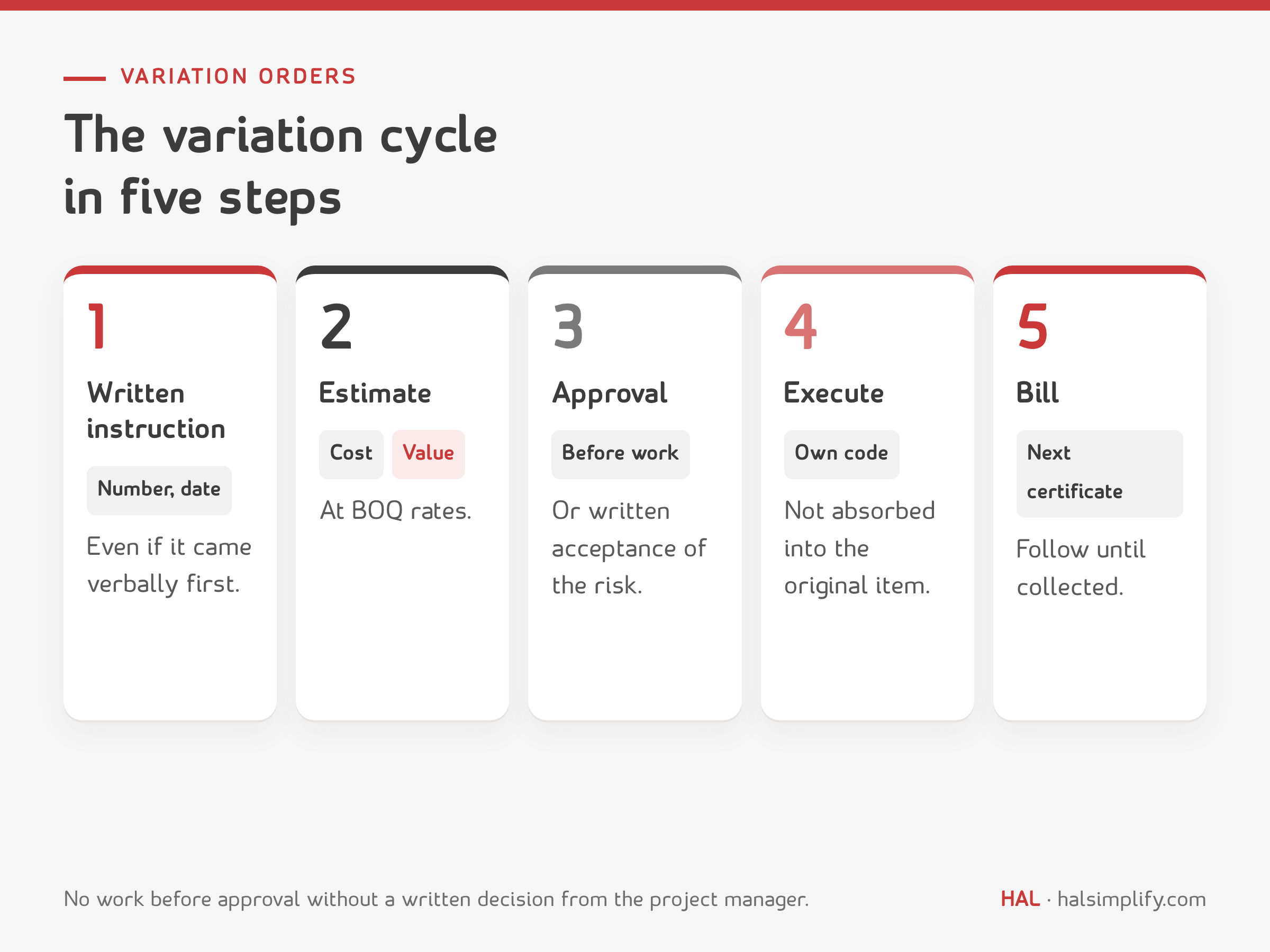
A third of the loss in our example came from variations. The cause is rarely bad faith on the main contractor's side; it is the lack of a clear chain of documents. A good system enforces that chain:
As for the certificates themselves, a subcontractor needs to raise each claim from the quantities executed against contract items, deduct retention and the advance-payment recovery, and see the retention balance for every project. For retention specifically, see our guide to retention in construction invoices.
These are the capabilities that hold the six leaks. Use them as questions in every demo, and ask to see each one on data that looks like yours, not on slides.
| Area | Ask the vendor to show you | Why it matters to a subcontractor |
|---|---|---|
| BOQ and variations | Loading the contract BOQ, and a variation register with statuses (submitted, approved, rejected) | A third of the loss in our example |
| Certificates and retention | A certificate from executed quantities with retention and advance recovery deducted, and the retention balance per project | Collection and cash |
| Site store and materials | A project material request, a project purchase order, and receipt and issue on site | SAR 120,000 in our example |
| Crews on several sites | Attendance and timesheets per worker by project and site, with the cost charged to the project | SAR 168,000 in our example |
| Payroll and wage protection | A payroll run that produces the wage file you need to upload to Mudad | A monthly obligation |
| Cost codes and profitability | Actual vs budget for every item and project, monthly | You see the loss early |
| Equipment | Equipment cost and depreciation charged to the projects that used it | True profitability |
| E-invoicing | An electronic tax invoice for every certificate, and readiness to integrate with ZATCA's Fatoora platform | A regulatory requirement |
On wage protection: the Ministry of Human Resources and Social Development requires establishments to submit their employees' wage files through the Mudad platform. The system does not upload for you, but there is a big difference between a file that comes out of a payroll linked to attendance and one assembled by hand from three spreadsheets every month.
On e-invoicing: Phase 1 (generation) started on 4 December 2021 and Phase 2 (integration) on 1 January 2023, rolled out in stages set by the Zakat, Tax and Customs Authority. Ask the vendor whether it is listed in ZATCA's solution provider directory and how it issues the invoice for a progress certificate specifically.
We will not rate vendors with stars or prices we have not verified. In practice the options fall into four types, each suited to a different contractor:
| Type | Suits | Watch for |
|---|---|---|
| General accounting software plus Excel | A small contractor with one or two projects | Certificates, variations and crews stay outside the system |
| General ERP with a projects module | A company with an IT team that accepts customisation | Certificates and retention often need customisation or a partner add-on |
| International construction ERP | Large firms with very large projects and an in-house implementation team | Cost, timeline, Arabic support and Saudi localisation |
| Saudi ERP with a contracting solution | A mid-size contractor that wants accounting, projects, materials, crews, payroll and e-invoicing in one Arabic and English system | Check the depth of certificates and variations on your own data in the demo |
For a buyer's checklist of contracting software in the Kingdom, see our contracting software buyer's guide for Saudi Arabia. One of the Saudi options in the last group is HAL Contracting; what we say about it below is only what its product page says.
Score every system on your shortlist with the same card, using at least three people: the finance manager, a project manager, and the storekeeper or HR lead. Rate each criterion from 0 to 5, then multiply by its weight.
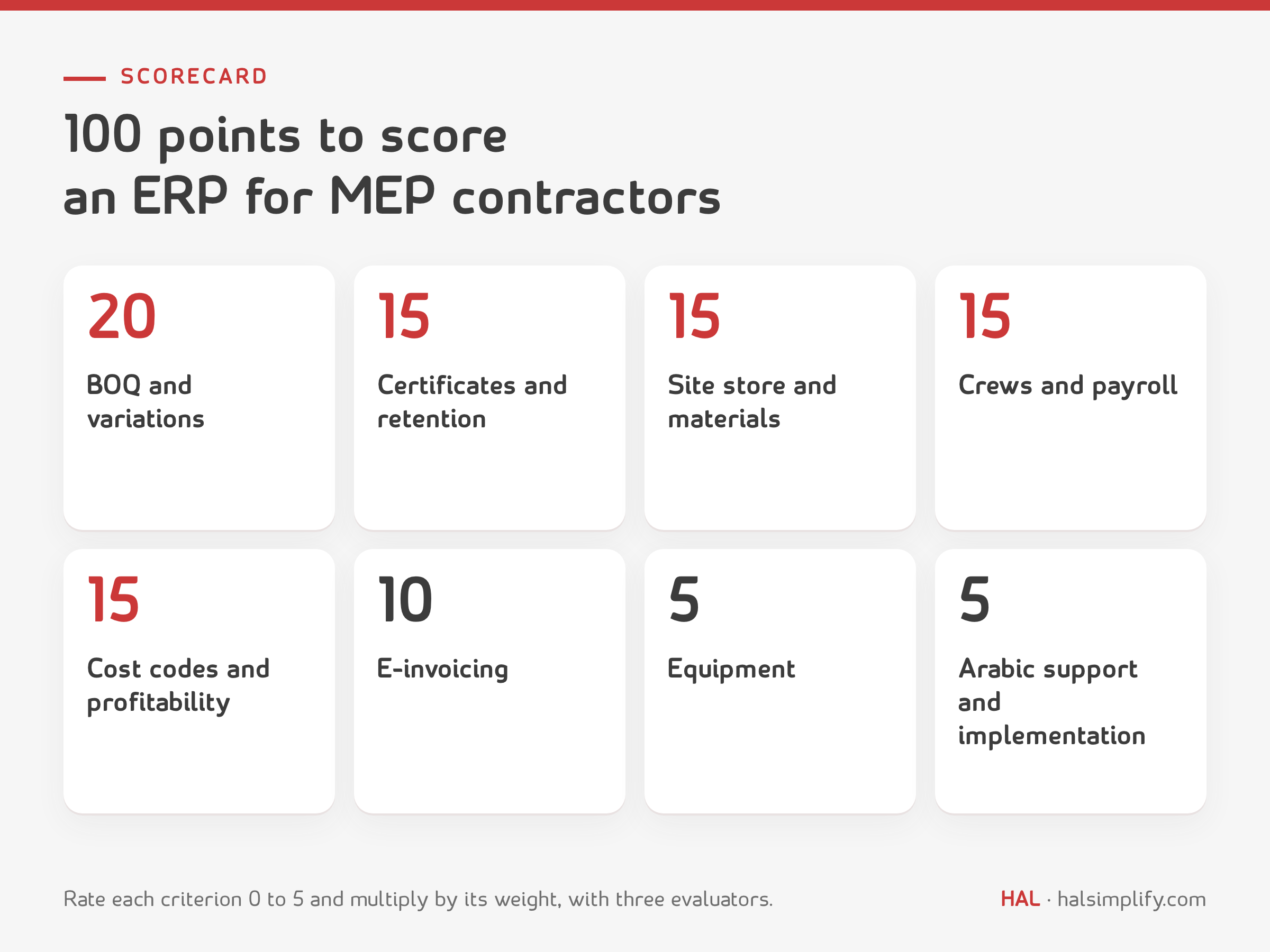
| Criterion | Weight |
|---|---|
| BOQ and variations | 20 |
| Certificates and retention | 15 |
| Site store and materials | 15 |
| Crews, timesheets and payroll | 15 |
| Cost codes and project profitability | 15 |
| E-invoicing | 10 |
| Equipment | 5 |
| Arabic support and implementation | 5 |
| Total | 100 |
Two rules: do not accept a demo on the vendor's data; give them a real BOQ, one variation and a past certificate and ask for them to be rerun in the demo. And ask for a reference who is a subcontractor, not a main contractor, because your needs differ.
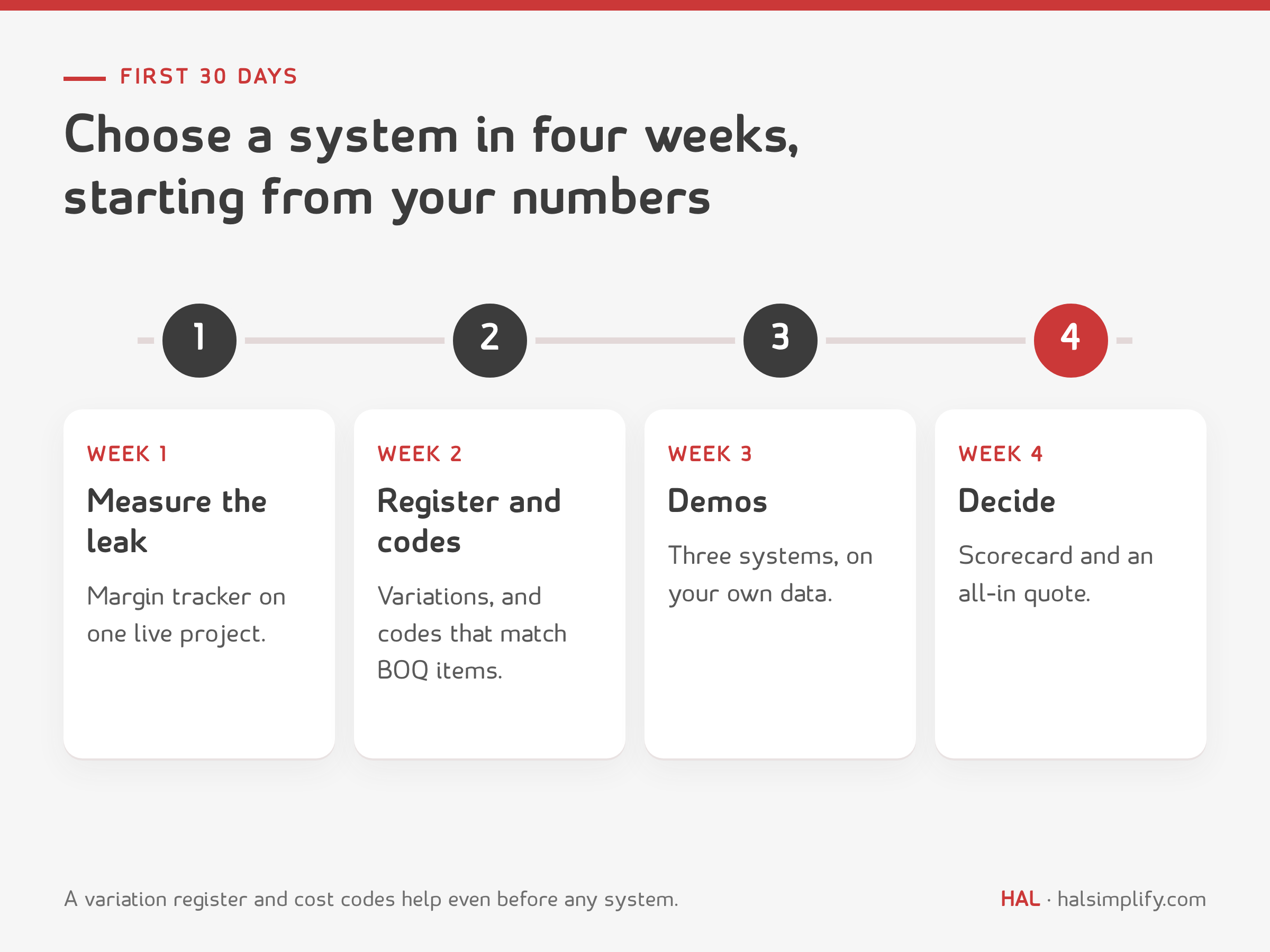
The kit includes:
HAL Contracting is designed specifically for the contracting sector and addresses three things that show up in our example: getting billing right, tracking manpower movements and costing, and understanding the profitability of each project. According to its product page:
Start with the free kit and measure the leak on one project. When you want to see these numbers in one system, book a demo and bring a real BOQ, a variation and a past certificate.
The best ERP for MEP contractors is the one that holds the BOQ, variations, progress certificates, retention, the site store and crews across several sites, and issues e-invoices that meet ZATCA's requirements. Score systems on one 100-point card and on your own data, not on how well known the vendor is.
A subcontractor submits certificates to a main contractor who certifies them, retains part and pays weeks later; it receives many variations from site and spreads its crews over several sites. So it needs a variation register, a retention balance and a cash forecast more than it needs large-scale project planning tools.
In our example, extra work costing SAR 640,000 was done and only SAR 260,000 was approved, so the project lost SAR 380,000 of margin. The fix is a fixed chain of documents: a written instruction, an estimate, approval before work, execution on its own item code, and billing in the next certificate.
The Ministry of Human Resources requires establishments to submit wage files through the Mudad platform. What to look for is a payroll linked to attendance and timesheets that produces the required file ready to upload, instead of preparing it by hand every month. Ask the vendor to show this in the demo.
Add up what you will pay each month in salaries and materials according to their payment terms, and compare it with what you will receive from certificates after retention and after the agreed payment period. In our example the gap was SAR 2,010,000 at the end of month three on a monthly certificate of SAR 1,500,000.
Yes. The kit (a PDF guide and an Excel workbook in English) is free; enter your name and email in the form above and it arrives in your inbox.