In short: An ERP for restaurants and food manufacturers starts where the restaurant POS stops: it costs every recipe, tracks central-kitchen transfers to branches, compares theoretical and actual food cost in each branch, and records wastage, ingredient lots and expiry dates so you can withdraw a product if you have to. A single restaurant may only need a good POS with stock control; a group with a central kitchen, or a food manufacturer, needs both, linked. This guide has two worked examples in SAR, a scorecard and a free kit (PDF guide and Excel workbook).
Thursday night in the central kitchen of a three-branch restaurant group. The head chef has prepared rice and chicken for the weekend in the usual quantities, and the driver takes them to the branches without a transfer note. On Sunday morning one branch throws away twenty kilos of cooked rice, while another runs out of chicken before dinner. At month end the finance manager sees food cost at 40% of sales while the recipes say 33%, and nobody knows where the seven points went.
This guide is for the owner and finance manager of a restaurant group, and for the owner of a small food factory or central kitchen that supplies its own branches or other customers. It sets out the real difference between a POS and an ERP, costs one menu item and a whole group's wastage, and gives you questions to put to every vendor.
Many people searching for a restaurant POS system really do need a POS, not an ERP. Being straight about that saves you money:
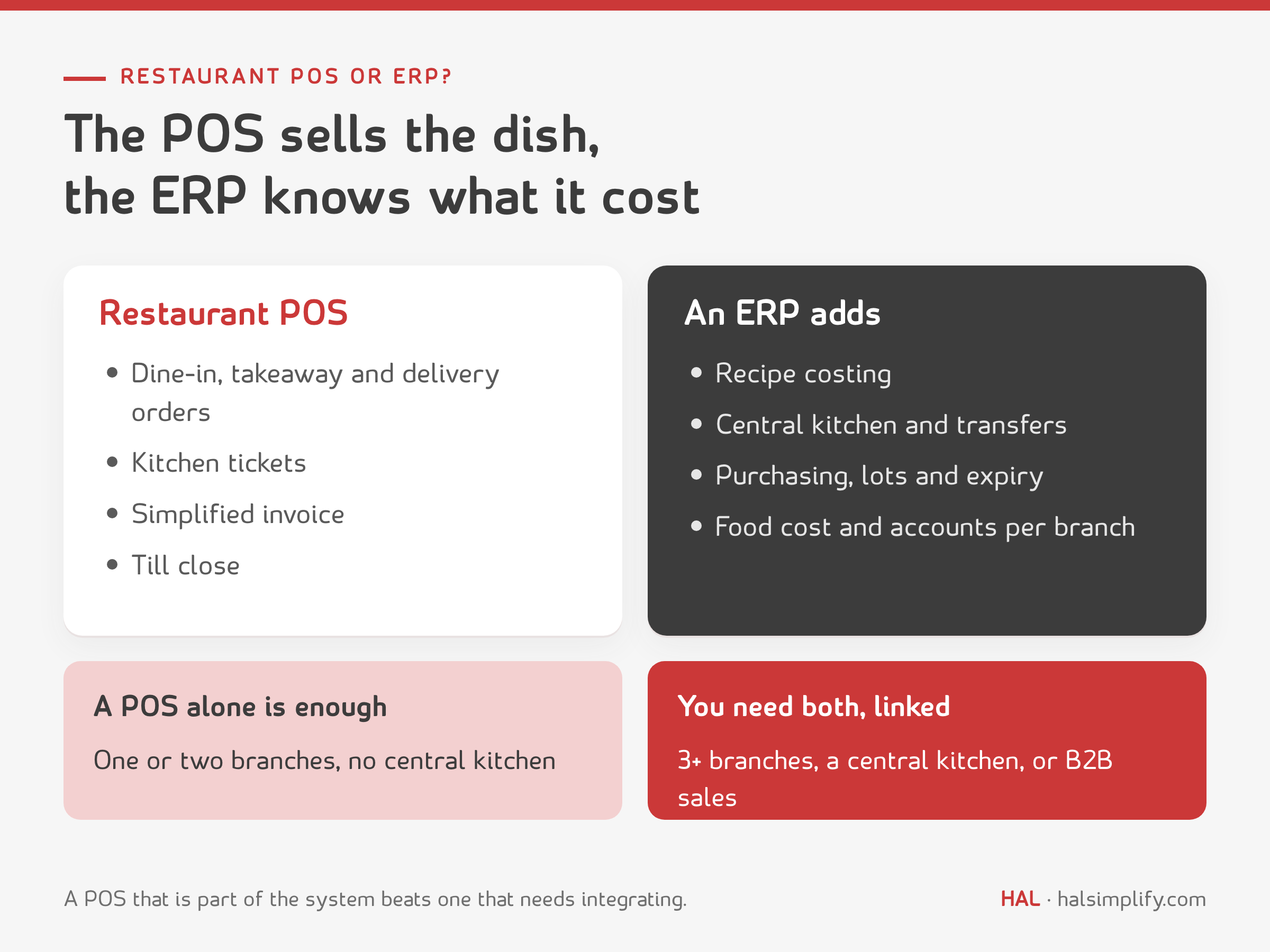
| Restaurant POS | ERP | |
|---|---|---|
| What it does | Takes dine-in, takeaway and delivery orders, sends them to the kitchen, issues the invoice, closes the till | Costs recipes; runs purchasing, stock, the central kitchen, production, accounts and payroll |
| Enough on its own when | One or two branches, no central kitchen, and the accountant works in separate software | — |
| You need it when | — | Three or more branches, a central kitchen, sales to supermarkets or hotels, or you want food cost per branch every month |
| The risk | Sales in the POS and costs in Excel, so you never see true profit | An ERP without a linked POS means re-keying sales by hand |
The rule: if you need an ERP, do not buy a separate POS that has to be integrated. Buy a POS that is part of the same system, or linked to it in a way you have seen working in the demo. For a detailed comparison of the two in retail generally, read ERP vs POS. Supermarket chains face the same question with shrinkage and branch replenishment; see the best ERP for supermarkets and multi-branch retail chains.
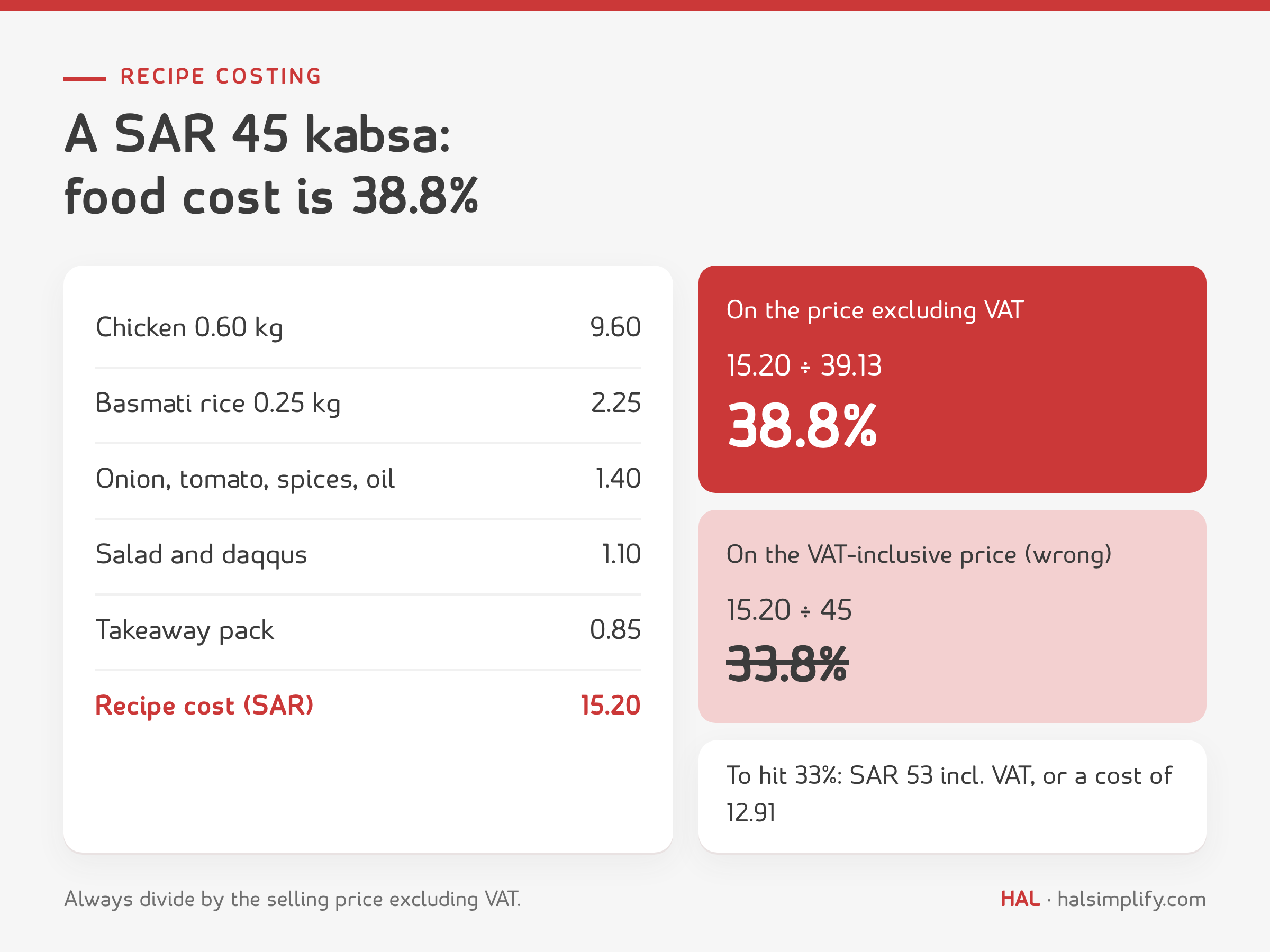
Recipe cost is everything that goes into one plate at purchase price, including packaging if it is a takeaway. Food cost percentage = recipe cost ÷ selling price excluding VAT. An example for a plate of chicken kabsa sold at SAR 45 including VAT:
| Ingredient | Quantity | Unit price (SAR) | Cost (SAR) |
|---|---|---|---|
| Chicken (half a bird, purchase weight) | 0.60 kg | 16.00 per kg | 9.60 |
| Basmati rice | 0.25 kg | 9.00 per kg | 2.25 |
| Onion, tomato, spices and oil | — | — | 1.40 |
| Salad and daqqus | — | — | 1.10 |
| Takeaway pack and cutlery | 1 | 0.85 | 0.85 |
| Recipe cost | 15.20 |
Use the weight you buy, not the weight after trimming or cooking, or the recipe will look cheaper than it is. Once you know the cost of your main dishes, compare what errors in them cost you with the price of a system on the HAL pricing page, or book a demo and bring one recipe with you.
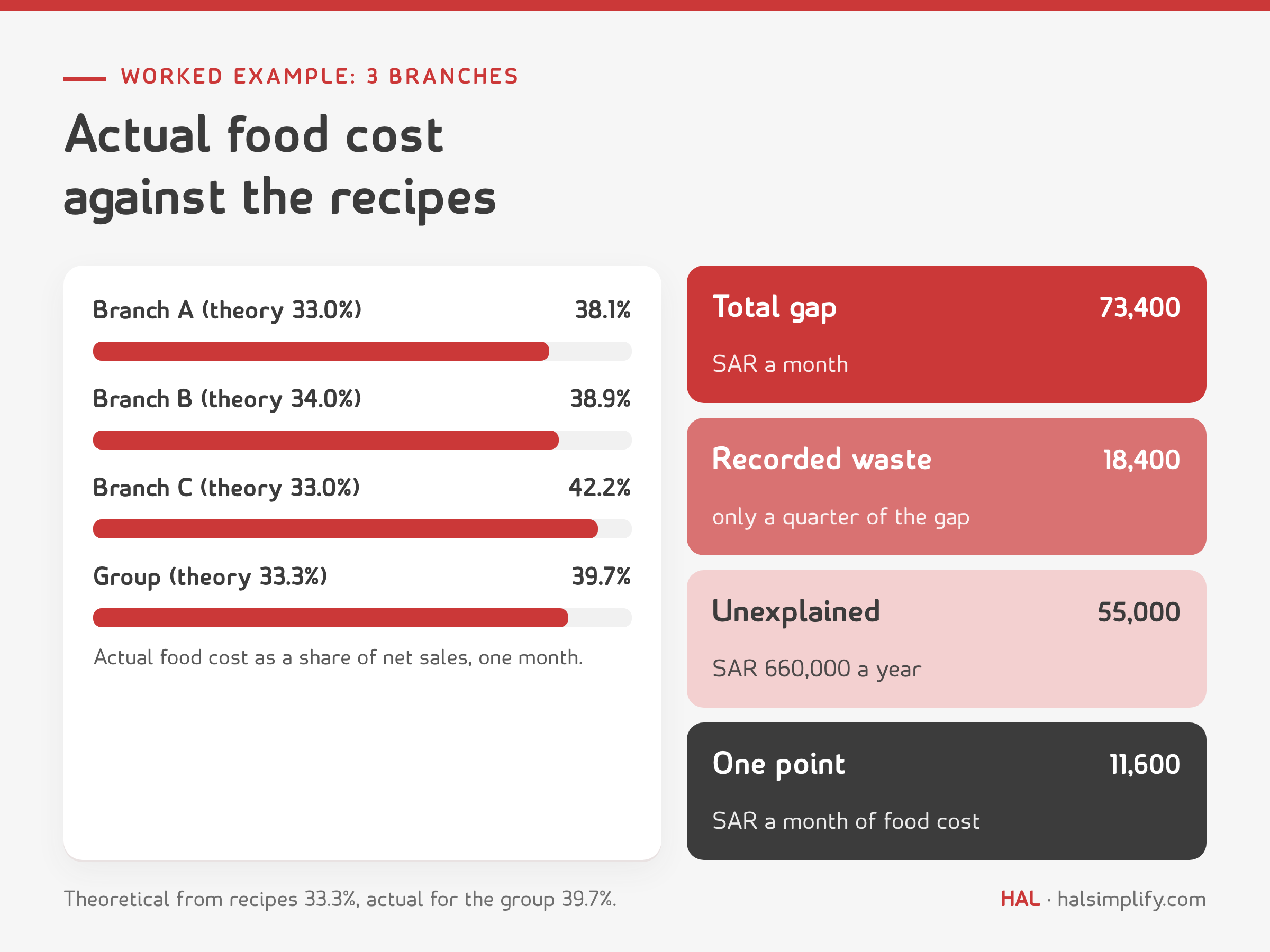
Theoretical food cost is what you should have used according to the recipes and the dishes sold. Actual food cost = opening stock + purchases + transfers from the central kitchen − closing stock. The gap between them is money that left the kitchen without going into a paid plate. One month, with hypothetical figures:
| Branch | Net sales | Theoretical cost | Actual usage | Gap | Recorded waste | Unexplained | Actual food cost |
|---|---|---|---|---|---|---|---|
| Branch A | 420,000 | 138,600 (33.0%) | 160,000 | 21,400 | 5,900 | 15,500 | 38.1% |
| Branch B | 380,000 | 129,200 (34.0%) | 148,000 | 18,800 | 5,700 | 13,100 | 38.9% |
| Branch C | 360,000 | 118,800 (33.0%) | 152,000 | 33,200 | 6,800 | 26,400 | 42.2% |
| Total | 1,160,000 | 386,600 (33.3%) | 460,000 | 73,400 | 18,400 | 55,000 | 39.7% |
The recorded waste (SAR 18,400) breaks down like this:
| Branch | Over-prep and trimming | Expired or spoiled | Order errors and returns | Total |
|---|---|---|---|---|
| Branch A | 3,200 | 1,800 | 900 | 5,900 |
| Branch B | 2,600 | 2,400 | 700 | 5,700 |
| Branch C | 4,100 | 1,500 | 1,200 | 6,800 |
| Total | 9,900 | 5,700 | 2,800 | 18,400 |
Three takeaways from the example:
For a full picture of each branch's profit, do not forget fixed costs such as branch rent paid in advance, which is spread over the months of the lease rather than charged in the month it is paid. We explain this with examples in prepaid expenses.
In groups with a central kitchen or a small factory, food turns from raw material into a semi-finished product and then into a plate in a branch. Every move without a document is a chance for a gap nobody can explain:
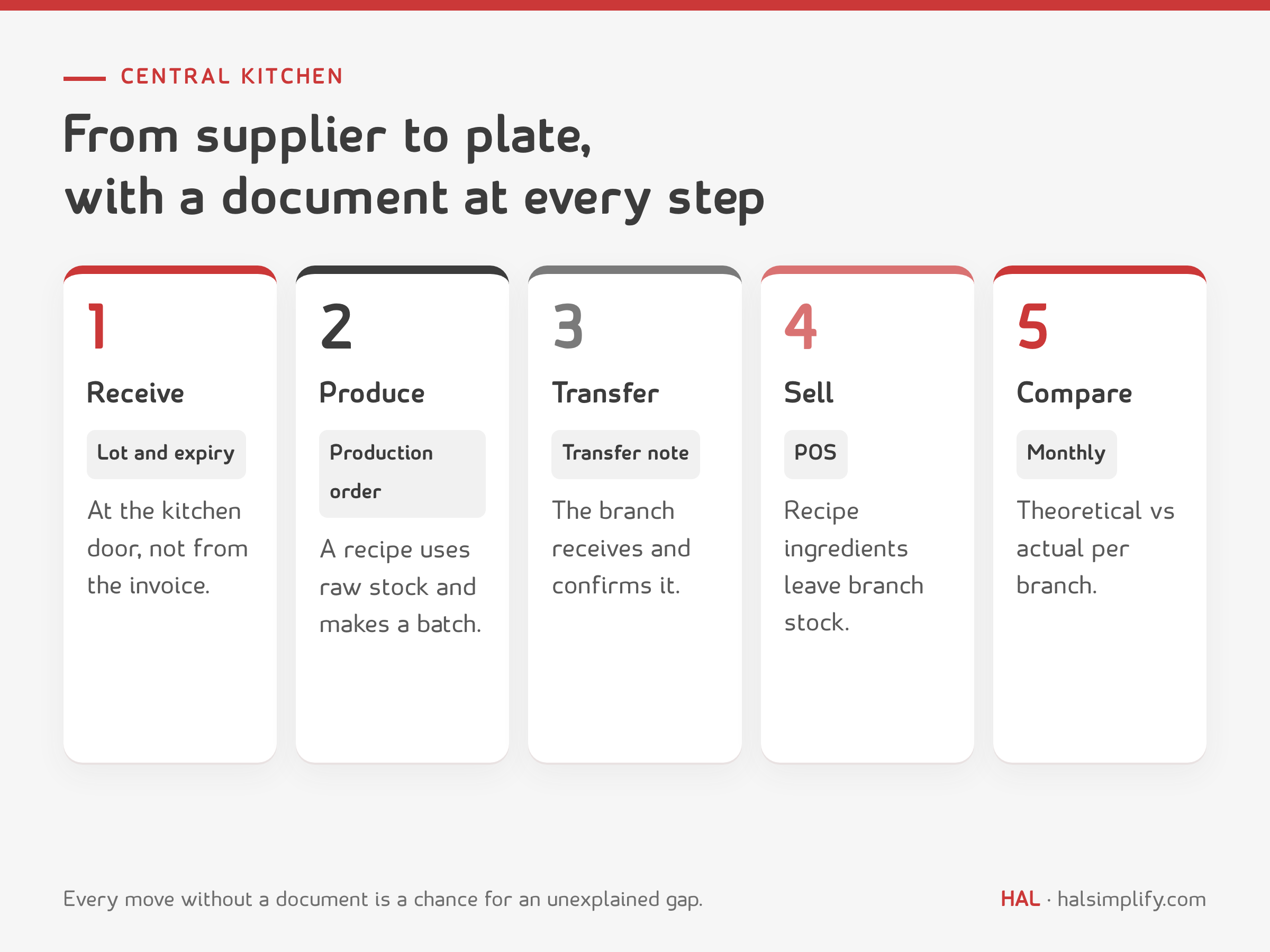
Ask every vendor about step four in particular: does a sale at the till deduct the recipe's ingredients from stock, or only the dish as a single unit? That is the difference between a system that measures food cost and one that counts plates.
Saudi Arabia's Food Law, issued by Royal Decree M/1, defines food tracking as the measures and procedures for tracing food, its sources and anything added to it at any stage of the food production chain. It requires a food establishment that knows or suspects that food it holds does not meet the Saudi Food and Drug Authority's (SFDA) requirements to notify the SFDA and take steps to withdraw it (Article 20), and empowers the SFDA to order a product's withdrawal or recall (Article 33).
In practice, you cannot withdraw a batch if you do not know where it came from or where it went. So ask the system for three things: a lot number and expiry date for every ingredient at receiving, a batch for every product that leaves your kitchen or factory, and a report that answers in minutes: "this lot of chicken, which products went into it, and which branch or customer received them?" When issuing stock, the rule is first expired, first out (FEFO). (This is a general explanation, not legal or regulatory advice; check the SFDA's requirements for your activity.)
The price of chicken, rice and oil changes every month, and recipe cost changes with it. Ask the system to hold supplier price lists, carry the latest purchase cost into the recipe automatically, and match the quantity received against the purchase order and invoice before payment. In food manufacturing, add a quality check at receiving: a lot that fails does not enter the stock available for production.
A restaurant's sales to guests are simplified tax invoices. In Phase 2 of e-invoicing, ZATCA's E-Invoicing Detailed Guideline says a simplified invoice is given to the buyer immediately and reported to the FATOORA platform within 24 hours of issue. A food manufacturer selling to a supermarket, hotel or another restaurant issues B2B tax invoices, which go through "clearance" by the platform before they are shared with the buyer. Orders from delivery apps need each app's sales kept separate so you can reconcile them with its settlements.
Score each system on each criterion from 0 (not there) to 5 (we saw it work with our recipe), then multiply by the weight. The result is out of 100.
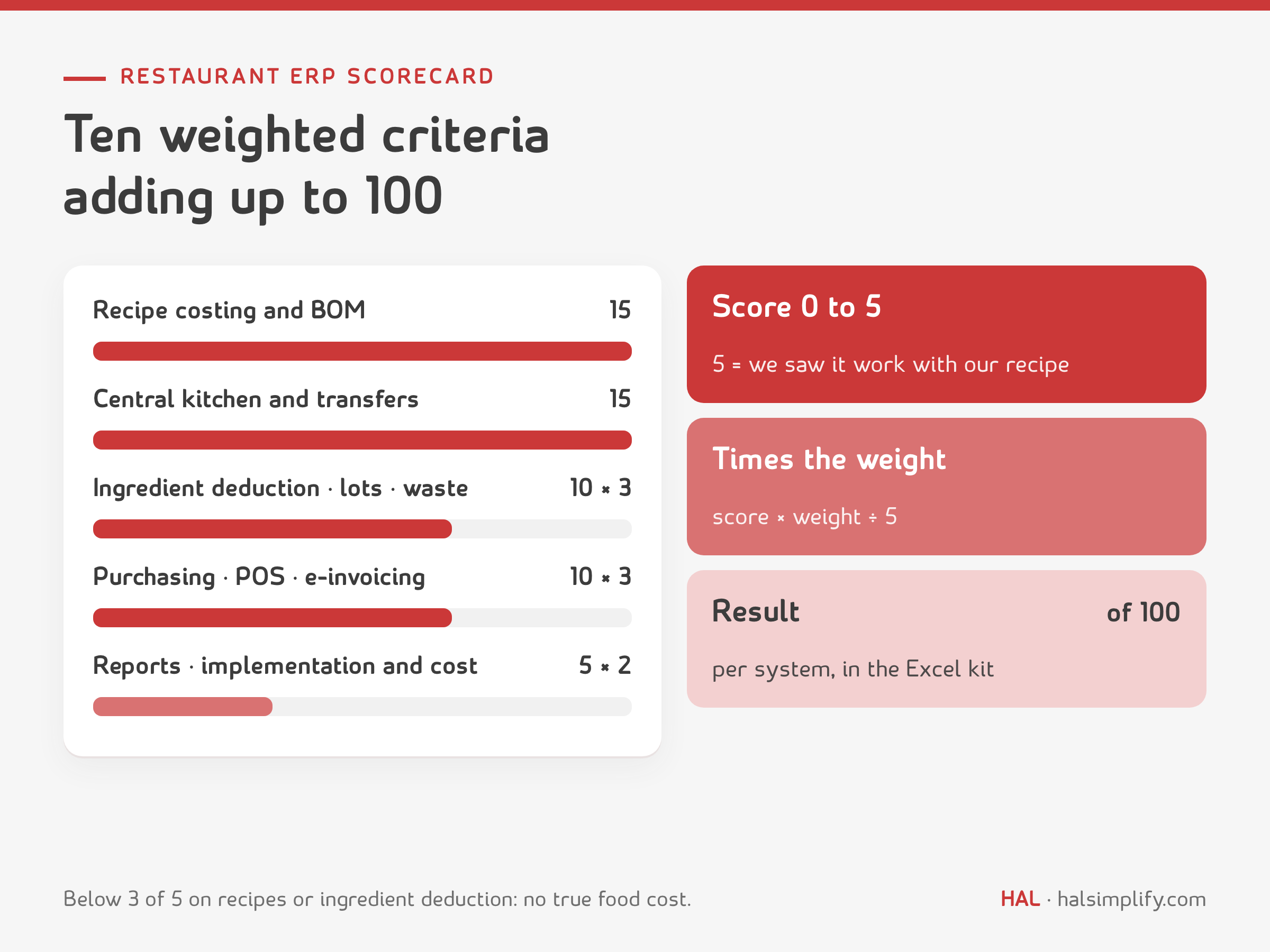
| # | Criterion | Weight | What to ask to see |
|---|---|---|---|
| 1 | Recipe costing and bill of materials | 15 | The kabsa recipe above, and its cost updating when the chicken price changes |
| 2 | Central kitchen and transfers to branches | 15 | A production order, then a transfer note the branch receives |
| 3 | Recipe ingredients deducted with every sale | 10 | Sell a dish, then check rice and chicken balances in the branch |
| 4 | Lots, expiry and traceability | 10 | Trace a lot from the supplier to the branch or customer |
| 5 | Wastage recording and reasons | 10 | Enter waste in a branch with a reason, and a monthly report per branch |
| 6 | Suppliers, purchasing and receiving | 10 | A supplier price list, and receiving matched to the purchase order |
| 7 | POS: dine-in, takeaway, delivery and offline | 10 | An order from a delivery app, and a sale during an internet outage |
| 8 | E-invoicing (simplified and standard) | 10 | Reporting a simplified invoice and clearing an invoice to a business customer |
| 9 | Food cost reports per branch | 5 | Theoretical vs actual, as in the example |
| 10 | Implementation, Arabic support and total cost | 5 | Duration, who implements, and cost over three years |
Any system that scores below 3 on criterion 1 or 3 will not give you a true food cost, however high its total.
Disclosure: this guide is published by HAL, and HAL ERP is one of the systems listed. Each description is taken from the vendor's own website as it appeared on 3 November 2026; we do not quote prices, customer counts or ratings. Apply the scorecard to every system, HAL included.
| System | What its website says | Usually suits |
|---|---|---|
| HAL ERP with HAL POSsible | A restaurant POS with table QR ordering, kitchen tickets and delivery-app orders that works offline and is part of HAL ERP; with stock, purchasing and manufacturing with BOMs and work-order costing | Restaurant groups with a central kitchen, and food manufacturers that want POS, production and accounts in one system |
| Foodics | A cloud POS and restaurant management system: orders, payments, inventory and connected branches, with an app marketplace for accounting and delivery | Restaurants and cafés that want a specialist POS with accounting software linked to it |
| Odoo | Open-source apps including restaurant POS, inventory and accounting; supports expiry dates for products tracked by lot | Businesses that want a flexible system built with an implementation partner |
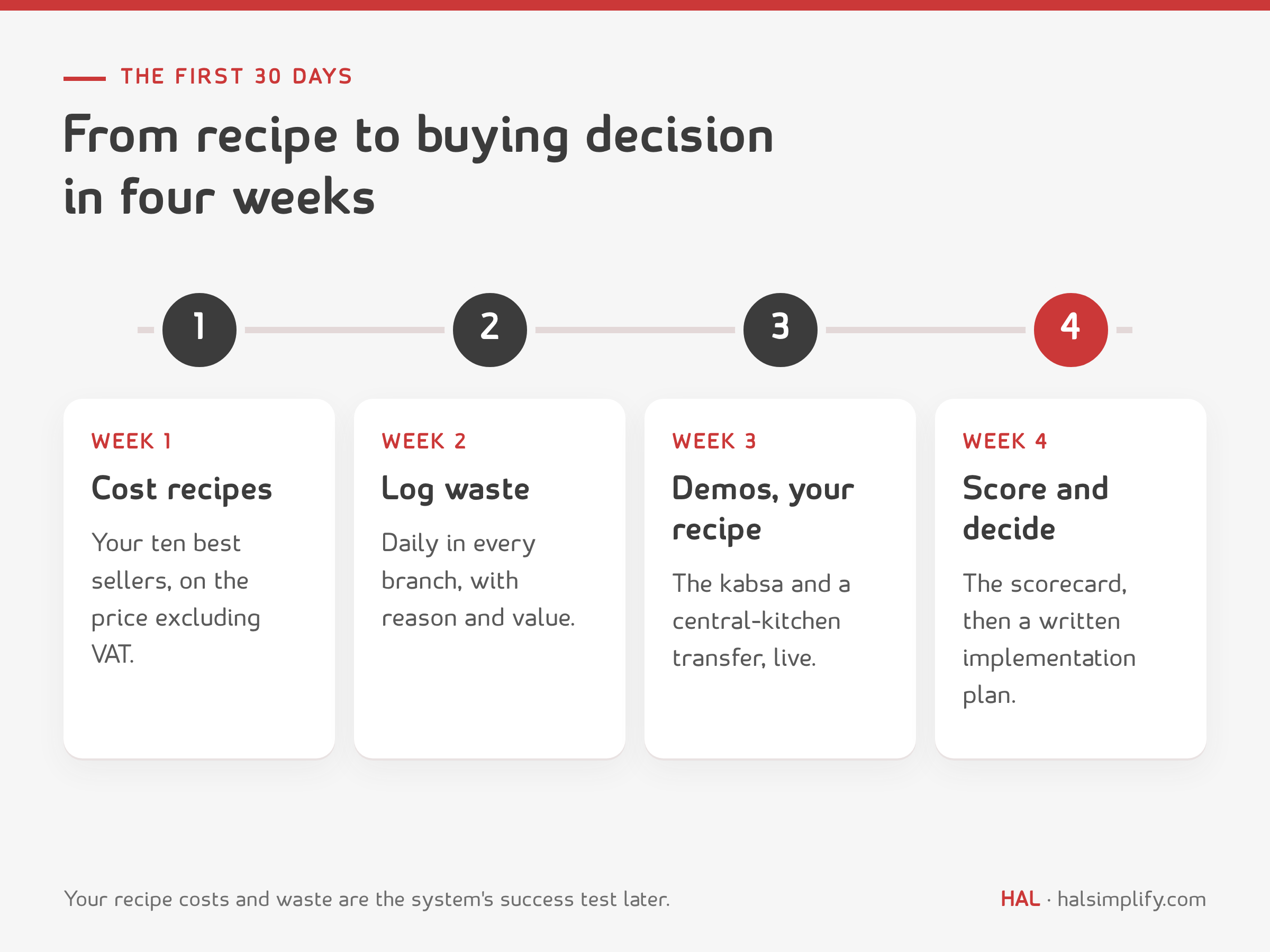
The kit turns this guide into tools you can use tomorrow:
HAL POSsible is a restaurant POS that is part of HAL ERP: table QR ordering, kitchen tickets printed at the right station, orders from HungerStation, Jahez, Keeta, Talabat, noon and ToYou inside the POS, offline selling that syncs when the connection returns, and invoices that meet ZATCA Phase 2. Each outlet has its own menu and prices, menu and price updates from HAL ERP reach every terminal, each sale moves stock out of the right store and posts to your books, and staff can raise a purchase request from the POS. Restaurants such as Burger Hunch (20 branches) and Joe's Cafe (5 branches) run on it today. For food manufacturers and central kitchens, HAL Manufacturing tracks BOMs and material, labour and overhead costs for each work order, with automated quality checks, and HAL's inventory module handles lots and moves between locations.
Cost your recipes and waste with the free kit first, then see HAL on your own recipe.
There is no single best system for every restaurant. A single restaurant may only need a good POS with stock control, while a restaurant group with a central kitchen or a food manufacturer needs an ERP that costs recipes, manages transfers and lots, and compares theoretical and actual food cost, with a POS linked to it. Score each system on weighted criteria after you have seen it work on your own recipe.
A restaurant POS takes the order, sends it to the kitchen, issues the invoice and closes the till. An ERP costs recipes and runs purchasing, stock, the central kitchen, production and accounts. You need both, linked, once you have three branches, a central kitchen or sales to other businesses.
Divide the recipe cost at purchase prices by the selling price excluding VAT. A kabsa costing SAR 15.20 and sold at SAR 45 including VAT (SAR 39.13 excluding it) has a food cost of 38.8%, not the 33.8% you get by dividing by the VAT-inclusive price.
Compare theoretical cost (recipes × dishes sold) with actual usage (opening stock + purchases + transfers − closing stock) for each branch, and log waste daily with its reason. In the three-branch example, the gap was SAR 73,400 a month, of which only SAR 18,400 was recorded as waste.
The Food Law requires a food establishment that knows or suspects that food it holds is non-compliant to notify the SFDA and withdraw it, and empowers the SFDA to order a withdrawal or recall. You cannot withdraw a batch if you do not know where it went, so record lot numbers and expiry dates at receiving and in production. This is a general explanation, not legal advice.
Yes. The kit (a PDF guide and an Excel workbook) is free. Enter your name and email in the form above and it will arrive in your inbox.