
In short: A teacher substitution register records who is absent, who covers each period, whether the cover arrived on time and what the class actually did. Paired with a timetable that leaves a free period for every teacher each day, two short, unannounced supervisor rounds and a ready cover-work pack for every class, it turns "we managed" into numbers: periods covered, periods lost and teaching minutes lost each month. Below: how the two registers work, how to plan fair cover, and a free kit (PDF guide and Excel tracker).
It is 9:40 on a Tuesday. Ms Hana called in sick at seven, and the morning scramble found cover for first and second period. Third period is Grade 6B Science. A free teacher is asked in the corridor and says yes, but she is marking, so she arrives eight minutes late and spends the period keeping the room quiet. Nobody writes any of this down. By the end of the month nobody can say how many periods Grade 6B lost, and the same three teachers have covered most of them.
Most schools cover absences. Fewer can show how well. This article explains two registers that fit on a page each: the substitution register, which records every cover, and the supervisor rounds register, which records what a short walk through the school finds. Whoever does rounds in your school can run them: the head of department, the compartment head, the vice principal or the supervisor. The free cover kit at the end gives you the printable forms, a cover-work pack template and an Excel tracker that adds up the month.
If you supervise a section of a school, some of these will sound familiar.
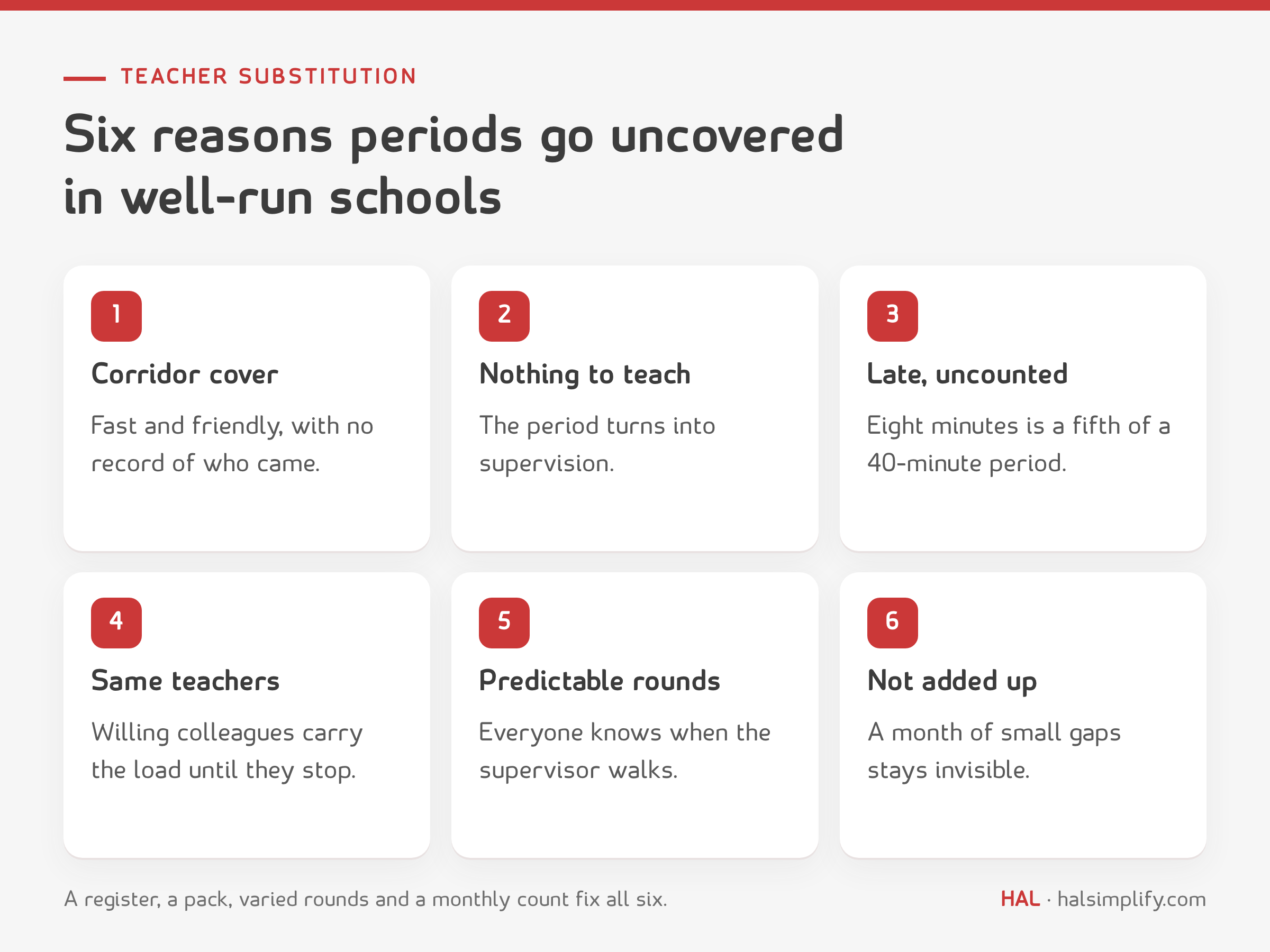
The two registers close all six, and each takes minutes a day.
Use one register for the whole school, filled by whoever arranges cover. A line holds the date, the teacher to be substituted and the reason, the period, the substitute and two acknowledgements.
| Column | What goes in it | Why |
|---|---|---|
| Date and period | Period 1 to 6 for each class covered | One line per period, so partial-day absences are exact. |
| Teacher to be substituted | Name and class | Links the gap to the teacher and the class. |
| Reason | Absent, On duty or Activity | A teacher on duty or out with students is a planned gap. Separating the three shows how many gaps the school creates for itself. |
| Substitute | Name | Fair rotation depends on it. |
| Cover pack used | Yes or No | Shows whether the period was teaching or supervision. |
| Arrival | On time or late, with minutes | The minutes feed learning time lost. |
| If late: why | The substitute's own explanation, in a line | A gap understood once is usually fixed once. |
| Acknowledgements | The substitute signs for the period; the teacher being covered signs within one school day | Both people know it happened, so the record is accurate. |
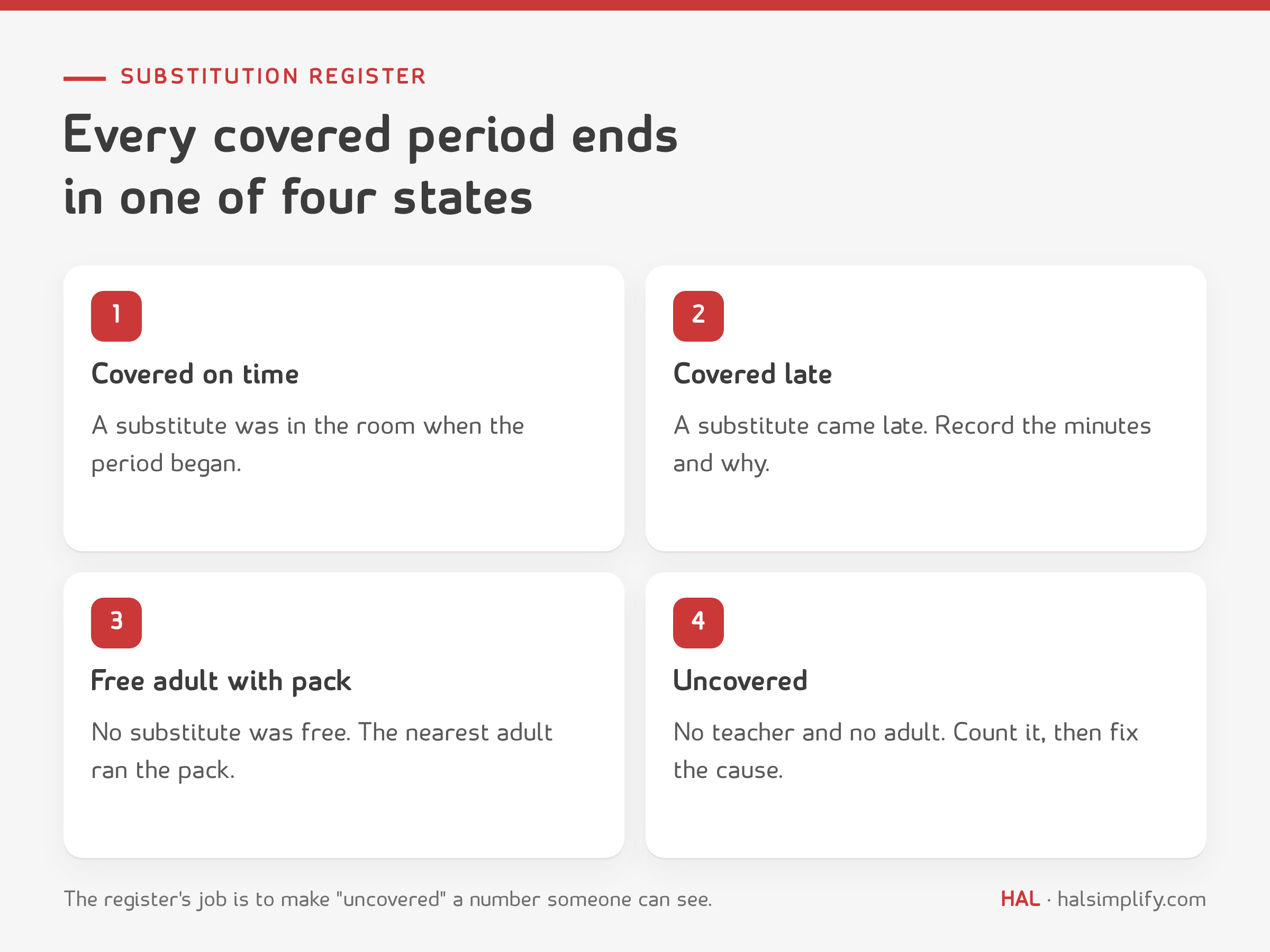
A period ends up in one of four states: covered on time, covered late, covered by the nearest free adult with the pack or uncovered. The register's job is to make "uncovered" a number somebody can see.
A cover-work pack is one page per class per term, written by the class's own teacher and kept with the supervisor. It lets any adult run a useful period without knowing the subject.
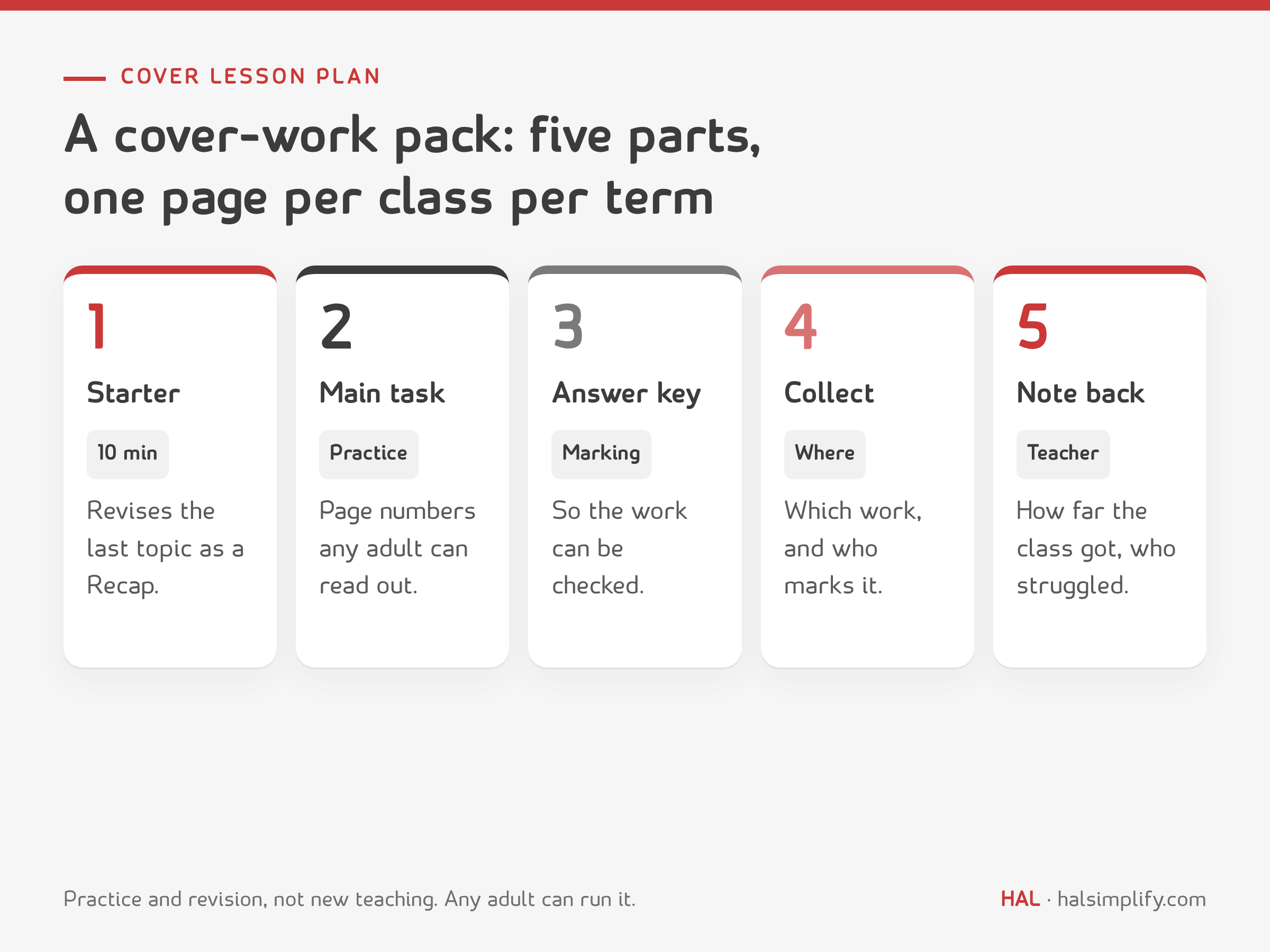
A good pack has five parts:
New teaching by a stand-in is rarely worth the risk. Practice, revision and reading are. When no substitute is free, the nearest free adult stays with the class and runs the pack, and the register shows the period as covered.
Rounds are a walk, with a clipboard and no scoring. Do two a day, at times that change from week to week, and cover a different block each time so no corridor is predictable. A random pattern sounds like surprise, and it is mostly fairness: every teacher is seen at ordinary times, not on a schedule they have worked out.
For each period of the day, the rounds register has four lines:
Rounds are different from a lesson observation. They check that a teacher is in the room and the class is working. A full observation checks how well the lesson is taught. If you want that second layer, see how to run a lesson observation.
Add up three things from the two registers: the minutes of periods that went uncovered, the minutes classes waited for late cover, and the minutes lost to teachers unavailable at rounds. Periods covered with a pack count as covered.
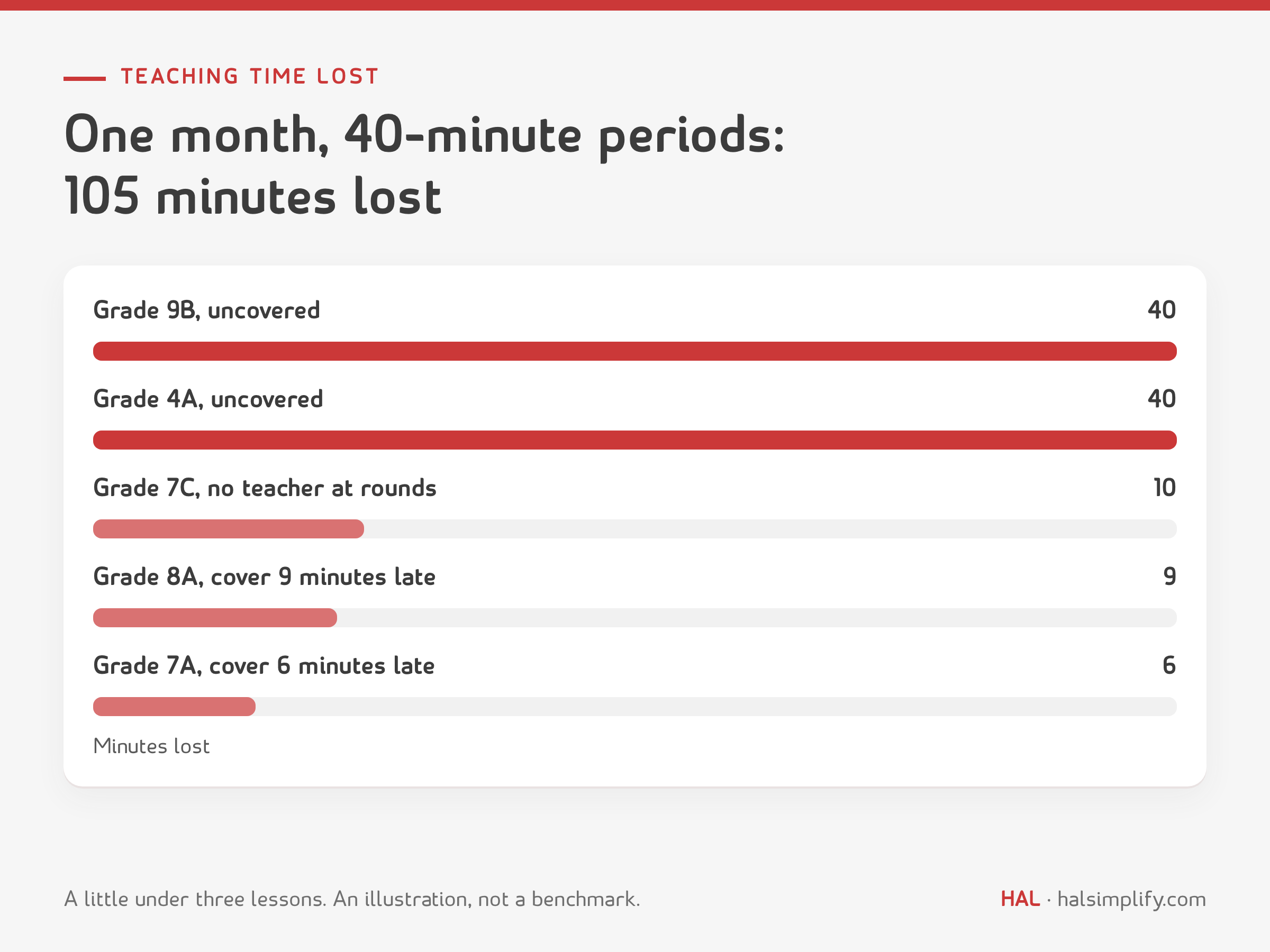
Take an illustrative month in a school with 40-minute periods. Two periods ended uncovered (80 minutes), two substitutes arrived six and nine minutes late (15 minutes) and rounds found one class without a teacher for ten minutes. That makes 105 minutes, a little under two lessons. One line per class then shows which grade lost the most, and a conversation about the pattern is easier than an argument about a single day.
The kit's Excel tracker does the arithmetic. Enter the period length once on the Settings sheet.
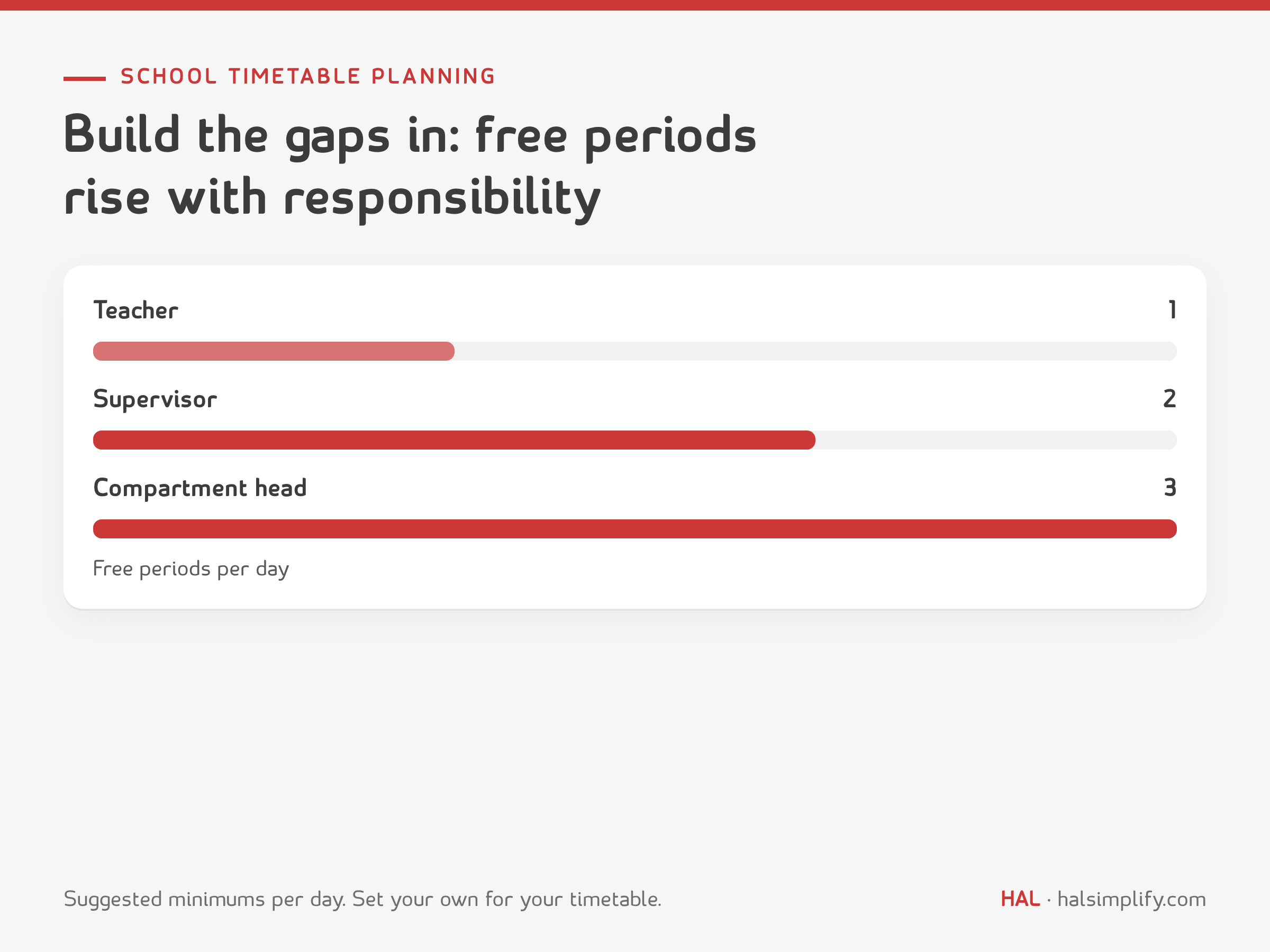
Cover works best when the timetable already leaves room for it. Plan every teacher a free period each day, and give more free time as responsibility grows: teachers, then supervisors, then compartment heads. Those gaps are where substitutions, rounds and correction work happen, so nobody has to choose between covering a class and marking a notebook.
| Role | Suggested minimum free periods per day | What the gaps are for |
|---|---|---|
| Teacher | 1 | Correction work, planning, and covering when asked in rotation |
| Supervisor | 2 | Rounds, arranging cover, and covering when no one else is free |
| Compartment head | 3 | Rounds, cover for the whole section, and the monthly review |
These numbers are a starting point. Your timetable, staffing and period count decide what is possible, so set your own in the kit's Settings sheet. What matters is the order and the habit: every role has a gap every day, and the more people depend on you, the more gap you get. A timetable with no gaps makes every absence a crisis, and the same people end up covering in their own marking time.
Build the timetable with three checks. Spread each teacher's free periods across the week and avoid placing them all on one day. Stagger them across blocks and periods, so someone is always free in every period. Keep a cover-work pack for every class, so a free teacher can walk in and teach a useful period.
Willing teachers become overloaded teachers. Once a month, put two numbers beside each teacher's name: periods covered for others and free periods in the timetable. If one teacher covers far more than colleagues with similar free periods, the rotation is unfair. Try three rules:
At month end, read three numbers: periods covered, late or uncovered, teaching minutes lost, and cover load per teacher. They tell you what the timetable asked of people, and they go straight into the monthly teacher report. Look for patterns in the timetable before patterns in people. A late cover on Wednesday period 1 every week usually points to a timetable problem.
Cross-check the two registers. The substitution register and the rounds register describe the same periods from two sides, so they should not contradict each other. If the substitution register says a class was covered on time, and a round found that class with no teacher, one of the records is wrong. The kit's rounds sheet flags that match, and the monthly summary counts them. Settle each one with the teacher and the supervisor. A register that is checked this way gets more careful on its own.
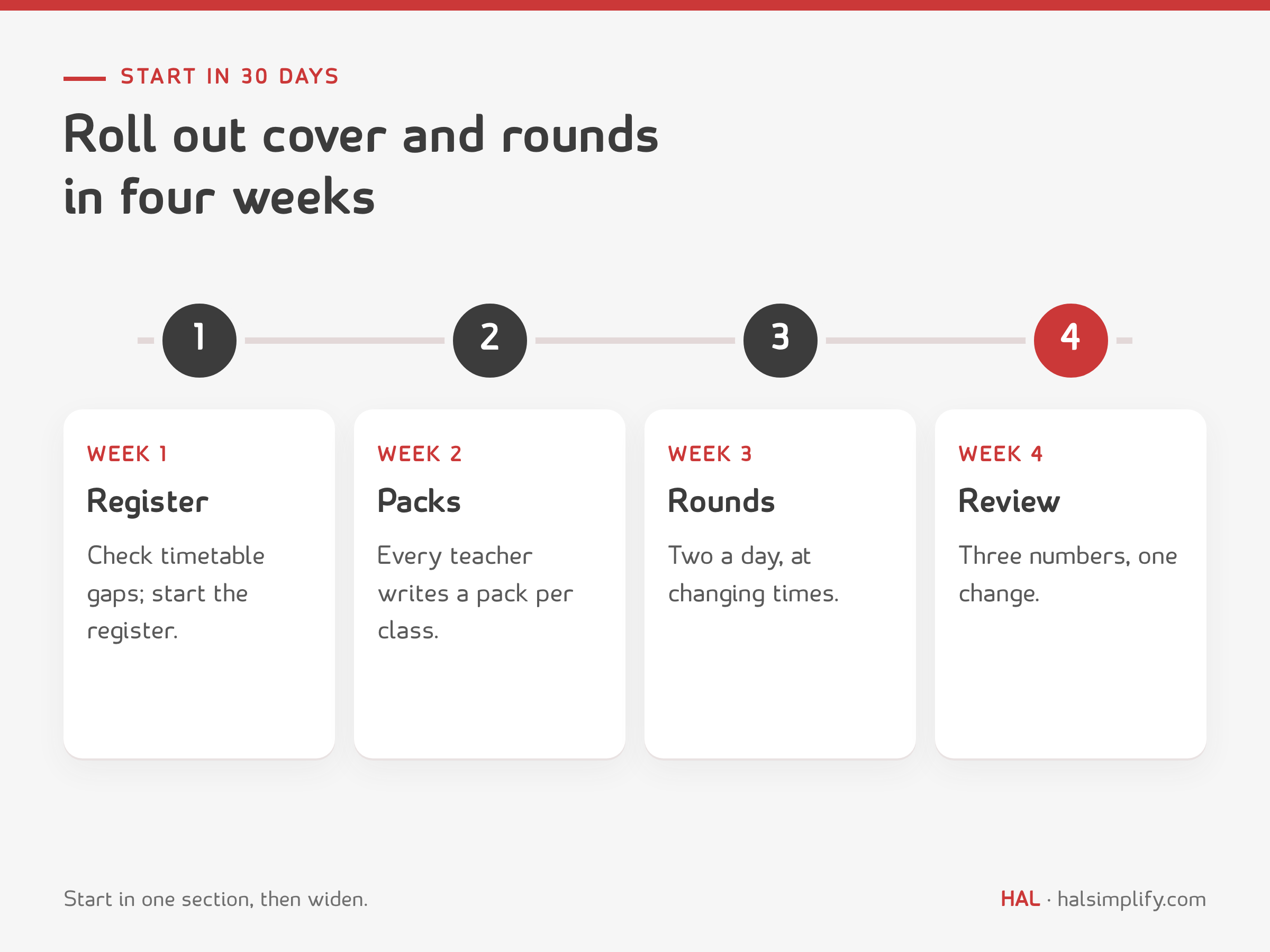
The kit has everything in this article, ready to use:
Two paper registers and a spreadsheet are the right place to start. As a school grows, the slow part is finding a free teacher quickly, filling the register from memory and adding up the month. When you look at software, check that it can record cover per period, hold the cover-work pack, show who has covered most and give you the monthly numbers without retyping. HAL Edge, HAL's education management system for schools in Saudi Arabia, keeps admissions, student data, faculty performance, fees and school operations in one system, in Arabic and English.
A record of every period one teacher covers for another: the date, the absent teacher and reason, the period, the substitute, whether cover arrived on time and whether a cover pack was used, with both teachers acknowledging the entry.
A cover-work pack for each class: a ten-minute starter, the main practice task with page numbers, an answer key, what to collect and a note for the returning teacher.
This kit suggests two short rounds a day at times that change each week, covering a different block each time. The aim is a fair picture of ordinary lessons and a record of any class without a teacher.
Add the minutes of uncovered periods, the minutes classes waited for late cover and the minutes lost to teachers unavailable at rounds. The Excel kit calculates this from your period length.
There is no universal number. A useful rule is at least one free period a day for every teacher, more for supervisors and more again for compartment heads, because they run rounds and arrange cover. The kit's Settings sheet lets you set the minimum for each role and flags anyone below it.
Yes. The kit is a free download: a PDF guide with printable forms and an Excel tracker that calculates cover, lateness and learning time lost for every teacher and class.