
In short: A material inspection request (MIR) is how a Saudi site asks for, and records, the technical check on material that has just arrived. It works best as the second of two signatures. The storekeeper first confirms the quantity against the purchase order, even for ready-mix concrete. The project manager then confirms the material matches the specification the consultant approved in the submittal. Only after both signatures does the delivery become stock. A rejection becomes a return against that receipt, a part delivery keeps the purchase order open, and every receipt records the building, floor and zone. Below: the two steps, the MIR fields, a worked porcelain example, a register with ageing, a monthly count and a free MIR and site receipt register kit.
It is Sunday, 7:10 in the morning, on a residential tower site in north Riyadh. Two ready-mix trucks are queuing at the gate, a lorry of porcelain tiles is parked behind them, and the storekeeper has one pen. He signs the concrete tickets, counts the porcelain boxes against the delivery note and signs that too. By Wednesday the supplier's invoice is with finance, and finance pays what the delivery note says. On Thursday the site engineer opens the boxes on the eighth floor and finds the tiles are a different series from the sample the consultant approved.
Nobody on that site was careless. The storekeeper did his job, which was counting. What was missing was a second, separate signature that says "this is the right material", and a rule that a delivery is not stock until both signatures are on it. This article sets out that rule as a Saudi general contractor runs it across several sites at once.
Most site stores mix two different questions into one signature: "did the quantity arrive?" and "is it what we ordered and the consultant approved?" When one person answers both on a busy morning, these things happen:
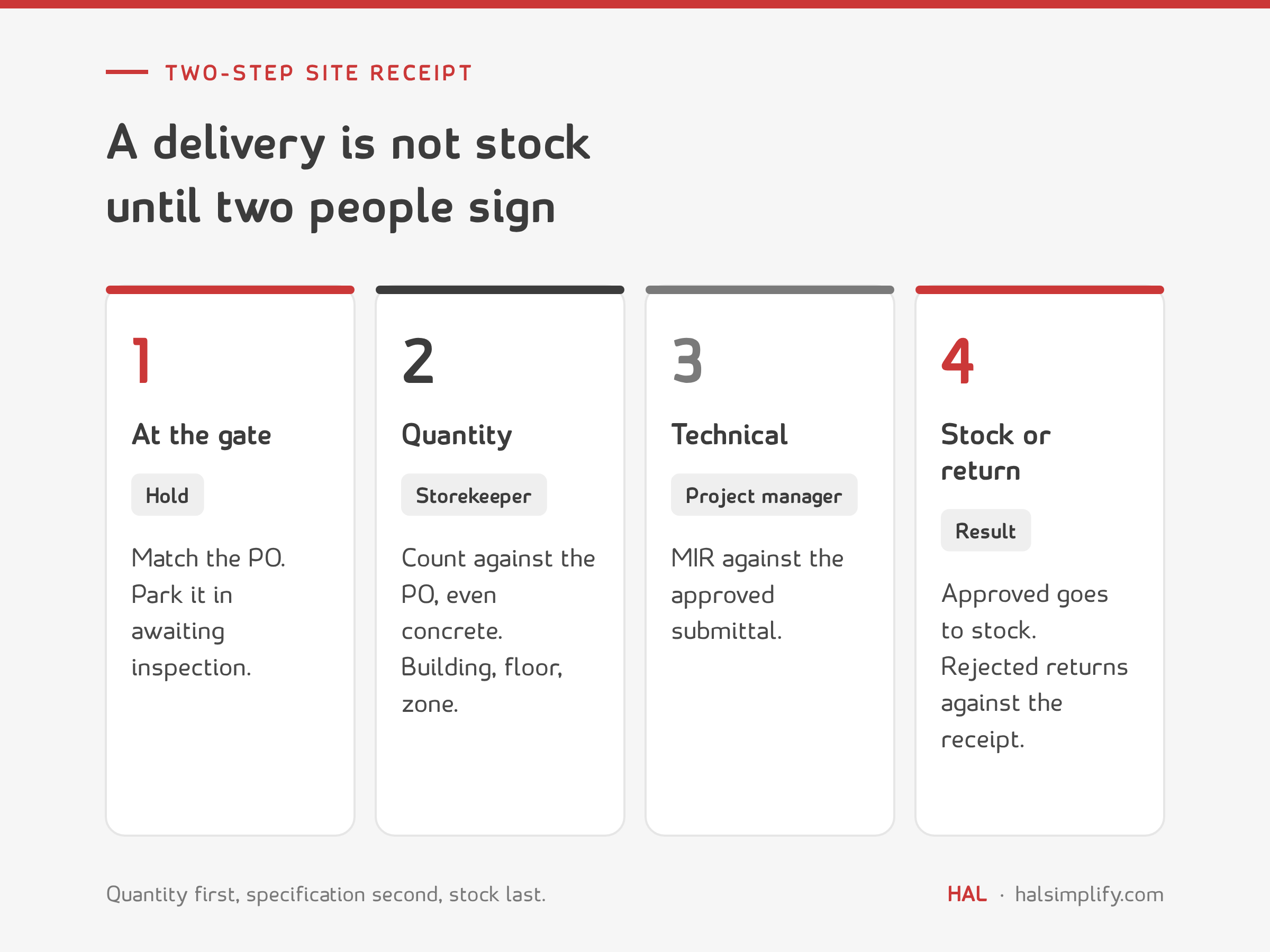
The fix is simple to say. Every delivery gets two signatures, from two people, in a fixed order. The storekeeper signs for quantity. The project manager signs for the technical check. Stock moves only after the second signature.
An MIR is a short form raised when material reaches site, asking the person responsible for the technical check to inspect it against what was approved. On many Saudi projects the consultant's inspector attends as well, as the contract and the inspection and test plan require. Inside the contractor, the technical decision in this method belongs to the project manager.
The MIR does not approve the material in principle. That happened earlier, in the material submittal, when the consultant approved the product, its data sheet and its sample before procurement chose a supplier. The MIR checks that what arrived is the thing that was approved.
| Document | When | Question it answers | Who decides |
|---|---|---|---|
| Material submittal | Before the supplier is chosen | Is this product acceptable for the job? | Consultant |
| Purchase order | After the submittal is approved | What, how much, by when, to which zone? | Procurement, cost control |
| Site receipt (step 1) | At the gate | Did the ordered quantity arrive? | Storekeeper |
| MIR (step 2) | Within a set time after receipt | Is this the approved material, in good condition? | Project manager, consultant where required |
| Work inspection request | After the material is installed | Is the finished work ready to cover? | Consultant |
If the installed work is your next question, our guide to the work inspection request (WIR) covers that later step.
The storekeeper's job is to count; judging the specification comes later. He checks the delivery against the purchase order and records what came, where it went, and what is still due.
The storekeeper then raises the MIR, or the receipt raises it for him. Either way, the MIR number goes on the receipt and the receipt number goes on the MIR, so each can always be found from the other.
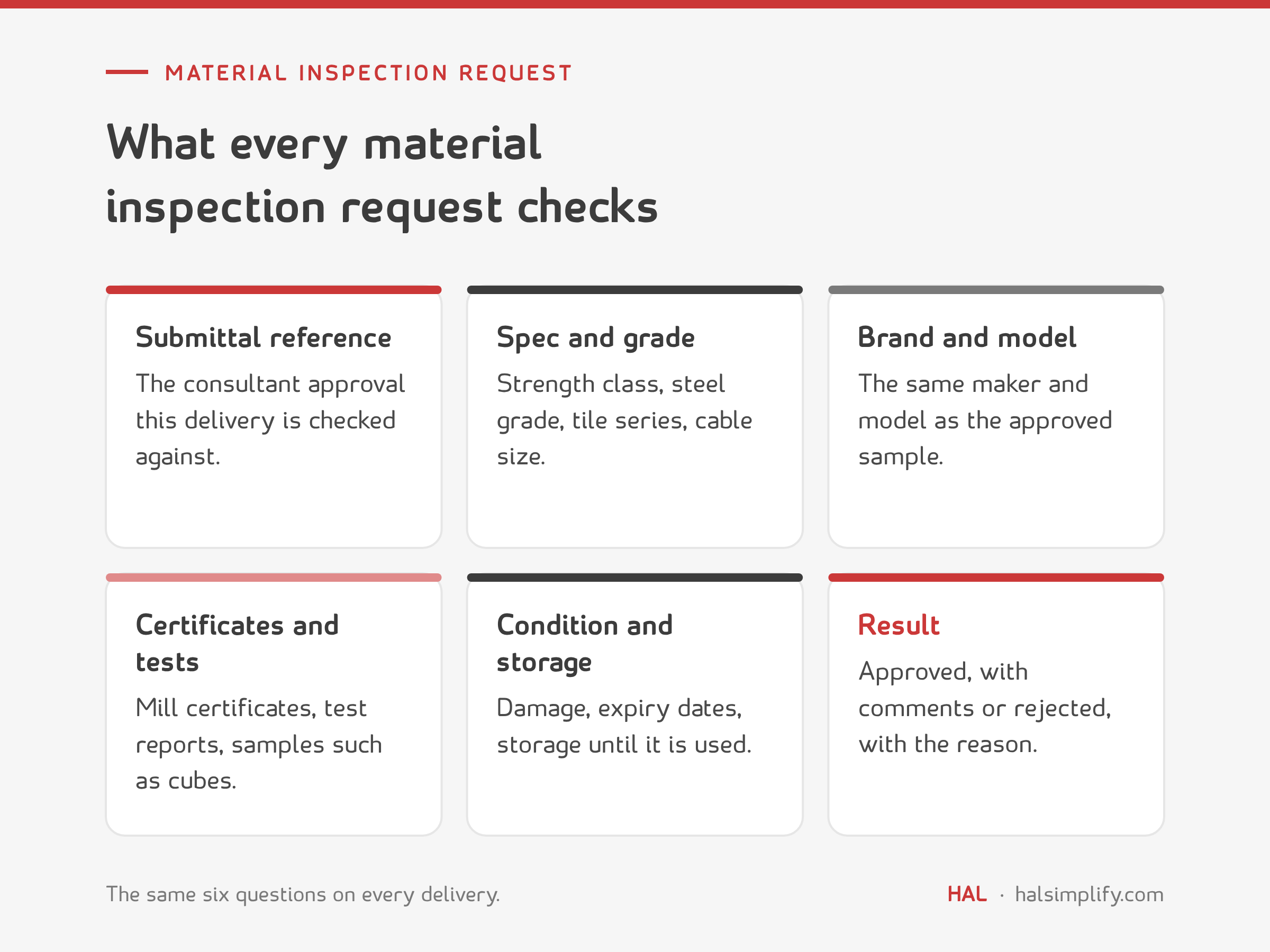
The project manager, with the consultant's inspector where the contract asks for it, checks the delivery against the approved submittal. A good MIR form asks the same questions every time:
Set a time limit for the check and measure it. Two working days after receipt is a reasonable starting point; your project may need less for concrete samples and allow more for complex equipment. Count working days on a Sunday-to-Thursday week. An MIR that waits a week leaves the site with two bad choices: install unchecked material or stop work.
A rejection is not a note in a WhatsApp group. It becomes a return against the receipt it came on, so the quantity leaves "awaiting inspection" and never reaches stock, the supplier's invoice can be matched to the accepted quantity only, and the PO line stays open for the replacement.
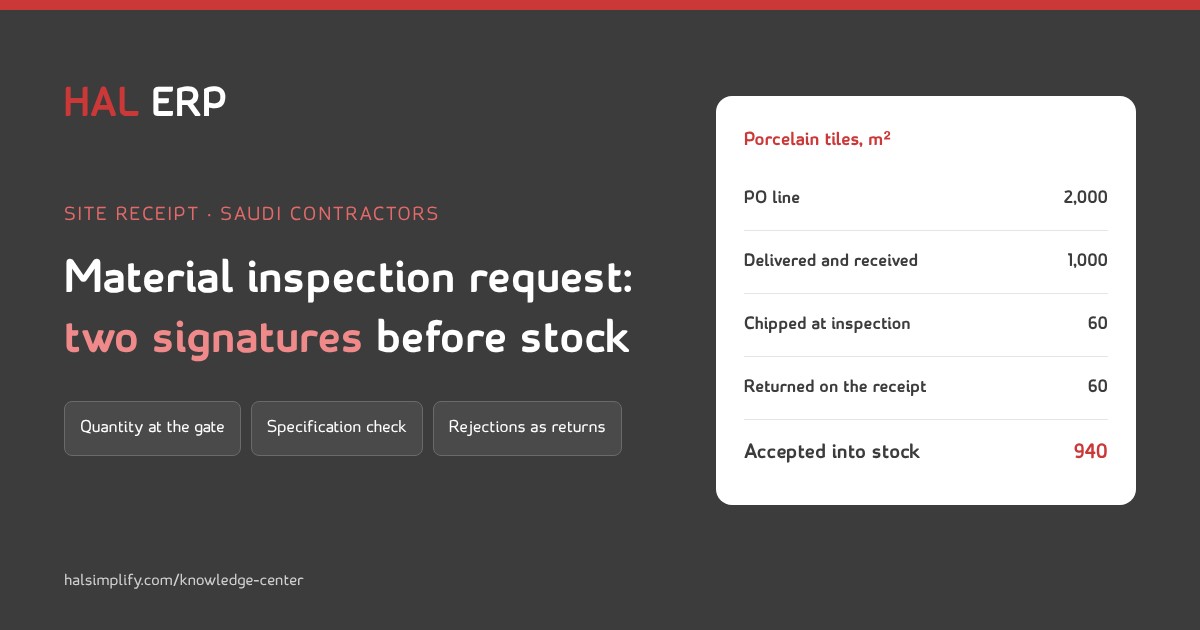
A worked example from a residential tower:
| Step | Quantity (m²) |
|---|---|
| PO line: porcelain tiles 60 × 120, phased delivery | 2,000 |
| First delivery received by the storekeeper (Building A, floor 8, zone east) | 1,000 |
| MIR result: 60 m² chipped, the rest matches the approved sample | approved with comments |
| Returned against the receipt | 60 |
| Accepted into stock | 940 |
| Still open on the PO for the next deliveries | 1,060 |
| Quantity the supplier can invoice for this delivery | 940 |
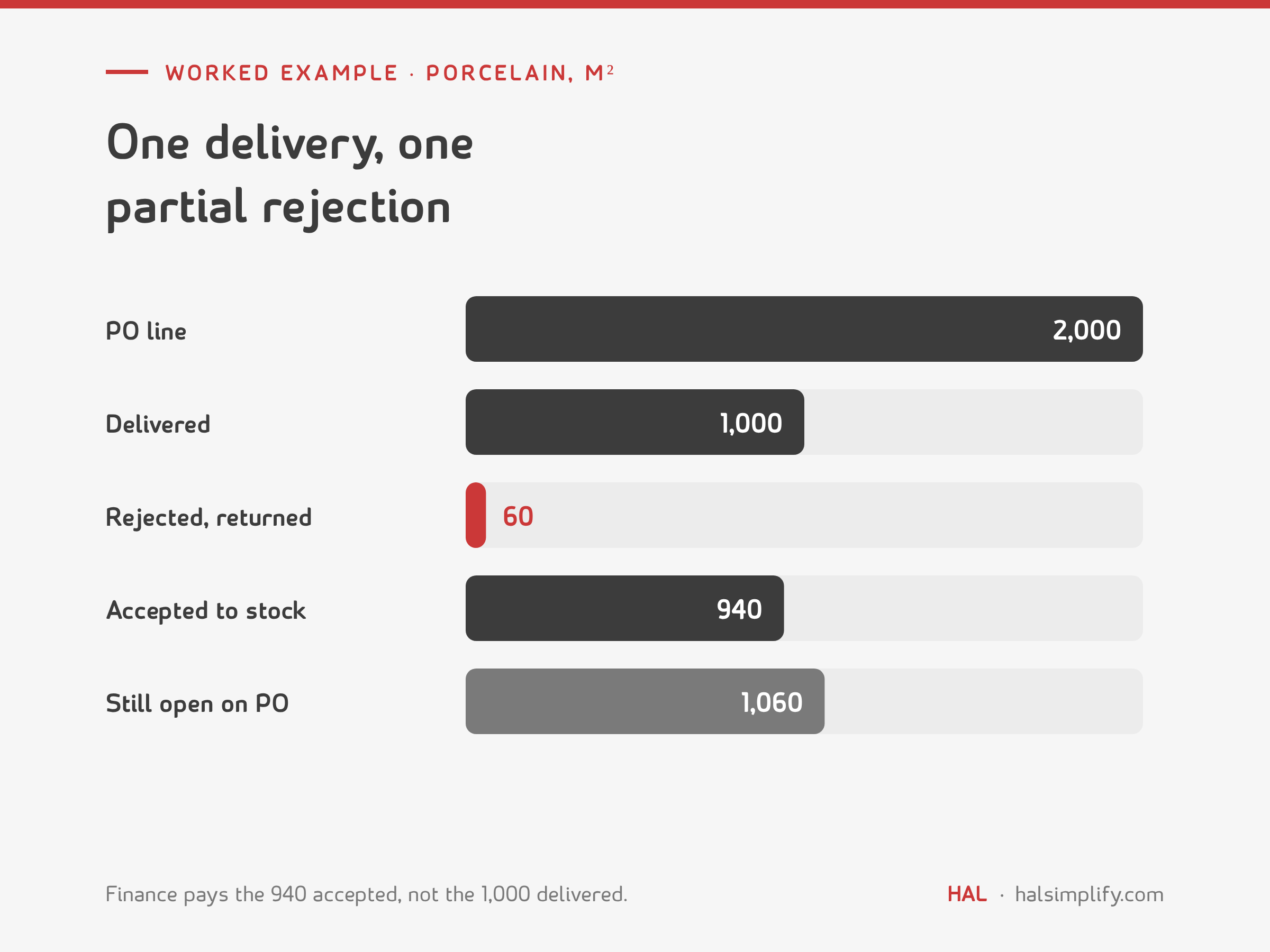
Three rules make this work. The return quotes the receipt and MIR numbers. The accepted quantity, not the delivered quantity, is what finance can pay. And the open balance stays on the PO until the last good delivery arrives, or until procurement formally closes the line.
The receipt is only as good as the order behind it. The Saudi contractor in our example now writes the delivery schedule into the PO by zone and date. As one of its managers put it in a requirements meeting, the schedule is there "so as a legal document I can say you're late." Each receipt is then compared with a dated line, and late or short deliveries become the basis for delay penalties instead of an argument.
This matters most for long-lead items. HVAC equipment may need a PO four to six months ahead with phased deliveries; most other materials are ordered within a week of the consultant's approval. A dated schedule, receipts against it and an MIR on each delivery are what let you prove which deliveries were late.
Give every MIR a number that tells you the project and the sequence, for example TWR2-MIR-0147. Keep one register per project with a row for every delivery, and four columns that matter more than the rest:
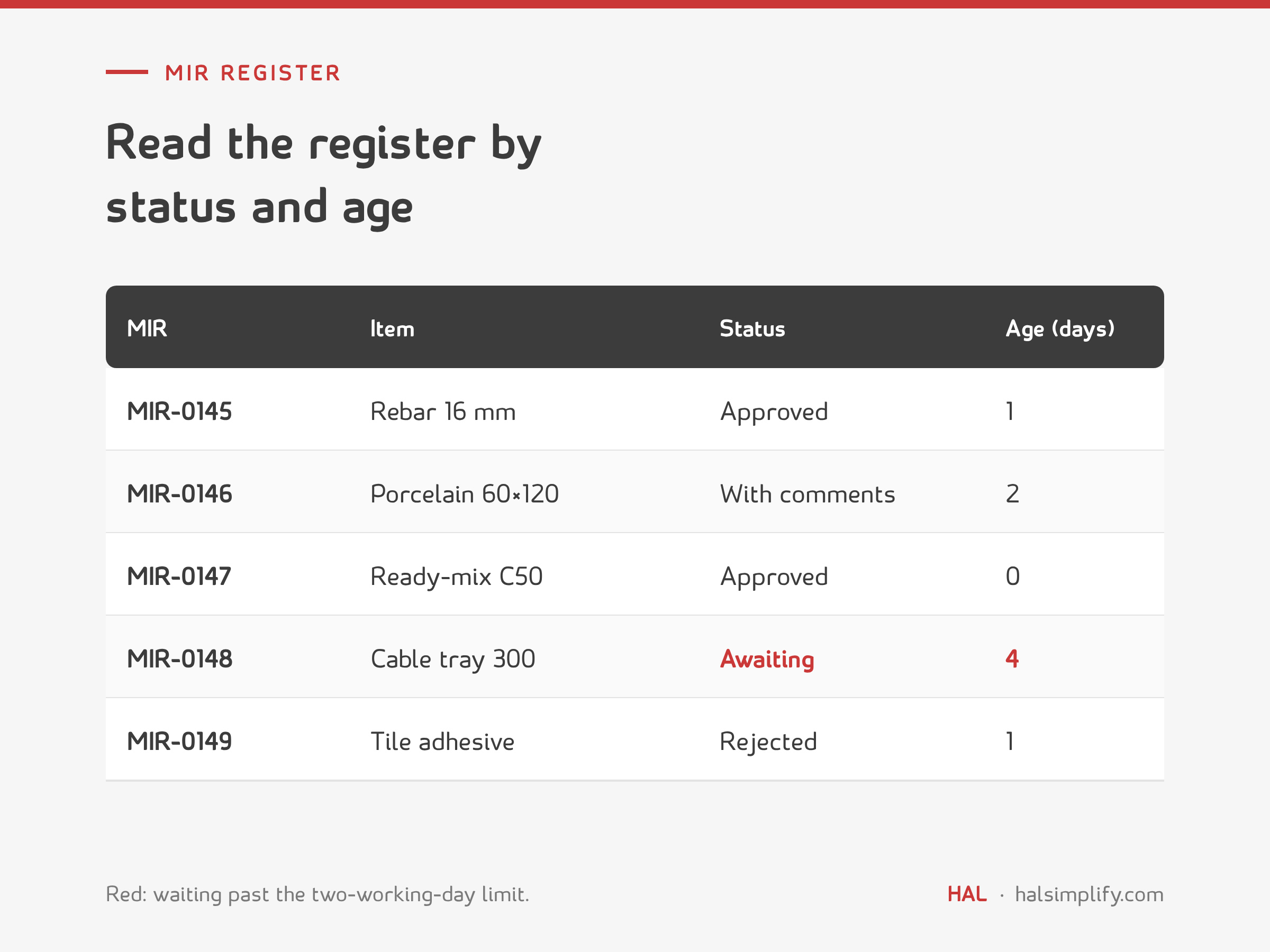
The site manager reads the overdue list every morning, the project manager clears it, and procurement reads the rejected list every week to decide which supplier to speak to. If the same supplier appears on the rejected list three times in a month, that calls for a conversation with the supplier.
Every site is a store, and a store you never count drifts. Once a month, count what is physically on site by building, floor and zone and compare it with the system. Then look at one more number: how long has each item been sitting there?
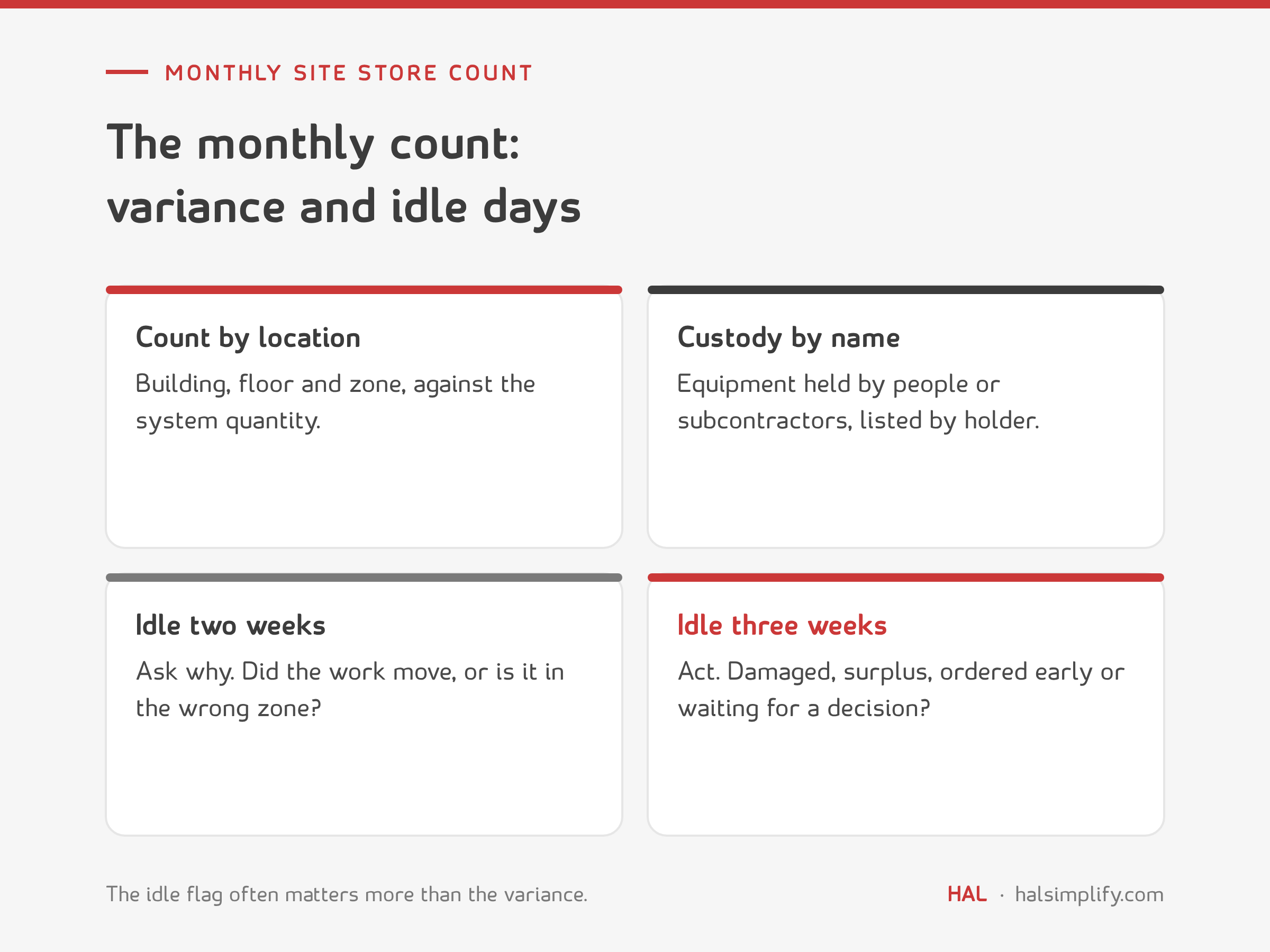
Equipment issued to people or subcontractors is tracked as custody, so the count can name who holds each item. The idle flag is often more useful than the variance: material that arrived early ties up cash and gets damaged long before anyone needs it.
The kit gives you everything above, ready to use on Monday:
A register works on one site. Across several sites, the receipt, the PO and the invoice need to live in one system. In HAL Contracting, site requests are raised against the BOQ, the item receipt is posted against the purchase order, and purchase order reconciliation shows what was ordered, received, invoiced and still pending for every PO and project. The vendor invoice is capped at the received quantity, and purchase returns and debit notes are raised against a receipt or invoice. Approval workflows with as many levels as you need can sit on any transaction. HAL's Quality Control page describes receiving inspections defined in quality control plans for inventory operations; ask HAL how that fits your site receipts. Where a site admin pays a supplier from company cash they hold, HAL's employee-custody vendor payment clears that advance against the supplier's bill, with both the vendor and the employee recorded correctly. See HAL pricing for the plans.
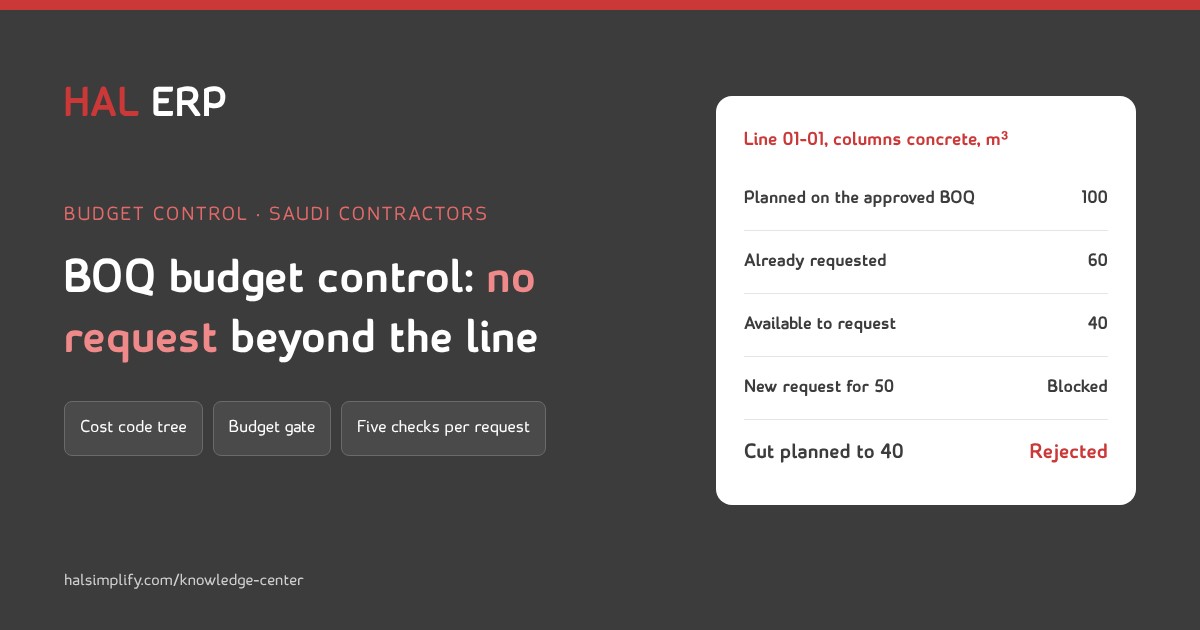
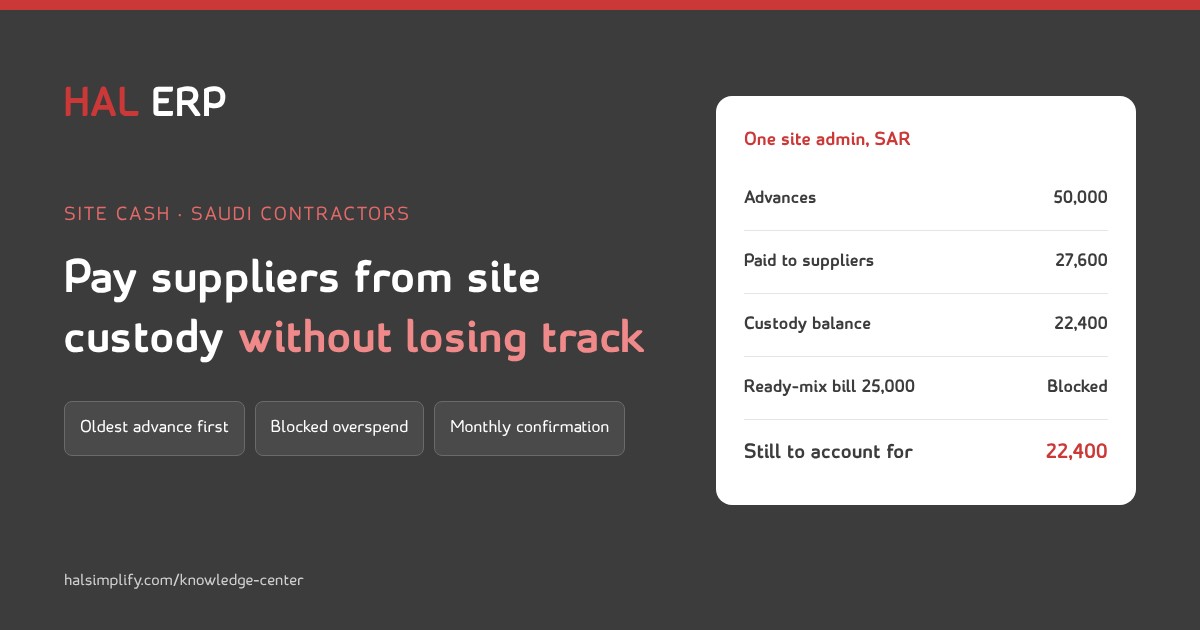
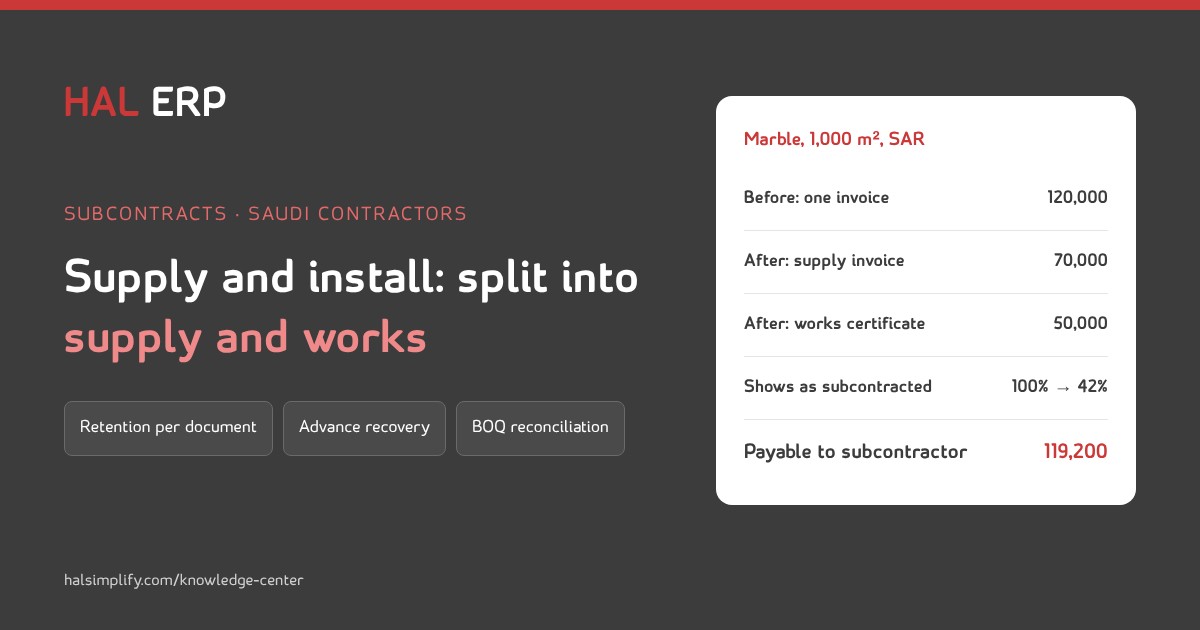
Related reading: paying suppliers from site petty cash, BOQ budget control for purchase requests and splitting supply and install subcontracts.
A material inspection request (MIR) is the form raised when material arrives on site, asking for a technical check that the delivery matches the material the consultant approved in the submittal. It records the specification, brand, certificates, condition and the result: approved, approved with comments or rejected.
The material submittal comes first and asks the consultant to approve a product before the supplier is chosen. The MIR comes later, when that product is delivered, and checks that what arrived is the approved product in good condition.
In the two-step method, the storekeeper signs the receipt for quantity and the project manager signs the MIR for the technical check. Where the contract or the inspection and test plan requires it, the consultant's inspector also inspects and signs.
Yes. The storekeeper signs each ready-mix ticket with its volume and pour location, so concrete is received like any other material and its cost follows the pour. The technical side, such as the mix class and cube samples, goes on the MIR.
The rejected quantity is returned against the receipt it arrived on. It never becomes stock, the supplier can invoice only the accepted quantity, and the purchase order line stays open for the replacement delivery.
Set a limit and measure it. Two working days from receipt, counted on a Sunday-to-Thursday week, is a reasonable starting point. The register's ageing column and overdue flag show which deliveries are waiting too long.