
In short: Job costing means comparing what each project actually costs with what you estimated, line by line, every month. Give every BOQ line a cost code, record what you have committed (purchase orders and subcontracts) beside what you have actually incurred (receipts, timesheets and certificates), and ask the project manager for the cost to complete. Budget minus forecast at completion shows where the margin is going while there is still time to act. The free job cost sheet (Excel and PDF) does the arithmetic.
Most contractors find out a project lost money after the final account. The tender was priced carefully, the client paid, the site was busy. But the estimate lived in one Excel file, purchases in another, site labour in one payroll for every project, and nobody put the three together until the job was over.
This guide is for contractors, steel and aluminium fabricators and other project-based firms in Saudi Arabia: owners, project managers, cost controllers and finance heads. It shows how to set up cost codes, separate committed from actual cost, cost labour properly (including the iqama, insurance and end-of-service that never appear on the payslip), handle subcontract certificates and retention, and read margin per job each month. A worked example follows one building through month 6.
Job costing assigns every riyal of cost to the job that caused it and compares it with the job's estimate. For a contractor, the estimate is the priced BOQ broken into materials, labour, subcontract, plant and other costs. The comparison is only useful if it happens while the job is running.
Monthly is the right rhythm because everything else on a Saudi project is monthly: progress claims, subcontractor certificates, payroll and the site stock count. A quarterly review finds an overrun after three claims have gone out at the old margin. A monthly one finds it while you can still re-price a variation, change a supplier or move a crew.
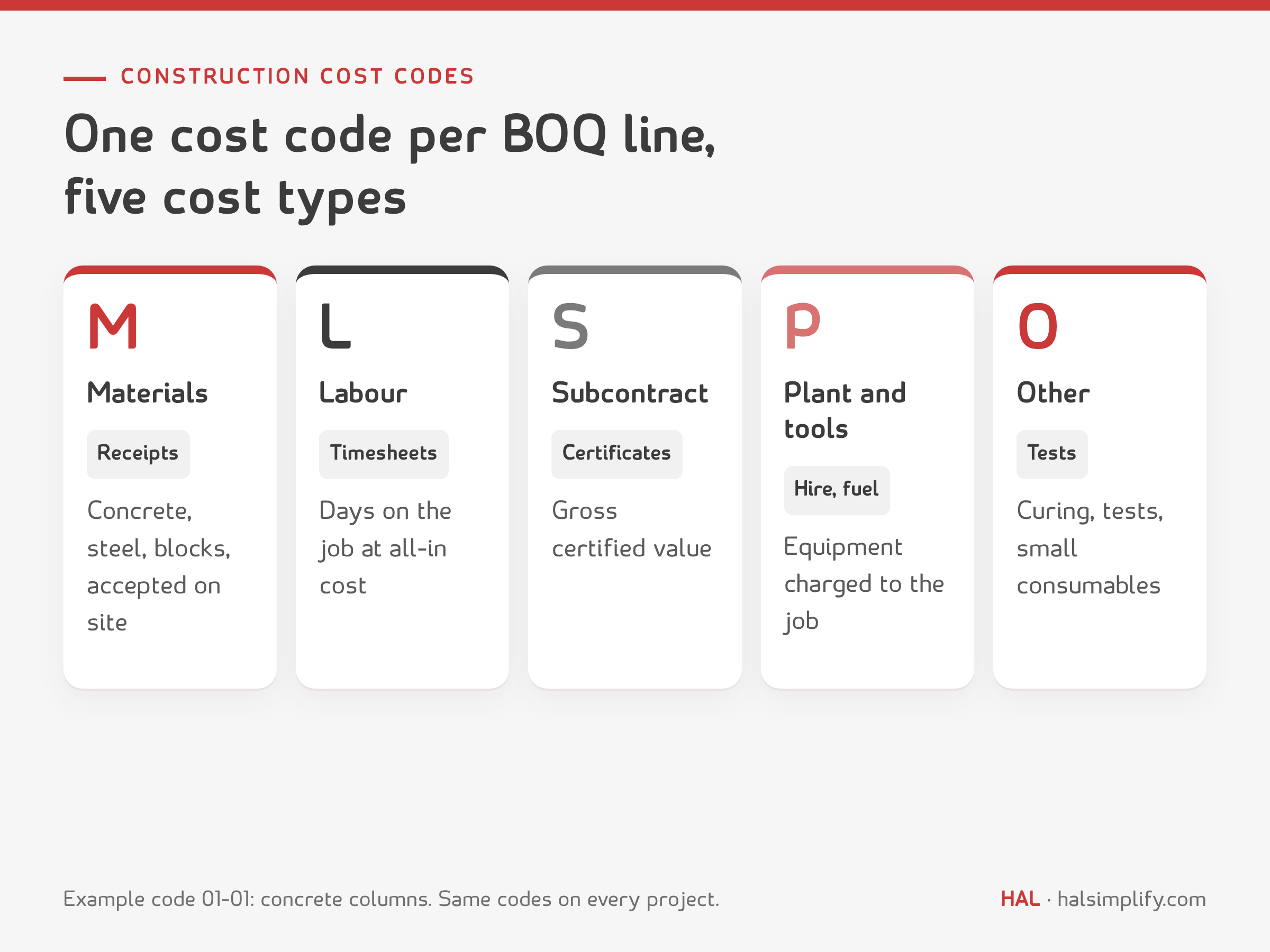
A cost code is the label every cost carries. Without it, a delivery of blocks is just "materials" and cannot be compared with anything.
For the BOQ itself, see our guide to BOQ management in civil engineering.
Actual cost is what has been incurred: material received, hours worked, work certified. Committed cost is what you have already agreed to pay: purchase orders and subcontracts issued, whether or not the invoice has arrived. Track both against the budget.
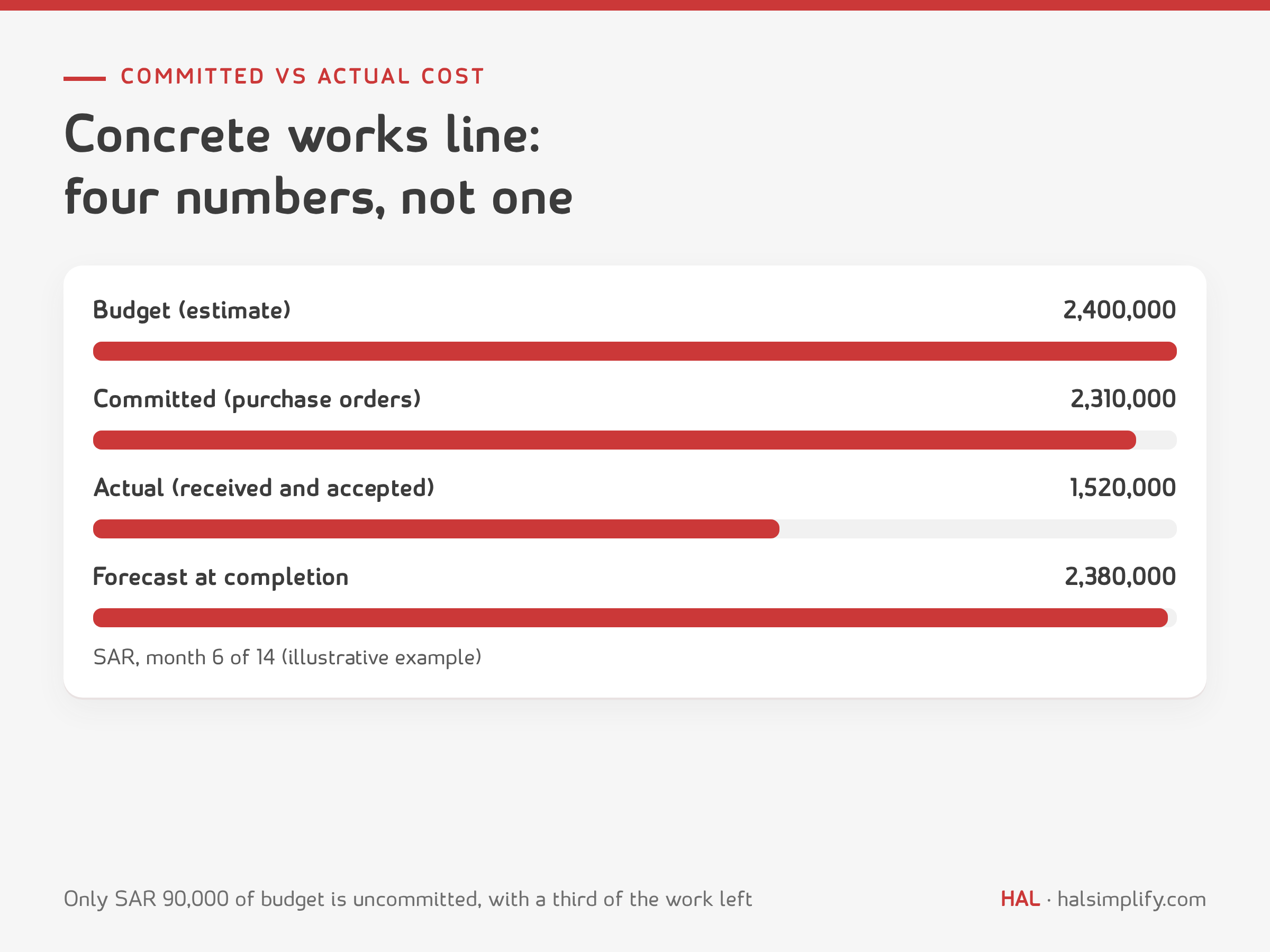
Why committed matters: on the concrete line in our example, SAR 1.52 million has been received, which looks comfortable against a SAR 2.40 million budget. But SAR 2.31 million is already on purchase orders. Only SAR 90,000 of the budget is uncommitted, with a third of the work left. Without the committed column, the first sign of trouble is an invoice that has already been ordered.
Four rules keep the two columns honest:
Labour is usually the biggest gap between estimate and actual, for two reasons: people move between sites, and their real cost is higher than their salary.
Charge labour by days on each project. A site timesheet per project, approved monthly, says who worked where. A mason with an all-in cost of SAR 3,900 a month and 26 paid days costs SAR 150 a day; 20 days on Tower B puts SAR 3,000 on Tower B. If all salaries post to one payroll ledger, the project report leaves out its biggest cost.
Use all-in cost, not salary. The rate per person should include everything the company pays to keep them on site: medical insurance, iqama and work permit fees, annual tickets, end-of-service accrual and the employer's GOSI contributions. End-of-service alone is half a month's wage per year for the first five years under the Saudi Labour Law, about SAR 625 a month on a SAR 15,000 wage.
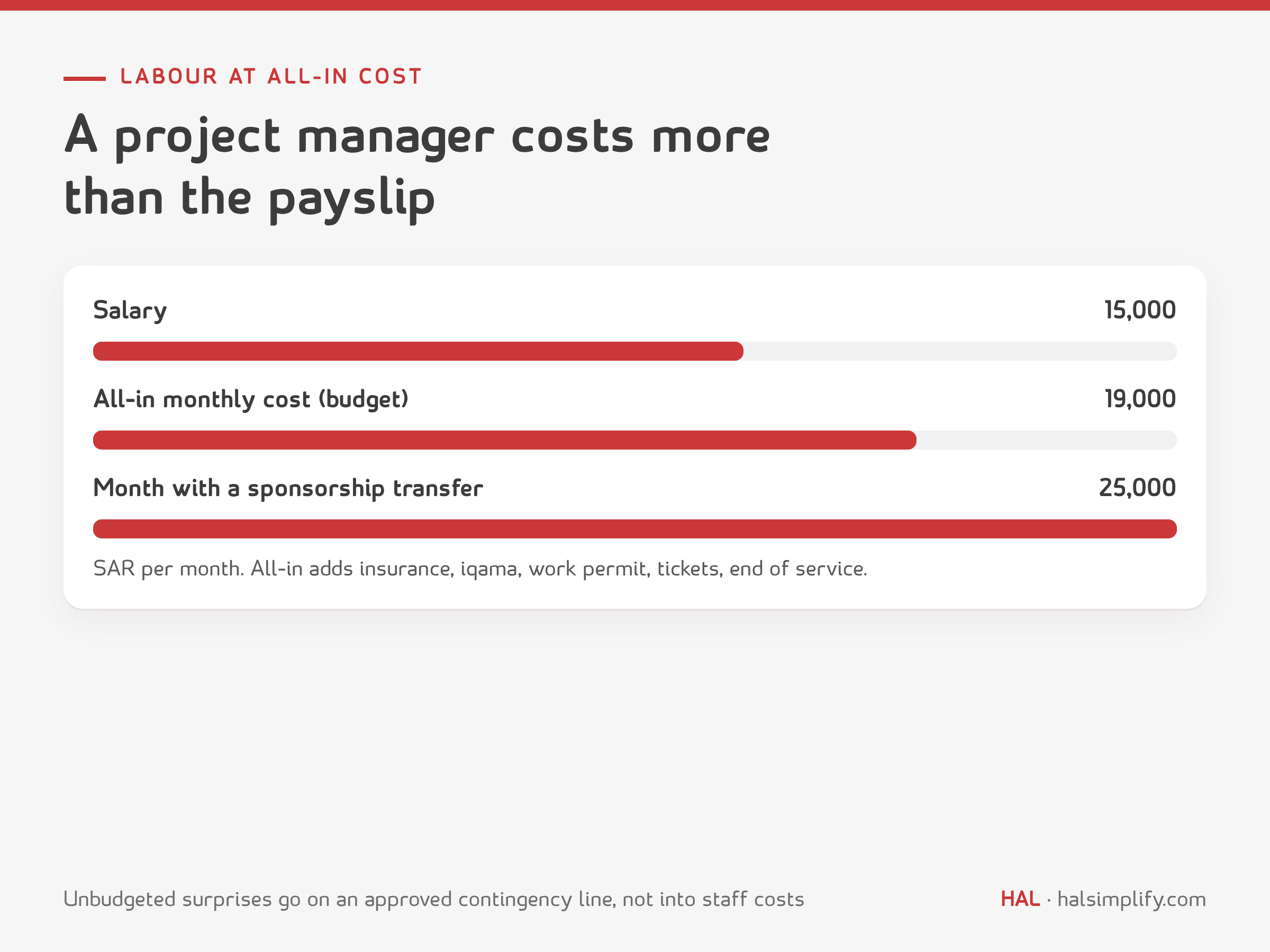
A real example from a Saudi general contractor's budget: a project manager on about SAR 15,000 a month was budgeted at SAR 19,000 a month all-in, once insurance, iqama, work permit, tickets and end-of-service were added. Then a SAR 6,000 sponsorship transfer, which nobody had budgeted, landed on the project. The fix the company chose was simple: a zero-value contingency line on each budget that only authorised people can raise, so a surprise like this is approved and visible rather than buried in "staff costs".
For more on site timesheets, see project timesheets: tracking hours and cost.
Subcontract cost arrives through monthly certificates, so treat each certificate like a mini progress claim:
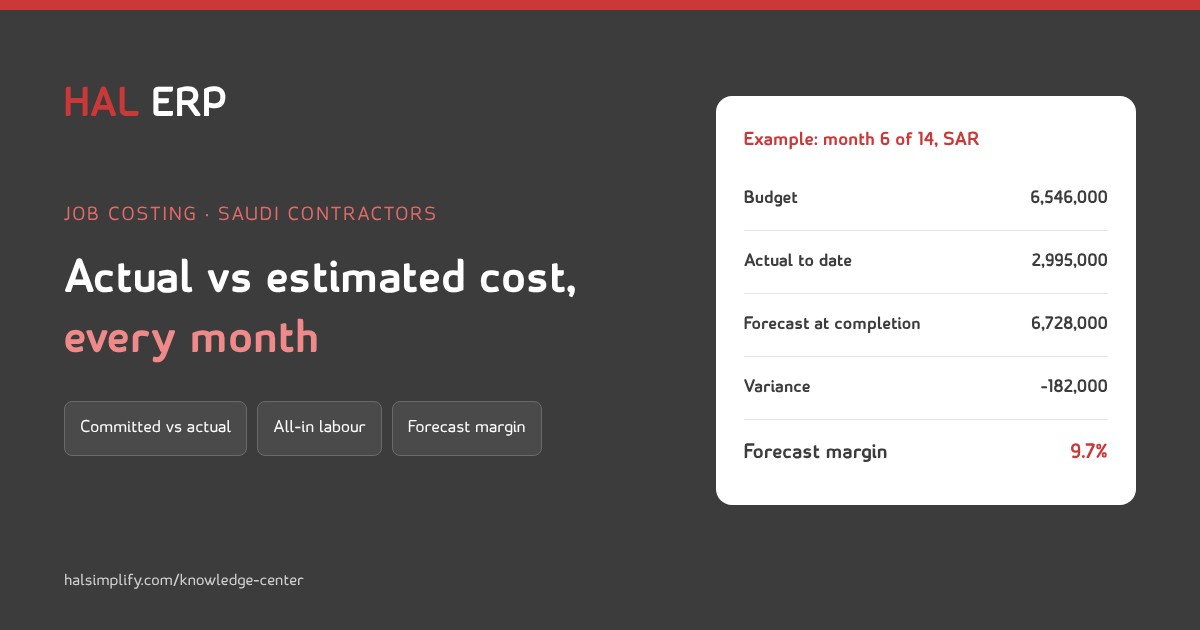
A Saudi contractor is building a four-storey residential block. Contract value SAR 7,450,000 before VAT; budget (estimated cost) SAR 6,546,000; planned margin SAR 904,000, or 12.1%. Fourteen-month programme; this is the month 6 cost review. The figures are illustrative, not benchmarks.
| Cost code | Line | Budget | Committed | Actual to date | Forecast at completion | Variance |
|---|---|---|---|---|---|---|
| 01 | Concrete works (materials) | 2,400,000 | 2,310,000 | 1,520,000 | 2,380,000 | +20,000 |
| 04 | Blockwork and plaster | 640,000 | 420,000 | 210,000 | 690,000 | −50,000 |
| 09 | Marble, supply and install (subcontract) | 360,000 | 366,000 | 0 | 366,000 | −6,000 |
| 12 | MEP (subcontract) | 1,450,000 | 1,450,000 | 435,000 | 1,450,000 | 0 |
| L1 | Site labour (timesheets) | 1,100,000 | 560,000 | 1,240,000 | −140,000 | |
| S1 | Project manager (all-in) | 266,000 | 120,000 | 272,000 | −6,000 | |
| G1 | Site overheads, tests and curing | 330,000 | 150,000 | 330,000 | 0 | |
| Total | 6,546,000 | 2,995,000 | 6,728,000 | −182,000 |
How to read it:
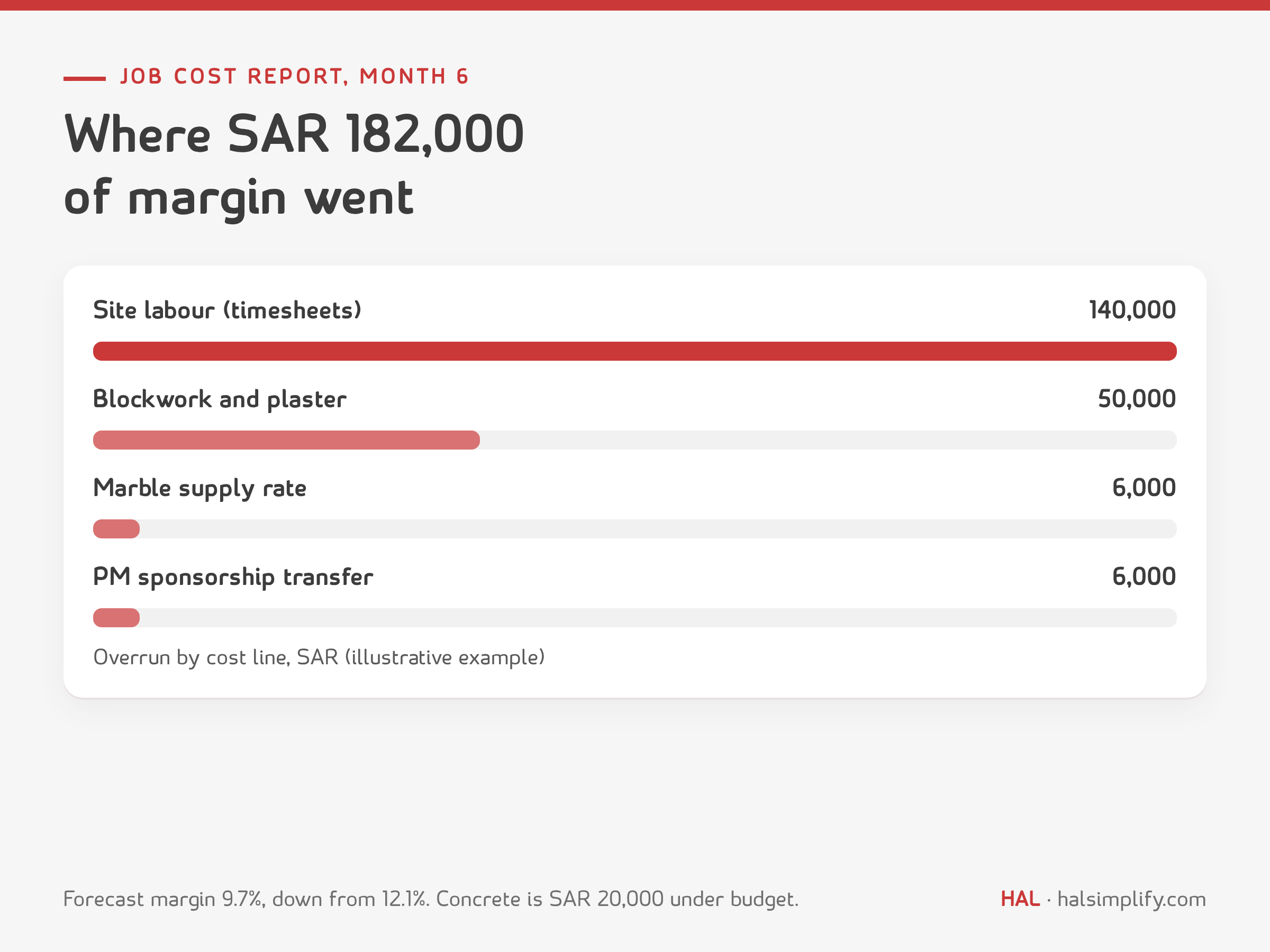
The decision this table supports is concrete: look at the labour on the frame and blockwork now, with eight months left, rather than at the final account.
Also watch the gap between site progress and what the client has certified. Some difference is normal; a gap that keeps growing is cash you have spent and not yet billed.
| When (working days after month-end) | Who | What |
|---|---|---|
| Day 2 | Site engineers, foremen | Timesheets approved per project; receipts on site completed |
| Day 3 | Procurement, cost control | Open POs and subcontracts updated; certificates checked against site quantities |
| Day 5 | Finance | Receipts not yet invoiced accrued; payroll posted by project at all-in cost |
| Day 6 | Project manager | Cost to complete for every line, in writing, with a reason for each change |
| Day 7 | GM, PM, cost control, finance | Job cost review: variance, forecast margin, warning signs, one action per overrun |
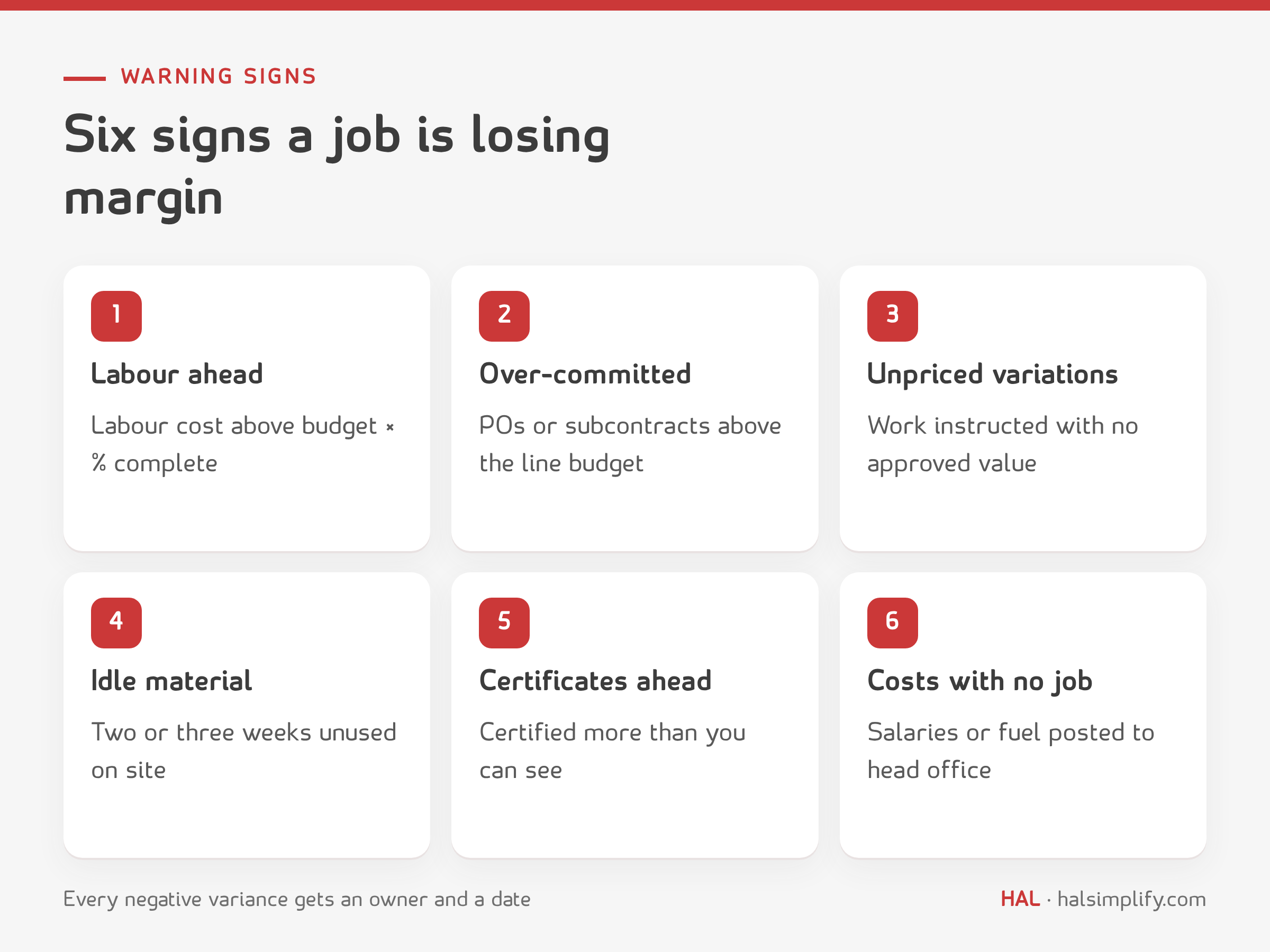
Keep the meeting short and keep one rule: every negative variance leaves the room with a named owner and a date.
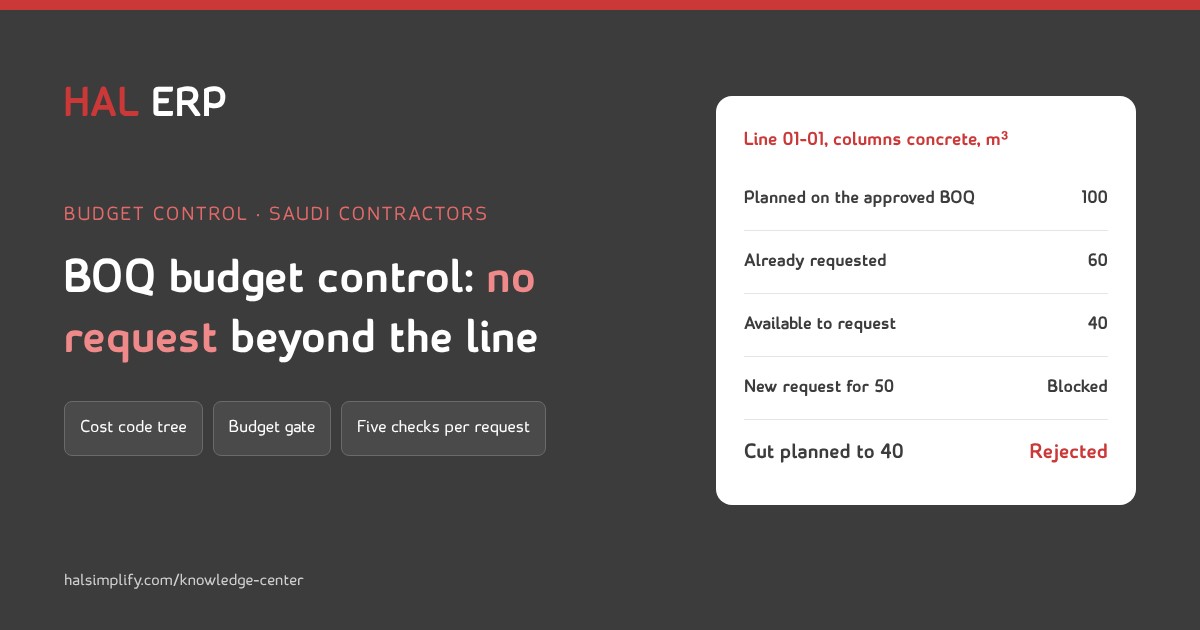
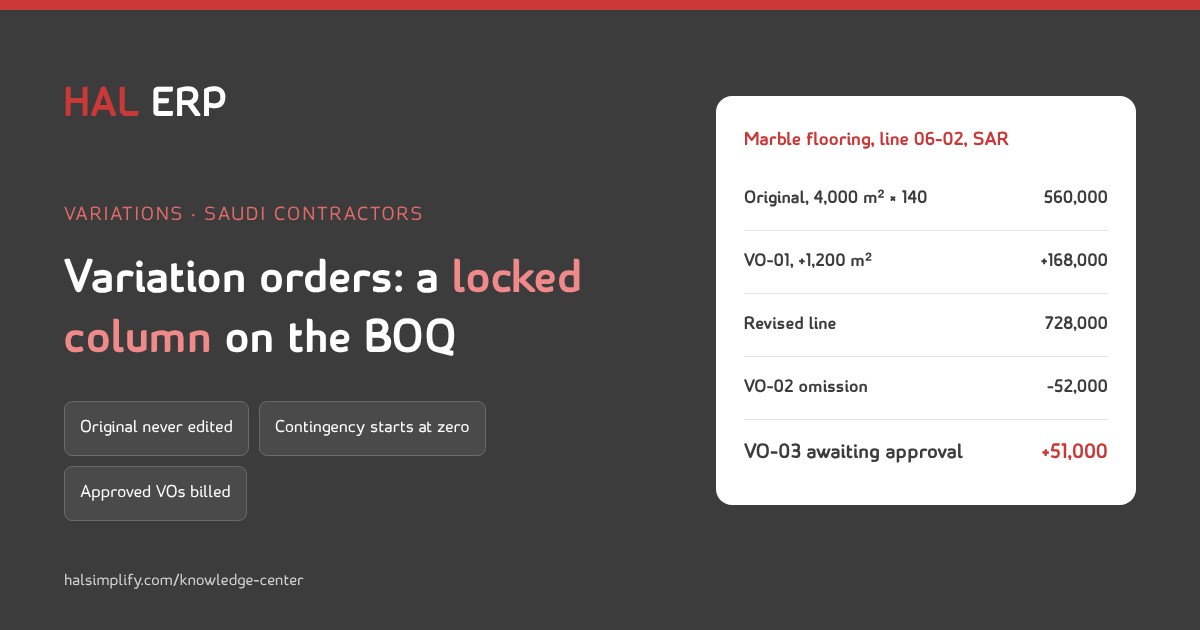
Related reading: monthly progress claims and retention, variation orders on the BOQ and BOQ budget control for purchase requests.
Job costing is tracking the cost of each project against its estimate, by cost code, every month. Each cost (materials received, labour from timesheets, subcontract certificates and site overheads) is tagged to the job and BOQ line that caused it, and compared with the budget to forecast the final cost and margin.
Committed cost is what you have agreed to pay through purchase orders and subcontracts, even before the invoice arrives. Actual cost is what has been incurred: material received, hours worked, work certified. Comparing both with the budget shows an overrun when the order is placed, not when the invoice is paid.
Add the actual cost to date and the project manager's estimate of the cost to complete each line. The forecast should never be lower than what is already committed. Budget minus forecast is the variance, and contract value minus total forecast is the forecast margin.
At all-in cost. The company also pays medical insurance, iqama and work permit fees, tickets, end-of-service accrual and the employer's GOSI contributions. A project manager on about SAR 15,000 a month can cost about SAR 19,000 all-in. Costing at salary makes every job look more profitable than it is.
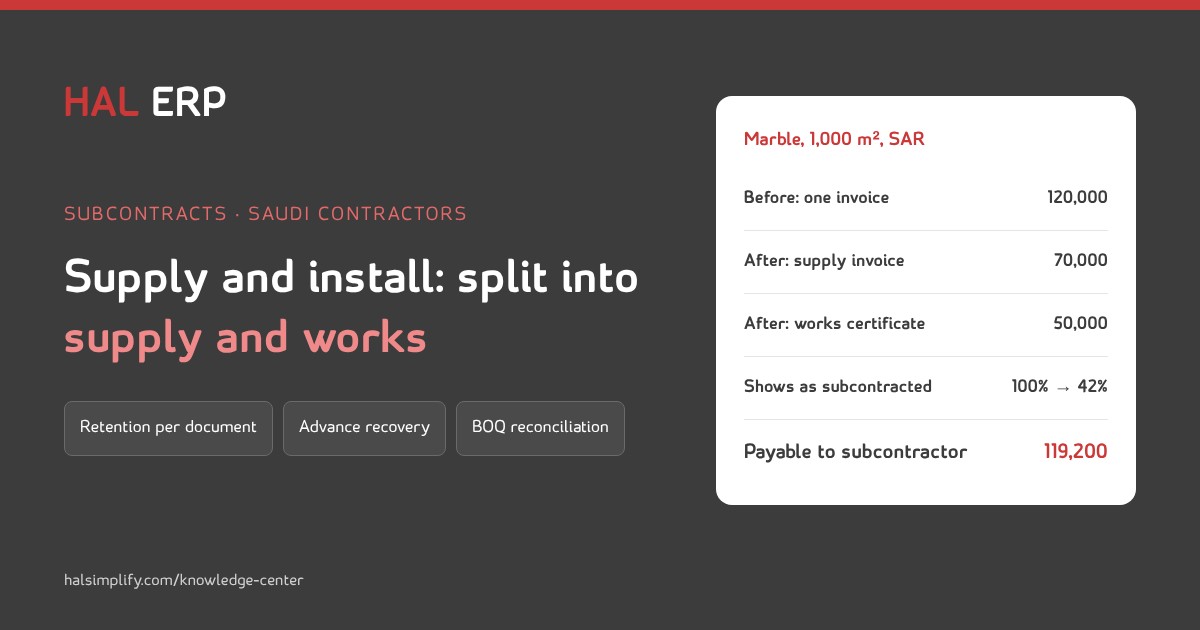
No. Record the subcontract cost at the gross certified value. Retention you hold back is a balance you owe the subcontractor later, and advance recovery offsets money you already paid. Both change cash this month, not the cost of the work.
For a VAT-registered contractor, no. Input VAT at 15% is recovered through the VAT return, so job cost is recorded before VAT. Only VAT you cannot recover belongs in job cost.
The kit has two parts:
HAL Contracting keeps each project's budget by activity and checks purchase requests and orders against it, counting requests, orders and stock issued as committed. HR moves people between projects with dates, and payroll posts each person's cost to the projects they worked on, by days. The project reconciliation report shows turnover, material, labour, subcontract and margin per project, with budget versus actual by project and cost centre. To see what this costs for your company, read our ERP cost guide for contractors, and for the wider cost control process, cost control in project management.