
In short: When head office raises the purchase order and the site admin pays the supplier in cash from company money they hold, site petty cash (an employee's custody, or imprest) is paying a vendor bill. Many Saudi companies clear this through a clearing ledger or manual journals, and the balances drift apart: one company could not trace about SAR 2.7M, and one employee's custody had reached about SAR 2.15M. The controlled way is to pay the vendor bill directly from the employee's custody, so the vendor balance and the custody balance clear in the same transaction, oldest advance first, only on approval. This article shows how, with a worked example and a free custody reconciliation sheet.
The head office in Riyadh raises a purchase order for blocks and hardware. The supplier delivers to a site four hundred kilometres away. The site admin pays him in cash from the custody the company gave her last month, photographs the receipt and sends it on WhatsApp. At month-end one accountant books the supplier's invoice and a payment through a clearing account. Another accountant, who looks after employee advances, reduces the site admin's custody with a journal. If both happen, in the same month, for the same amount, the clearing account goes back to zero. If not, it doesn't.
Multiply that by twenty sites and three years. This guide shows why the clearing account fills up and how to stop it.
Paying a supplier from site cash is normal in Saudi contracting, especially when the site is in another region and the supplier wants cash on delivery. The payment itself is fine. The bookkeeping around it is where the money disappears.
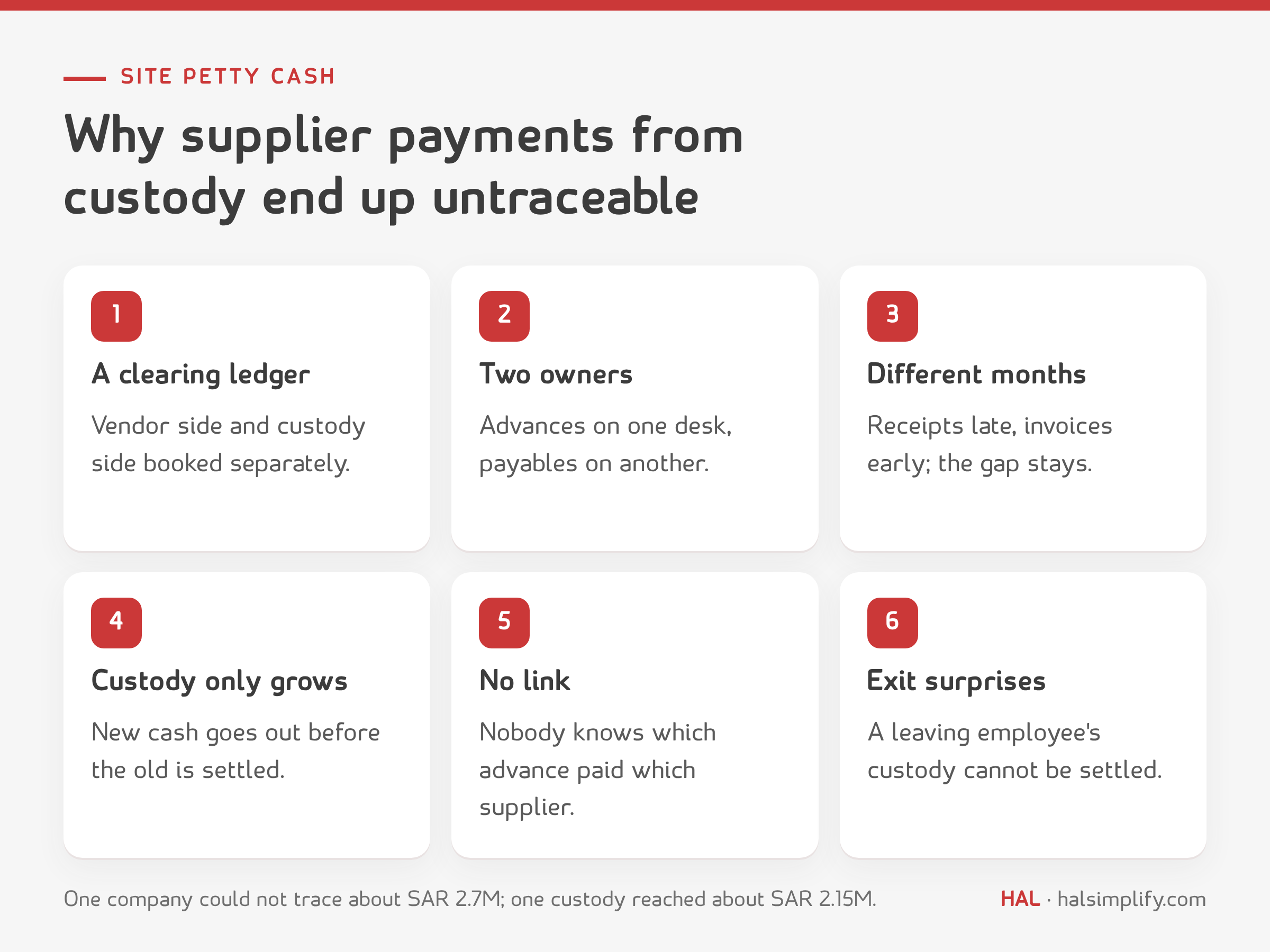
This is not a small-company problem. One company we worked with could not trace about SAR 2.7M sitting in the clearing ledger, and one employee's custody balance had reached about SAR 2.15M. Both built up the same way: entries on the two sides that never met.
Treat it as what it is: a vendor bill payment where the money comes from an employee's custody instead of a bank account. One transaction, two beneficiaries.
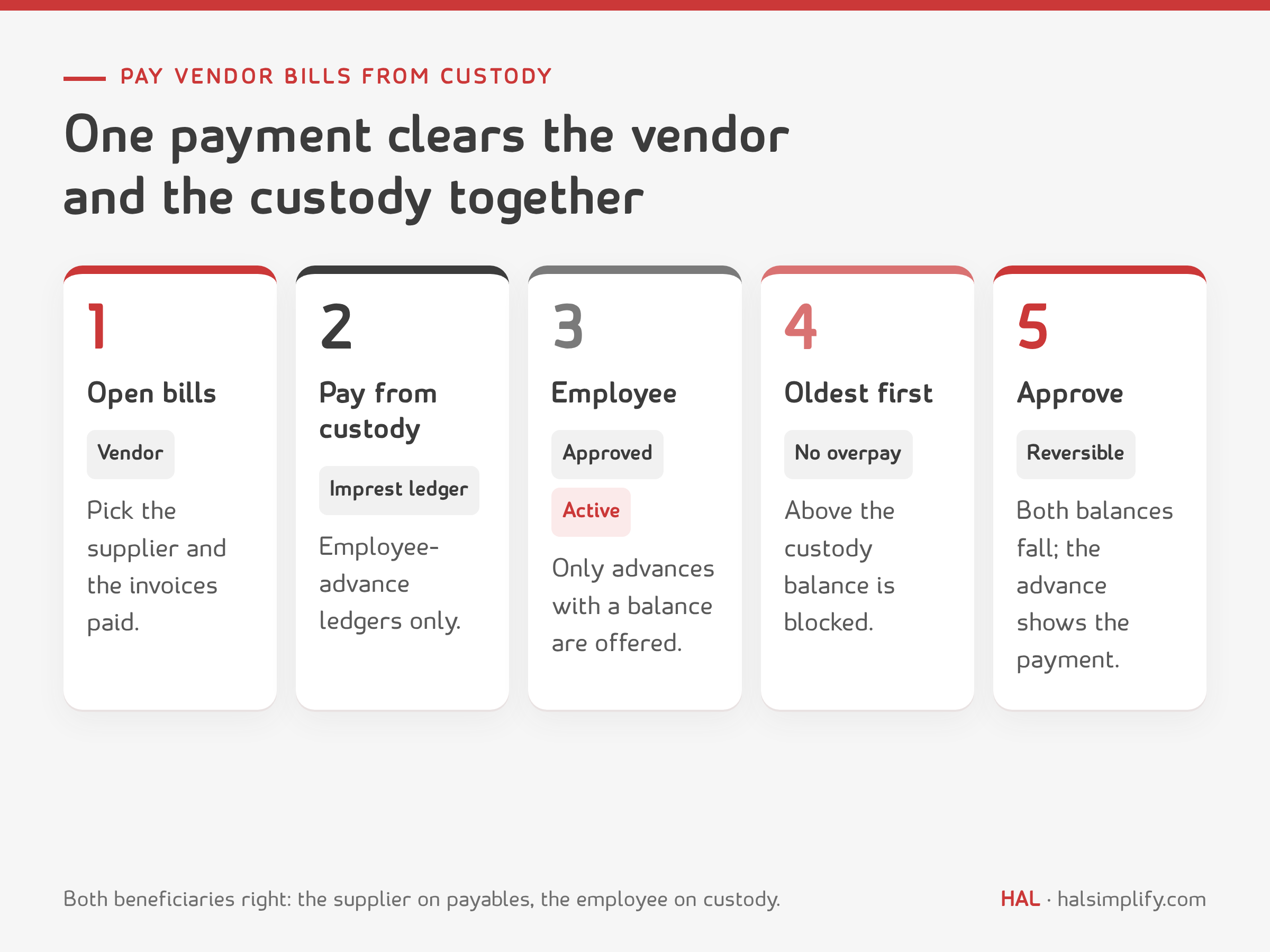
The test of the method is simple: after approval, the supplier ledger shows the supplier as paid, the custody ledger shows the employee with less custody, and the advance record shows which vendor payment cleared it. There is nothing left in the middle.
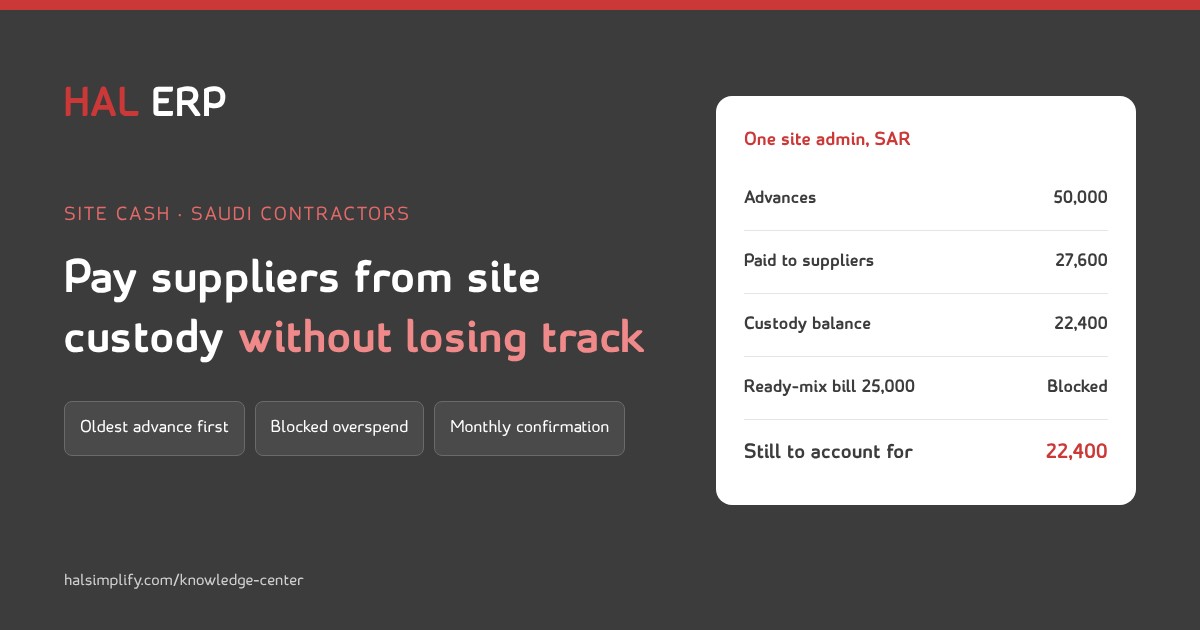
Here is one site admin on a site in the Eastern Province, with custody issued from Riyadh in September.
| Date | Transaction | Amount (SAR) | Custody left on advance 1 | Custody left on advance 2 |
|---|---|---|---|---|
| 1 Sep | Advance 1 issued | 20,000 | 20,000 | |
| 15 Sep | Advance 2 issued | 30,000 | 20,000 | 30,000 |
| 18 Sep | Pay block supplier's bill | 18,400 | 1,600 | 30,000 |
| 25 Sep | Pay hardware supplier's bill | 9,200 | 0 | 22,400 |
| 2 Oct | Pay ready-mix bill of 25,000 | Blocked | 0 | 22,400 |
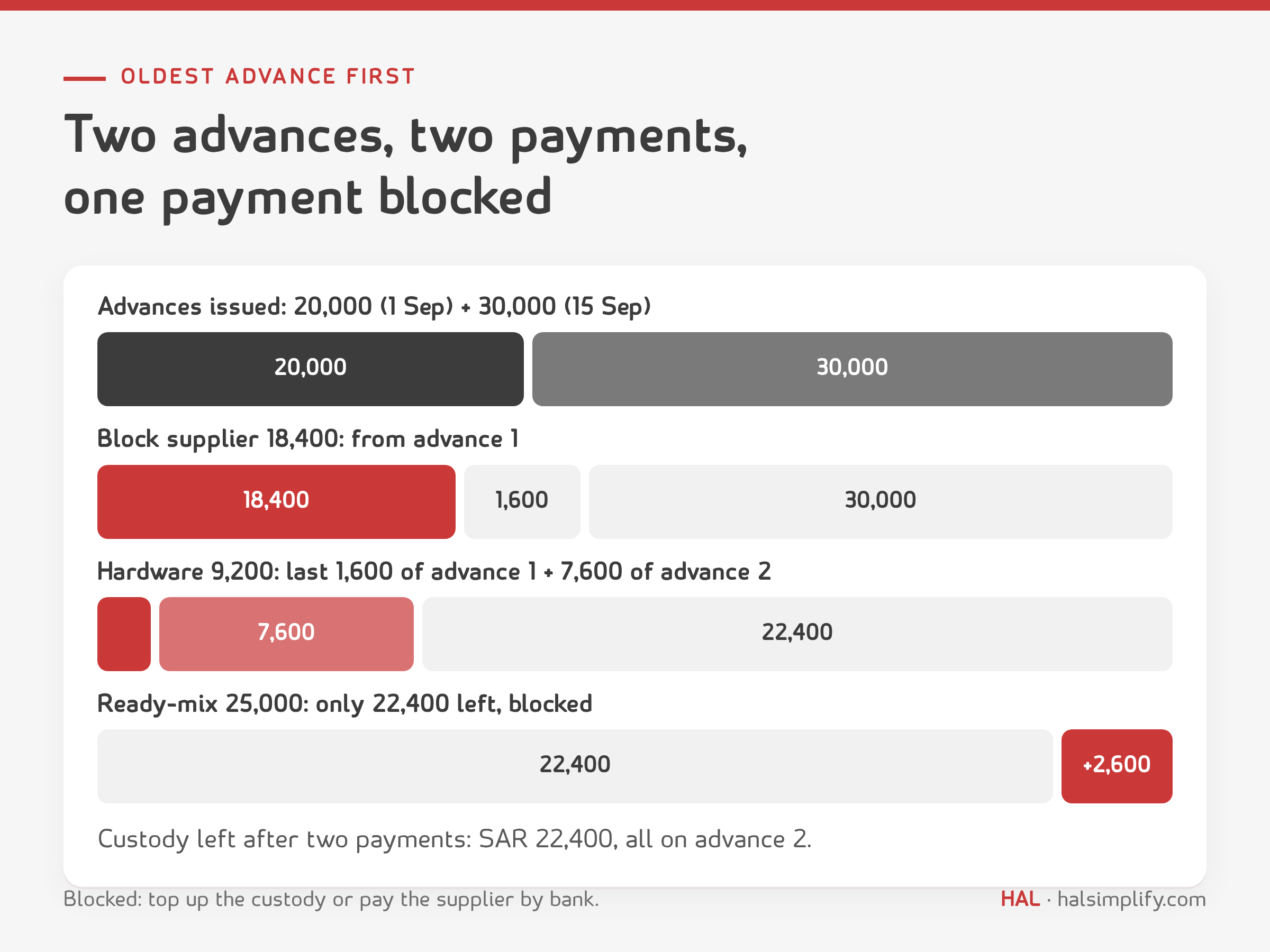
The second payment takes the last SAR 1,600 of advance 1 and SAR 7,600 from advance 2. The third is blocked because the site admin only holds SAR 22,400. Head office either tops up the custody or pays that supplier by bank transfer. Either way, nobody discovers the overspend three months later.
Oldest-first matters because it keeps the age of the custody honest. An advance that is two months old and still open is a question to ask this week, not a line in next year's audit.
The difference is easiest to see in the entries.
| Step | Clearing-ledger way | Controlled way |
|---|---|---|
| Custody issued | Dr Employee custody · Cr Bank | Dr Employee custody · Cr Bank |
| Supplier's tax invoice | Dr Project cost, Input VAT · Cr Supplier payable | Dr Project cost, Input VAT · Cr Supplier payable |
| Supplier paid in cash | Dr Supplier payable · Cr Clearing (one person) | Dr Supplier payable (beneficiary: supplier) · Cr Employee custody (beneficiary: employee), in one transaction |
| Receipt reaches accounts | Dr Clearing · Cr Employee custody (another person, often another month) | Nothing more to post |
| Month-end | Clearing account carries every mismatch | No clearing balance to explain |
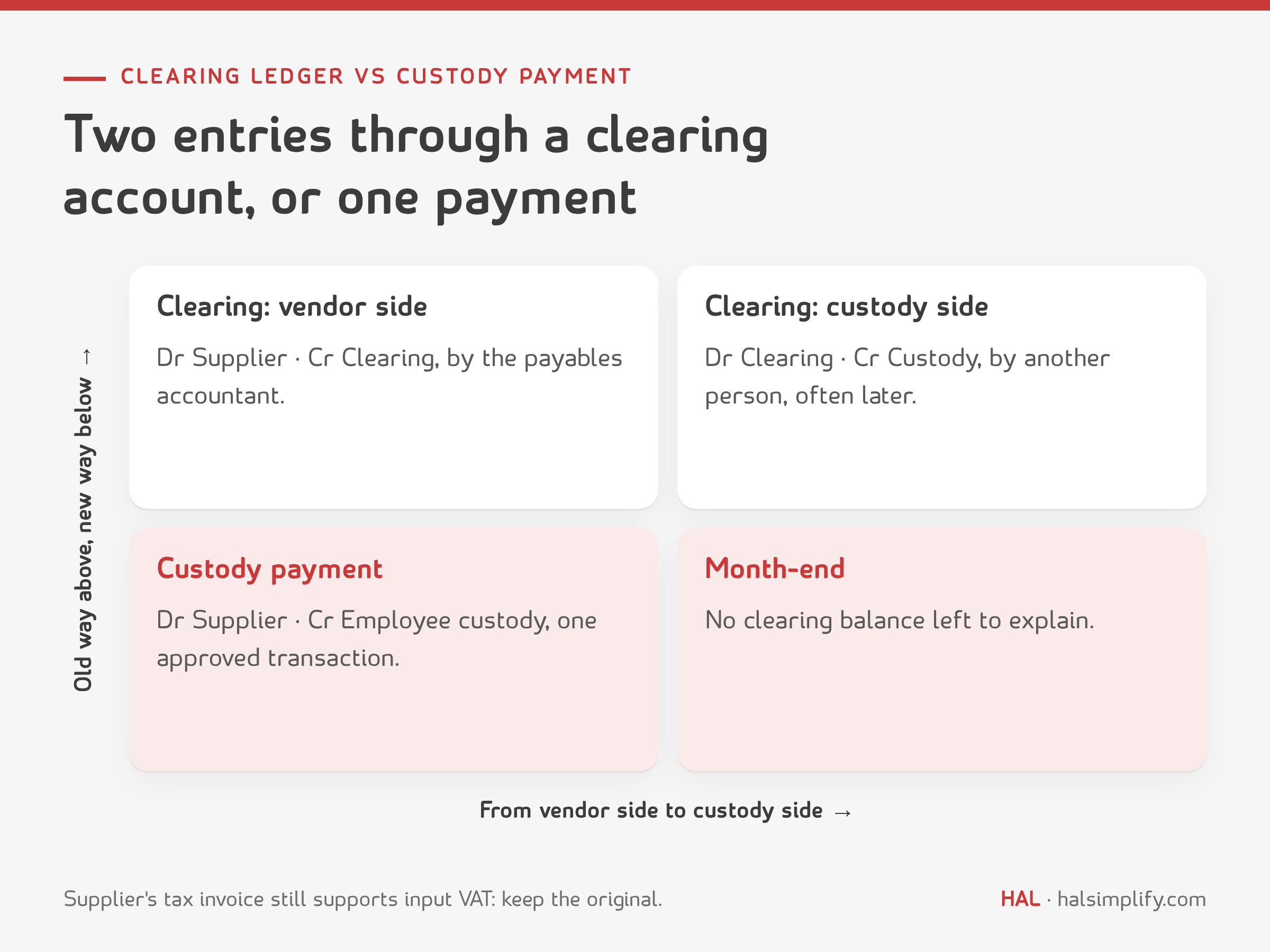
Both beneficiary ledgers stay right: the supplier ledger shows the payment against the supplier, and the employee ledger shows the custody used by that employee. For VAT nothing changes. The supplier's tax invoice, with its VAT number, still supports your input VAT, so the site admin must hand in the original invoice with the delivery note, not just a cash receipt.
A few rules make the method stick:
Our guide to petty cash controls covers imprest funds in general; this method applies the same discipline to supplier payments.
If your clearing account already holds years of entries, fix the flow first and the history second.
| Week | Do this |
|---|---|
| 1 | List every custody holder with balance and oldest open advance. Set limits by role. |
| 2 | Freeze the clearing account for new postings. Brief site admins on handing in original tax invoices. |
| 3 | Run all cash supplier payments through the controlled method and the reconciliation sheet. |
| 4 | Month-end: custody confirmations signed, sheet agreed with the ledger, aged advances followed up. |
The site custody (petty cash) reconciliation sheet (Excel, with a PDF guide) runs the method on your own numbers:
HAL Contracting handles site petty cash as employee imprest or custody: issue cash to a person for a project, clear it against their bills and charge cash purchases to the project budget. A vendor bill payment can be paid from the imprest custody ledger instead of a bank. You pick the vendor and its open invoices, choose the employee and, if you want, which of their advances to use; only active, approved advances with a balance are listed. With no advance chosen, the oldest is cleared first, and paying more than the custody balance is blocked unless a setting allows it. Approval reduces the advance balance, the payables line keeps the vendor as beneficiary and the custody line names the employee, the advance record shows which vendor payment cleared it, and reversals restore the balances. Bill payments themselves are made against approved, unpaid invoices only, never above the balance, as in HAL Accounting. See HAL pricing for what it costs.
Related reading: material inspection requests and two-step site receipt, BOQ budget control for purchase requests and job costing: actual vs estimated cost.
It is company cash held by an employee on site, usually the site admin or storekeeper, as custody (also called an imprest or employee advance). It pays small or urgent costs and often pays suppliers who deliver to a site far from head office.
Because the vendor side and the custody side are then booked as two separate entries, often by two people in different months. Any mismatch stays in the clearing account. One company could not trace about SAR 2.7M that had built up this way.
When an employee has more than one open advance, a payment clears the oldest one before touching the newer ones. It keeps the age of custody honest, so an old open advance is followed up quickly.
In a controlled process, no. The payment is blocked unless company policy explicitly allows it. Head office then tops up the custody or pays the supplier by bank transfer.
Yes. Paying in cash does not change the VAT treatment. The supplier's tax invoice with its VAT number supports your input VAT, so the site admin should hand in the original invoice with the delivery note.
Stop new postings to it first, then list the balance by employee and supplier, clear what you can match, confirm the remaining custody with each employee in writing, and take what is left to management for a one-time decision.