
In short: A monthly progress claim (also called an interim payment certificate, or IPC) is how a Saudi contractor gets paid for the work done each month. Site records the quantity done on every BOQ line, the consultant and owner certify it, finance issues a tax invoice with 15% VAT, and the owner deducts retention and recovers part of the advance before paying. This article walks through one claim on a SAR 43M project with real, rounded numbers, shows how retention released in one or two portions changes your cash, and gives you a free IPC and retention calculator in Excel.
It is the 22nd of the month. The quantity surveyor is chasing three site engineers for their measurements, the consultant has sent back last month's claim with comments on the blockwork, and finance is asking which figure goes on the tax invoice. Next month someone in management will ask how much retention the owner is holding across all projects, and the answer will take a day to build.
The progress claim is the most important document a contractor produces every month. It decides revenue, VAT and cash in one go. This guide follows one claim from site to bank on a real Saudi project, rounded and anonymised, so you can check your own cycle against it.
A progress claim is the contractor's request for payment for the work done in a period, usually one month. Once the consultant and the owner approve it, it becomes a certificate (the "interim payment certificate", or IPC in FIDIC-style contracts; most Saudi site teams simply call it the مستخلص). The contractor then issues a tax invoice for the certified amount.
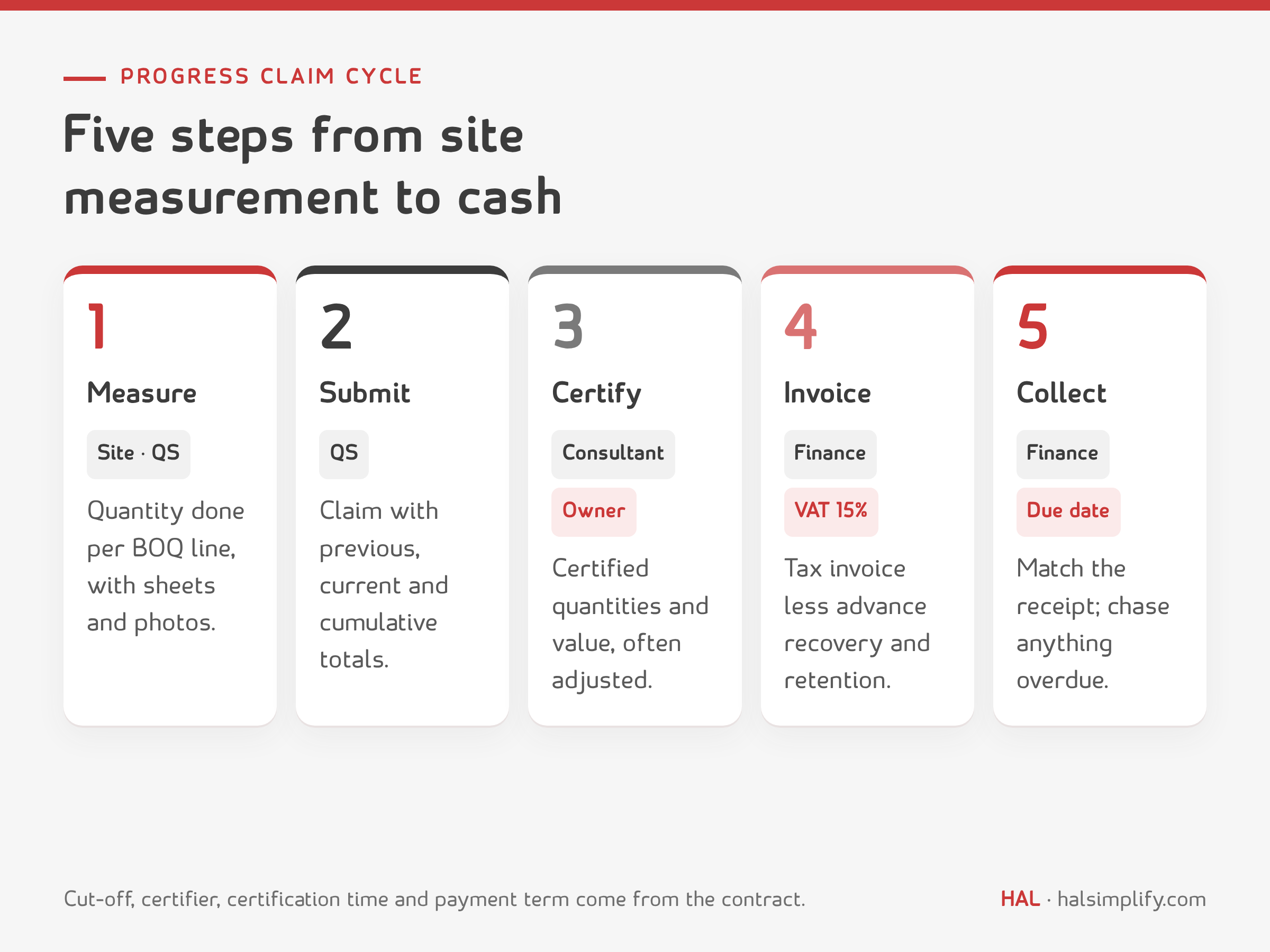
The cycle has five steps, and each one has an owner.
| Step | Who | What leaves the desk | Typical timing |
|---|---|---|---|
| 1. Measure | Site engineer, then QS | Quantity done per BOQ line, with measurement sheets and photos | Cut-off day, for example the 25th |
| 2. Submit | QS or commercial manager | The claim: quantities, values, previous and cumulative totals | Within a few working days of cut-off |
| 3. Certify | Consultant, then owner | Certified quantities and value, often with changes | As the contract says, often two to four weeks |
| 4. Invoice | Finance | Tax invoice on the certified value, with VAT, retention and advance recovery | Right after certification |
| 5. Collect | Finance | Receipt matched to the invoice; retention moved to its own balance | The payment term, for example 10 days after certification |
The contract sets the cut-off day, who certifies, how long they have and when payment is due. Write those four facts on the first page of your claim file, because every late payment argument comes back to them.
Every claim starts as a progress form: one row per BOQ or budget line, with the quantity done this period. The best forms we have seen on Saudi sites separate two quantities that most templates merge.
A Saudi general contractor building multi-storey blocks runs its monthly form with three rules, and they are worth copying:
Expect the consultant to certify a slightly different figure from the one you submitted. On that contractor's projects, site progress and certification differed by up to ±5% in a month. That is normal. What matters is that you can show the difference line by line and carry the uncertified quantity into the next claim instead of losing it.
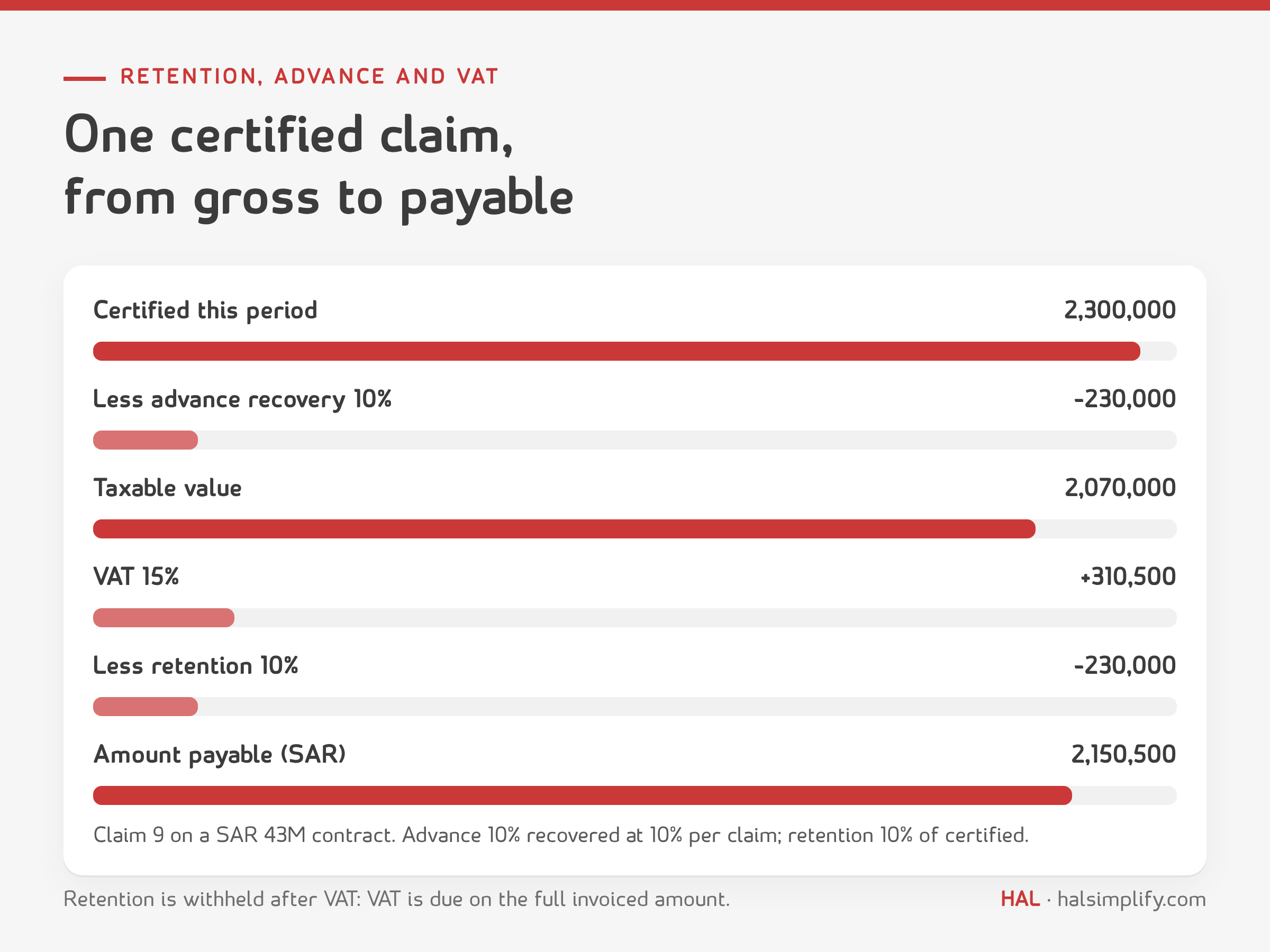
Here is claim 9 on a SAR 43M (ex-VAT) building contract. The owner paid a 10% advance (SAR 4.3M) at the start, and the contractor issued a tax invoice with VAT when it was received. The contract says the advance is recovered at 10% of each claim and retention is 10% of the gross value certified. Your percentages will differ; the order of the calculation usually does not.
| Line | Amount (SAR) | How it is worked out |
|---|---|---|
| Submitted this period | 2,360,000 | From the progress form |
| Certified this period | 2,300,000 | Consultant's figure, 2.5% below submitted |
| Less advance recovery (10%) | −230,000 | VAT was already paid on the advance when it was received |
| Taxable value | 2,070,000 | Certified minus advance recovered |
| VAT (15%) | 310,500 | On the taxable value |
| Invoice total incl. VAT | 2,380,500 | |
| Less retention (10% of certified) | −230,000 | Withheld by the owner; VAT is still due on it |
| Amount payable | 2,150,500 | Due 10 days after certification |
Two VAT points catch finance teams out, and both come from ZATCA's VAT guideline for the contracting sector (second issue, May 2026):
Contracts with government entities can have special date-of-supply rules, so check those separately. The retention invoice format article covers the invoice layout in detail.
Retention is your money, held as a guarantee. On this contract, 10% retention on SAR 43M means SAR 4.3M sits with the owner by the final claim. How it comes back depends on the contract.
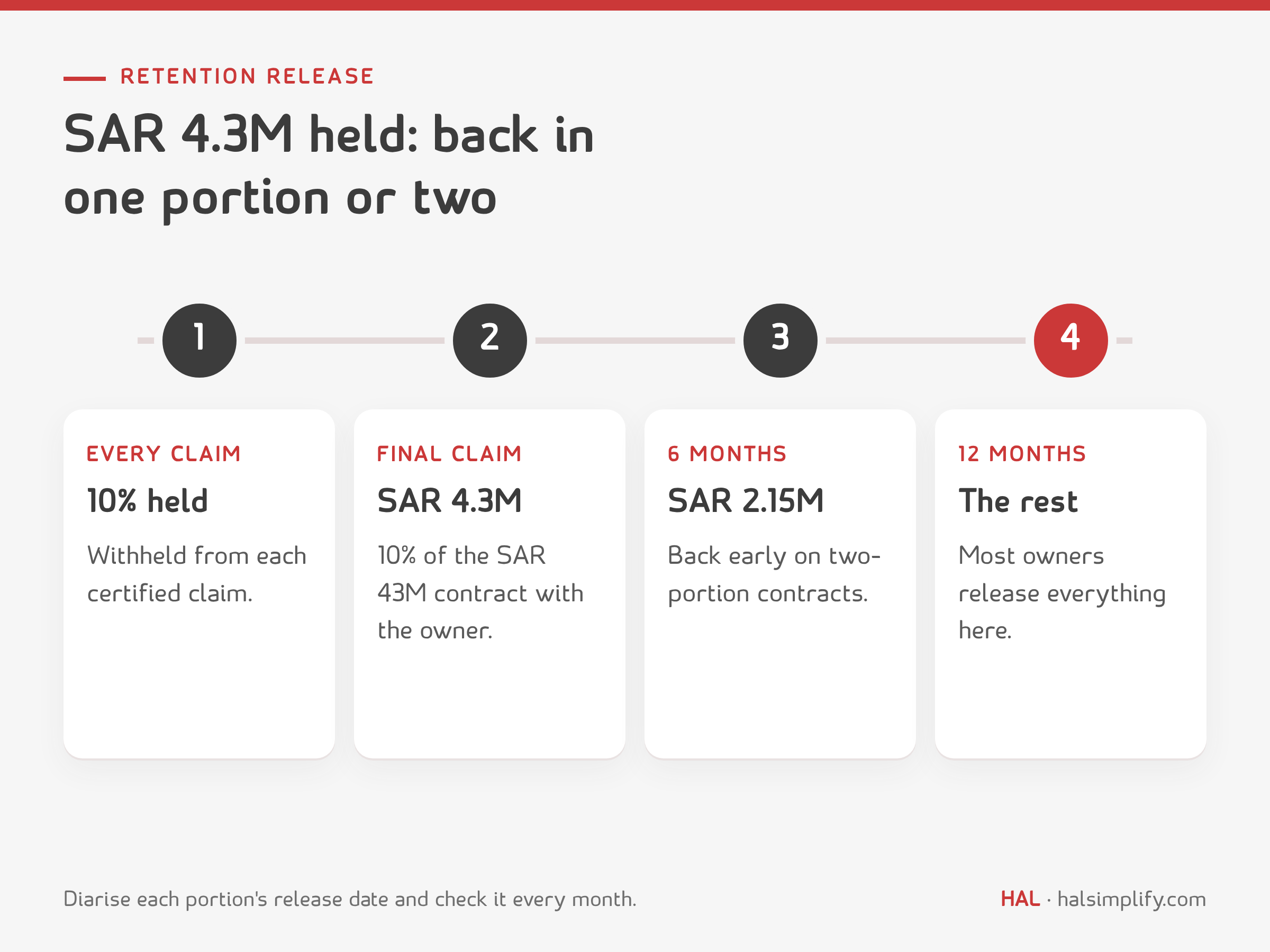
Retention fails quietly in three ways: nobody diarises the release date, nobody chases the release document, and nobody notices that the owner has released one portion and not the other. Keep a retention balance per project, split by release date, and review it every month with the receivables. If you also hold retention from your own subcontractors, track it the same way, in the other direction.
The same general contractor reads one dashboard per project every month. These are its real figures, rounded:
| Measure | Figure |
|---|---|
| Contract value (ex-VAT) | SAR 43M |
| Certified to date | SAR 17M |
| Collected | SAR 14M |
| Receivable | SAR 3M |
| Payment term | 10 days after certification |
| Physical progress, actual vs planned | 54% vs 53% |
| Cash in vs cash out | SAR 14M vs SAR 13M |
| Target margin | 10–20% |
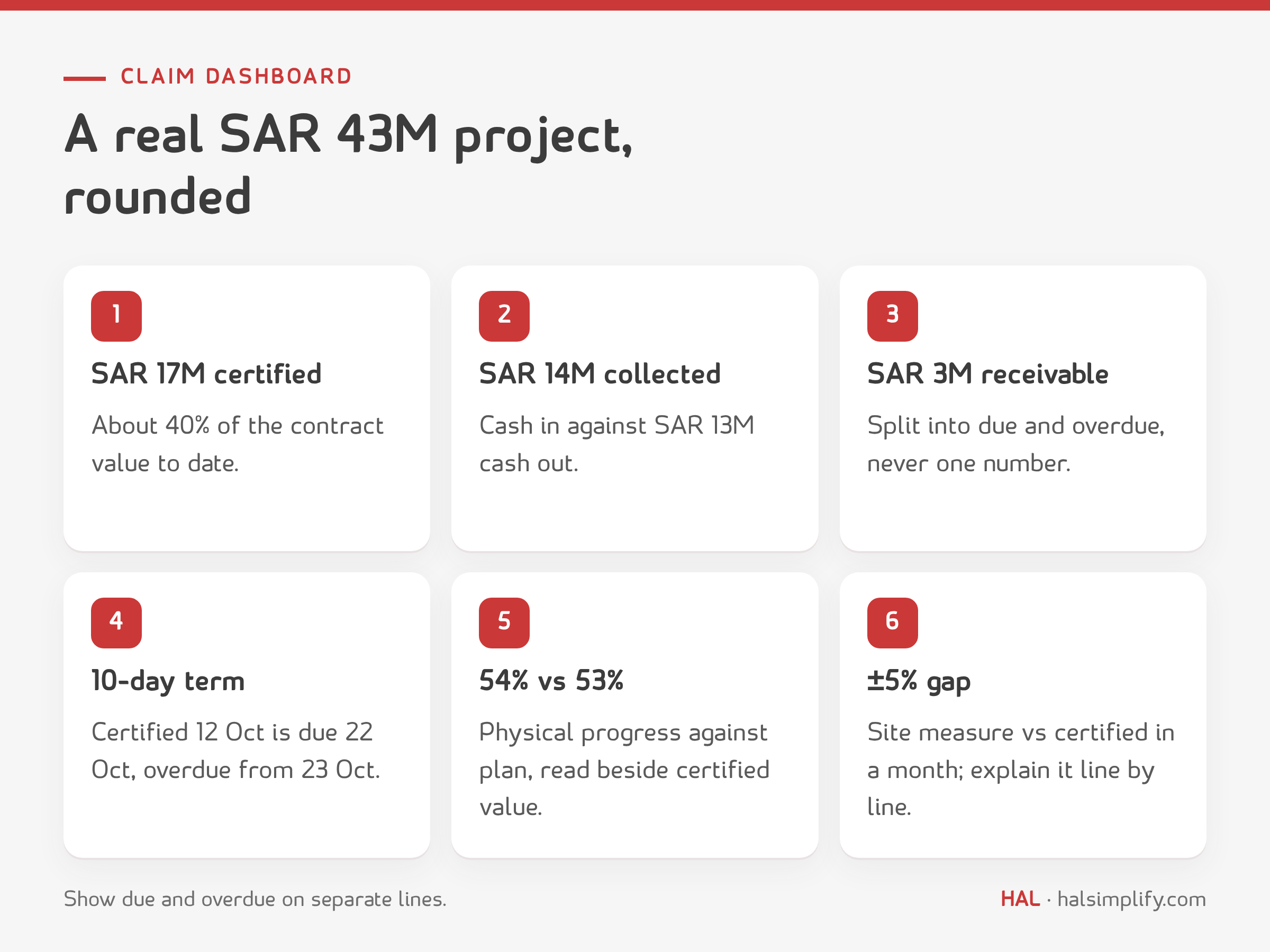
Three things on it are worth noticing.
Most late payments start inside the contractor's own office. Check these before blaming the owner:
Then track every claim against its due date. Due date equals certification date plus the payment term. Count working days in your follow-up (Sunday to Thursday), and agree in the contract what happens when a due date falls on a Friday or Saturday. Each week, list overdue claims by days overdue, with a named person chasing each one.
Using claim 9 above (simplified; your chart of accounts will differ):
| Event | Debit (SAR) | Credit (SAR) |
|---|---|---|
| Advance received at the start | Bank 4,945,000 | Advance from client 4,300,000; Output VAT 645,000 |
| Claim 9 certified and invoiced | Client receivable 2,150,500; Retention receivable 230,000; Advance from client 230,000 | Contract revenue 2,300,000; Output VAT 310,500 |
| Payment received | Bank 2,150,500 | Client receivable 2,150,500 |
| Retention released after 12 months | Bank | Retention receivable (no VAT) |
Many contractors recognise revenue on the percentage of completion rather than on certification, so agree the method with your auditor. Our guide to retention in construction explains the retention entries and their effect on cash flow.
The IPC and retention calculator (Excel, with a PDF guide) runs the cycle above on your own contract:
The example rows use the SAR 43M contract from this article, so you can see every formula working before you type over them.
When claims run across several projects, the spreadsheet becomes the bottleneck. In HAL Contracting you pick the project and HAL brings its contract terms. Enter the work done, and the progress claim deducts retention by percentage or amount, recovers the client's advance together with its VAT, and takes off penalties or other deductions, each to its own ledger. Retention is released later with a retention invoice for the same project. The claims register shows client approval date, ZATCA status, balance, retention held and advance recovered for every claim, and claims are issued with ZATCA Phase 2 e-invoicing. Customer payments are applied against open invoices in HAL Accounting. See HAL pricing for what it costs.
Related reading: variation orders on the BOQ, splitting supply and install subcontracts and job costing: actual vs estimated cost.
The progress claim is what the contractor submits for the work done in a period. Once the consultant and owner approve it, it becomes the interim payment certificate (IPC). The contractor then issues the tax invoice for the certified amount, with VAT, retention and advance recovery shown on it.
Yes, when you invoice the full certified amount. ZATCA's contracting guideline says VAT is due on the whole invoiced amount even if the owner withholds part as retention, and no further VAT is declared when the retention is paid later. Contracts with government entities can follow special rules, so check those separately.
The contract sets a recovery rate, often a fixed percentage of each certified claim, until the advance is fully recovered. Because VAT was already paid when the advance was received, each claim deducts the advance recovered before calculating VAT, so the same money is not taxed twice.
Most Saudi owners release retention after 12 months; release is often tied to completion and the defects liability period, so check your contract. Some release it in two portions, typically half at 6 months and half at 12. Track each portion with its own release date and balance.
The consultant measures independently and may disagree on quantities, quality or attachments. A difference of a few percent is common; one contractor saw up to ±5% in a month. Show the difference line by line and carry any uncertified quantity into the next claim.
On the day after its due date, which is the certification date plus the payment term in the contract, for example 10 days. Track due and overdue claims separately and give every overdue claim a named person to chase it.