
In short: A variation order (VO) protects your margin only when it lives in its own locked column on the approved BOQ and the project budget, next to an original line that nobody edits. Quantity changes are owned jointly by project management and the technical office; changes to budget value sit with top management only. Contingency lines start at zero and only authorised people raise them, and every approved VO flows to the next progress claim. Below: why variations leak margin, the locked VO column, who may change what, the VO steps from instruction to invoice, a worked SAR example of the effect on contract value, retention and VAT, and a free variation order log for Excel.
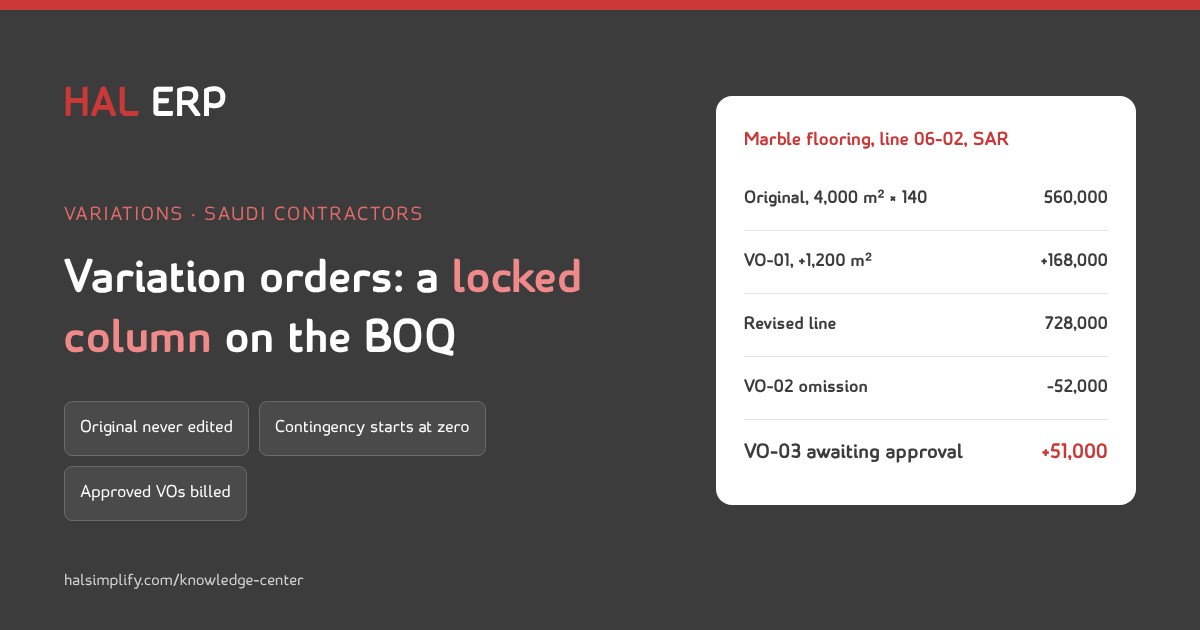
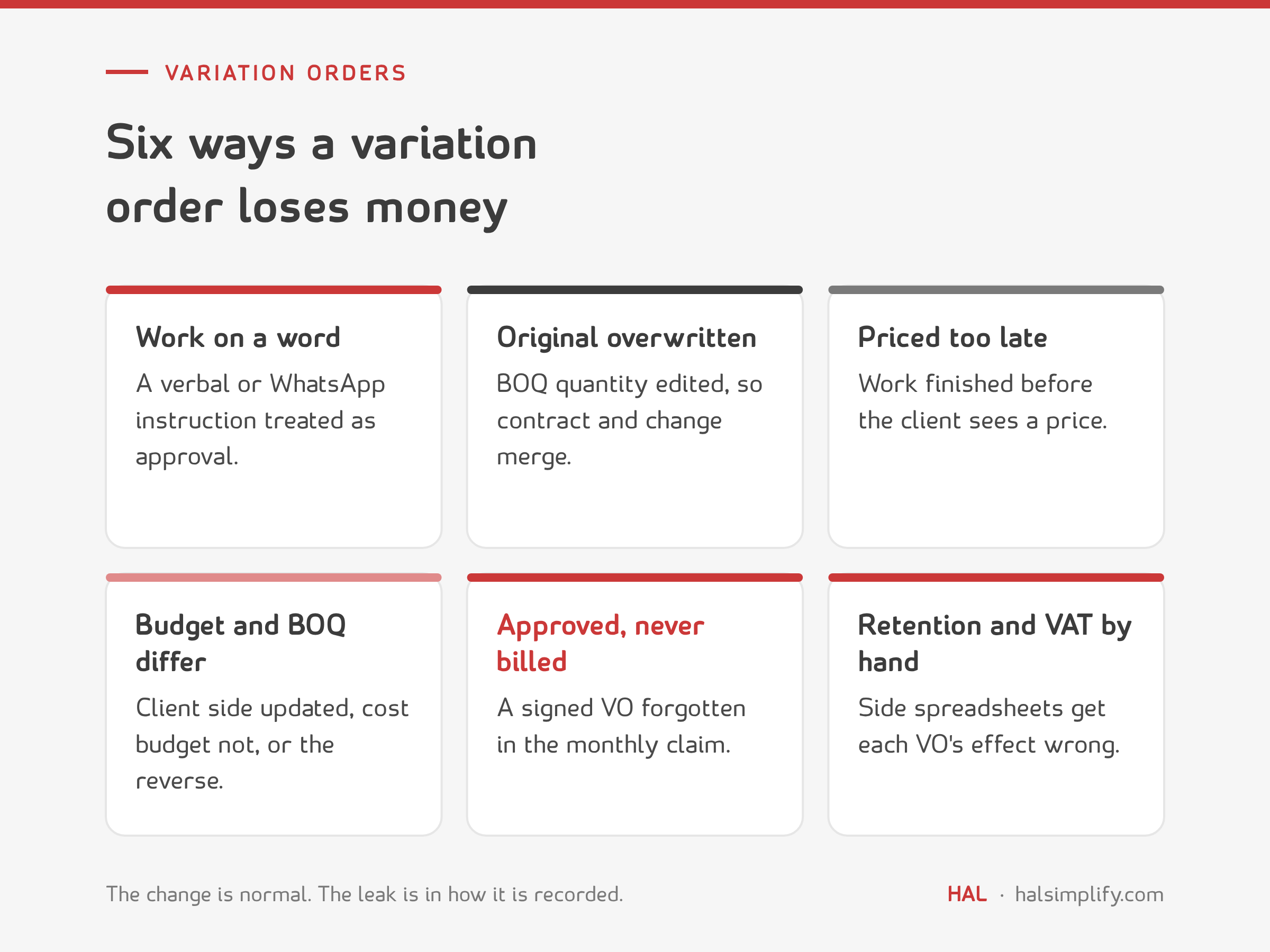
The lobby marble was never in the drawings. The client's representative asked for it on a site walk in March, the consultant wrote a site instruction, and the subcontractor started in April. By June the work was finished and photographed. In September the commercial manager found that nobody had priced it, the client had not signed anything, and the original BOQ line for marble had simply been "updated" to the new quantity. The project looked on budget. It was not; it was carrying SAR 168,000 of work nobody had billed.
Most contractors have a version of this story. The variation was real, the work was good, and the money still went missing, because the change was written over the original line instead of beside it.
A variation is any change to the scope, quantity, specification or timing of the work agreed in the contract: an addition, an omission or a substitution. The change itself is normal. The leak happens in how it is recorded.
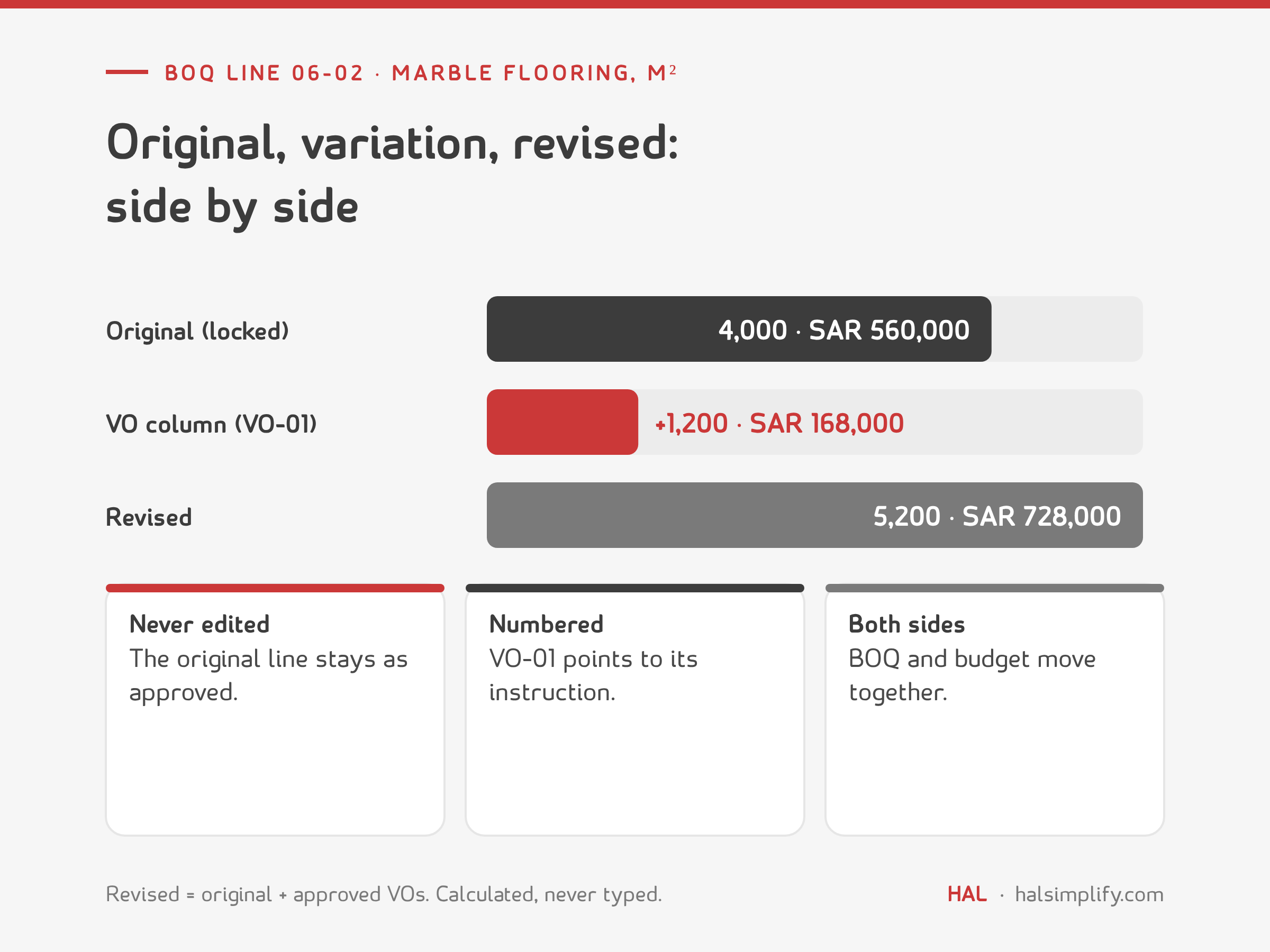
The Saudi general contractor in our example keeps a VO column on the approved BOQ and on the project budget. Every line has three numbers that sit side by side and never replace each other:
| BOQ line 06-02, marble flooring | Quantity (m²) | Rate (SAR) | Amount (SAR) |
|---|---|---|---|
| Original (approved, locked) | 4,000 | 140 | 560,000 |
| Variation column (VO-01) | +1,200 | 140 | +168,000 |
| Revised (original + VO) | 5,200 | 140 | 728,000 |
Four rules keep the column honest:
If you are new to how a BOQ is built, our guide to BOQ in civil engineering covers the basics first.
The column only works if few people can touch it. The contractor split the rights this way:
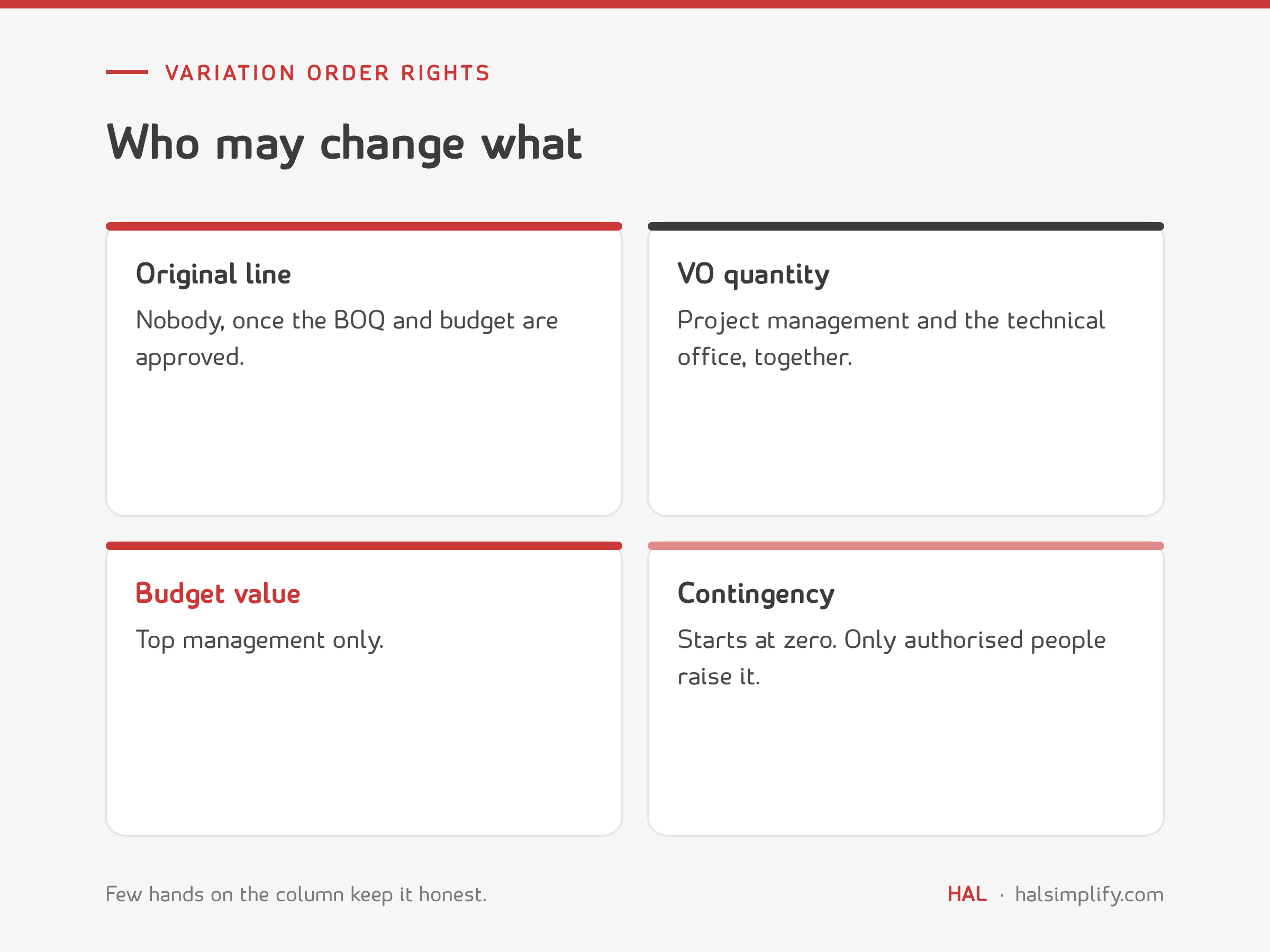
Contingency covers internal costs the budget missed, and it is kept apart from client variations. In one case the budget for a project manager was about SAR 19,000 a month all-in, covering salary, insurance, iqama, work permit, tickets and end-of-service. Then an unbudgeted SAR 6,000 sponsorship transfer arrived. Instead of quietly stretching another line, an authorised person raised a zero-value contingency line by SAR 6,000, with a reason. The cost became visible, and nobody billed the client for it. For a broader view of sizing contingency, see our contingency budget guide.
Your contract, whether FIDIC-based or a government contract, sets who may instruct a variation and how it is valued. Inside the contractor, the same five steps apply to every VO:
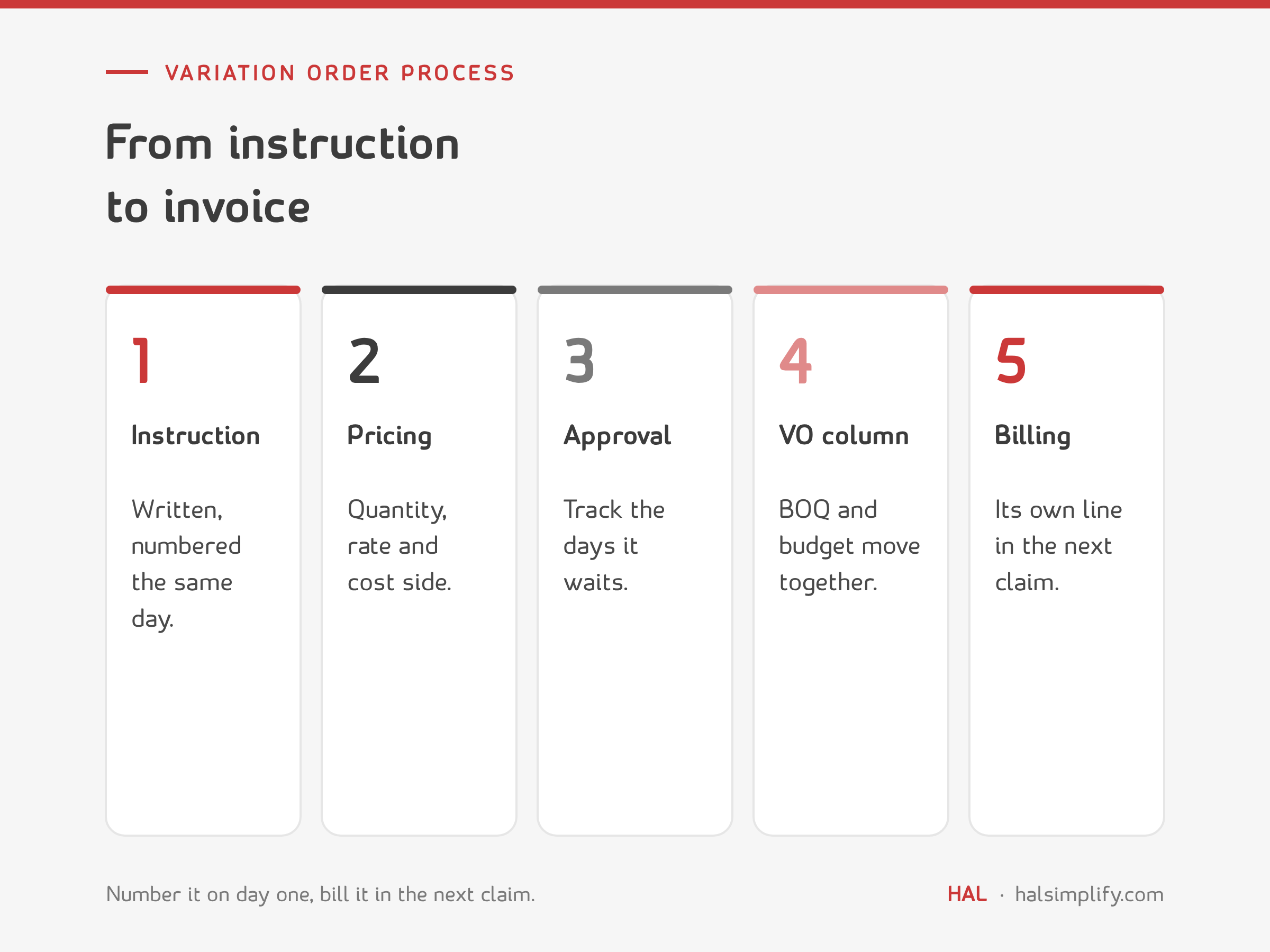
Decide in advance what happens to work done before approval. Many contractors bill it only once the VO is approved, but they record the quantity done each month so nothing is lost while they wait.
A worked example on a building contract of SAR 43 million excluding VAT, with 10% retention and VAT at 15%. The rates and figures are illustrative.
| VO | Description | Type | Value (SAR) | Status |
|---|---|---|---|---|
| VO-01 | Marble to lobbies and corridors, 1,200 m² × 140 | Addition | +168,000 | Approved |
| VO-02 | False ceiling omitted in plant rooms, 800 m² × 65 | Omission | −52,000 | Approved |
| VO-03 | Extra blockwork, 600 m² × 85 | Addition | +51,000 | Awaiting approval |
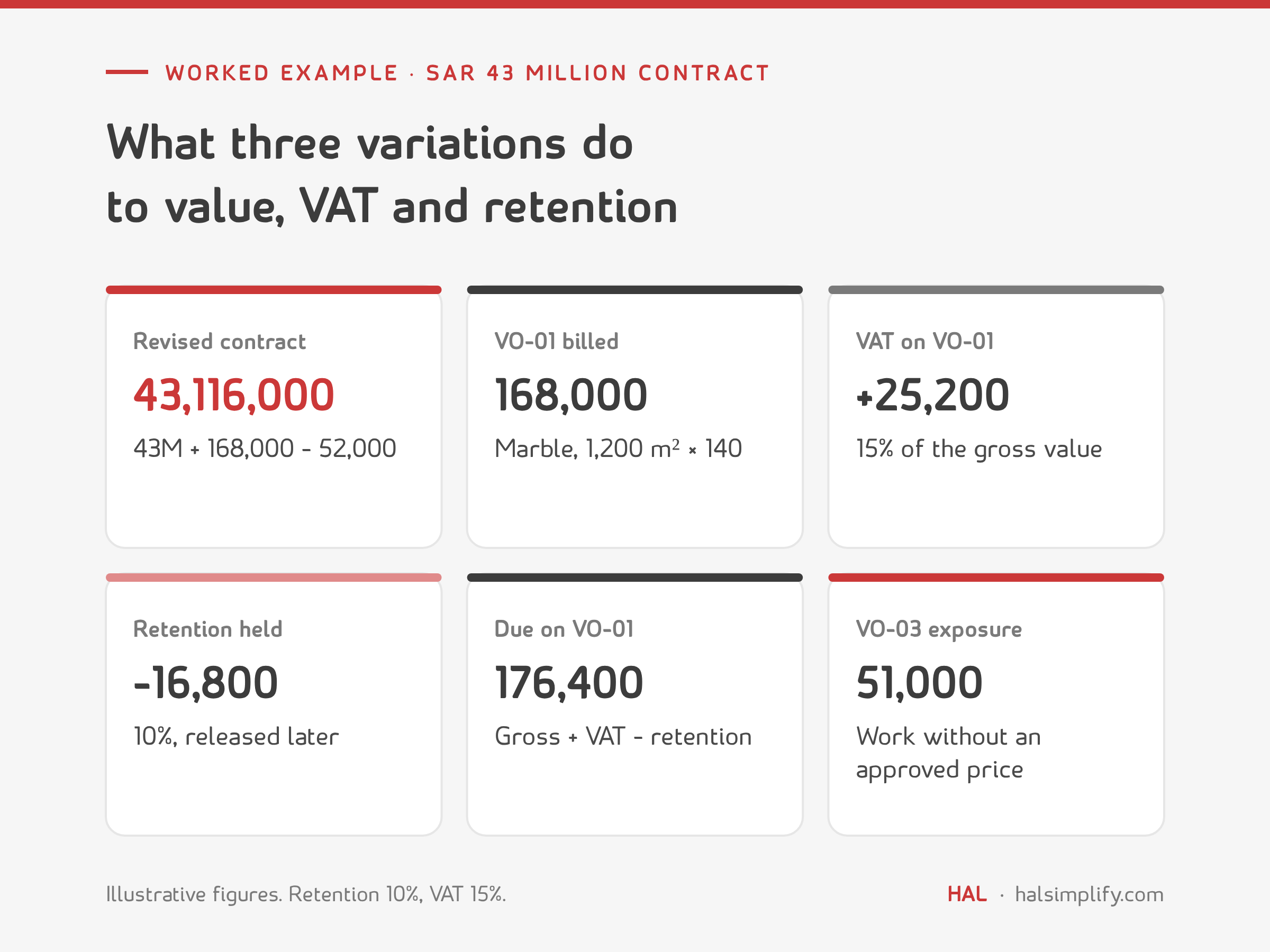
Two things in this example are easy to miss. The omission reduces the contract, and with it the retention the client holds and the margin on the job. And the retention on VO-01 is money you have earned but will receive only when the client releases it, often after 12 months. Our guide to retention in construction explains the release.
Keep one number on the front page of every project report: approved VOs not yet billed. It is earned money sitting in nobody's claim. Check it in three places every month:
Read the list in the monthly commercial meeting. A pending VO older than 30 days is a letter to the consultant. An approved VO with nothing billed after the work is done is a question for whoever prepared the claim.
The kit puts the method above into one workbook and a short guide:
In HAL Contracting, each project records its contract value, advance, performance bond and retention percentages, re-measurement and variation orders. The BOQ keeps the fixed contract quantity while re-measured and variation quantities move beside it, and the original, re-measured, variation and revised budgets are kept side by side, with each change approved through a workflow. Progress claims deduct retention, recover the advance with its VAT and take off penalties, each to its own ledger, and the claims register shows retention held and the balance for every claim. Approval workflows with as many levels as you need can sit on any transaction. See HAL pricing for the plans.
Related reading: monthly progress claims and retention, BOQ budget control for purchase requests and job costing: actual vs estimated cost.
A variation order is a recorded change to the work in the contract: an addition, an omission or a substitution of scope, quantity or specification. It carries a number, the instruction it came from, its price and the client's approval, and it changes the contract value once approved.
They describe the same thing. "Variation order" is the usual term on FIDIC-based contracts and in Saudi Arabia and the Gulf; "change order" is more common in North America. What matters is that it is written, priced, approved and recorded beside the original line.
The client or the consultant approves them as the contract sets out. Inside the contractor, project management and the technical office own the quantity, and top management alone approves changes to budget value.
No. The original line stays locked. The variation goes into a separate VO column, and the revised quantity and amount are calculated as original plus approved VOs, so the contract and the change can always be told apart.
An approved addition raises the contract value, so retention is held on it when it is billed and VAT at 15% is charged on it. An omission reduces both. In the worked example, billing a SAR 168,000 VO adds SAR 25,200 of VAT and SAR 16,800 of retention held.
A variation order log is the register of every VO on a project: number, instruction, description, quantity, rate, value, status, approval dates, billed and unbilled amounts and days waiting. It is the one place to see the revised contract value and what is still to be billed.