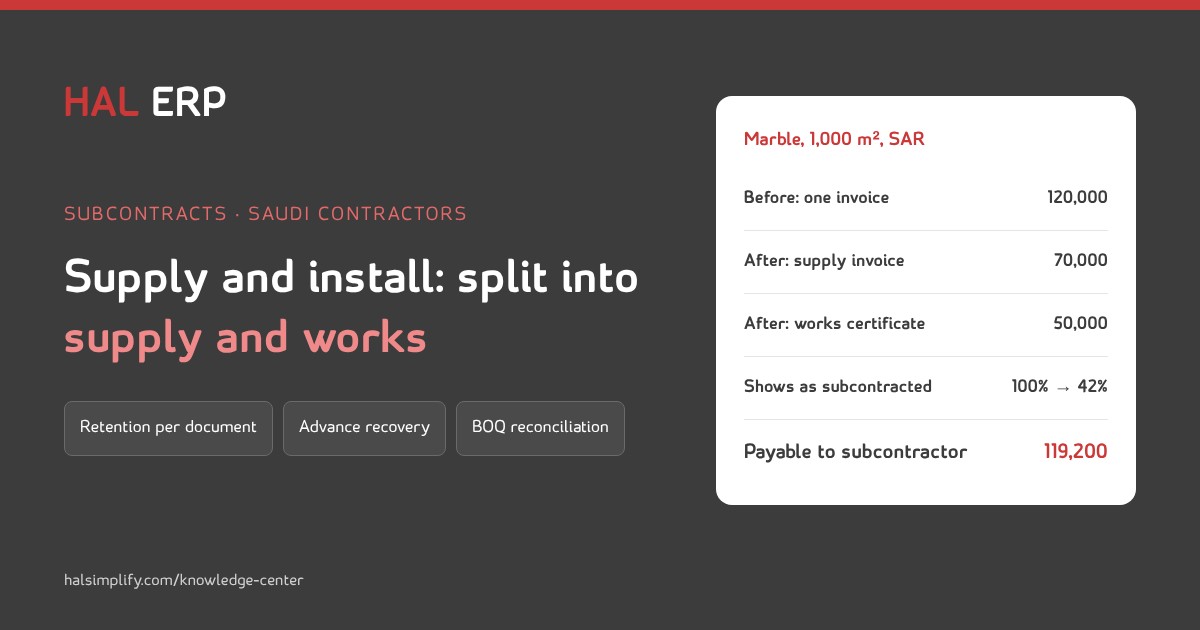

In short: When every subcontract invoice says supply and install, a Saudi contractor cannot show which materials it supplied itself, and its contractor-classification profile can look as if it subcontracted whole projects. The fix is to split each subcontract into a supply invoice and a works certificate that both reconcile to the BOQ quantity, for example 1,000 m² of marble supplied and 1,000 m² installed, with retention and advance recovery tracked per subcontractor. This article shows the split with a marble example, the two ways to do it, how to handle the subcontractor who wants to keep his supply margin, and a free Excel template.
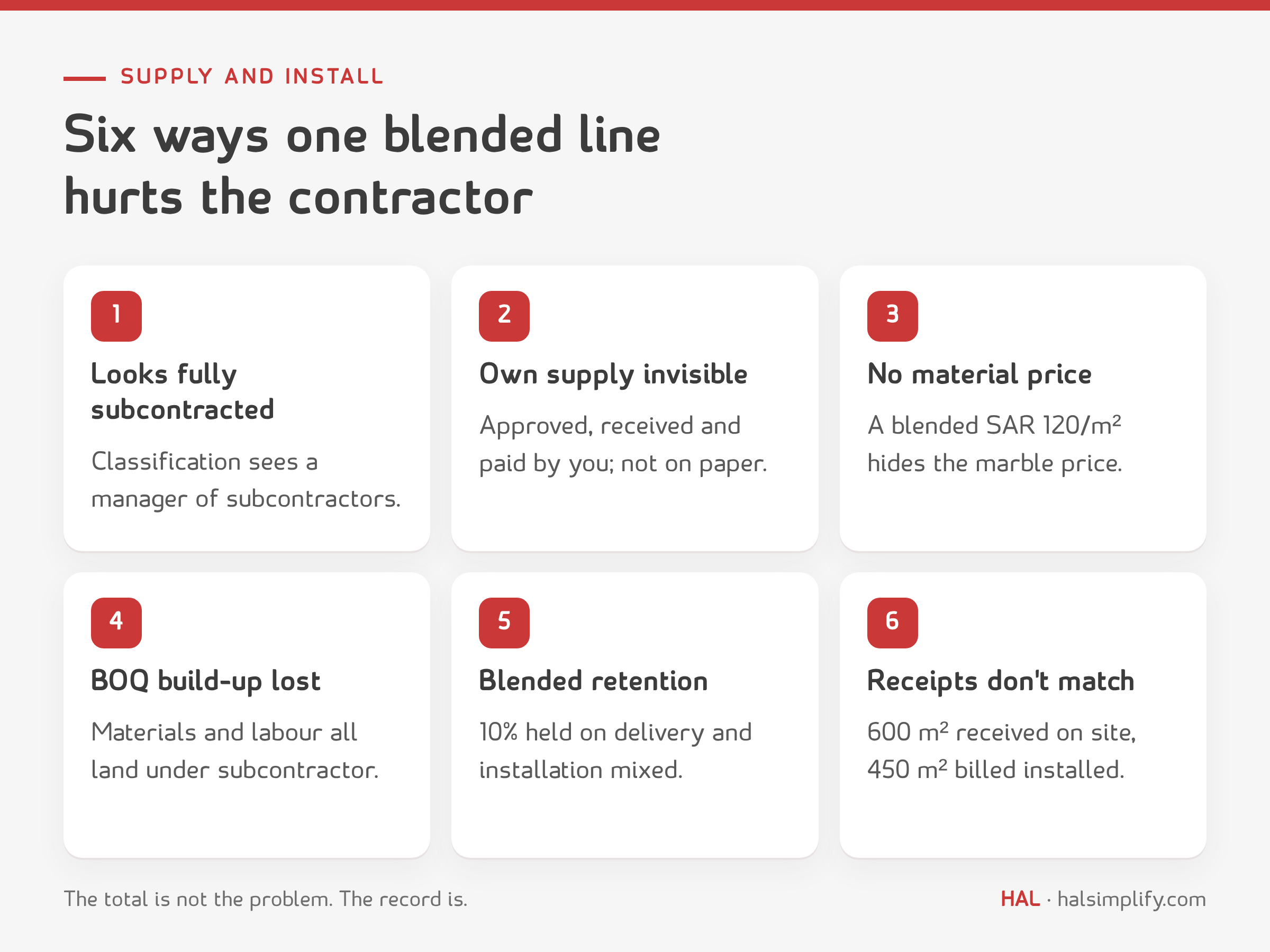
A Saudi general contractor went through a contractor-classification review. The reviewer asked a simple question: on this building, what did you supply yourselves and what did you subcontract? Finance pulled the subcontract invoices. Marble, porcelain, gypsum, HVAC, aluminium: every one of them said "supply & install". On paper, the company had subcontracted the building. In reality it had bought, approved, stored and paid for most of the materials through its own procurement and site teams.
Nobody had done anything wrong. The invoices simply did not say what had happened. This guide shows how to make them say it.
A supply-and-install subcontract is a perfectly normal agreement. The trouble starts when the invoice is one line with one rate, month after month.
Every subcontract gets two documents: a supply invoice for material delivered to site, priced per unit of material, and a works certificate for work installed, measured and priced per unit of installation. Both carry the same BOQ line, and both add up to the BOQ quantity.
Take marble flooring on a BOQ line of 1,000 m². In the market a split like this is roughly SAR 70/m² for supply and SAR 50/m² for installation.
| Before: one invoice | After: two documents | |
|---|---|---|
| Document | "Supply & install marble" | Supply invoice + works certificate |
| Quantity | 1,000 m² | 1,000 m² supplied + 1,000 m² installed |
| Rate | SAR 120/m² | SAR 70/m² supply + SAR 50/m² install |
| Value | SAR 120,000 | SAR 70,000 + SAR 50,000 |
| Shows as subcontracted | SAR 120,000 (100%) | SAR 50,000 (about 42%) |
| Shows as own supply | Nothing | SAR 70,000 (about 58%) |
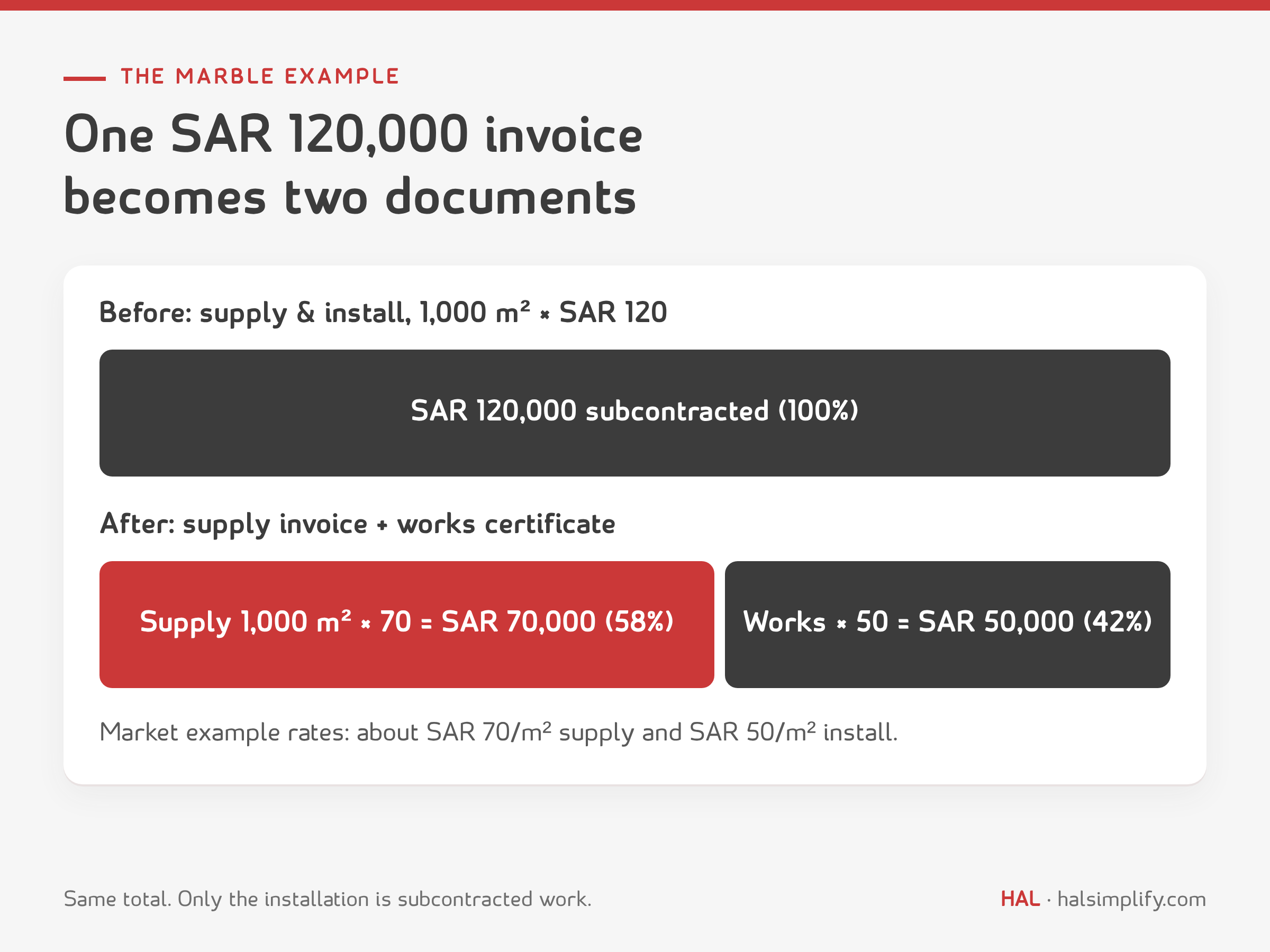
The total does not change. What changes is the record: the material is on a document that matches your site receipt, and only the installation is subcontracted work.
The rule is simple, and worth writing into every subcontract: the sum of the supply documents equals the BOQ quantity, and so does the sum of the works documents. A BOQ line of 1,000 m² can be covered by several documents from more than one company. On that general contractor's sites one BOQ line could have four or five subcontractors.
| Document | Subcontractor | Month | Supplied (m²) | Installed (m²) |
|---|---|---|---|---|
| Supply invoice | Marble subcontractor | 1 | 600 | |
| Works certificate | Marble subcontractor | 1 | 450 | |
| Supply invoice | Marble subcontractor | 2 | 400 | |
| Works certificate | Marble subcontractor | 2 | 350 | |
| Works certificate | Marble subcontractor | 3 | 200 | |
| Total against BOQ 1,000 m² | 1,000 | 1,000 |
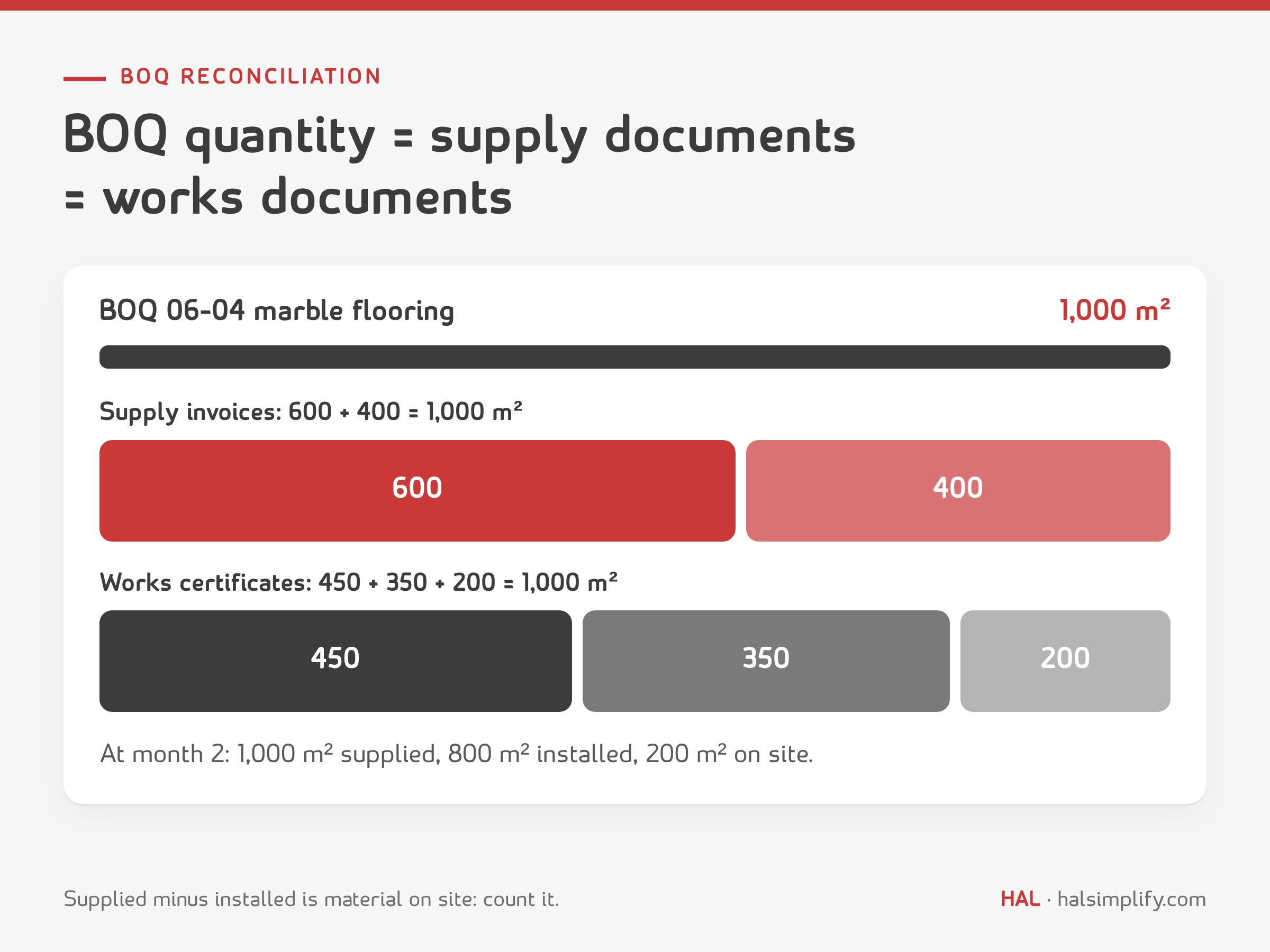
At the end of month 2 the line reads 1,000 m² supplied and 800 m² installed. The 200 m² difference is material on site, which your storekeeper should be able to count. If supplied ever exceeds the BOQ quantity, or installed exceeds supplied, someone has to explain it before the next payment.
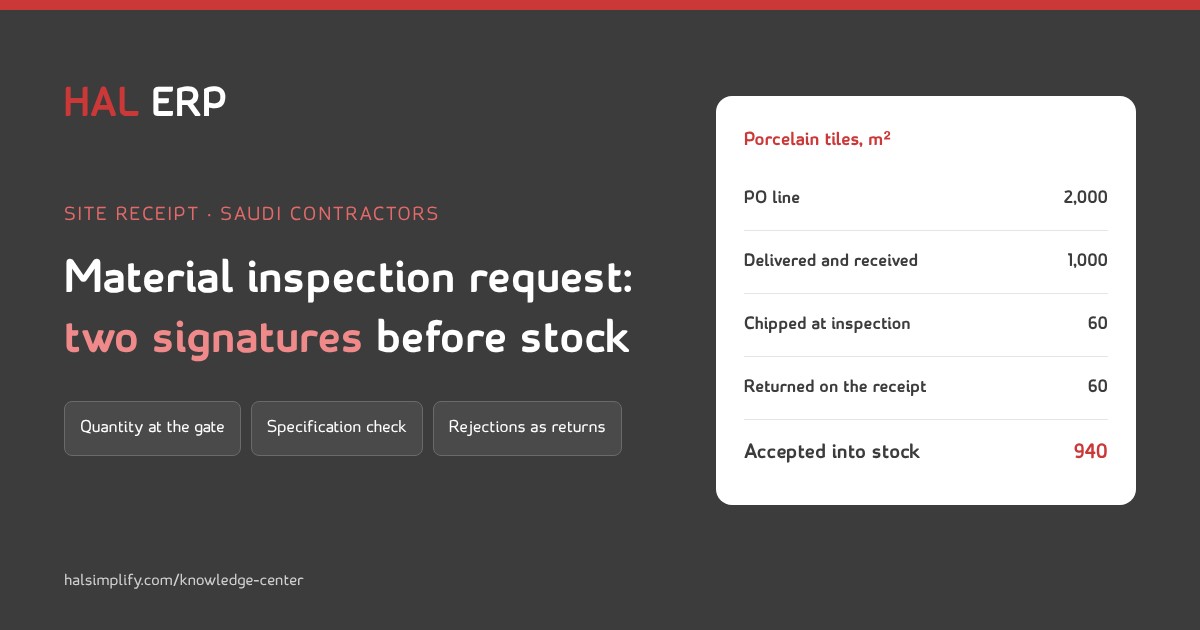
Two habits make this work. The supply invoice is matched to your site receipt, quantity first and then a technical check by the project manager against the approved material, with building, floor and zone on the receipt. The works certificate is matched to a measurement, in the same way you measure your own claim to the owner.
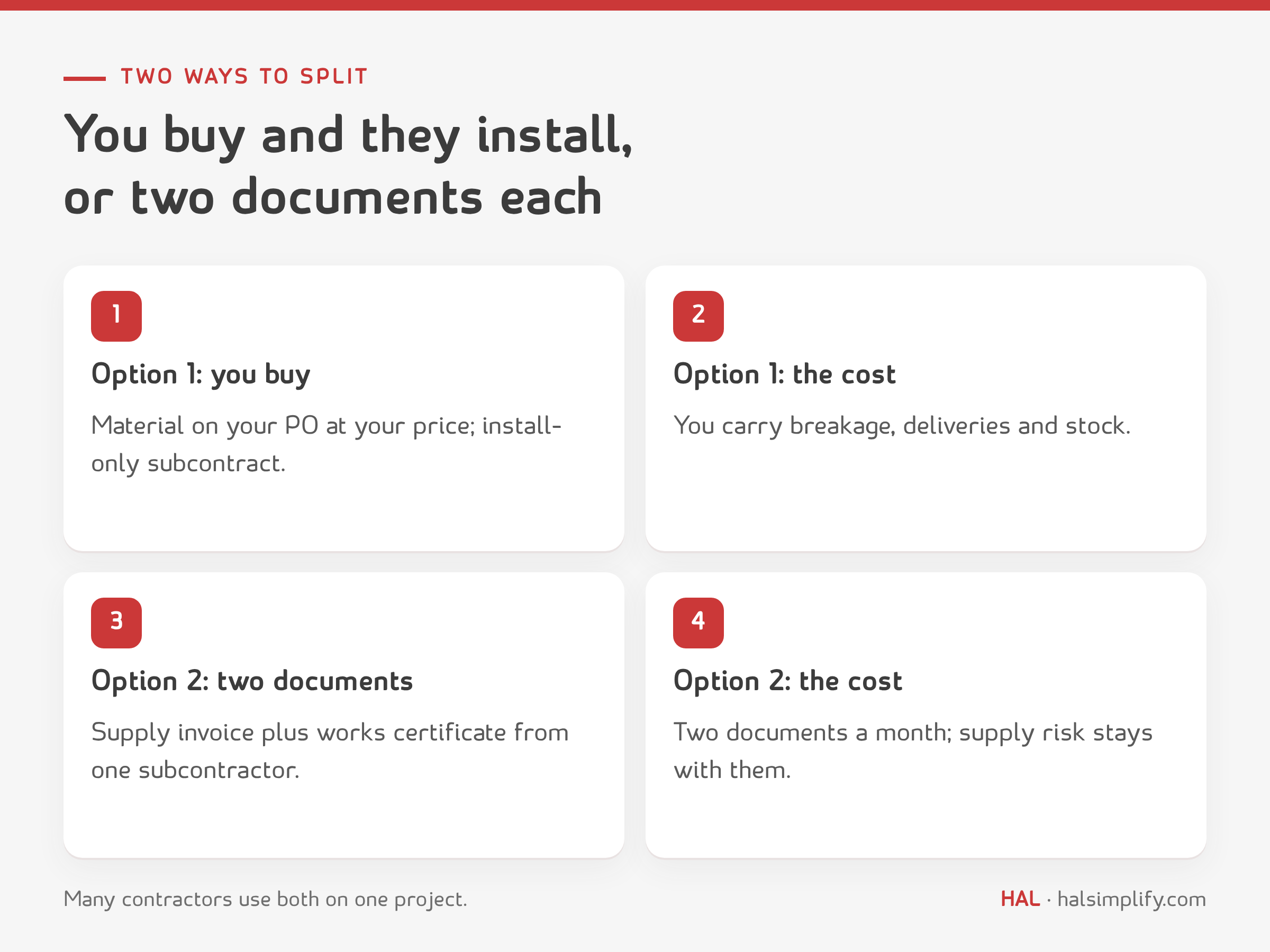
There are two ways to get there, and many contractors use both on the same project.
| Option 1: you buy, they install | Option 2: two documents per subcontractor | |
|---|---|---|
| How it works | You issue the PO to the manufacturer or distributor; the subcontract is install-only | The subcontractor supplies and installs, but bills supply and works separately |
| Material on your PO | Yes, at your negotiated price | No, on the subcontractor's invoice |
| Who carries breakage and wastage | You, unless the install-only subcontract says otherwise | The subcontractor |
| Admin | More POs, deliveries and stock to manage | Two documents a month per subcontractor |
| Works best for | High-value, long-lead or bulk items: porcelain, marble, HVAC units | Specialist items where the subcontractor's supply chain matters |
Option 1 also lets you split one material across sources. That general contractor bought 20,000 m² of porcelain as two POs, 15,000 m² from the manufacturer and 5,000 m² from a distributor, and hired installation separately. For long-lead items such as HVAC, the PO may go out four to six months ahead with phased deliveries, which is easier to control when the PO is yours.
Whichever option you choose, keep one rule from the vendor master: no VAT number and commercial registration on file, no payment. Both documents are tax invoices with 15% VAT, and your input VAT depends on them being right.
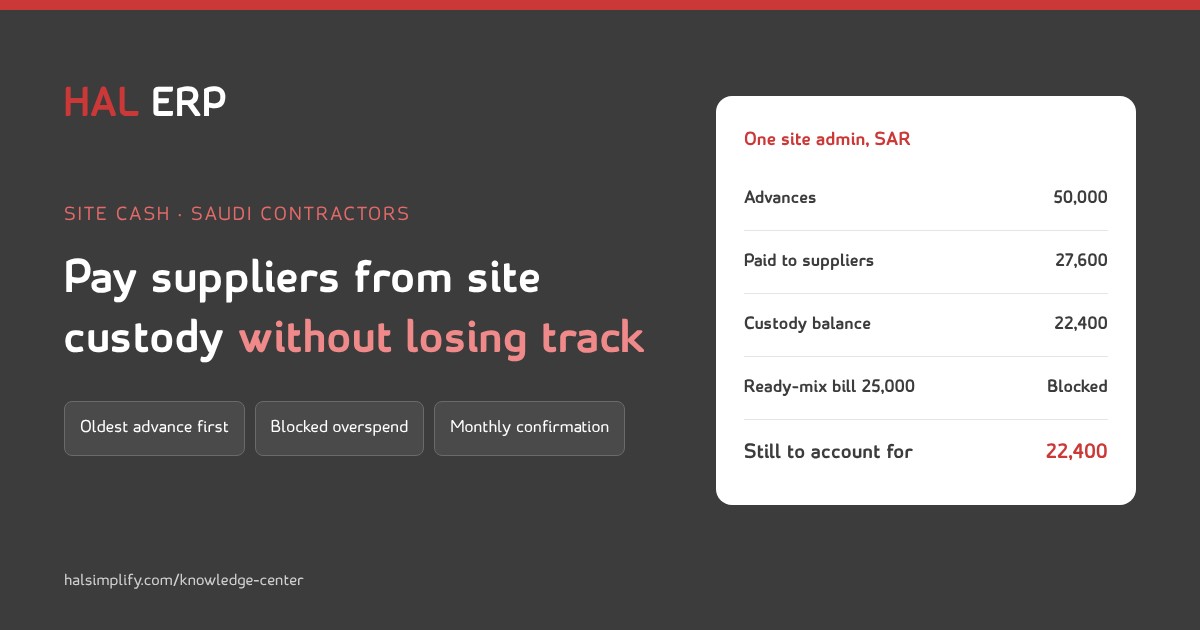
Each subcontract carries its own retention and advance terms, and once you split, you apply them per document. In this example the marble subcontractor received a SAR 12,000 advance (10% of SAR 120,000), recovered at 10% of every document, with 10% retention on works certificates only.
| Document | Value | Advance recovery | VAT 15% | Retention | Payable |
|---|---|---|---|---|---|
| Supply invoice, 600 m² × 70 | 42,000 | −4,200 | 5,670 | 0 | 43,470 |
| Works certificate, 450 m² × 50 | 22,500 | −2,250 | 3,037.50 | −2,250 | 21,037.50 |
| Supply invoice, 400 m² × 70 | 28,000 | −2,800 | 3,780 | 0 | 28,980 |
| Works certificate, 350 m² × 50 | 17,500 | −1,750 | 2,362.50 | −1,750 | 16,362.50 |
| Works certificate, 200 m² × 50 | 10,000 | −1,000 | 1,350 | −1,000 | 9,350 |
| Total | 120,000 | −12,000 | 16,200 | −5,000 | 119,200 |
The advance is fully recovered by the last certificate, and SAR 5,000 of retention is held against the installation, which is where defects show up. Some agreements also hold retention on supply; the template lets you set a separate rate for each.
Retention you hold from subcontractors is money you owe later. Cost control usually sees it as a commitment before finance does, so put it on the same report as the retention your owner holds from you.
Expect resistance. A subcontractor who buys marble at one price and bills it inside a blended rate earns a margin on the material. Splitting the invoice shows that margin, and option 1 can remove it.
| Week | Do this |
|---|---|
| 1 | List active subcontracts with a supply element. Mark which are already split. |
| 2 | Pick the three highest-value lines. Agree option 1 or 2 with each subcontractor. |
| 3 | Issue the first split documents and reconcile them to the BOQ and site receipts. |
| 4 | Review the supply-vs-subcontracted profile per project with management. |
The subcontract supply/works split template (Excel, with a PDF guide) does the arithmetic:
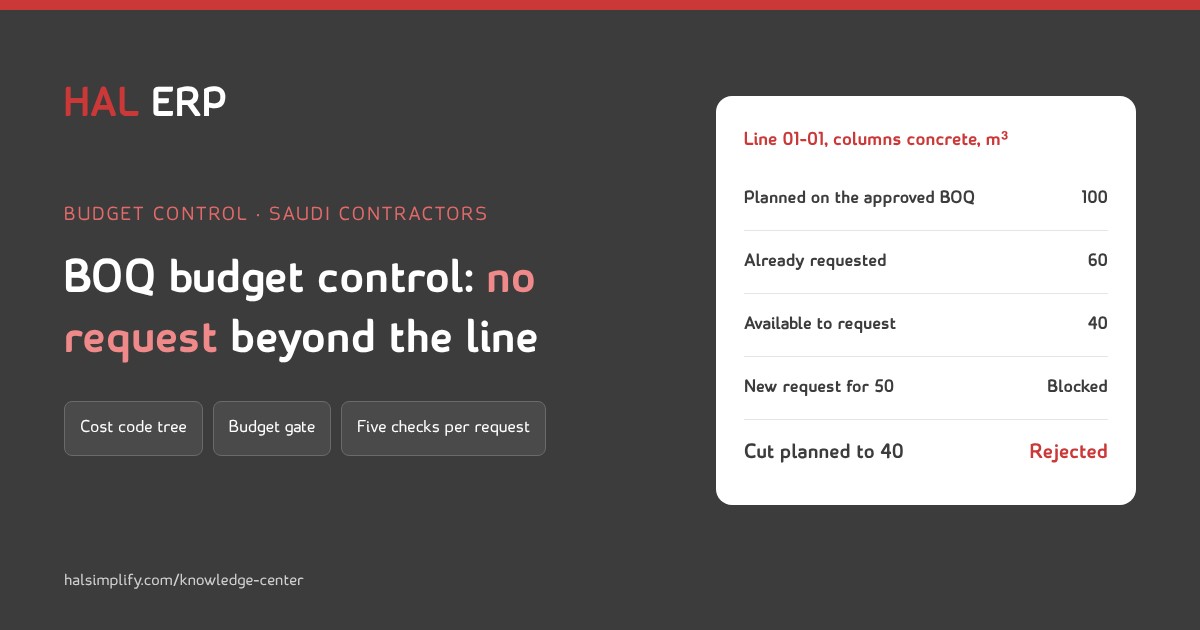
In HAL Contracting, procurement sets the budget by activity and ties every BOQ item to it, and purchase requests from site are checked against the BOQ balance and the budget, then checked again at the purchase order. With "consume stock", material received on site is issued to the project at once, the vendor invoice is capped at the quantity received with any advance deducted automatically, and the purchase order reconciliation shows ordered, received, invoiced and pending for every PO, project and supplier. Vendor advances are capped at the PO value and settled against the invoice that follows. Our guide to subcontracting in procurement covers the wider process, and HAL pricing shows what it costs.
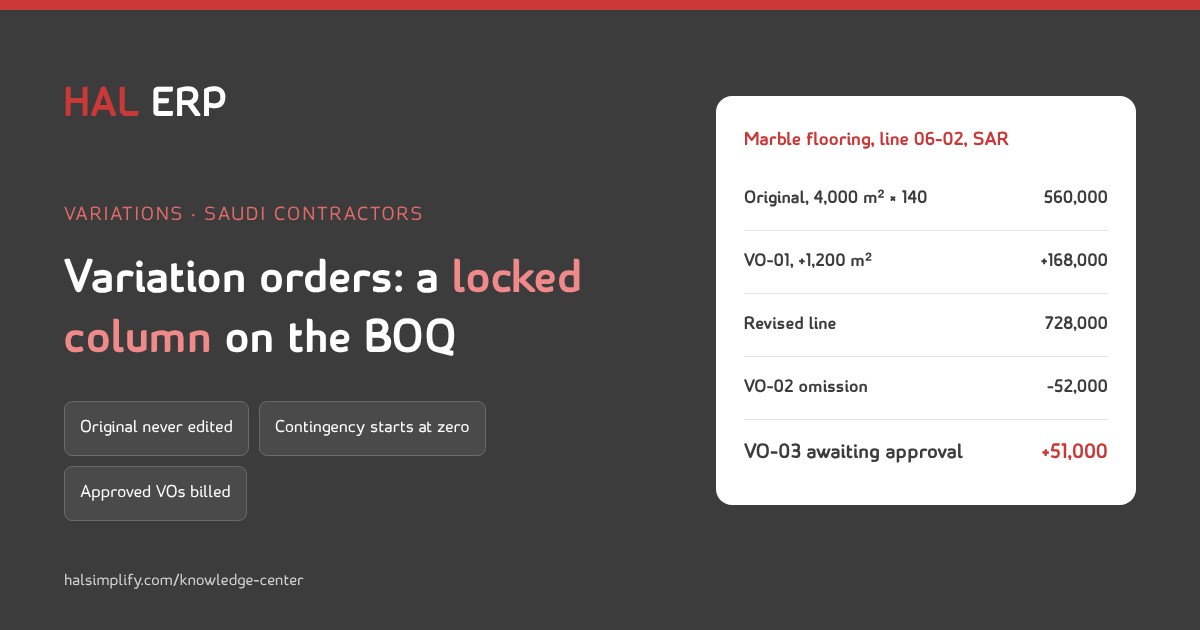
Related reading: monthly progress claims and retention, material inspection requests and two-step site receipt and BOQ budget control for purchase requests.
The subcontractor provides the material and installs it, usually for one rate per unit. It is a normal arrangement, but when every invoice shows only that one rate, the contractor's records cannot show which materials it supplied and which work it subcontracted.
So that the supply invoice matches your site receipt and the works certificate matches a measurement, both against the same BOQ quantity. Your profile then shows the material as supply and only the installation as subcontracted work, which matters in a contractor-classification review or prequalification.
Not necessarily. In the marble example, SAR 120/m² becomes SAR 70/m² supply plus SAR 50/m² installation, the same total. Prices move only if you buy the material yourself or the subcontractor adjusts the install rate.
The sum of all supply documents for a BOQ line equals its quantity, and so does the sum of all works documents. If 1,000 m² is on the BOQ, the supply invoices add up to 1,000 m² and the works certificates add up to 1,000 m². Supplied minus installed is material on site.
Per document, using the terms in each subcontract. A common setup recovers the advance at a fixed percentage of every document and holds retention on works certificates, where defects appear. Some agreements also hold retention on supply.
Keep the total the same, allow a fair handling margin on supply, and write the split into the next tender. For high-value materials, buy them yourself and hire installation only.