
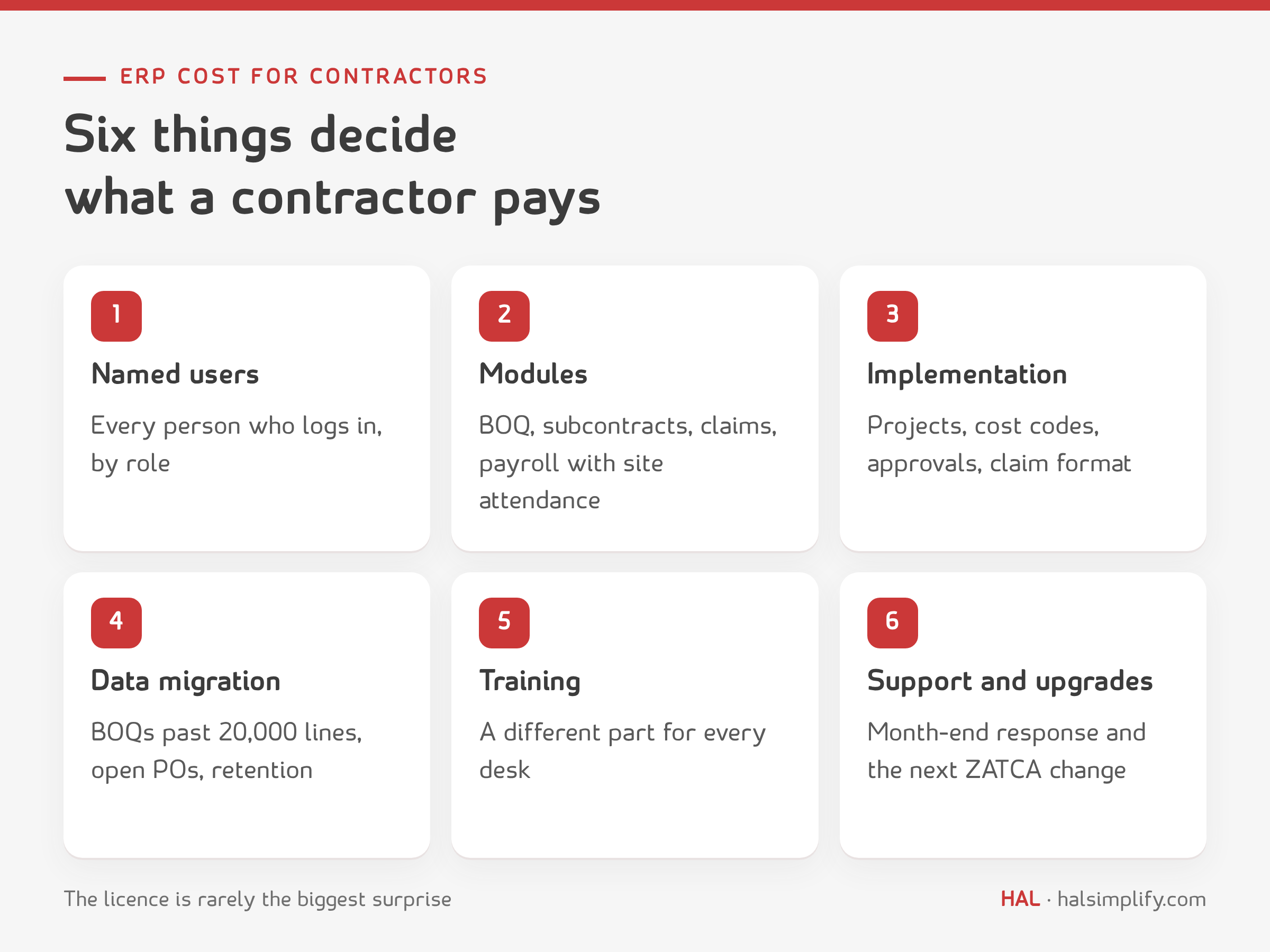
In short: The ERP cost for contractors depends on six things: how many people need a login, which modules you run (projects and BOQ, procurement, subcontracts, progress billing, HR and payroll with site attendance), implementation, data migration, training, and support. The licence is usually the smallest surprise. The bigger ones are migrating large BOQs, ZATCA Phase 2, per-user creep and your own team's time. Compare vendors on one three-year total, before and after 15% VAT. HAL publishes its plan prices on the pricing page.
The quotes arrive in the same week. One is priced per user per month. One is a yearly subscription with implementation "to be quoted after workshops". The third is a single number with a long list of exclusions. You run a contracting company with 150 people across four sites, and you need to decide which of the three will cost less over the next three years, and which one will still be standing when your biggest project hits its peak.
This guide is for owners, general managers and finance heads of Saudi contractors with 50 to 500 staff. It explains what drives the price, where the hidden costs sit, the questions that flush them out, and a three-year worksheet that puts every quote on the same rows. The free contractor ERP budget kit at the end gives you the checklist as a PDF and the worksheet as an Excel file that does the arithmetic.
A trading company buys an ERP for stock, sales and accounts. A contractor needs all of that plus a project spine: every purchase, man-day and claim tied to a project budget. That spine is what makes contractor ERP projects bigger, and it shows up in six cost drivers.
Price the modules you will use in the first year, then the ones you will add. This table lists what each module does for a contractor and what typically pushes its setup cost up.
| Module | What it does for a contractor | What makes it cost more |
|---|---|---|
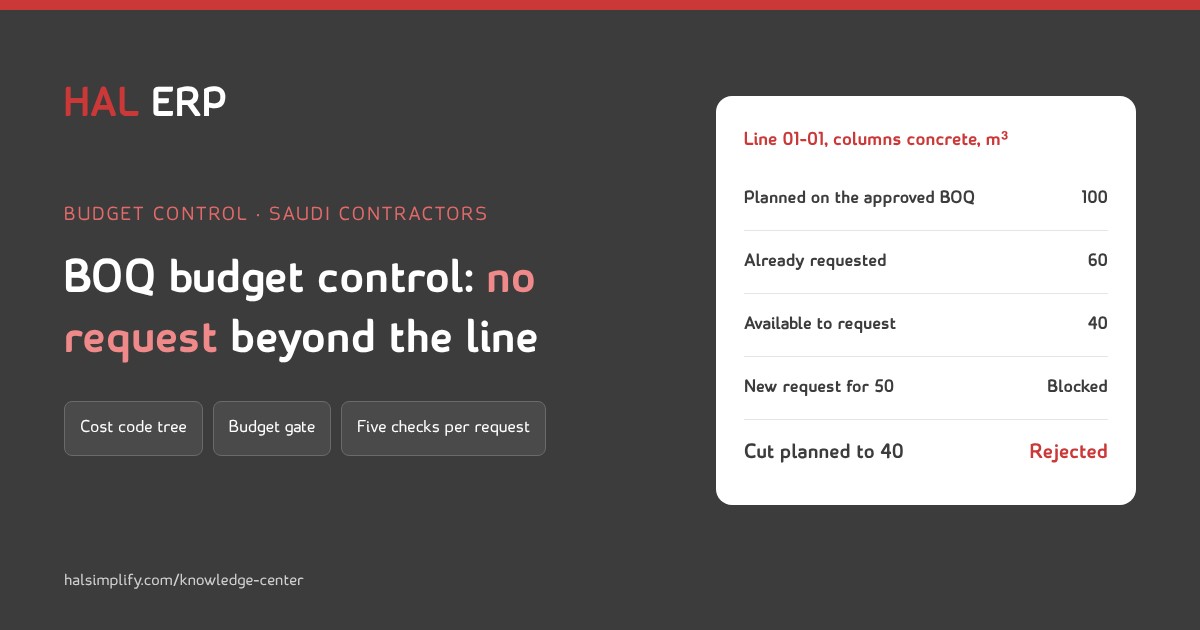
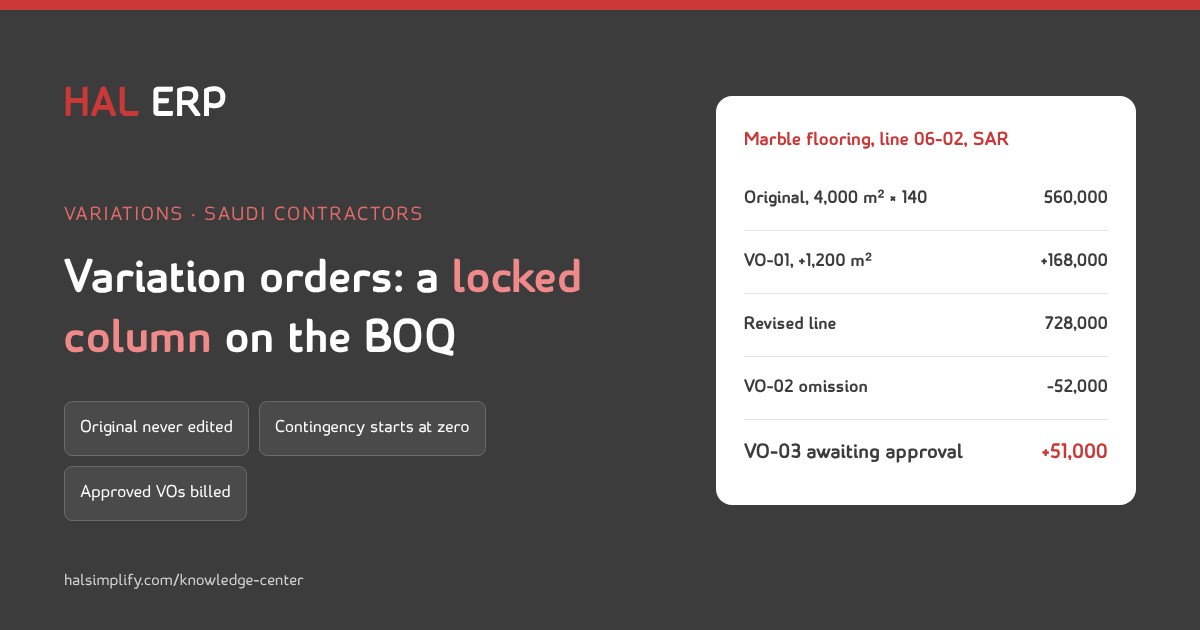
| Projects, budget and BOQ | One budget per project and activity; every request and order checked against it | Many projects at once, re-measurable contracts, frequent variation orders |
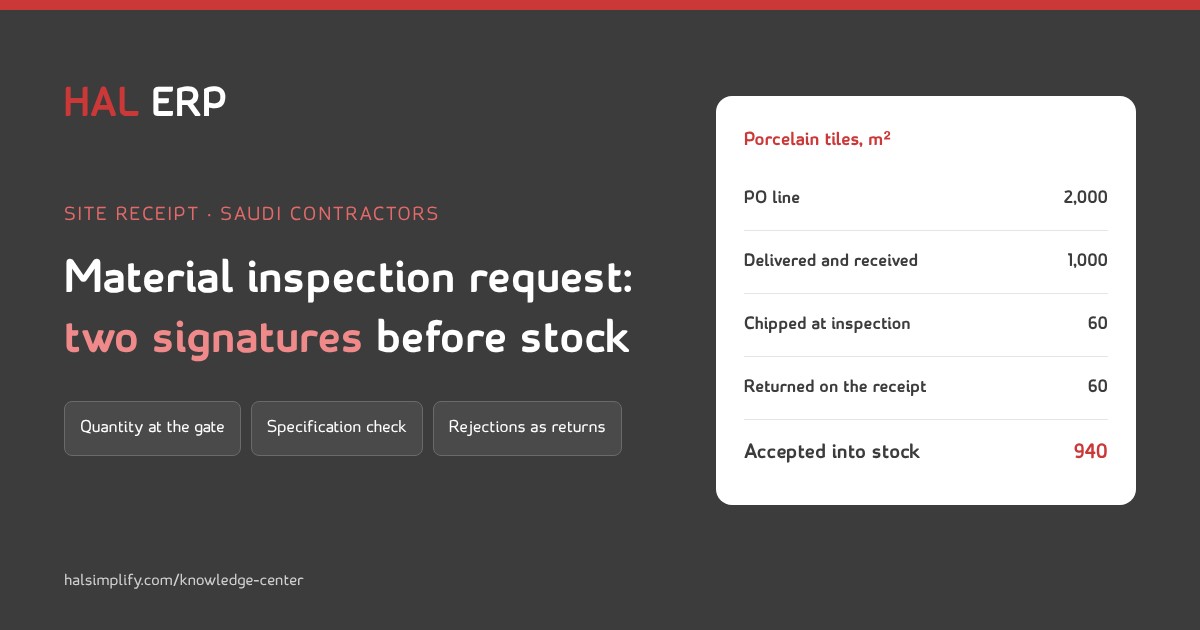
| Procurement and site stores | Requests from site, quotations, purchase orders, receipts on site | Several stores, two-step receiving, long-lead items with phased delivery |
| Subcontracts | Subcontract value, certificates, retention and advance recovery | Many subcontractors per BOQ line, supply and install split into two invoices |
| Progress billing | Monthly claims with retention, advance recovery, penalties and VAT | Unusual claim formats, two retention release dates, consultant approval steps |
| HR and payroll with site attendance | Iqama and contract records, site timesheets, payroll posted to each project | Crews moving between sites, several pay categories, end-of-service and leave rules |
| Accounting and ZATCA | Ledgers, VAT returns, e-invoices cleared through ZATCA Phase 2 | Several companies or divisions, group consolidation |
Two questions decide most of the difference between quotes. Does the vendor price these as one suite or as separate add-ons? And is the contracting logic (BOQ checks, claims, retention) standard in the product, or built for you during implementation? Logic built for you is logic you pay to rebuild at every upgrade.
For a fuller checklist of what contracting software must cover, see our contracting software buyer's guide.
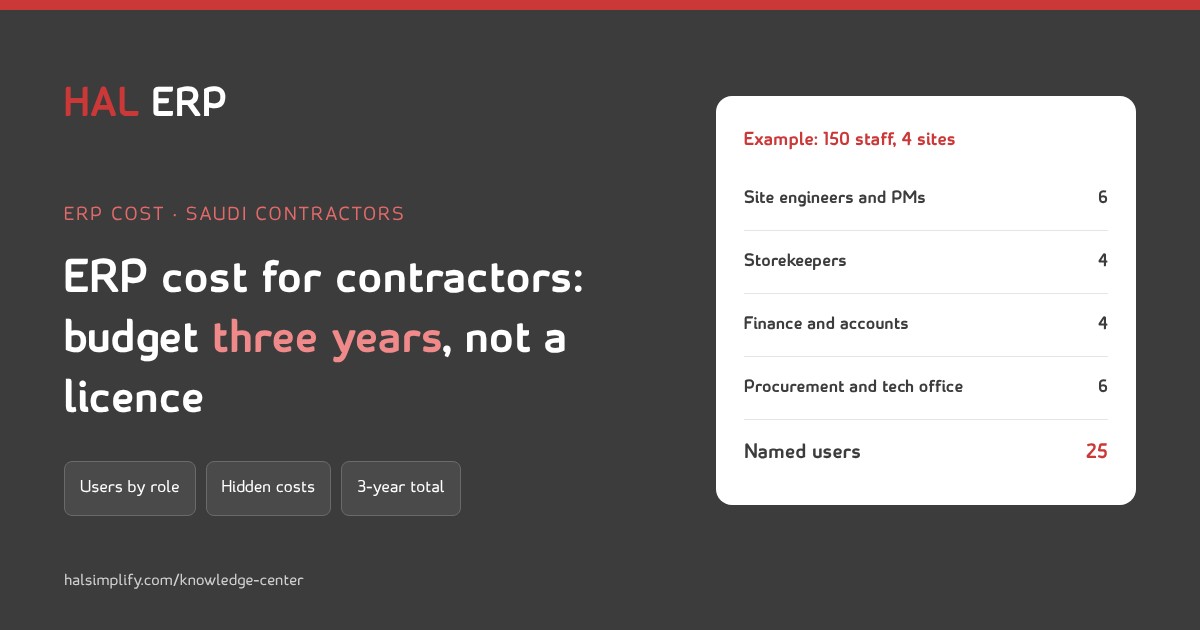
Count users by role, not by department head. Here is a worked example for a contractor with about 150 staff on four sites. Your numbers will differ; the method is the point.
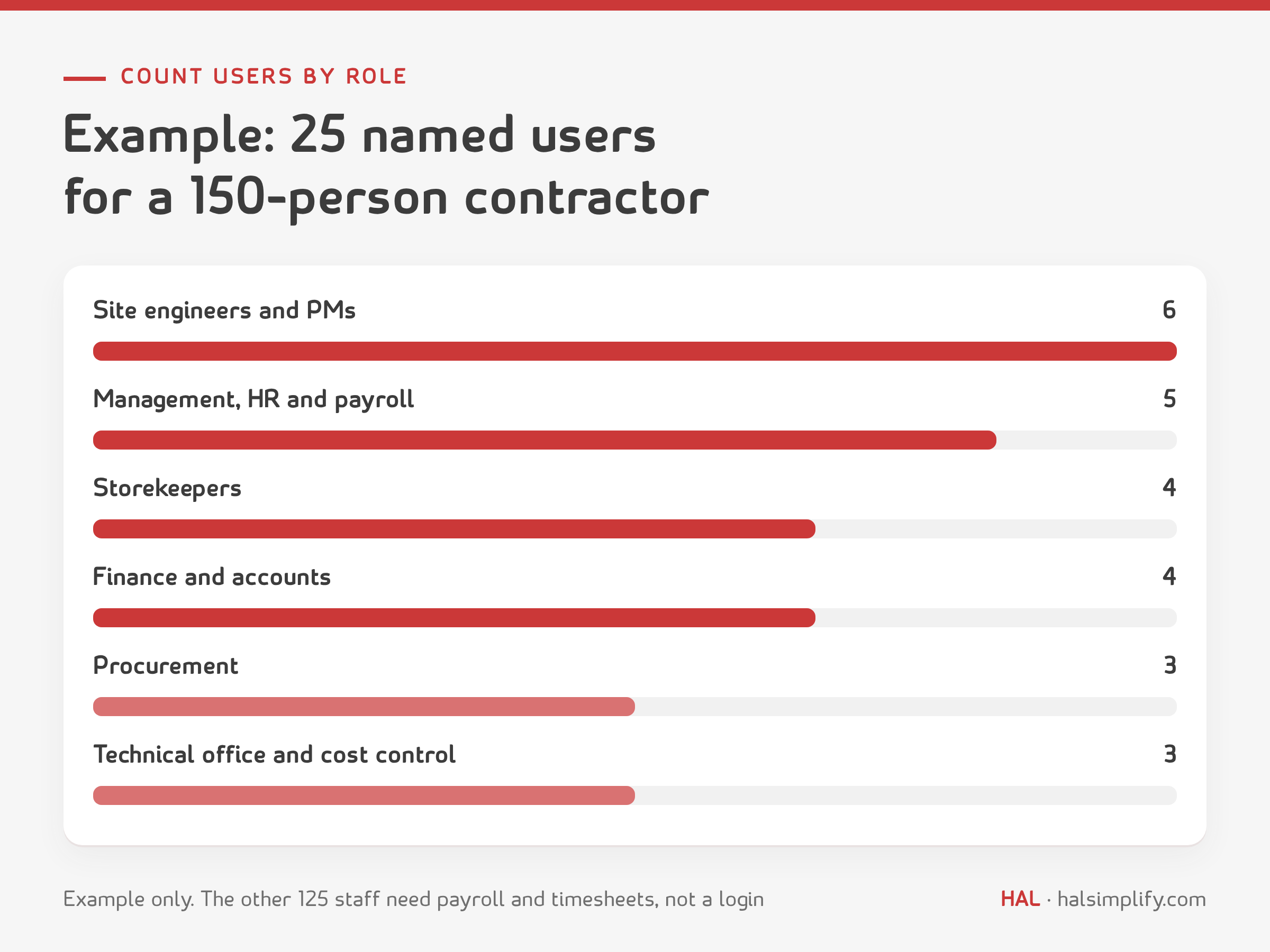
| Role | Example count | Why they need a login |
|---|---|---|
| Site engineers and project managers | 6 | Raise material requests against the BOQ, record progress, approve receipts |
| Storekeepers | 4 | Receive deliveries on site, issue material, monthly counts |
| Finance and accounts | 4 | Invoices, payments, claims, VAT and month-end |
| Procurement | 3 | Quotations, purchase orders, vendor follow-up |
| Technical office and cost control | 3 | Check quantities and prices, approve the BOQ and budget changes |
| Management | 3 | Approvals and project margin reports |
| HR and payroll | 2 | Employee records, transfers between projects, payroll |
| Named users | 25 |
The other 125 people, mostly site labour, still appear in the ERP as employee records with timesheets and payroll. Ask each vendor whether those records count as users, as a separate per-employee fee, or not at all. That one answer can change a quote more than the user price itself.
A contractor's implementation is mostly about money data that is already in motion: projects half-built, orders half-delivered, claims half-paid. Plan for these items, and ask each vendor who does each one.
Most of the cost is not the upload. It is cleaning the data first: duplicate vendors, BOQ lines with no cost code, employees on the wrong project. Budget your own team's time for it. On HAL's contracting page, we state that going live typically takes 4 to 10 weeks, depending on the number of projects, divisions and modules you start with, in phases that begin with the desks that touch money.
These are the lines that are missing from the first quote and show up in the first year.
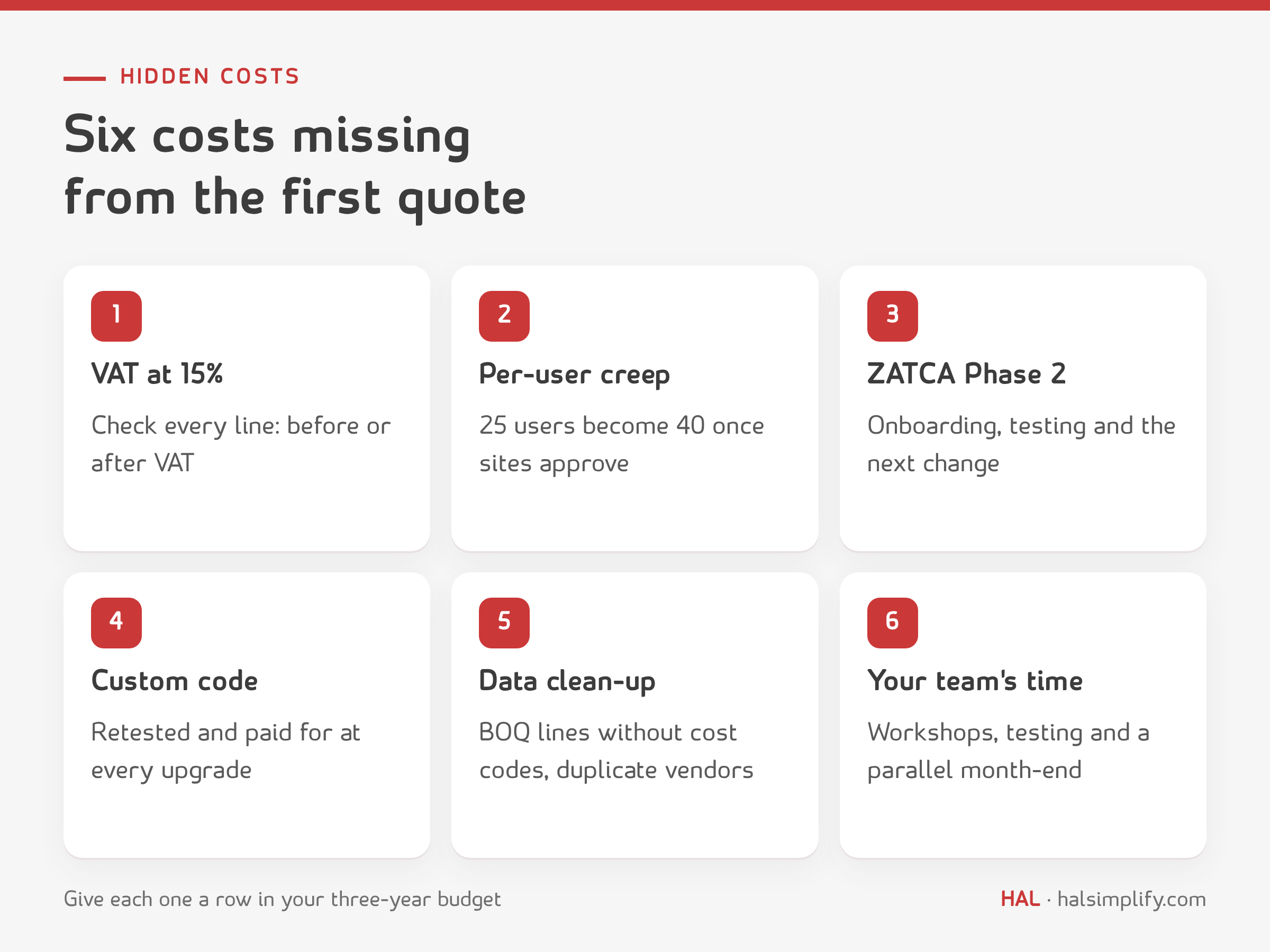
Other lines worth a row in your budget: biometric attendance devices for the head office, tablets for storekeepers, integration with your bank and payroll channels, and extra training when you open a new site.
HAL's pricing page lists three plans. As listed on our pricing page, the Gold plan is SAR 1,999 per user per year and is aimed at small businesses (accounting, sales and procurement). The Platinum plan is SAR 4,999 per user per year and is described as made for contracting and construction, adding consumable management, cost accounting, asset management and multiple stores. The Enterprise plan is priced on demand for mid-sized and large businesses and adds HR modules, group and holding companies, project management and manufacturing, with more modules on request.
Whichever plan you look at, ask for a written quote built on your own user count and modules. The pricing page also states: "No hidden fees, ensuring budget clarity." Use the questions below to hold every vendor, HAL included, to the same standard.
Put every quote on one sheet with the same rows, for three years, at your real user count. Then compare the totals, not the monthly price.
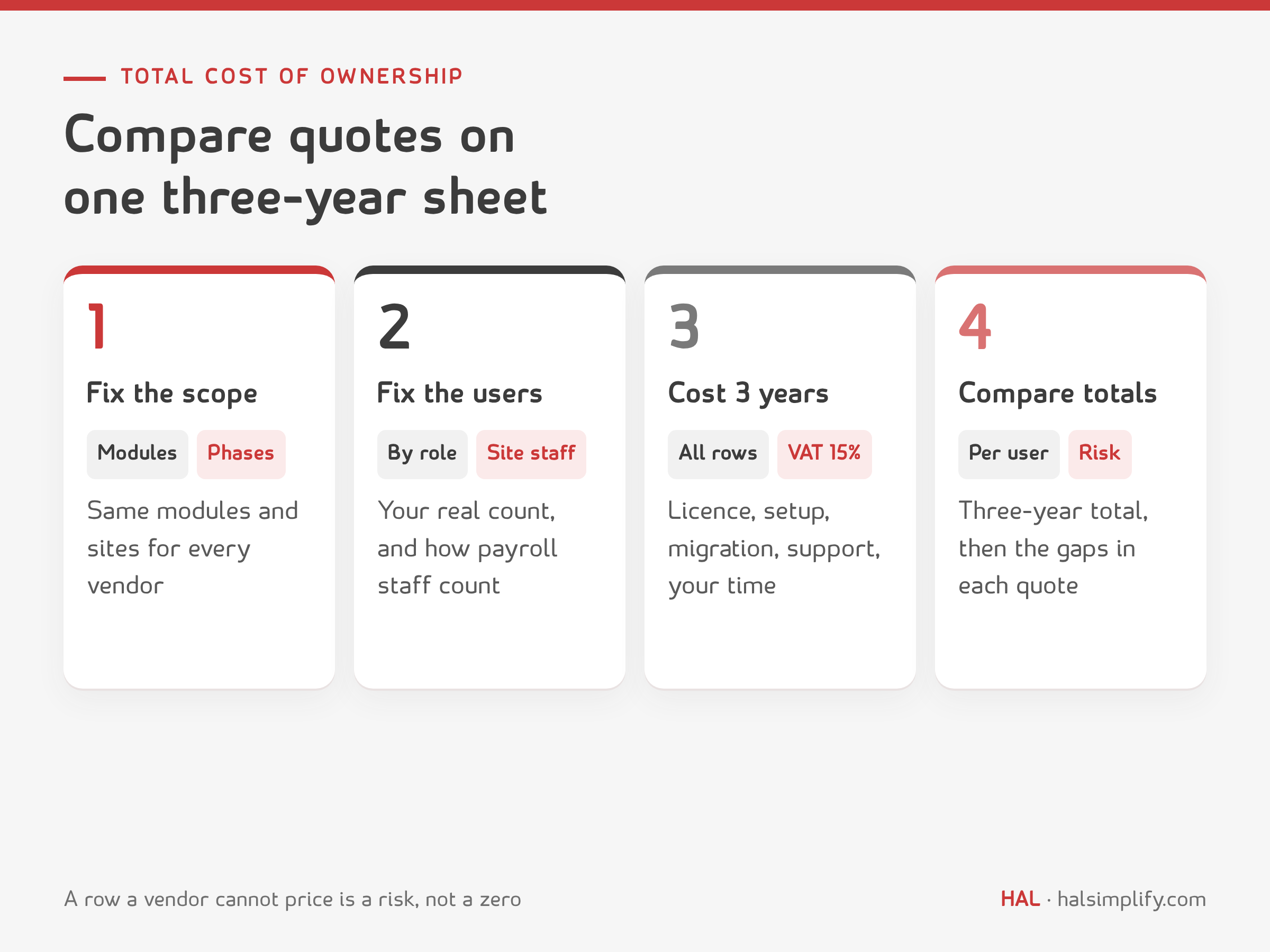
| Row | Year 1 | Year 2 | Year 3 |
|---|---|---|---|
| Subscription or licence (users × price) | ✓ | ✓ | ✓ |
| Implementation (fixed price, in writing) | ✓ | ||
| Data migration (BOQs, open POs, subcontracts, employees, balances) | ✓ | ||
| Training (each desk, plus new sites) | ✓ | ✓ | ✓ |
| ZATCA Phase 2 onboarding and changes | ✓ | ✓ | ✓ |
| Integrations (bank, attendance devices, payroll channels) | ✓ | ✓ | ✓ |
| Customisation and its retesting at upgrade | ✓ | ✓ | ✓ |
| Support, hosting and backups | ✓ | ✓ | ✓ |
| Your team's time | ✓ | ||
| Contingency (a percentage you choose) | ✓ | ✓ | ✓ |
| VAT at 15% | ✓ | ✓ | ✓ |
To show the arithmetic with a published figure: the licence line alone for 25 users at the Platinum price as listed on our pricing page is 25 × SAR 4,999 = SAR 124,975 a year, or SAR 374,925 over three years. That is one row, not a quote; confirm with every vendor, HAL included, whether a quoted line includes VAT. Fill the other rows from each vendor's written proposal, and treat any row a vendor cannot price as a risk, not as zero.
The Excel worksheet in the kit does this for three vendors side by side, adds VAT and a contingency, and shows the cost per user per year.
Send the same questions to every vendor, in writing, and score the answers.
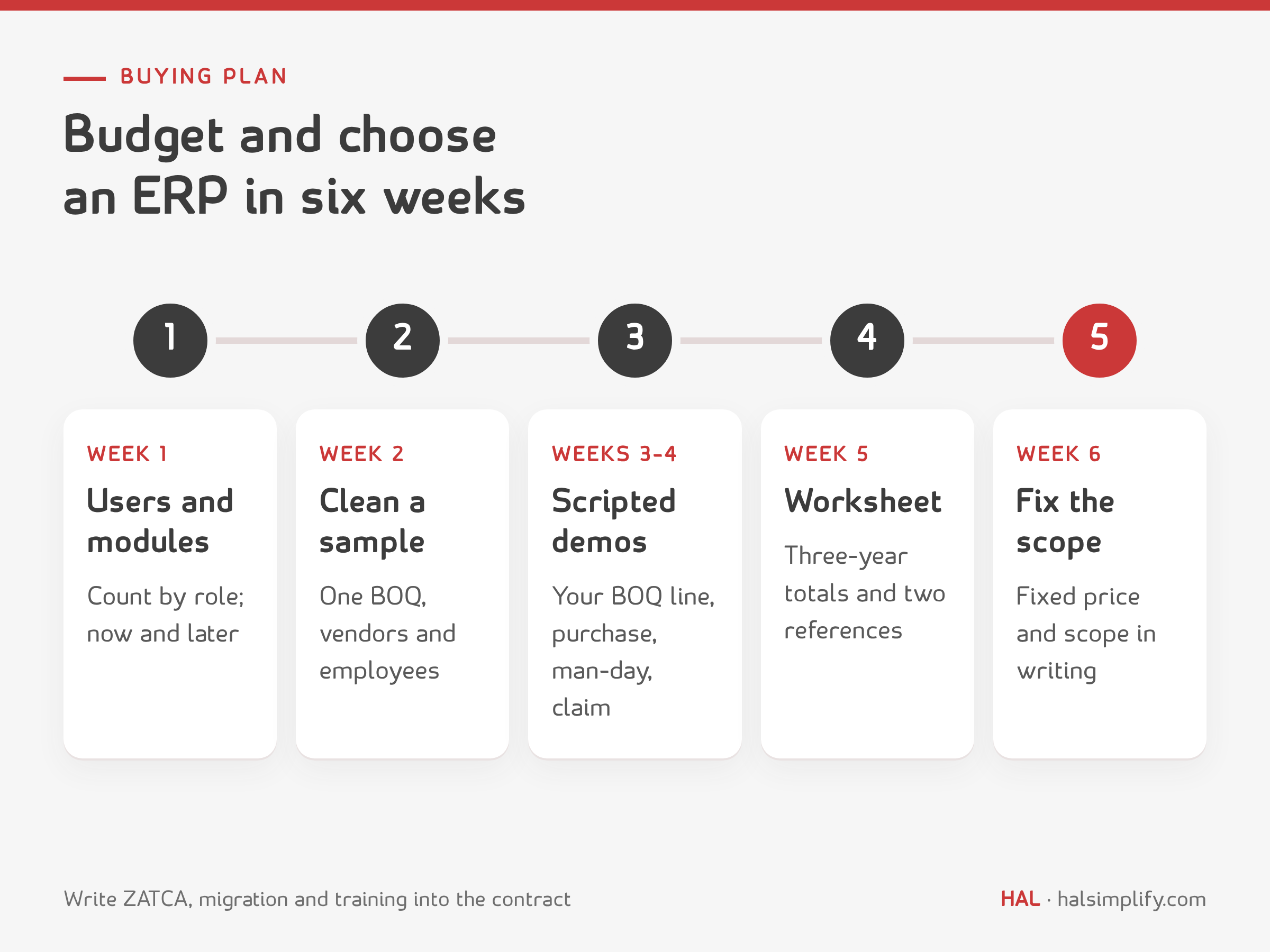
A simple six-week rhythm keeps the decision moving. Week 1: list users by role and the modules you need now and later. Week 2: clean a sample BOQ and your vendor and employee lists. Weeks 3 and 4: scripted demos where each vendor runs your own BOQ line, purchase, man-day and claim. Week 5: fill the three-year worksheet and call two references of a similar size. Week 6: negotiate a fixed scope and price, with ZATCA, migration and training written in.
Six things: the number of named users, the modules (projects and BOQ, procurement, subcontracts, progress billing, HR and payroll with site attendance), implementation, data migration, training, and support and upgrades. For contractors, migrating large BOQs and open commitments and setting up the claim and retention rules usually take the most effort after the licence.
HAL's pricing page lists the Gold plan at SAR 1,999 per user per year and the Platinum plan, described as made for contracting and construction, at SAR 4,999 per user per year. The Enterprise plan, which adds HR modules, group companies and project management, is priced on demand. These are the prices as listed on our pricing page; ask for a written quote on your own users and modules.
It depends on the vendor. Site labour usually needs employee records, timesheets and payroll rather than a login, but some vendors charge per employee record as well as per user. Ask every vendor how they count people who are on payroll and timesheets but never log in.
There is no standard price. It depends on the number of projects and divisions, the modules, the size of your BOQs, the open commitments to migrate and how much is configured versus custom-built. Ask each vendor for a fixed implementation price in writing that names migration, ZATCA Phase 2 onboarding and training.
It depends on the number of projects, divisions and modules. HAL states that HAL Contracting typically goes live in 4 to 10 weeks, in phases that start with the desks that touch money. Data clean-up and your team's availability for workshops and testing are the usual reasons projects run longer.
Put every quote on the same rows for three years at your real user count: subscription, implementation, migration, training, ZATCA, integrations, customisation, support, your team's time, contingency and 15% VAT. Compare the three-year totals, and treat any row a vendor cannot price as a risk.
The kit has two parts you can use this week:
HAL Contracting runs a contracting company from contract award to project margin: BOQ and budget control, purchases checked against the budget, site manpower and payroll by project, progress claims with retention and advance recovery, and ZATCA Phase 2 e-invoicing, in Arabic and English. Bring a BOQ and last month's claim to a demo and see the same project in HAL. For plan prices, see HAL pricing. If you are still comparing the wider market, read our guide to ERP cost in Saudi Arabia or the best ERP for MEP and civil contractors.