
In short: A monthly teacher report collects, on one page per teacher, the scores supervisors already give during the month: for the lesson plan, for the lesson observed, for notebook correction and for the other routines. It tells a teacher which part to work on, for example "your Summary average is 70% and your Evaluation average is 46%, so improve how you test the objective." Because it is built from rubrics your school defines, it becomes a fair, continuous record of teaching quality that can be factored into the yearly appraisal. Below: why one-off appraisals fall short, where each score comes from, how to define your own rubrics, a worked example, the monthly conversation and a free kit (PDF guide and Excel workbook).
It is March. The principal has to complete the appraisal for 40 teachers. She remembers the lessons she saw, the complaints she heard and the teachers who are easy to talk to. For the rest, she writes something safe. Meanwhile the school has a year of scores from lesson plans, observations, notebook checks and rounds, in six different registers that nobody has put side by side.
That is the gap this article closes. The monthly teacher report is the page that puts those scores side by side every month, so the appraisal in March is a summary of what the teacher already knows, not a surprise.
Appraisal forms are usually filled once or twice a year. Four things go wrong, all familiar.
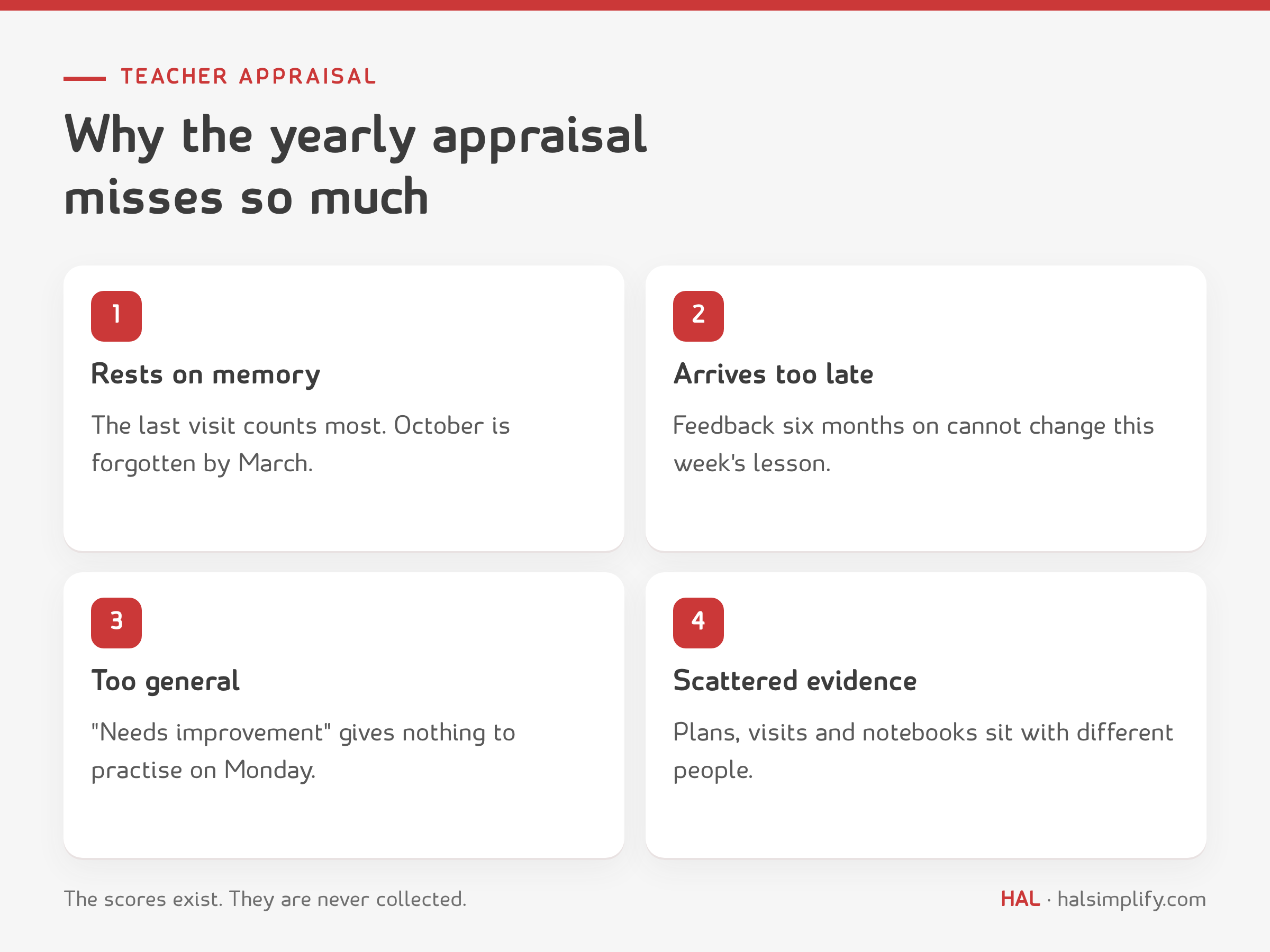
None of this is a failure of the people. It is what happens when the scores exist but are never collected.
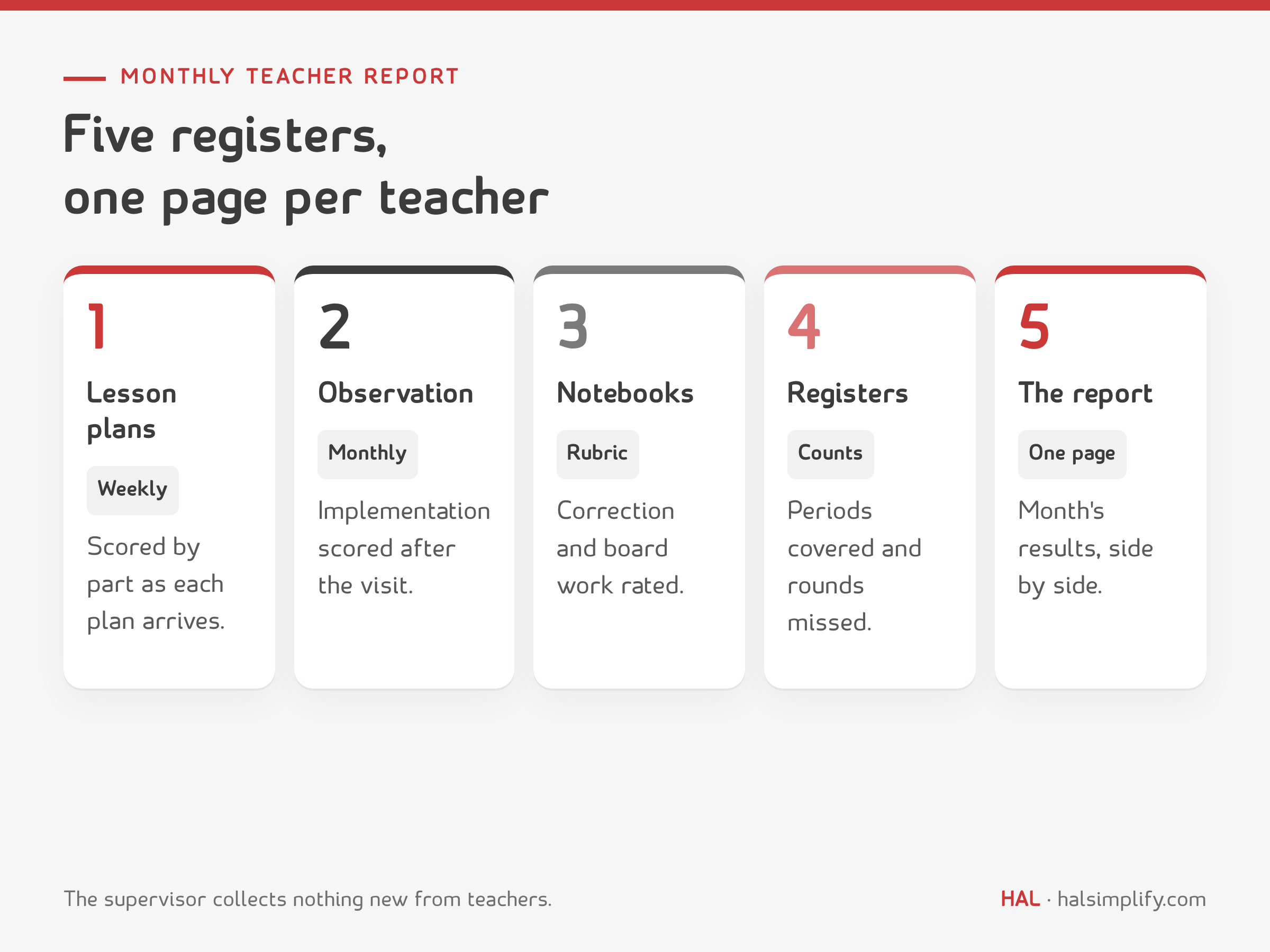
It is a consolidation page. One row per teacher, one column per routine your school already runs. The supervisor fills it once a month from the registers. Nothing new is collected from the teacher.
The teacher submits the lesson plan on the usual day, and the supervisor scores it. When the supervisor sits in a lesson, they review it and score the implementation. Notebook checks, board work, scoreboard use, substitutions and rounds are recorded where they happen. The report pulls the month's result from each of them.
The scores are quantitative, so the message to the teacher is specific. "Your lesson plans average 70% on Summary and 46% on Evaluation" tells a teacher where to look. "Your plans need improvement" does not.
The report has two versions, because class teachers and subject teachers do different work. Many teachers are both, so they appear in both.
Subject teacher report
| Column | Where it comes from | How it shows |
|---|---|---|
| Subjects handled | The timetable | Names and classes |
| Lesson plan (RISE note) | The weekly plan review, see the RISE lesson plan system | Monthly average per part, in % |
| Implementation in class | The full observation, see the lesson observation register | Monthly score and band |
| Periods substituted | The substitution register, see every period covered | Number of periods covered for colleagues |
| Not in class during rounds | The supervision rounds register | Times out of rounds made, with the reason |
| Board work | The observation rubric | Rating from your rubric |
| Notebook correction | The notebook check, see notebook checking | Rating from your rubric |
| Scoreboard use | The class scoreboard | Rating from your rubric |
| Response to the given work | Supervisor's follow-up on feedback | Rating from your rubric |
Class teacher report
| Column | Where it comes from | How it shows |
|---|---|---|
| Notebook checking | The class teacher's rotating check | Done on time, rating from your rubric |
| Handbook (planner) checking | The weekly planner check, see homework register and student planner | Done on time, rating from your rubric |
| Scoreboard checking | The class scoreboard | Rating from your rubric |
| Response to the given work and submission of reports | Deadlines in the school calendar | On time, late, missing |
| Report card preparation | The report card cycle | Accuracy and deadline |
| Attendance register | The daily register | Complete and up to date |
| Awareness of class students | The late bloomers list from exam analysis | Does the class teacher know each student on the list, and the agreed next step? |
Counts such as periods substituted are shown as they are. They describe workload and contribution, not quality, so they carry no score.
The most important design point is that every scored column is a rubric your school defines. The report does not contain HAL's idea of good teaching. It carries yours.
A rubric is a short list of areas, with a description of what each level looks like and the weight of each area. The RISE lesson plan rubric, the observation rubric and the notebook checking rubric in this series are examples. They are a starting point to copy, change or replace.
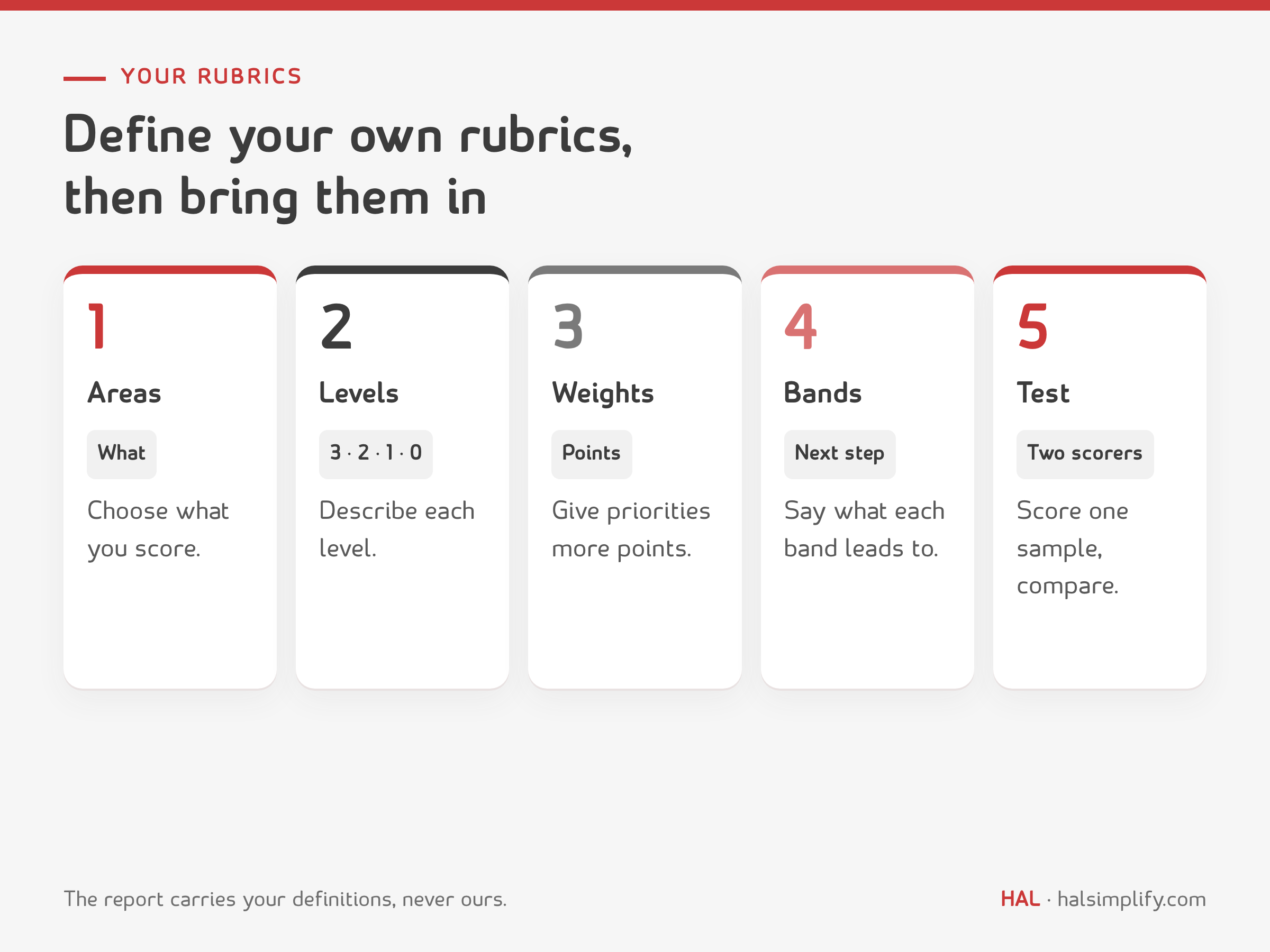
When a rubric changes, the report follows. The report only asks for each rubric's monthly result, whatever the rubric looks like. That is why one report can fit a primary section, a secondary section and a school that follows a different board.
Take a made-up Grade 6 Science teacher in October at a sample school. The school uses the sample RISE rubric.
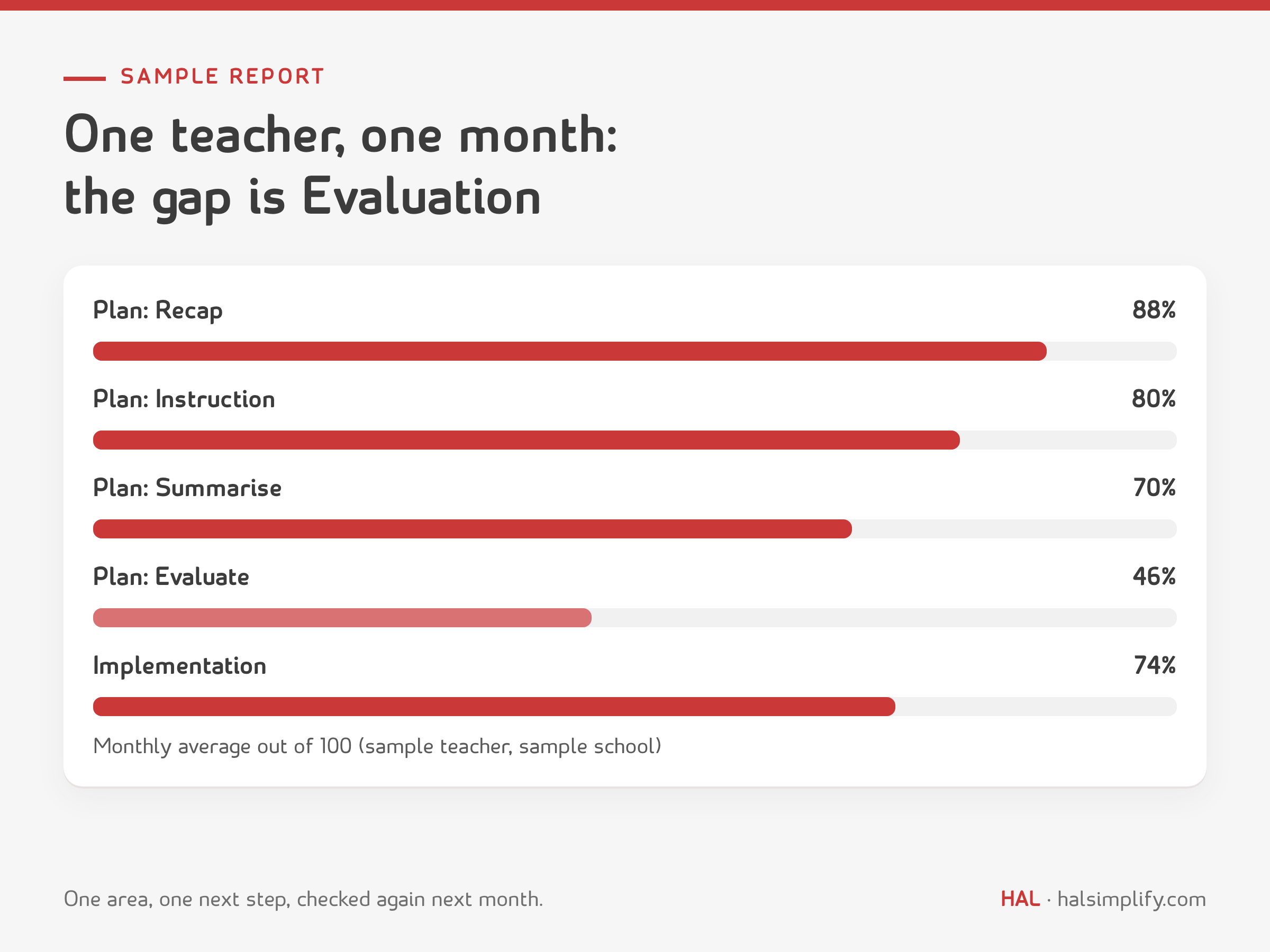
Notice what the supervisor did not do. They did not label the teacher weak. They found one area, agreed one step and will look again.
The report has room for one column of student results from exam analysis, such as the class average in the teacher's subject beside the school's average for that subject.
Use it to start a conversation. Do not use it to rate the teacher. A teacher given the weakest section, or the topic that is hardest to teach, will look worse on a single number. Ask what is different, not who is to blame.
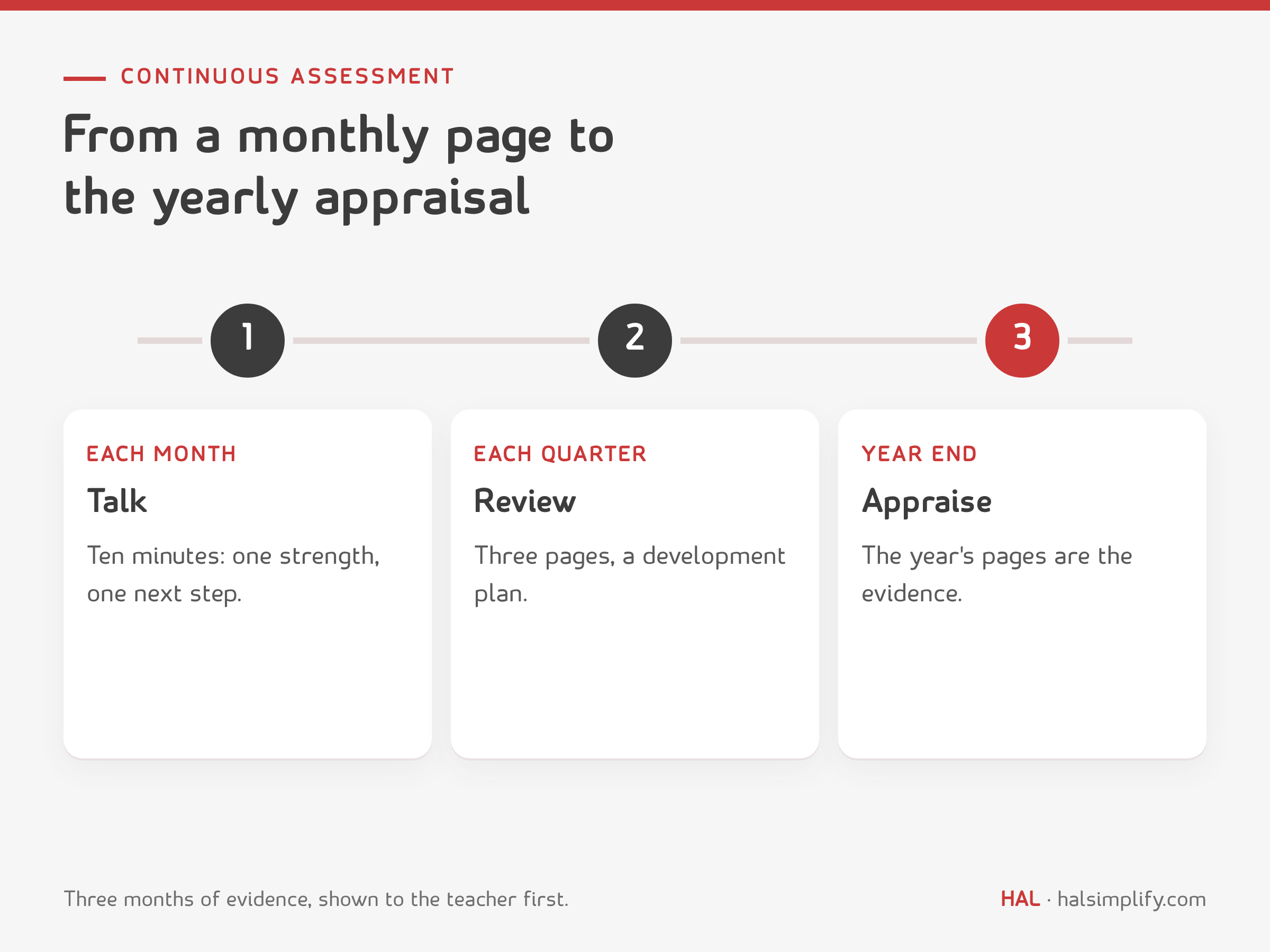
The report supports three moments: a monthly conversation, a quarterly review and the yearly appraisal.
| When | Who | What |
|---|---|---|
| Week 1 of each month | Supervisor and teacher, 10 minutes | Read the page together, name one strength, agree one next step with a date |
| End of each quarter | Head of department with the compartment head | Read three monthly pages, agree a development plan, note recognition |
| End of year | Principal | Attach the year's pages to the appraisal; they are the evidence |
Many schools already make the head of department responsible for assessing each teacher every quarter. The monthly report gives that review its evidence, so it does not start from a blank page.
A few habits keep it fair:
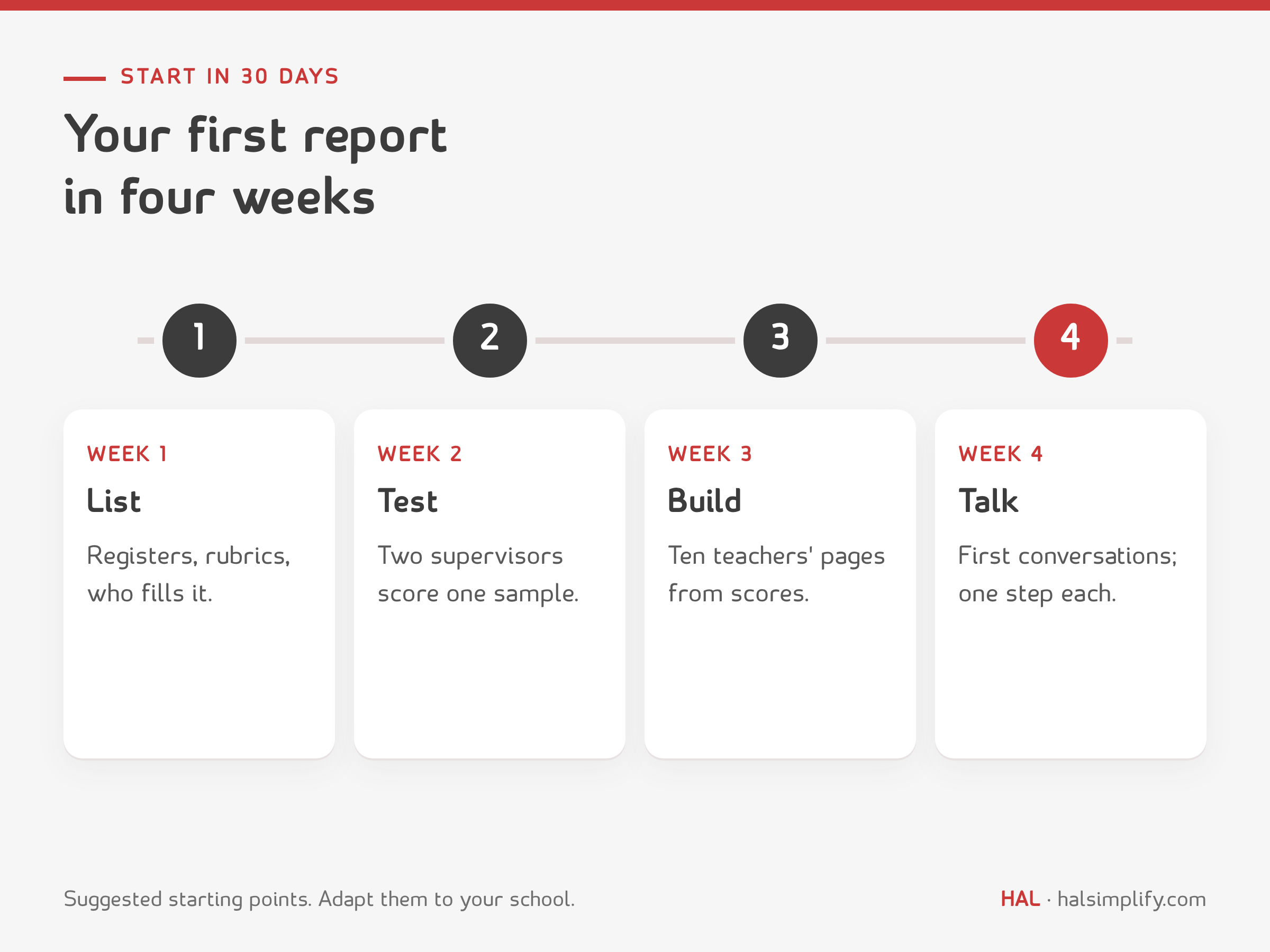
The kit has two files.
On paper, someone collects the scores from six registers every month. In a system where the scores are recorded as they happen, the report builds itself. The lesson plan is submitted and scored. The observation is entered after the visit. The notebook check is logged. At month end, every teacher's page is already there.
HAL Edge, HAL's education management system, keeps academic routines, faculty performance and school data together, in Arabic and English. Because your rubrics are settings, the school's own definitions carry into the system.
A one-page summary per teacher that collects the month's scores from the lesson plan review, lesson observation, notebook checks and other routines. It shows the teacher which area to improve and gives supervisors a continuous record for appraisal.
The scores your school already records: lesson plan, implementation in class, notebook correction, board work, scoreboard use and response to feedback, plus counts such as periods substituted. Add one next step and a date.
It happens every month, from evidence collected as the work is done. The yearly appraisal then summarises it instead of relying on memory.
Yes. Every scored column in the report is a rubric the school defines: the areas, the descriptions of each level, the weights and the bands. The kit includes a sample and a template to replace it.
The report can be factored into the appraisal as evidence. Each school decides how much weight it carries. We suggest it is read over three months, shown to the teacher first and used to support improvement.
Yes. The kit is a free download: a PDF guide and an Excel workbook where you set your rubrics and get a report page for each teacher.