
In short: A best classroom of the month award is a shield given each month to the class that scores highest on a published sheet. The compartment head scores every class on a few categories: academics, cleanliness, attendance and punctuality, learning resources and interaction, uniform, discipline and English communication. Most points come from records the school already keeps, and two are physical checks done by rotating checkers from outside the class. Lapses are counted per student so class size is fair, and the winner gains recognition, not cash. Below: why classroom awards lose their meaning, the categories and where each score comes from, fair counting, rotating checkers, a worked example and a free kit (PDF guide and Excel workbook).
On the first working day of the month, two classes believe the shield is theirs. One has the tidier room. The other had the better marks. The principal asks the compartment head how it was decided, and the answer is "we all felt Class 7-B deserved it". The shield goes to 7-B for the fourth time. By Thursday, nobody in the other classes is wiping the desks.
A classroom award can do real good. It makes a room something students look after together, it rewards attendance and punctuality, and it gives the school a reason to look at every class once a month. It only works when the criteria are published, the evidence is real and the judges are not the classes themselves. The free best classroom kit at the end gives you the sheet and the workbook.
Five habits kill them, in roughly this order.
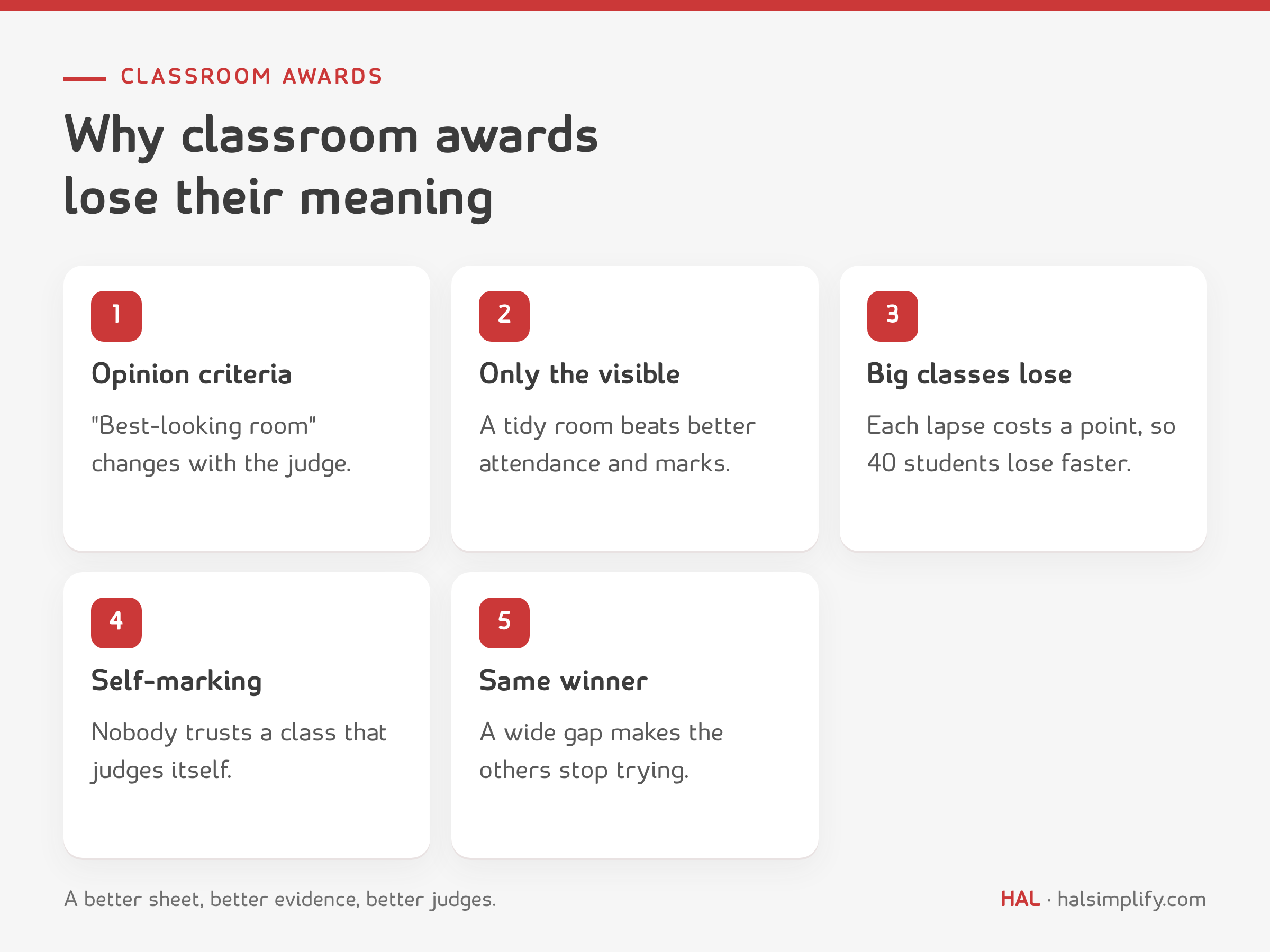
The fix is not a better shield. It is a better sheet, better evidence and better judges.
It is a monthly assessment sheet, one per compartment. Down the side, the classes of the compartment. Across the top, the categories your school chooses, each with a maximum number of points. At the end of the month the compartment head totals each class, the highest total is the best classroom, and the principal approves the result. The winning class holds the shield for the next month.
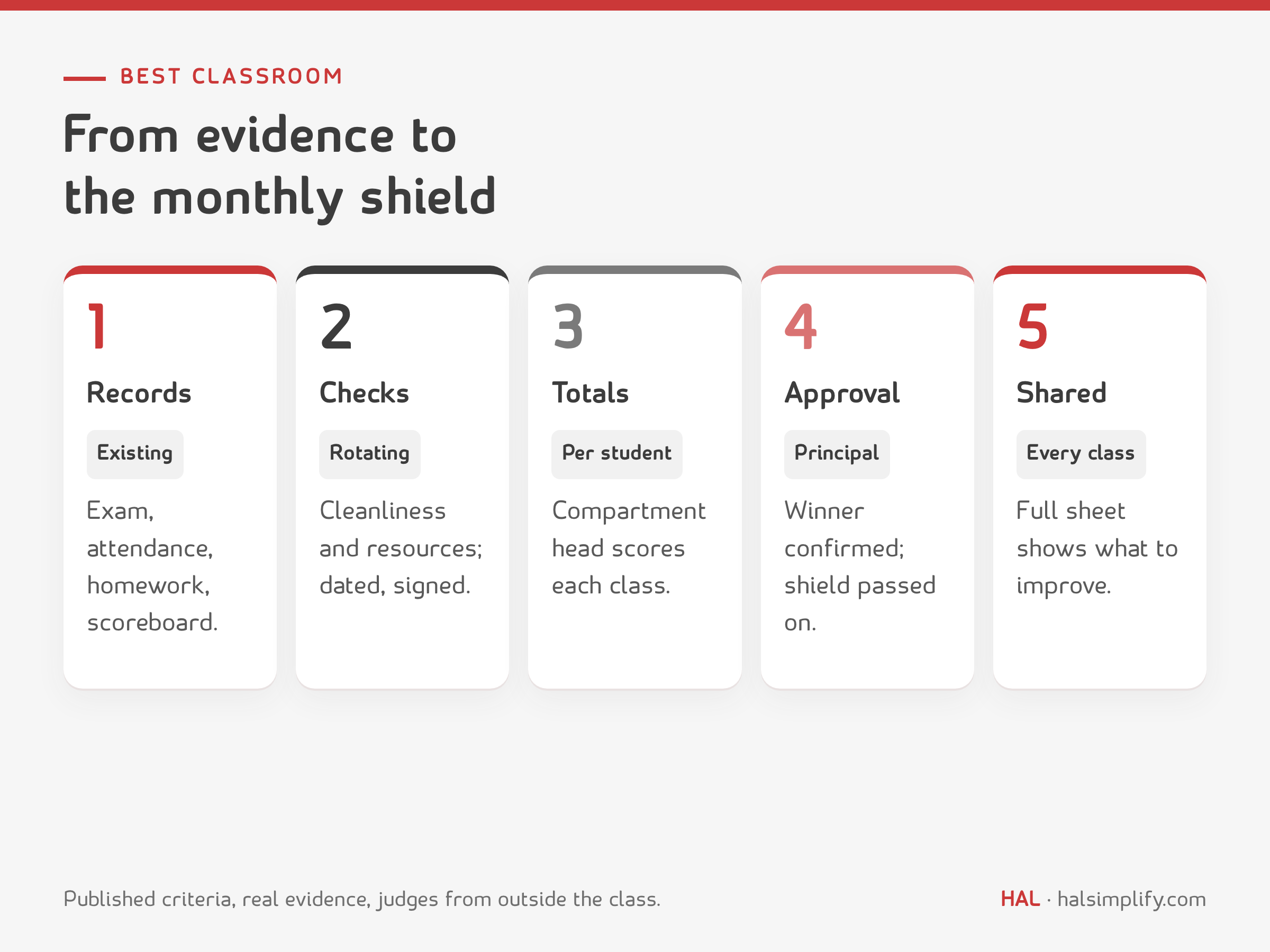
Each category is tied to evidence, so nobody has to guess. The categories below come from a shield sheet used in a school we worked with. They are a sample. Replace them with what your school wants to see.
| Category | Evidence | Who provides it |
|---|---|---|
| Academic performance | Failures, class average and the number of top scores in the month's exam, see exam analysis | Exam coordinator |
| Classroom cleanliness | Cobwebs removed, floor, desks and benches, lights and fans | Rotating checker, dated and signed |
| Attendance and punctuality | Full attendance, the class monthly average, late arrivals, late submission of notebooks and homework | Attendance register, homework register |
| Learning resources and interaction | A chart per subject on the current lesson, a model per lesson, no chorus answers, answering in order, students asking sensible questions | Rotating checker |
| Uniform and grooming | Uniform, haircut, nails, neat hair, pressed dress and polished shoes | Class scoreboard |
| Classroom discipline | Seating, sitting position, movement, quarrels, polite language | Class scoreboard |
| English communication | Use of English in class | Class scoreboard |
| Parents' attendance | Parents at school meetings, if your school tracks it | School meeting records |
Some schools add a category for values and routines that matter to them, such as prayer discipline. The categories, the maximum points for each and what earns them are settings your school defines.
The original sheet deducts a point for each lapse. It is simple, but a class of 40 loses points faster than a class of 20.
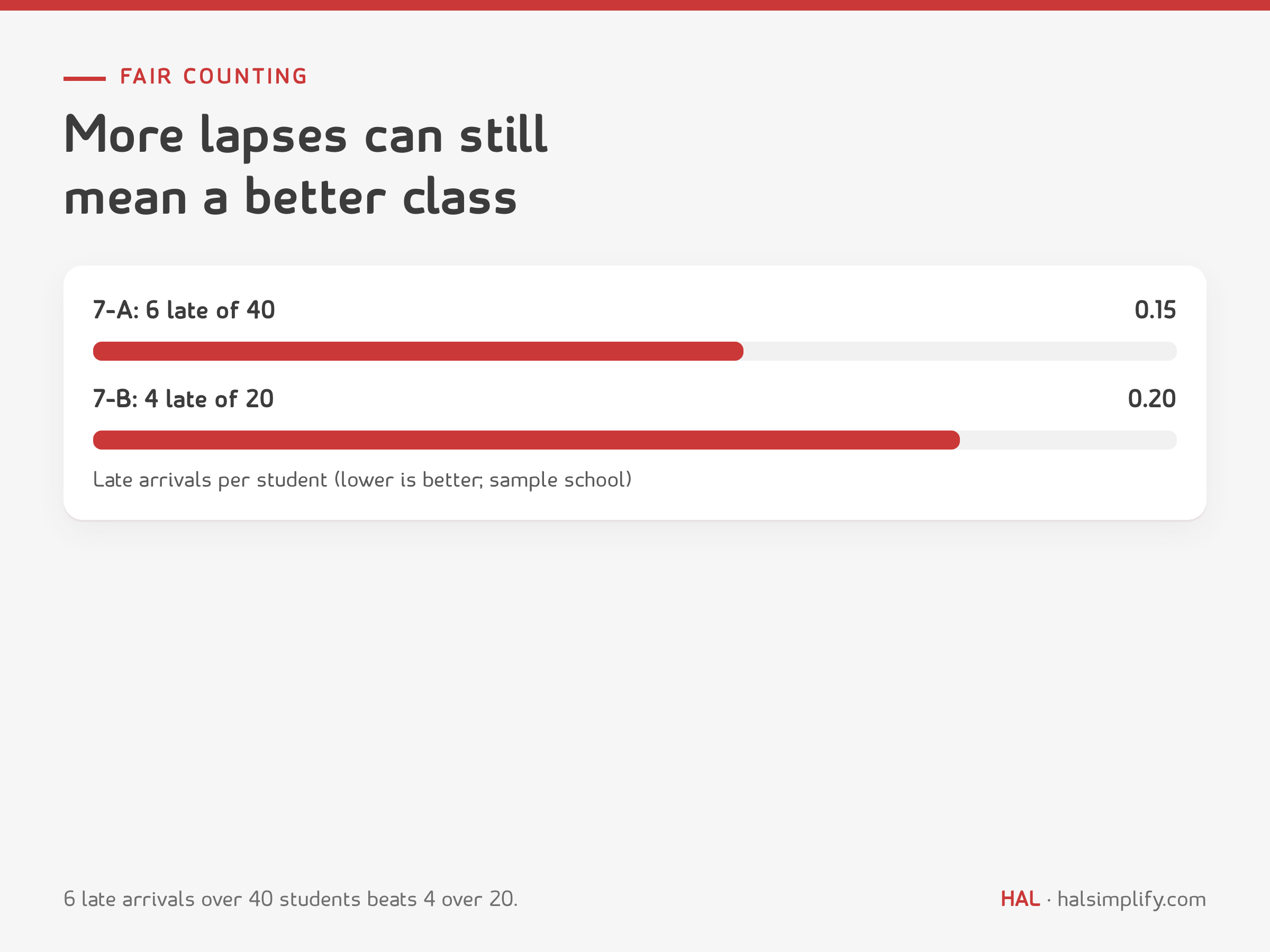
Work with a rate per student: lapses divided by the number of students. Class 7-A (40 students, 6 late arrivals) has a rate of 0.15. Class 7-B (20 students, 4 late arrivals) has a rate of 0.20. The raw count says 7-B is better. The rate says 7-A is. Convert the rate to points with one rule for every class, and put a floor under it so a category never goes below zero.
Two categories need someone to look at the room: cleanliness and learning resources and interaction. The rules below keep those checks credible.
Four categories (uniform, discipline, English communication, parents' attendance) are not scored again. They are read from the class scoreboard and the school's records, so the best classroom sheet adds no new work for teachers. That is the point: the scoreboard measures habits student by student, the best classroom sheet reads the same facts class by class.
Keep the recognition modest and public.
The sheet is shared with every class, with its own scores and the winner's. A class that finished second can see exactly what to improve.
The class leader receives the sheet with the class teacher, signs it, and brings the result to the class. The leader helps the class prepare for the month: who looks after the board, the desks, the charts and the models. The leader does not score any class, including their own.
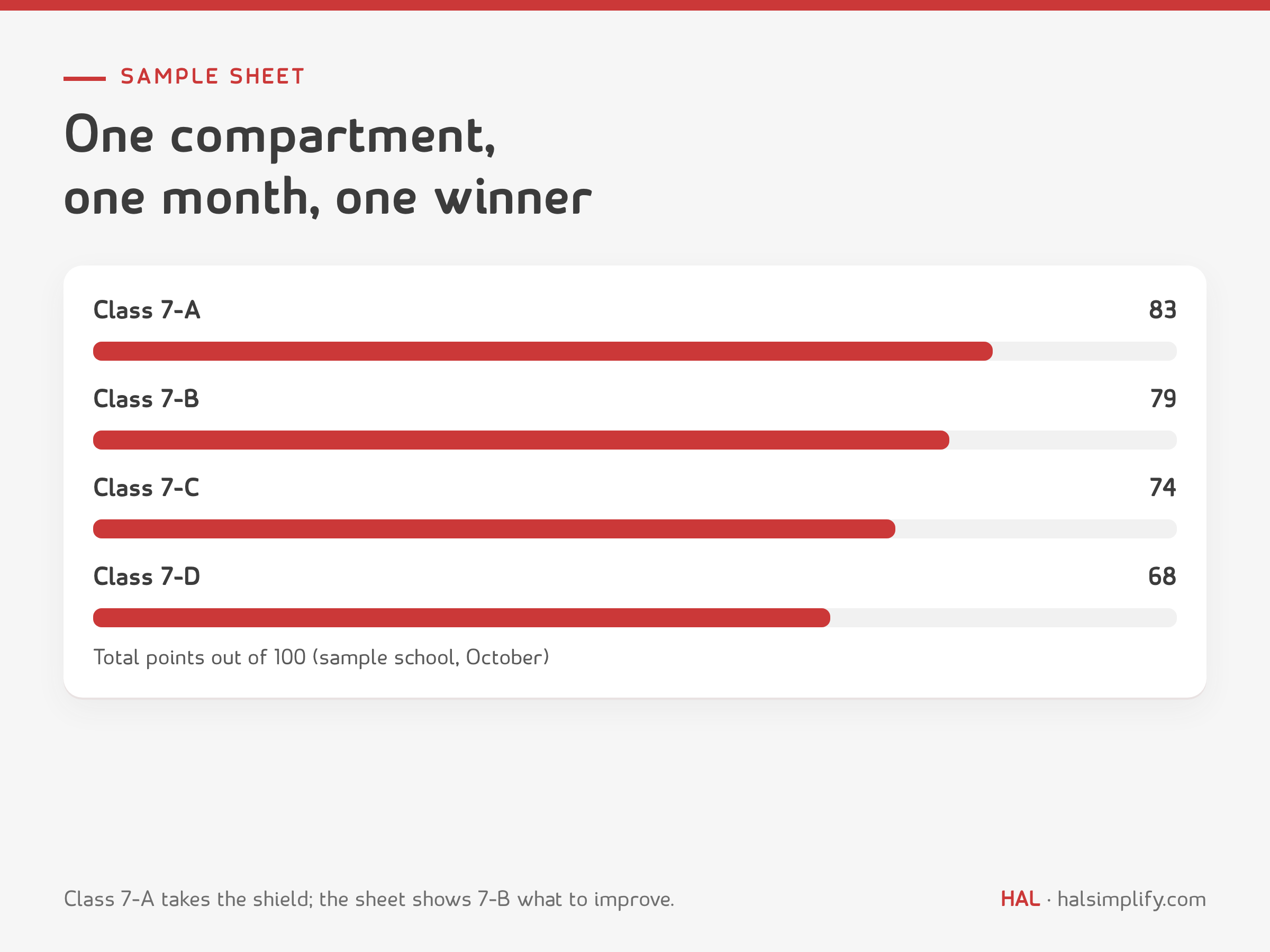
Take a made-up compartment with four classes at a sample school in October.
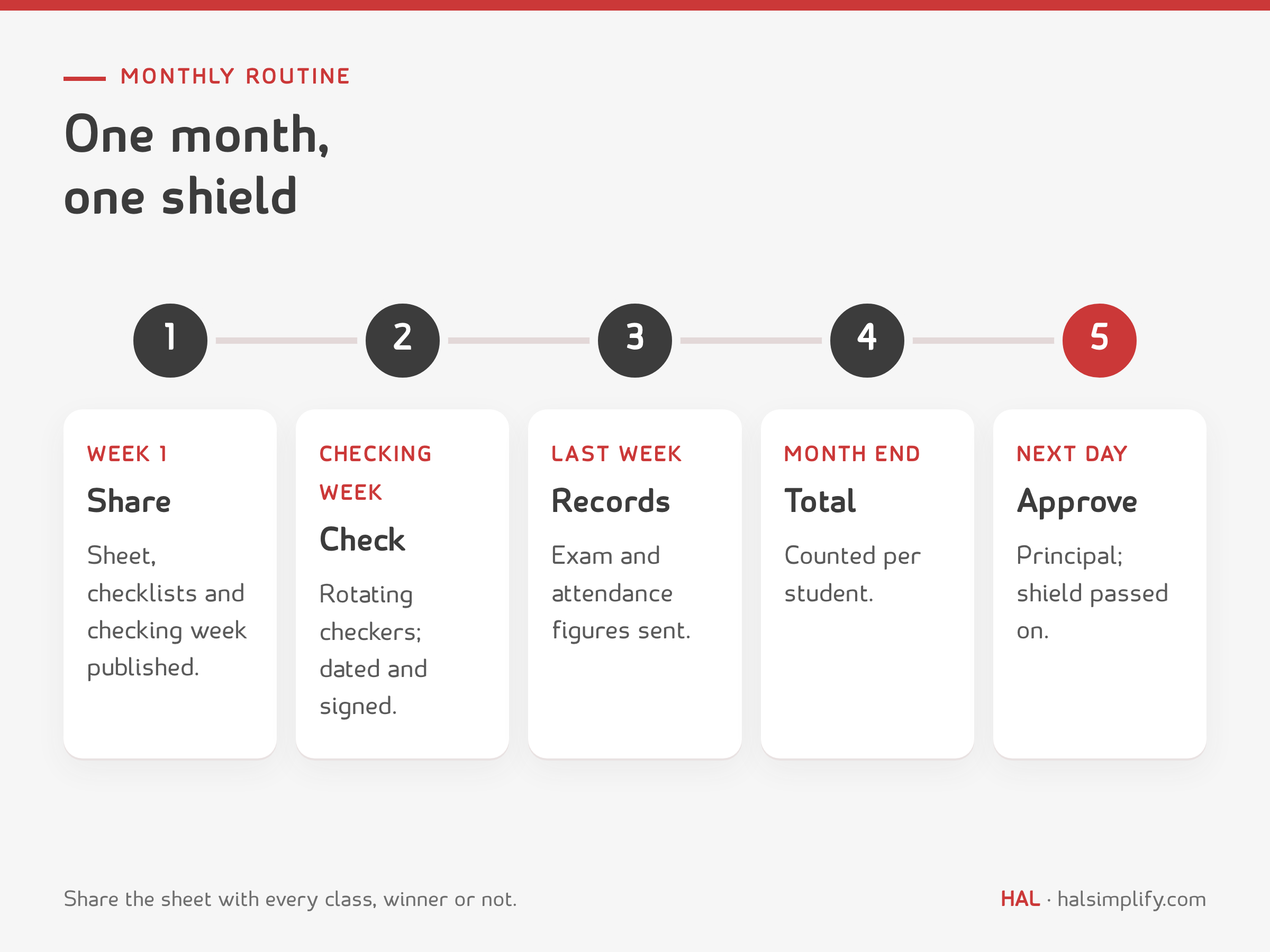
| When | Who | What |
|---|---|---|
| Week 1 | Compartment head | Share the sheet, the checklist and the checking week |
| Checking week | Rotating checkers | Check cleanliness and learning resources; date and sign |
| Last week | Exam coordinator, class teachers | Send the academic and attendance figures |
| Month end | Compartment head | Total each class on rates; mark the winner |
| Next day | Principal | Approve; shield passed on; sheet shared with every class |
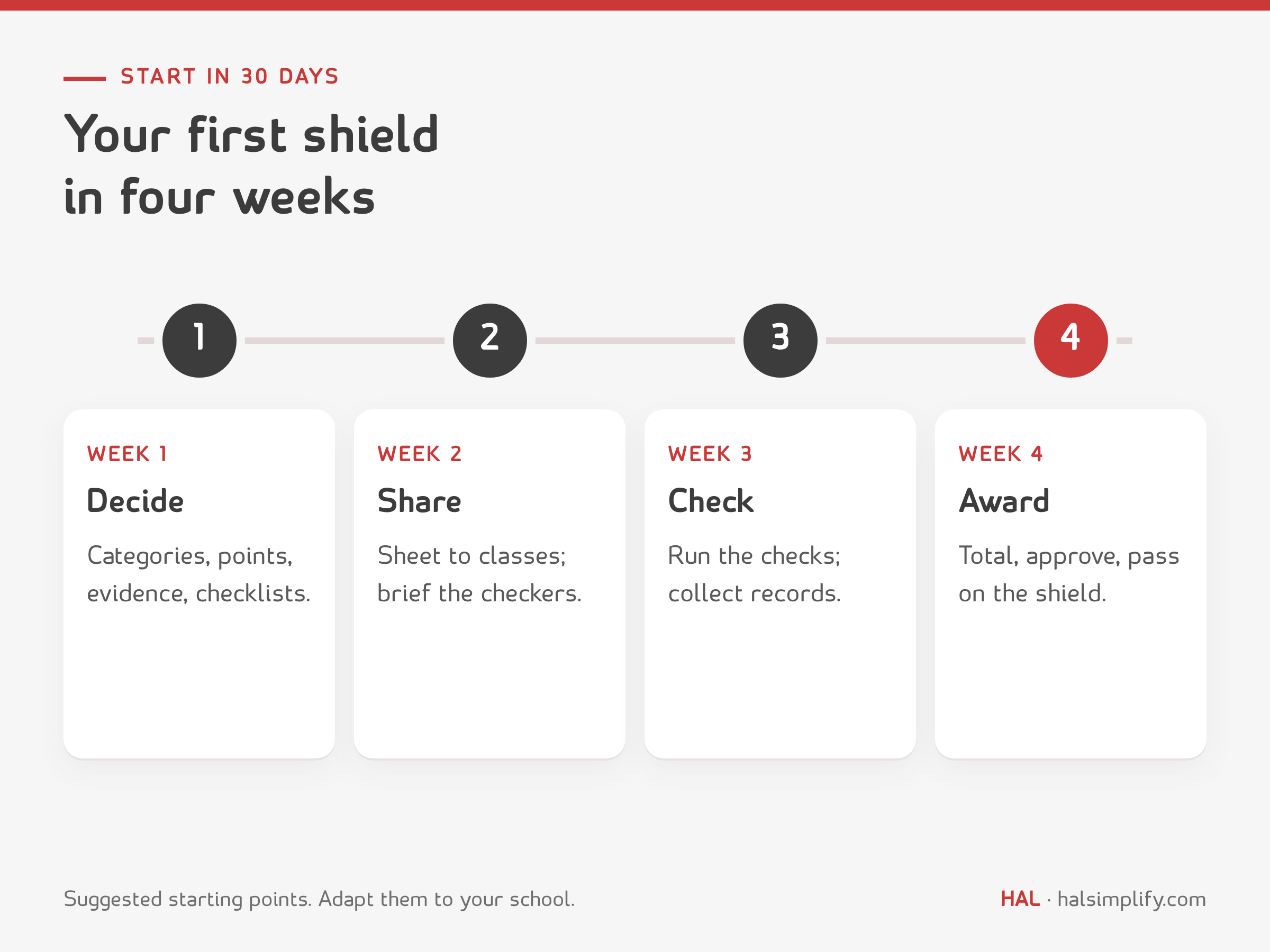
The kit has two files.
On paper, someone gathers figures from the exam sheet, the attendance register and the scoreboard before the shield can be awarded. In a system where those records already live together, the academic, attendance and scoreboard categories fill themselves and the compartment head only adds the physical checks.
HAL Edge, HAL's education management system, keeps academic routines, faculty performance and school data together, in Arabic and English.
Get the next routine in your inbox
One practical school routine a week, each with its free PDF guide and Excel tracker. Unsubscribe any time.
A monthly award for the class that scores highest on a published sheet covering categories such as academics, cleanliness, attendance and punctuality, learning resources, uniform and discipline.
Publish the criteria, tie every category to evidence, count lapses per student so class size does not matter, use rotating checkers from outside the class and share the full sheet with every class.
Observable items such as cobwebs removed, floor, desks and benches, and lights and fans, each rated perfect, average, poor or not done, with the checker's name and the date.
We suggest not. Recognition such as the shield, naming the class teacher and leader at assembly and a small shared privilege keeps the focus on the class, not the reward.
Yes. The categories, the maximum points, the evidence and the rules are settings the school defines. The kit includes a sample you can replace.
Yes. The kit is a free download: a PDF guide and an Excel workbook that scores each class from your own categories and ranks them.