
In short: A curriculum plan works when the whole school shares one calendar of weeks. Each week is labelled as a teaching, revision, exam or holiday week and shows its working days. Each teacher then places a topic against every teaching week of their subject, and marks it done, partly done or behind. The yearly plan sets the months, the monthly plan splits them into units, and the weekly plan becomes the note a teacher teaches from, the RISE note. A syllabus coverage tracker then shows, week by week, which class and subject is on track before the exam arrives. Below: why plans drift, the week calendar, the three plan levels, how to track coverage, a worked example and a free planner kit (PDF guide and Excel workbook).
It is the first week of December. The Grade 8 Science teacher has finished the chapter she planned for October. Two sections of Grade 8 Maths are six topics apart. The quarterly exam is in two weeks, and nobody can say, with a number, how much of the syllabus is left for each class.
None of these teachers is careless. Each one made a plan in August. But the plans were made alone, in different formats, against different ideas of how many teaching weeks there are, and nobody looked at them again until the exam paper was due. The free curriculum planner kit at the end gives you the calendar, the three plan levels and the tracker.
Five habits, in roughly this order.
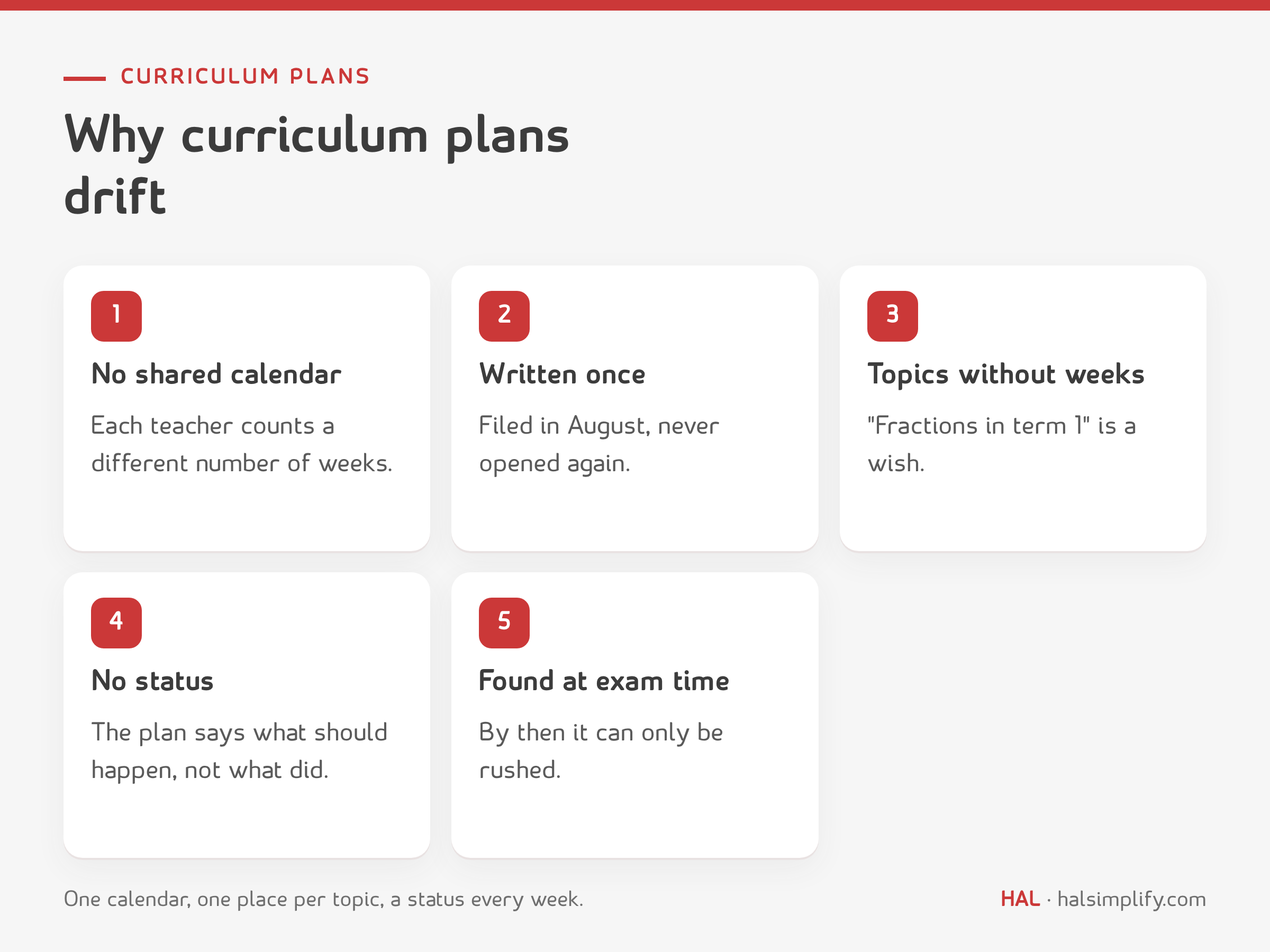
The fix is not a longer document. It is one calendar, one place per topic and a status every week.
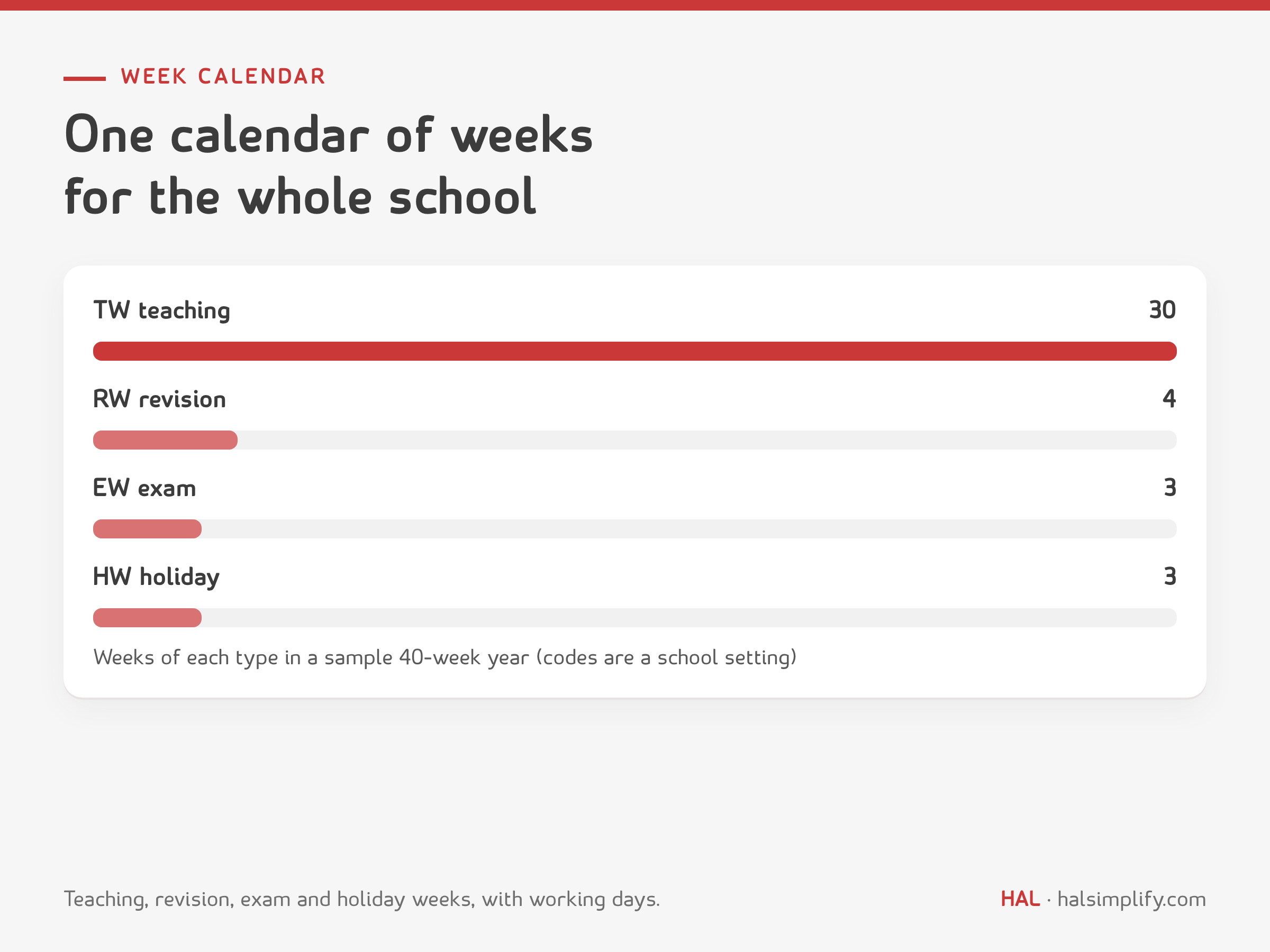
Start with the weeks, not the topics. Number every week of the academic year and label each one with a code. The school's academic calendar sets the codes. The codes below are a sample. Replace them with what your school uses.
| Code | Meaning | What it is for |
|---|---|---|
| TW | Teaching week | New content. Numbered in order: TW 1, TW 2, and so on |
| RW | Revision week | Revision of the portion covered before an exam |
| EW | Exam week | Unit tests and term exams |
| HW | Holiday week | Public holidays and school breaks |
Against each week, record the working days. A week after a public holiday may have four days, not five. Teachers see how many periods they really have, so the plan fits the year that will happen.
The calendar is built once a year by the vice principal or academic coordinator and shared with every teacher before anyone plans a topic. Everything else sits on top of it.
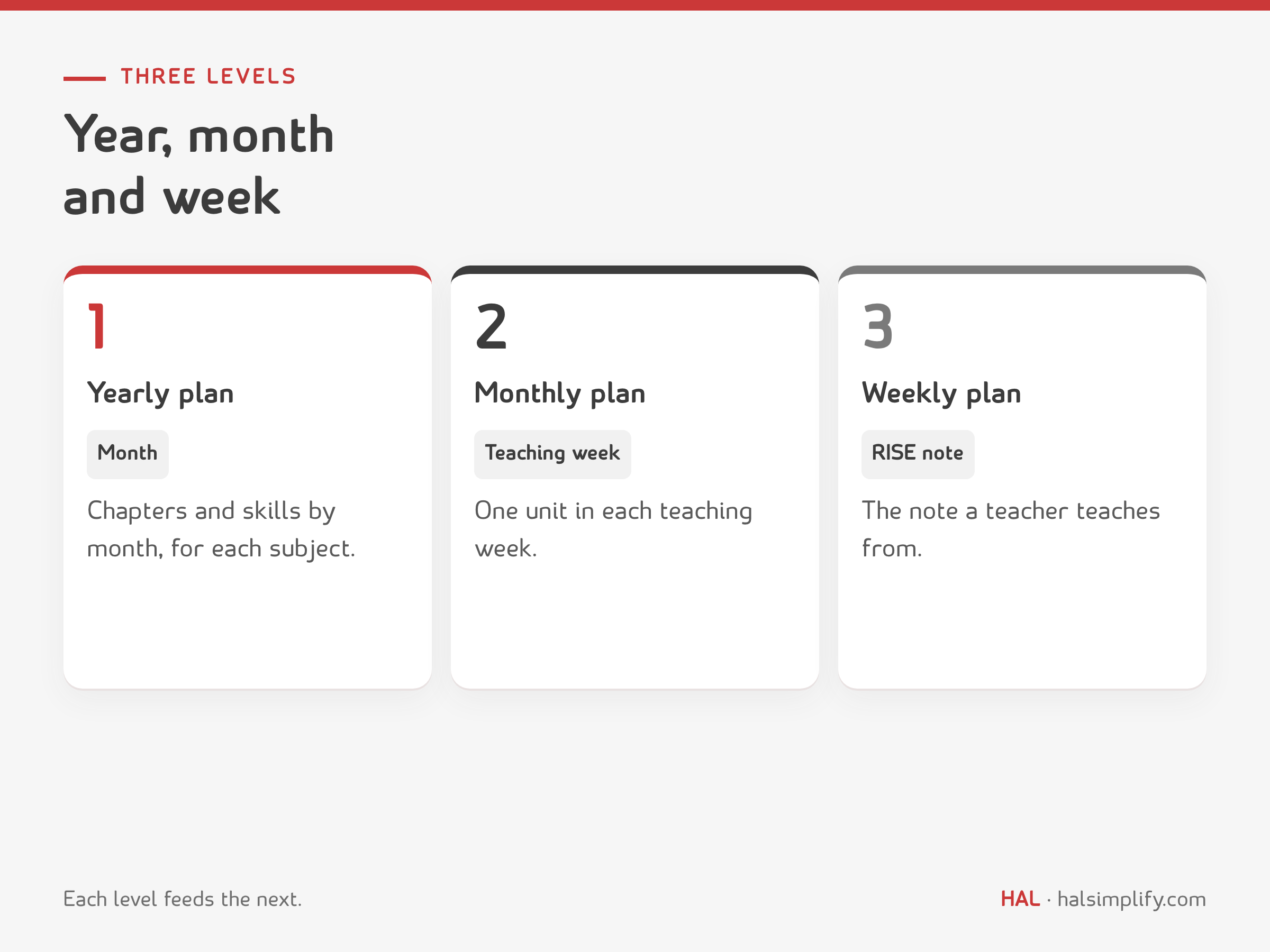
Each level answers a different question, and each one feeds the next.
| Level | Who writes it | The question it answers |
|---|---|---|
| Yearly plan | Head of department with the subject teachers | Which chapters or skills fall in which month? |
| Monthly plan | Subject teacher | Which unit falls in which teaching week of the month? |
| Weekly plan | Subject teacher, from the monthly plan | What will I teach in each period of this week? |
For early years the yearly plan can be a simple grid: months down the side, subjects across the top. For older classes it is a table by class and subject. The shape matters less than the rule: every topic lands in a month, then in a teaching week, then in a period.
The weekly plan is where the curriculum meets the classroom. For each period, the teacher writes the short note they will teach from: the objective, and the four steps of RISE. The plan does not stop on a shelf. It is the first thing the teacher uses each morning.
Many schools send parents a one-page weekly plan: what each subject will cover this week, and what practice at home helps. It is short, it comes straight from the weekly plan, and it costs the teacher almost nothing to produce. Parents see what the school is teaching. Students are less able to say "we did nothing". A school that shares the plan can answer a question about the syllabus with the page itself.
Planning is half the job. The other half is a status for every teaching week, filled in by the teacher on Thursday.
Give each status a value and you have a number. Done counts as 1, partly done as one half, behind as 0. The coverage of a class and subject is the topics done, divided by the topics planned up to this week. The school sets the line below which a subject is flagged, for example 90 per cent.
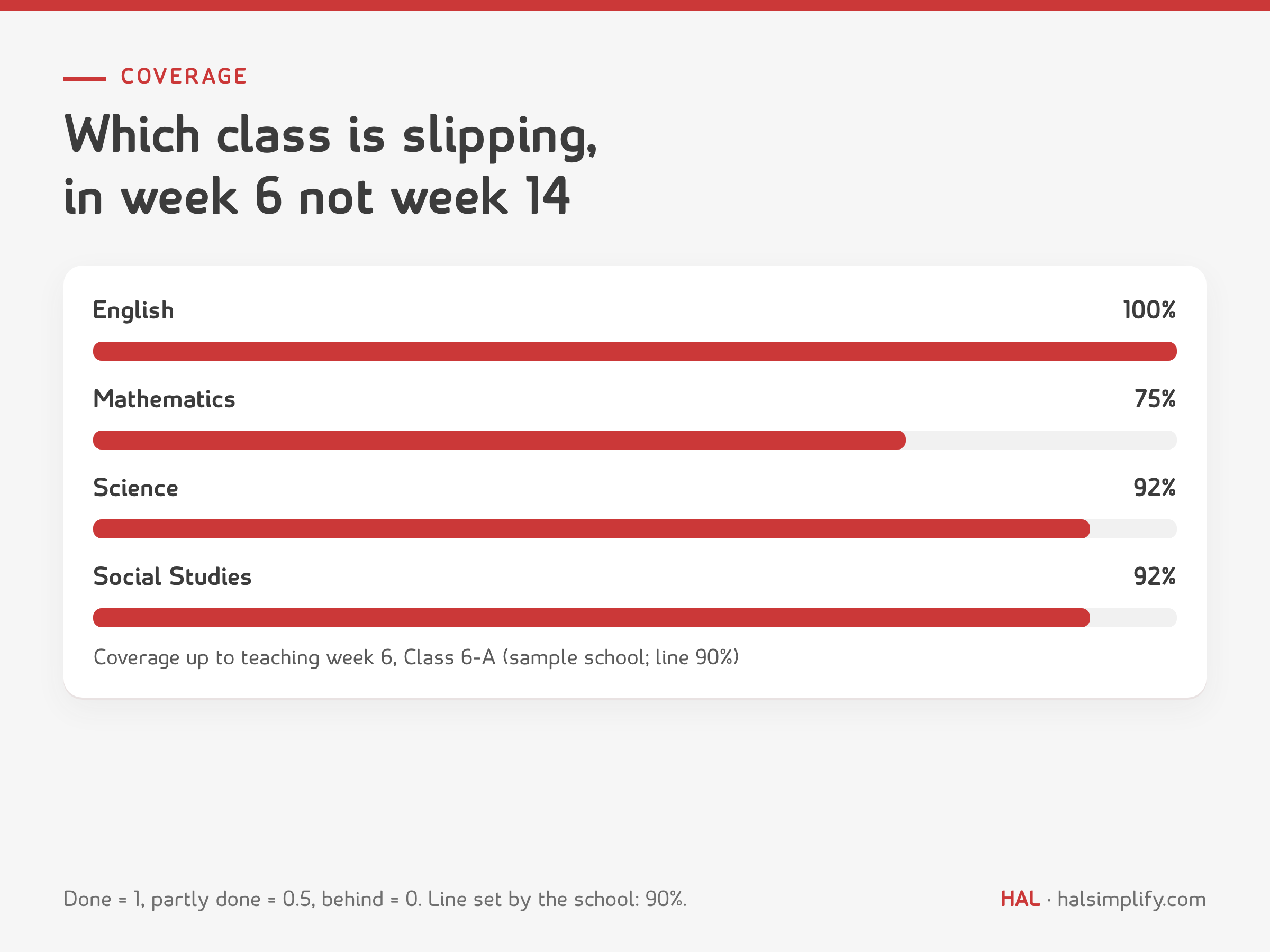
A flagged subject is not a failure. It is a question asked early: what happened, and what is the catch-up? Common answers are using a revision week, adding a period, moving a topic or dropping one with the head's approval.
Take a made-up Grade 6 Maths class at a sample school, in the first six teaching weeks of the year.
| When | Who | What |
|---|---|---|
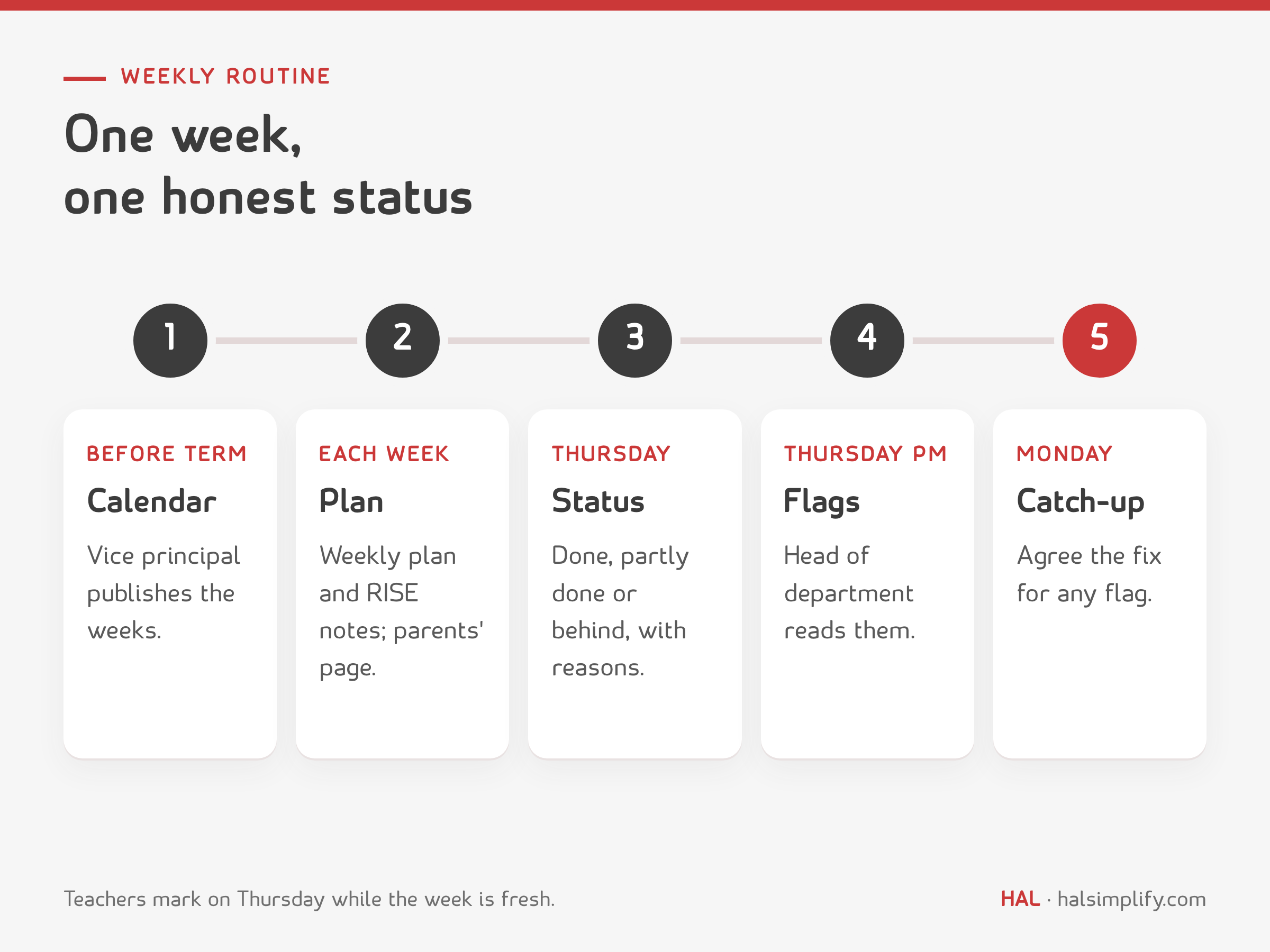
| Before term | Vice principal | Publish the week calendar |
| Start of year | Head of department, teachers | Agree the yearly plan; split into monthly plans |
| Each week | Subject teacher | Write the weekly plan and RISE notes; send the parents' page |
| Thursday | Subject teacher | Mark the status of the week |
| Thursday afternoon | Head of department | Read the flagged subjects and class sections |
| Monday | Head of department, teacher | Agree the catch-up for any flagged subject |
The kit has two files.
On paper, the calendar, the plans and the status are three files that someone has to bring together. In a system where the weekly plan, the lesson notes and the other academic registers live together, coverage can be read as it happens.
HAL Edge, HAL's education management system, keeps academic routines, faculty performance and school data together, in Arabic and English.
A plan that places each subject's topics against the weeks of the academic year. It usually has three levels: a yearly plan by month, a monthly plan by teaching week and a weekly plan by period.
For each subject, the months and the chapters or skills that fall in each, based on a calendar that has already taken out exam and holiday weeks.
Have each teacher mark every teaching week as done, partly done or behind. Count done as 1, partly done as one half and behind as 0, and divide by the topics planned up to that week.
The plan for one week of teaching: the topic or unit for the week, split into the periods, with a short teaching note for each. In our series that note is the RISE note.
We suggest it. A one-page weekly plan lets parents see what the school is teaching and how to help at home, and it comes straight from the teacher's weekly plan.
Yes. The codes, the number of weeks, the coverage line and the status rules are settings the school defines. The kit includes a sample you can replace.
Yes. The kit is a free download: a PDF guide and an Excel workbook that tracks coverage by class and subject from your own calendar.
Get the next routine in your inbox
One practical school routine a week, each with its free PDF guide and Excel tracker. Unsubscribe any time.