School events: plan, run and review every event like a project
Published By
Umar Shariff
Education
Nov 13, 2026
About the author: Umar Shariff has run a school and redesigned the process flow across all of its departments, turning it into a model school. As a school process consultant, he has helped schools in India and Saudi Arabia write the process guidelines that make them quality learning institutions. He is passionate about teaching and still teaches today.
In short:School events work when each one is run as a small project in three stages. Plan: a one-page proposal with the purpose, the date, the skill the event builds, who takes part and a budget. Run: a ready-runner task list with an owner and a deadline for every task, a duty roster, and judging criteria published before the day. Review: results, cost against budget, who took part and a list of next actions. Across the year, balance the events by the skill each one develops, and make sure every student takes part in at least one. Below: why events go wrong, the three stages, a skill-balanced year, how to judge a competition fairly, an annual day example and a free events planner kit (PDF guide and Excel workbook).
It is the Tuesday before annual day. The programme has changed twice. Nobody is sure who has the prize list, two teachers think they are in charge of the stage, and the judges for the afternoon's competition have just been told, for the first time, what they will be judging. On Thursday the day goes well, because the staff are good at improvising. On Friday nobody records what it cost, who took part or what to change next year. In March, the same dozen students are on stage again.
Events are some of the best days in a school year. They give students a place to show what they can do and give parents a reason to visit. They go better when they are planned like any other piece of work, and they can be better still when every one of them ends with a short review. The free school events planner kit at the end gives you the proposal, the task list, the judging sheet and the review.
Why do school events go wrong?
Five habits, in roughly this order.
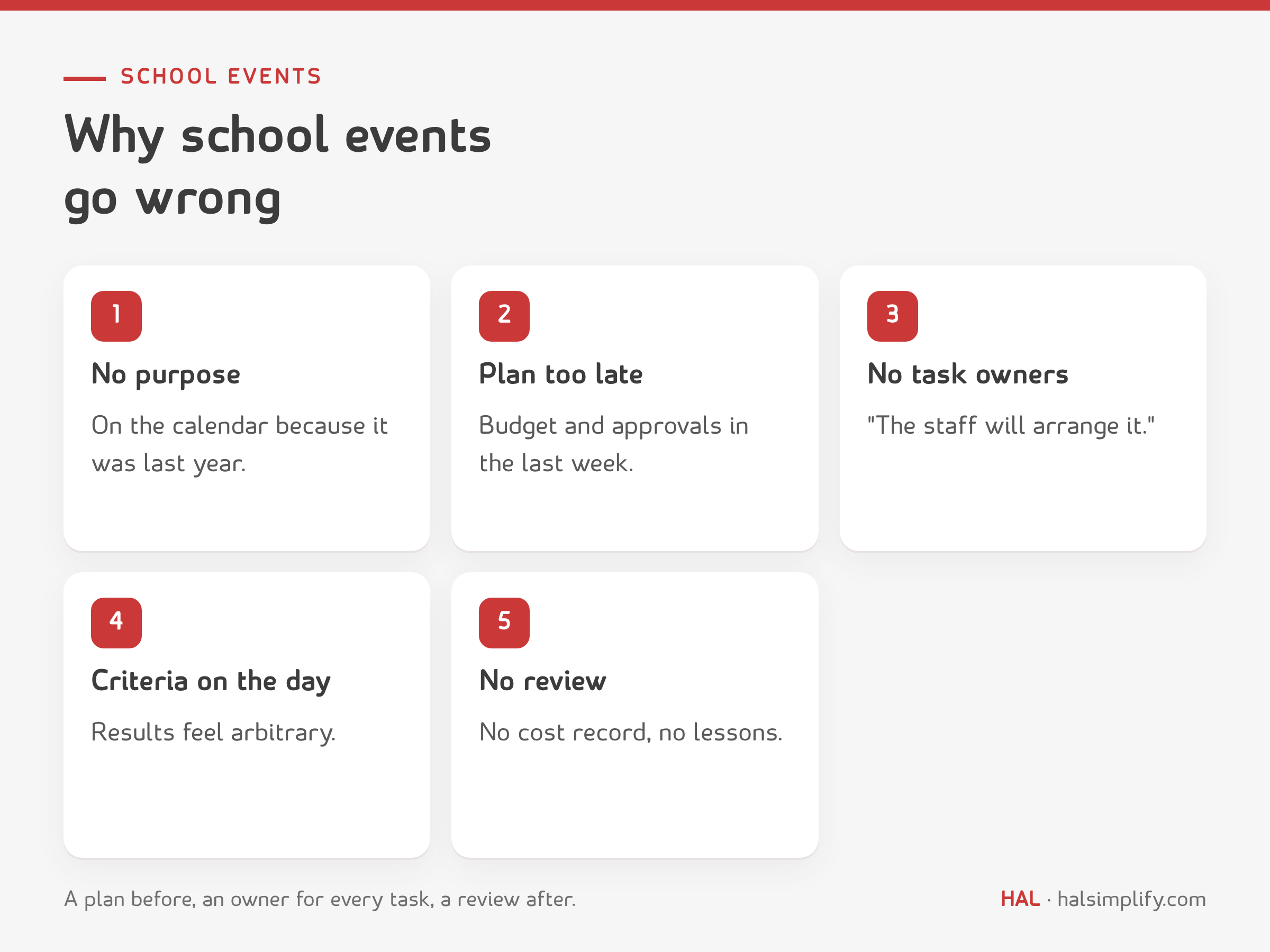
Five reasons school events go wrong
No purpose. The event is on the calendar because it was last year, and nobody can say what it is meant to build in the students.
The plan comes too late. The proposal, the budget and the approvals arrive in the last week, so everything is rushed.
Tasks without owners. "The staff will arrange it" means nobody has.
Criteria are invented on the day. Judges and students learn the rules together, so results feel arbitrary.
There is no review. Costs, participation and lessons are not recorded, so next year starts from scratch.
The fix is not more effort on the day. It is a plan before, an owner for every task and a review after.
The three stages of an event
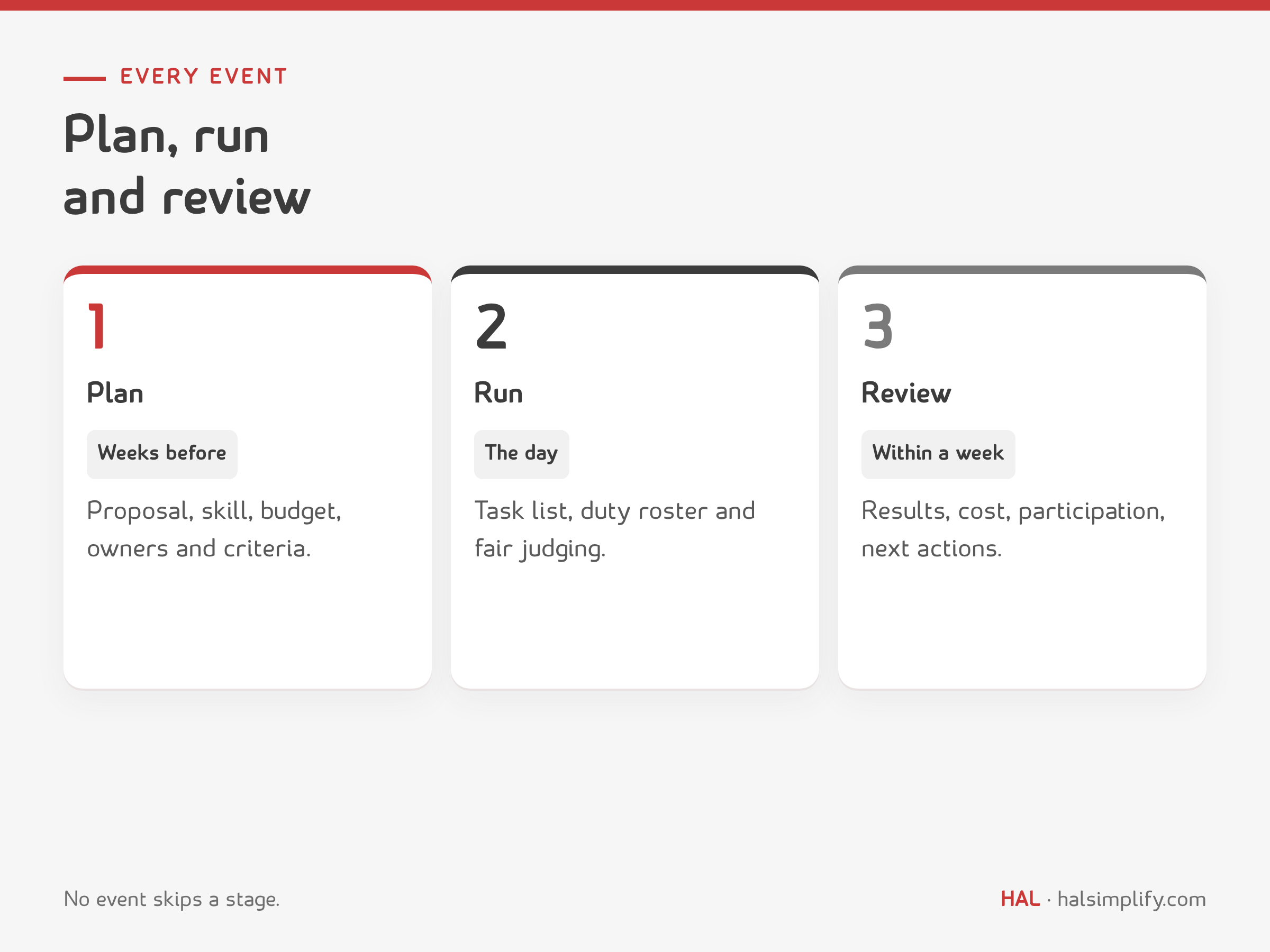
Every event, whether it is a drawing competition, a sports week or the annual day, moves through the same three stages.
Plan, run and review
Stage
When
What happens
Who owns it
Plan
Weeks before
Proposal approved; date, budget, participants and criteria set; tasks listed with owners
Event coordinator, principal
Run
In the last week and on the day
Task list worked through; duty roster followed; judging done to the published criteria; results and prizes recorded
Event coordinator, task owners
Review
Within a week after
Results, cost against budget and participation recorded; feedback gathered; next actions agreed
Event coordinator, principal
The stages, the headings and the people are settings your school defines. What matters is that no event skips a stage.
School event planning: a one-page event proposal
The proposal is the event's charter. Keep it to one page, written by the person who will coordinate the event and approved before anything is spent.
Name and date. Check the date against the year's calendar, the exam weeks and the holidays. See the curriculum plan for how to label the weeks of the year.
Purpose. What the event is for, in one sentence.
Skill it develops. One of the skill areas your school has chosen, such as language, physical, life skills, arts and academics, or values and character.
Who takes part. Classes or houses, and how students are chosen or invited.
Budget. Each cost line, with the amount planned. Add a small contingency.
Coordinator and approver. One named person and one named approver.
A proposal takes twenty minutes to write. It saves the week before the event.
Balance the year by skill
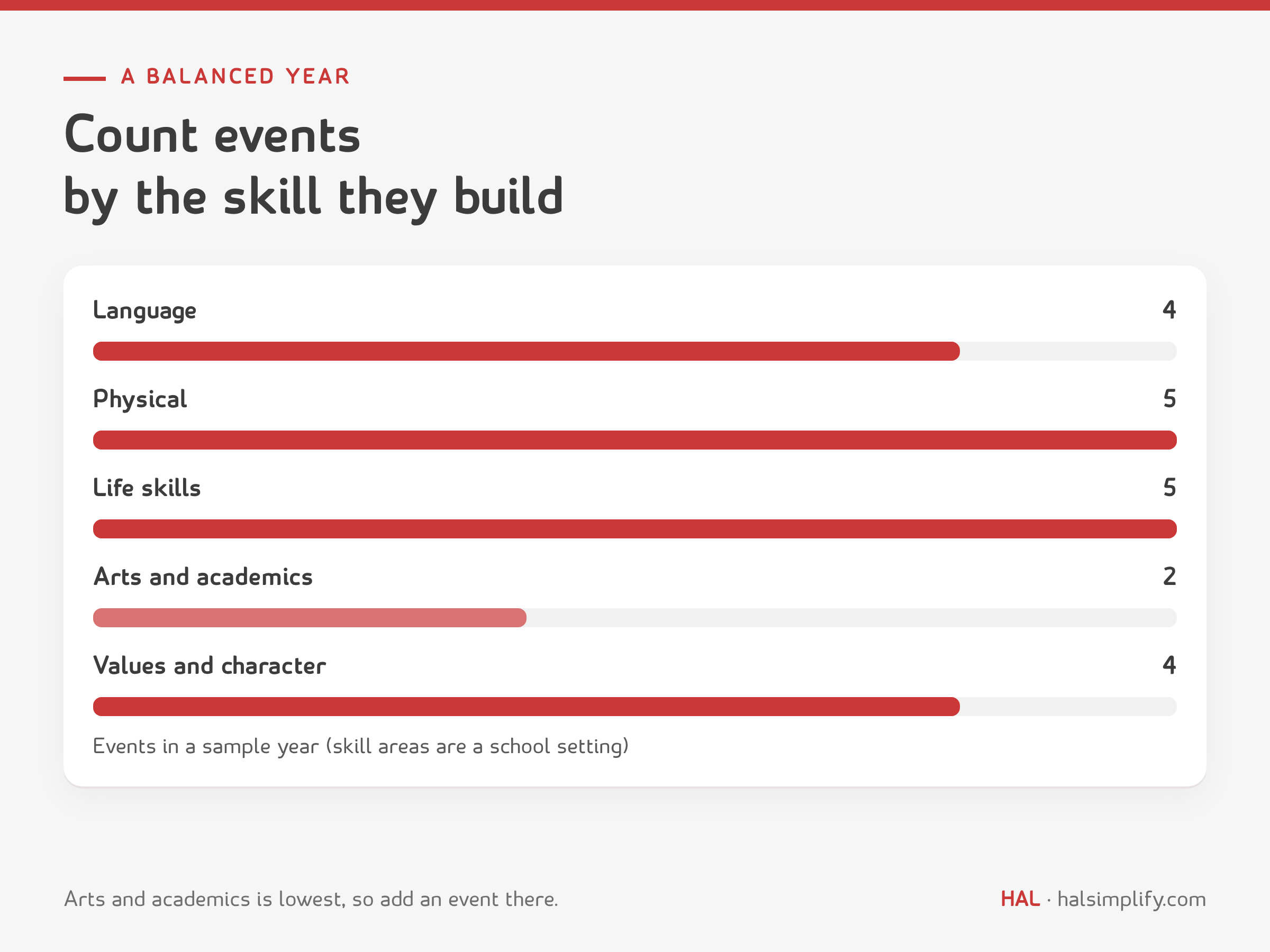
A school with ten events a year can easily hold six of one kind. Give each event a skill code and count them across the year. The skill areas below are a sample from a school's yearly events calendar. Choose your own.
Events by skill code across a sample year
A count like this shows the gap at once. In the sample year, arts and academic events are the fewest, so the coordinator adds one. Then check the year's calendar against the exam weeks, the parent meetings and the holidays, and spread the events so that no month carries them all.
Make sure every student takes part
A school can run excellent events and still leave some students out. Keep a participation register: each student, each event they joined. At mid-year, look for students with none, and invite them to something that suits them. The aim is that every student takes part in at least one event a year, and ideally in one of each skill area over a few years. A quiet student who joins a drawing competition has taken a first step.
Event planning checklist for schools: the ready-runner, the roster and the criteria
Running an event well comes down to three documents.
A ready-runner task list. Every task, who owns it, the deadline and its status. Split it into before the event (book the venue, print certificates, brief the judges), on the day (set up, welcome, run the schedule, clear up) and after (thank-yous, results, accounts). It is a list anyone can pick up and see what is late.
A duty roster. Who is where, at what time, with a named back-up.
Published criteria for any competition, shared with students and judges before the day.
School competition judging criteria: how do you judge fairly?
Most arguments about results come from criteria that nobody agreed in advance. A fair judging sheet has five parts.
A published judging sheet
Criteria and points. Three to five criteria, each with a maximum, adding to a round total. The sample above is for a drawing competition. Your school sets its own.
Published before the day. Students and judges see the same sheet.
Two judges, scoring alone. Each marks independently, and the scores are averaged.
A tie-break. Decide the rule in advance, such as the higher score on the first criterion.
A result sheet and a prize list. The scores, the ranking and the prizes are recorded and shared, so every student can see how the result was reached.
Review: results, cost and next actions
The review is the shortest stage and the one most schools skip. Within a week of the event, the coordinator records:
Results and prizes. Who won, and the scores that decided it.
Cost against budget. Planned, actual and the difference for each line.
Participation. How many students took part, by class and by house, and any who took part for the first time.
What went well and what to change. Three of each, from staff, students and, where it fits, parents.
Next actions. Action, owner and deadline, carried into next year's proposal.
A 30-day start for school events
Annual day planning: a worked example
Take a made-up annual day at a sample school, planned eight weeks ahead.
Proposal (week 8 before). Purpose: show every class's work to parents. Skill: arts and academics. Participants: every class. Budget: SAR 8,000 including a 10 per cent contingency. Coordinator: one teacher. Approver: the principal.
Check the calendar (week 7). The date sits clear of the exam weeks and the parent meetings.
Task list (week 6). Forty tasks, each with an owner and a deadline: programme, stage, sound, certificates, invitations, refreshments, first aid.
Duty roster (week 3). Who is at the gate, the stage, the classes and the car park, with a back-up for each.
Programme and criteria (week 3). The running order is fixed. Any item that is judged has its criteria shared with the classes.
On the day. The coordinator works from the task list, and the duty roster is on every teacher's phone or clipboard.
Results and prize list (that day). The prize list is checked against the result sheets before the awards.
Review (week 1 after). Actual cost SAR 8,650, which is SAR 650 over, with the difference explained in the sound and refreshment lines. Four hundred and twelve of 420 students took part. Three things to change are agreed and become next year's first actions.
Start in 30 days
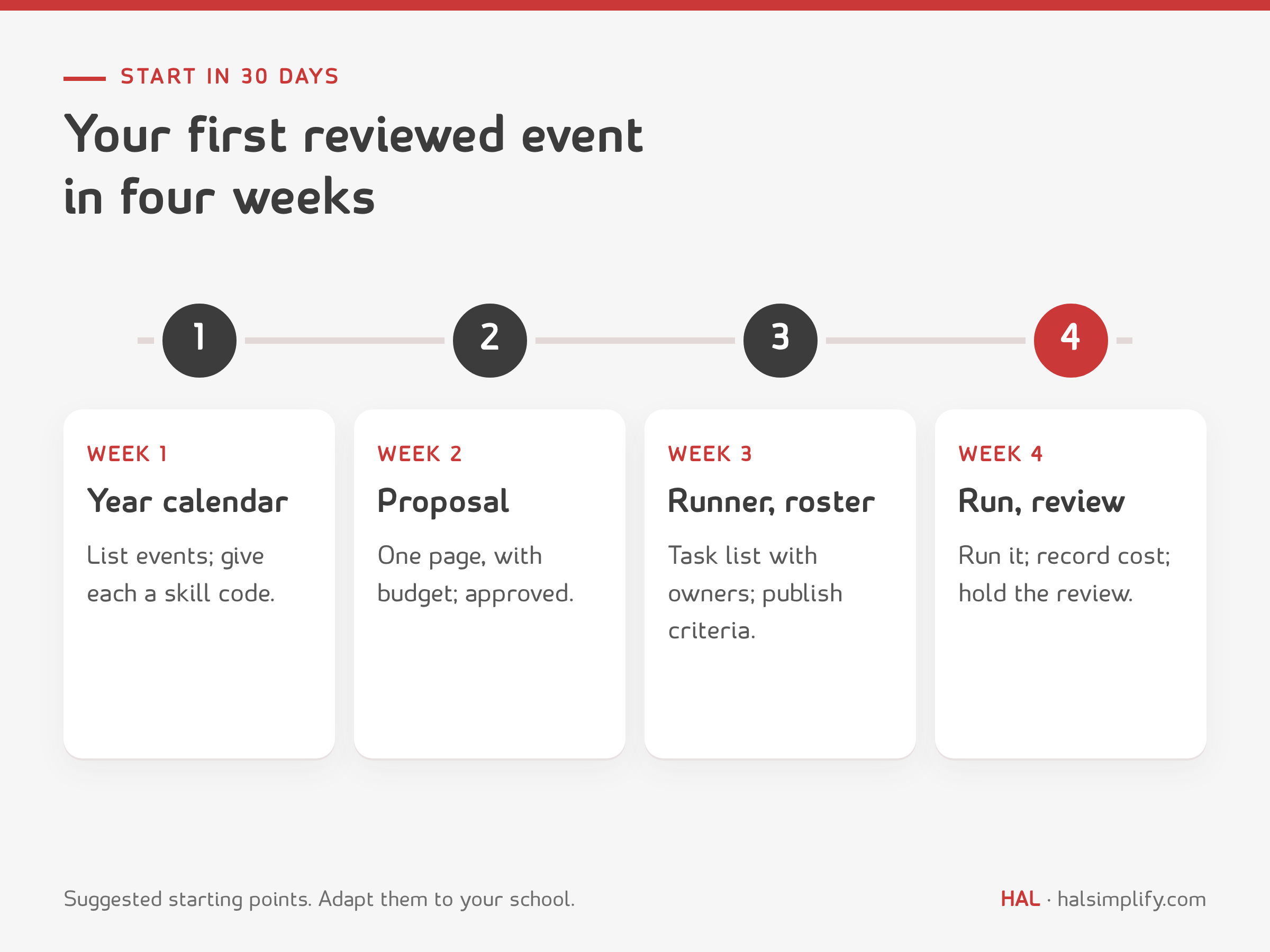
Week 1: list the year's events, give each a skill code and count them. Add or move events to fill the gaps.
Week 2: the coordinator writes the one-page proposal for the next event and gets it approved.
Week 3: build the ready-runner task list and the duty roster. Publish any judging criteria.
Week 4: run the event, record the results and cost, and hold the review.
Download the free school events planner kit
The kit has two files.
A PDF guide with the three stages, the one-page proposal, the ready-runner task list, the duty roster, the judging and result sheets, the review form, a worked example and blank pages to print.
An Excel workbook where you set your own skill areas, list the year's events with a skill code and a balance check, plan each event's budget against actual cost, keep a task list with owners, record judges' scores and results, track which students have taken part and run the post-event review. The sample events, students and figures are only an example. Replace them with your own.
When events live with the registers
On paper, the calendar, the task lists and the participation register are separate files that someone has to bring together. HAL Edge, HAL's education management system, keeps academic routines, faculty performance and school data together, in Arabic and English.
Frequently asked questions
What are school events for?
They let students show what they can do, build skills such as language, teamwork and confidence, and give parents a reason to visit. A good event also gives the school a record of what it cost and what students gained.
How do you plan a school event?
Write a one-page proposal first: purpose, date, skill it develops, who takes part and a budget. Then list the tasks with owners and deadlines, make a duty roster, publish any judging criteria and review the event within a week afterwards.
What should an event planning checklist for schools include?
Every task with its owner, deadline and status, split into before the event, on the day and after the event, together with a duty roster that names a back-up for each post.
How do you judge a school competition fairly?
Publish three to five criteria with their points before the day, use two judges who score alone, agree a tie-break in advance and share the result sheet and prize list.
How do you plan an annual day?
Start about eight weeks ahead with a proposal and a budget, check the date against the exam weeks and parent meetings, list the tasks with owners, prepare a duty roster and a running order, and review the cost and participation afterwards.
Should every student take part in an event?
We suggest so. A participation register shows who has taken part, so the school can invite the students who have not, ideally to an event that suits them.
Is the school events planner kit free?
Yes. The kit is a free download: a PDF guide and an Excel workbook with the proposal, task list, judging sheet, participation register and review.
Get the next routine in your inbox
One practical school routine a week, each with its free PDF guide and Excel tracker. Unsubscribe any time.