
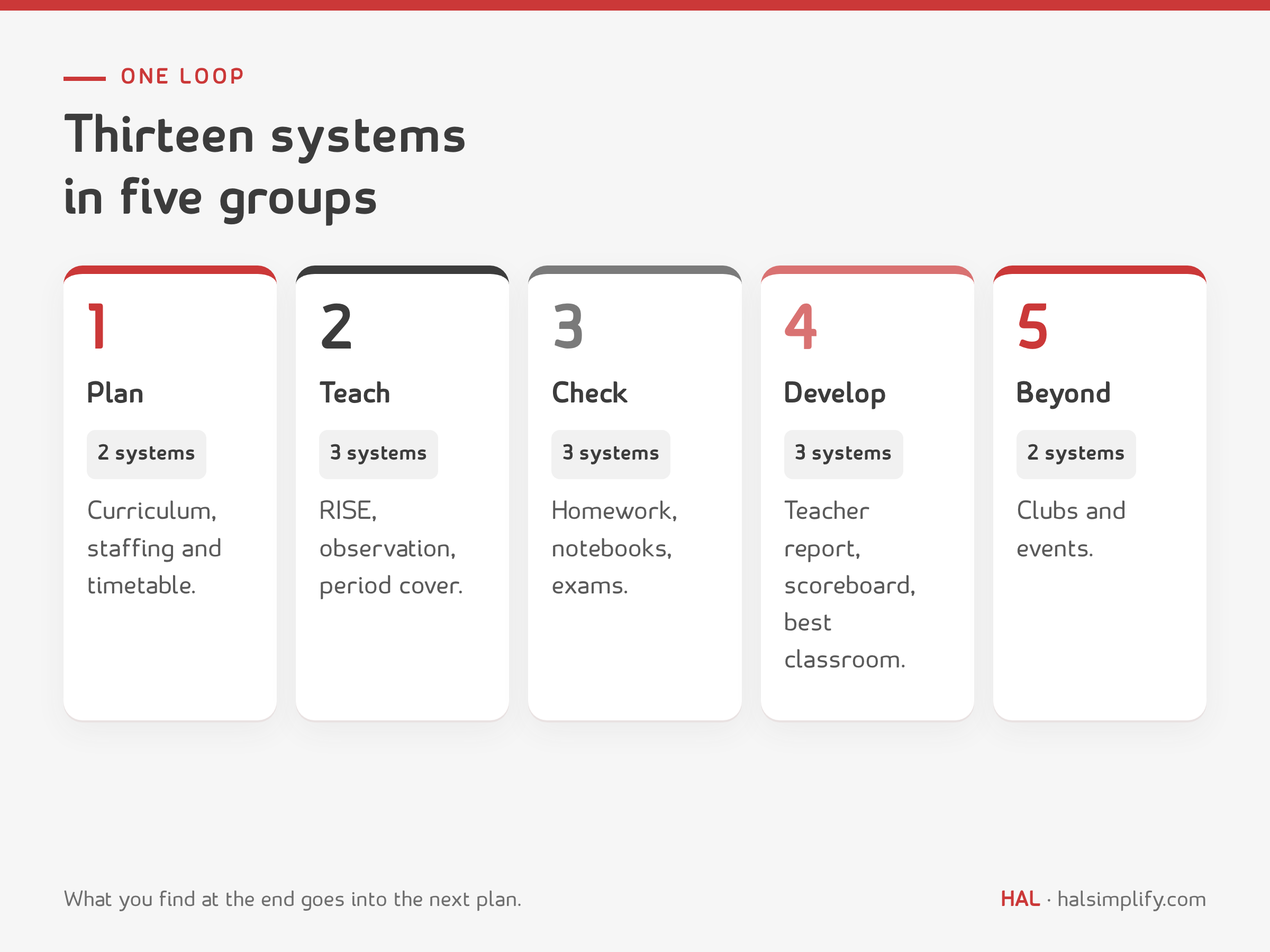
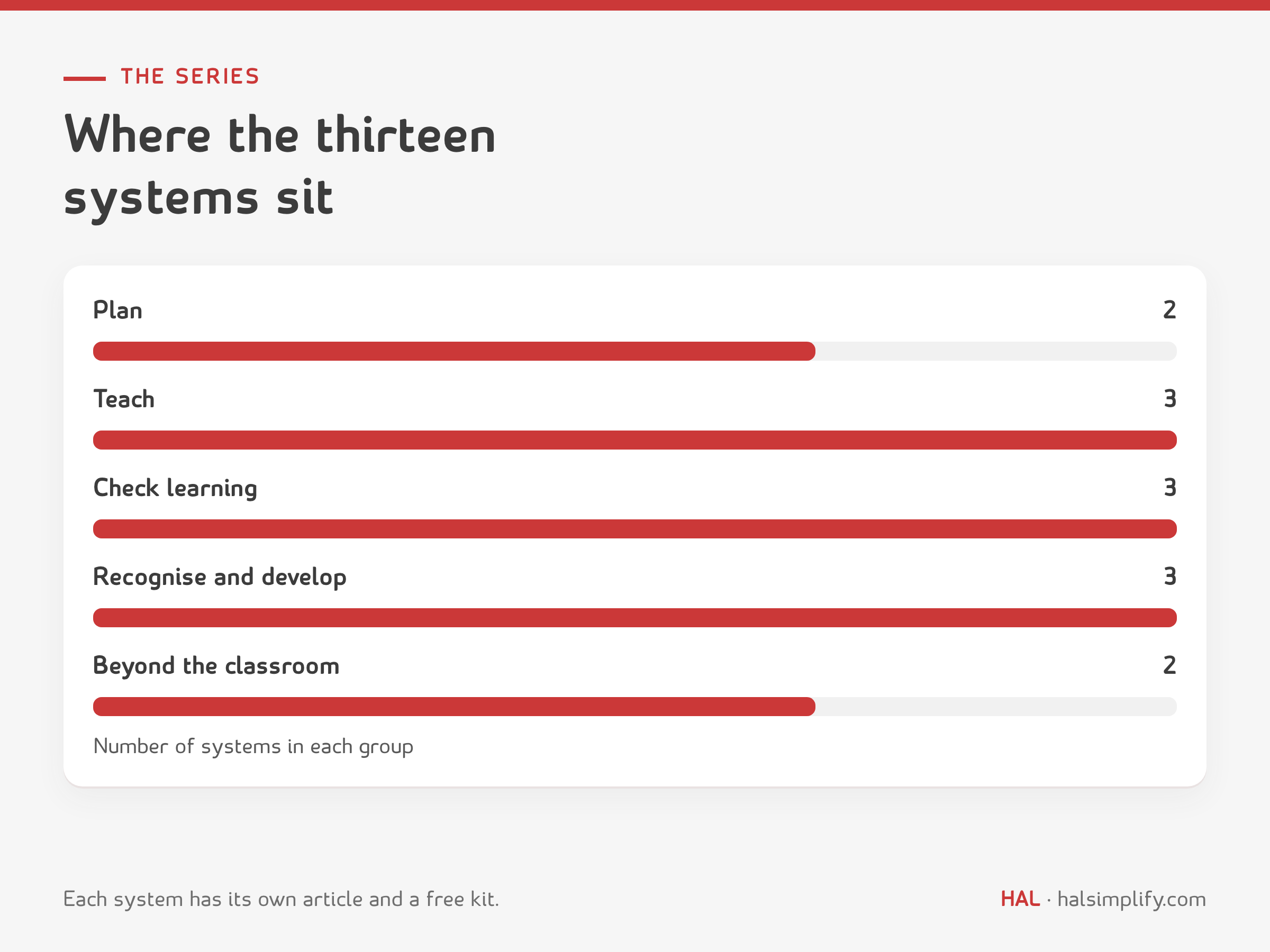
In short: School quality improvement is not one big project. It is a small number of routines that run every week and every month, each with an owner, a record and a review. This series describes thirteen of them in five groups: plan (curriculum and staffing), teach (lesson plan, observation, period cover), check learning (homework, notebooks, exams), recognise and develop (teacher report, class scoreboard, best classroom) and beyond the classroom (clubs, events). Each system has a free kit, a PDF guide and an Excel workbook. Below: how the thirteen fit into one loop, what each does, who owns it, and how to start with three of them in thirty days.
A new principal walks into her school in August. The teachers are committed and the parents are friendly, and she asks a simple question: how do we know that what we plan is what happens in class? The answers come from memory. The coordinator remembers the lessons she saw. The supervisor remembers who was absent. The exam results sit in a file, and the clubs list was last updated in September.
Nothing here is a failure of effort. Schools run on people who care, and caring people improvise well. The trouble comes when a school grows. What one person could keep in their head needs a record that three people can read, and a routine that continues when someone is on leave.
This page is the map. Every system below has its own article, and every article ends with a free kit you can use on Monday. Read them in order, or start with the one that hurts most.
A school improvement plan usually names goals: better results, better attendance, happier parents. Systems are what make the goals happen. Across all thirteen, the same five parts repeat, and they are a good test of any routine in your school.

Each article describes a suggested starting point. Rubrics, bands, free-period counts, club names and event types are settings that each school decides. Take what fits, change what does not.
School quality assurance works best as a loop. You plan the year, teach to the plan, check what students learned, recognise and develop the people involved, and then use what you found to plan the next term. The five groups below follow that order.
| Group | Systems | The question it answers |
|---|---|---|
| 1. Plan | Curriculum plan, staffing and timetable | Do we know what to teach each week, and have we the people for it? |
| 2. Teach | RISE lesson plan, lesson observation, period cover | Does the plan reach the classroom, and is every period taught? |
| 3. Check learning | Homework register, notebook checking, exam analysis | What did students learn, and who needs help? |
| 4. Recognise and develop | Monthly teacher report, class scoreboard, best classroom | Do teachers and classes see their progress, fairly? |
| 5. Beyond the classroom | School clubs, school events | Does every student explore an interest and take part? |
Curriculum plan: from the year to the month to the week. One school calendar of weeks, labelled teaching, revision, exam or holiday. Each teacher places a topic against every teaching week, and a coverage tracker shows which class is on track long before the exam. Owner: the academic coordinator, with each subject teacher. Kit: the curriculum planner kit.
School staffing and timetable planning. Start with periods, not people. Add up the periods each subject needs, divide by what one teacher teaches, and subtract the teachers you have. The result is your vacancy by subject and compartment, and it also sets a sample free-period ladder by role. Owner: the principal and vice principal. Kit: the staffing and timetable planner kit.
The RISE lesson plan. A one-page plan teachers keep on the desk and teach from: Recap, Instruction, Summarise, Evaluate. It is reviewed with one 50-point rubric. Owner: the teacher, reviewed by the coordinator. Kit: the RISE lesson plan kit.
Lesson observation. Short drop-ins and one full observation per teacher each month, scored out of 100 with the teacher's RISE note in hand, followed by a ten-minute conversation and one agreed next step. Owner: the department head. Kit: the lesson observation kit.
Every period covered. A substitution register and two short supervisor rounds show how many periods were covered, how many were lost and how many teaching minutes that cost. Owner: the supervisor. Kit: the period cover kit.
Homework register and student planner. Every assignment is recorded once, so the school sees the workload each class carries and parents see it in the planner. Owner: subject teachers, with class teachers checking the planner weekly. Kit: the homework and planner kit.
Notebook checking. A small, regular, recorded check with a rating guide, a deadline for corrected work and follow-up for students who are behind. Owner: the class teacher and subject teachers, with a monthly roll-up for the supervisor. Kit: the notebook check kit.
Exam analysis. Four views, subject, class, compartment and late bloomers, turn a sheet of marks into decisions, and every level of the school reads the view that fits its job. Owner: the principal and compartment heads. Kit: the exam analysis kit.
The monthly teacher report. The scores supervisors already give during the month, from the lesson plan, the observation and the notebook check, are collected on one page per teacher. It shows which part to work on, and it gives the yearly appraisal a year of evidence. Owner: the principal, with supervisors. Kit: the monthly teacher report kit.
Class scoreboard and house points. One sheet per class per month, where teachers mark a few habits, with fairness rules that keep it honest. The totals roll up into house points. Owner: the class teacher. Kit: the class scoreboard kit.
Best classroom of the month. A published sheet scores each class on academics, cleanliness, attendance, resources, uniform, discipline and English communication, using records the school already keeps and rotating checkers. Owner: the compartment head. Kit: the best classroom kit.
School clubs. A one-page planner for every club, a weekly club period in the timetable, every student in at least one club, and real roles for older students as president and secretary. Owner: the club coordinator. Kit: the club planner kit.
School events. Each event is a small project: a one-page proposal and budget, a ready-runner task list with owners, judging criteria published before the day, and a review afterwards. Owner: the event coordinator. Kit: the school events planner kit.
The thirteen are not separate. The weekly curriculum plan becomes the RISE note. The RISE note is what the observer holds in the classroom. Observation, notebook and homework scores flow into the monthly teacher report. Exam analysis shows which topics need a second look, and that goes back into next term's curriculum plan. The staffing plan decides how many free periods exist for cover, and the period cover register tells you whether the staffing plan was right.
The same links run outward. The class scoreboard and best classroom use attendance, notebook and homework records. Clubs and events can use the week calendar from the curriculum plan, so they are planned around the exam weeks. When you add one system, you often find that half of its data already exists in another.
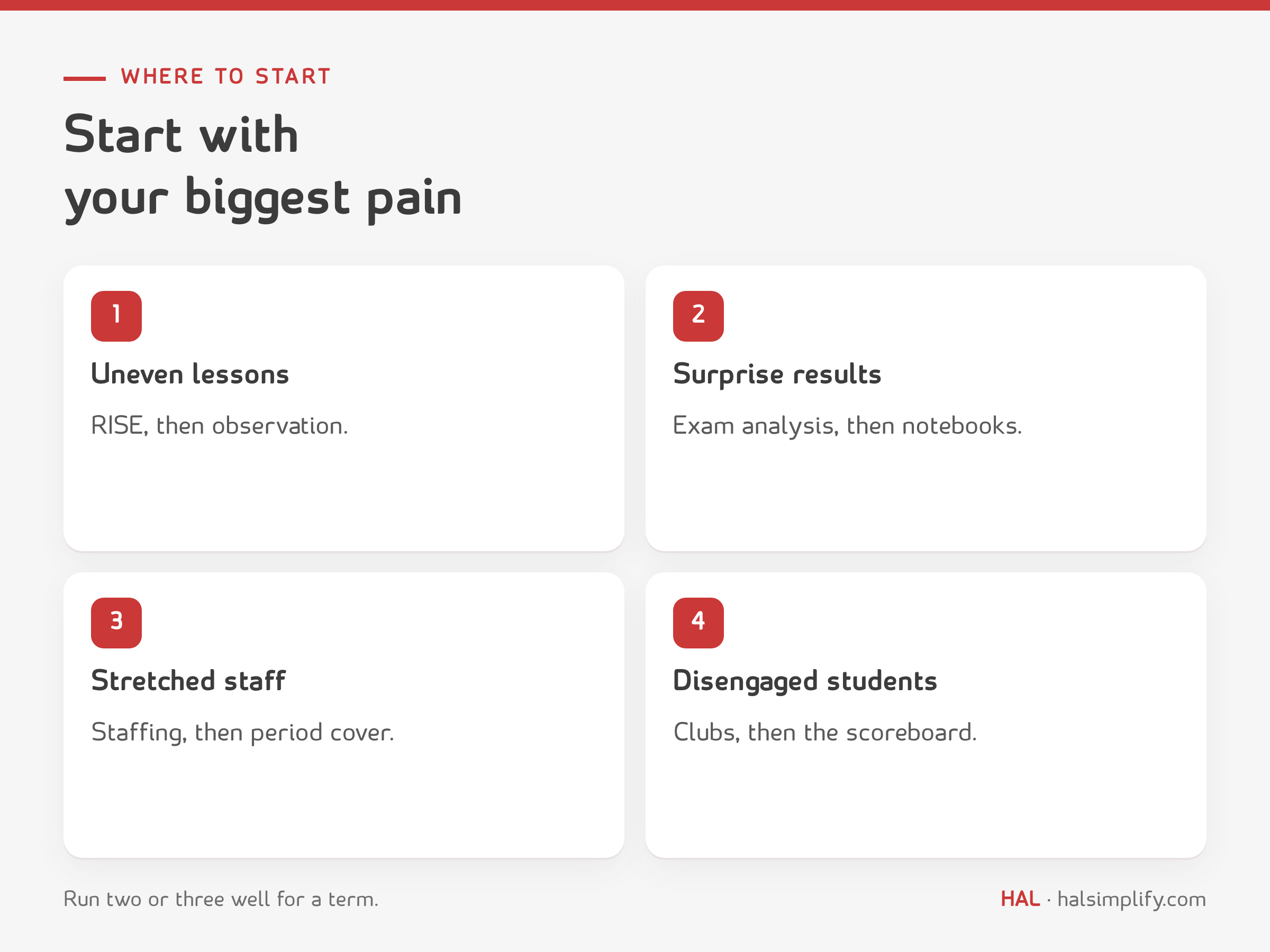
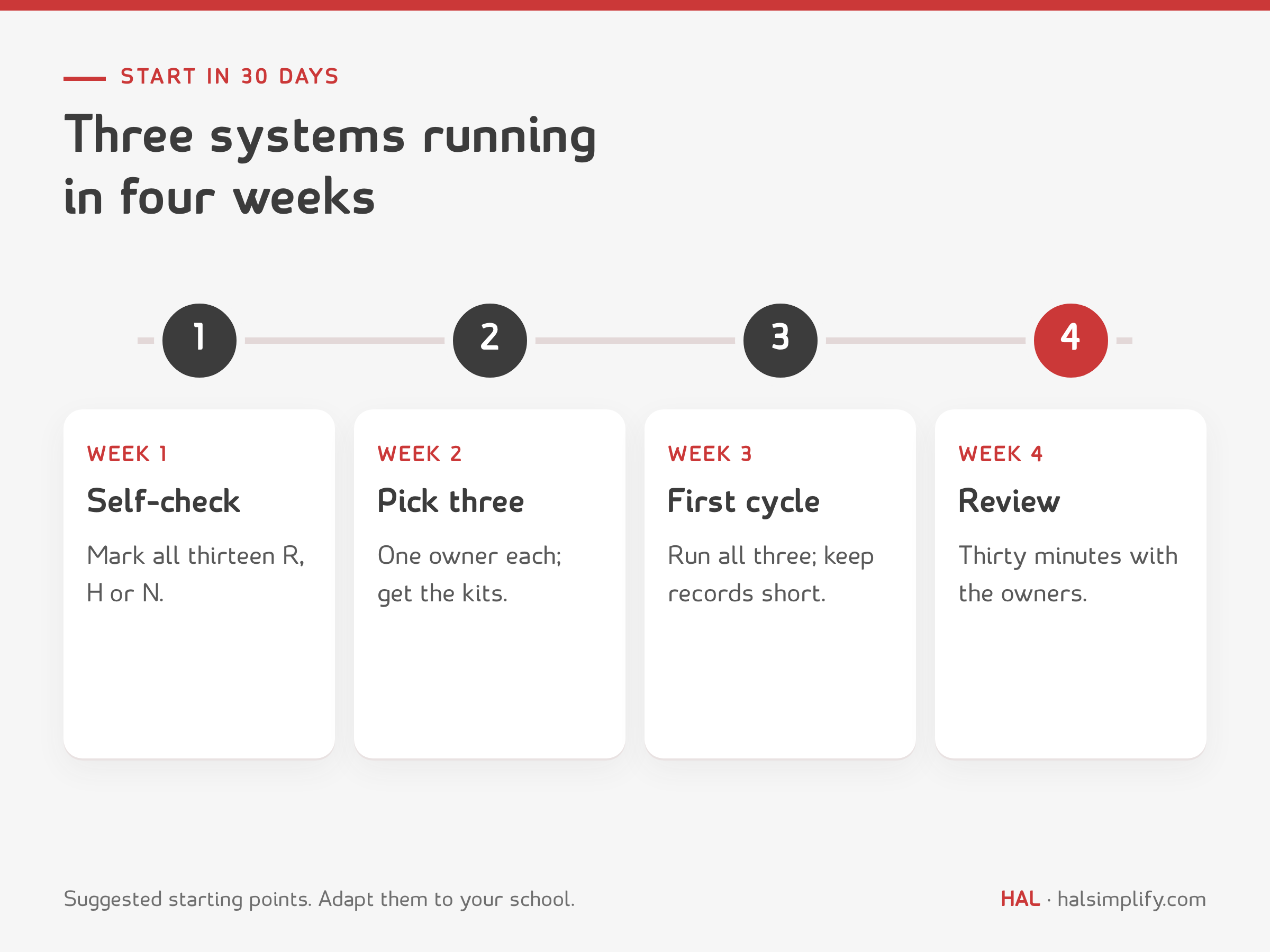
Do not try all thirteen at once. Pick the three that match your biggest pain, and run them well for a term.
The map is a one-page PDF. It lists the thirteen systems with an owner, how often each runs and the kit that supports it, and it has a simple self-check so you can see where your school is today.
On paper, thirteen systems means thirteen files. HAL Edge, HAL's education management system, keeps academic routines, faculty performance and school data together, in Arabic and English.
It is the steady work of making teaching, learning and school life better through routines that run every week and every month. It relies on clear owners, short records, fair rules and regular review, not on one-off projects.
Start with a few routines that cover planning, teaching, checking learning and developing staff. Give each an owner and a record, review the records monthly and act on what they show. The thirteen systems in this series are a suggested starting point.
It is how a school checks that what it plans is what happens, and what students learn. Lesson observation, notebook checking, exam analysis and the monthly teacher report are quality assurance routines.
Goals for the year, and the routines that will deliver them, each with an owner, a record and a review date. A plan without routines is a wish list.
The one that matches your biggest pain. For uneven lessons, RISE and observation. For surprise results, exam analysis. For stretched staff, staffing and timetable planning. Run two or three well for a term before adding more.
No. Every article comes with an Excel workbook and a PDF guide. Software becomes useful when the school grows and the records need to link, which is the point of an education management system.
Yes. Each article has a free PDF guide and Excel workbook, and this page has a free School Systems Map.