
In short: School clubs work when each one is run like a small project. Give every club a one-page club activities planner: a name and tagline, its purpose, its vision, its values, named leaders, goals for the year, projects with deadlines, the periods it needs and a list of next actions with owners. A club coordinator looks after all clubs, every student joins at least one club to explore an interest, and older students take real roles as club president and secretary. Protect a weekly club period in the timetable, record attendance, and review each club at the end of every term. Below: why clubs fade, what the planner holds, how students explore and lead, how to protect the time, a worked example and a free club planner kit (PDF guide and Excel workbook).
It is the last period on Thursday, the club period. In one room, twelve students are waiting for a teacher who was told on Wednesday that the club "just needs someone to supervise". In another, a drama club is rehearsing the same scene it rehearsed last month. A new student is wandering the corridor, because no list says which club she belongs to. Two terms later, the school says it has twelve clubs, and nobody can say what any of them achieved.
Clubs are one of the best things a school offers. They give students a place to try something, to be good at something the timetable never tests, and to lead before anyone calls it leadership. They only keep their value when someone writes down why the club exists, who runs it, what it will do and how much time it has. The free club planner kit at the end gives you the one-page planner, the register and the review.
Five habits, in roughly this order.

The fix is not more clubs. It is a planner, a leader and a protected period for each one.
One page per club, filled in at the start of the year by the club's staff and student leaders, and reviewed by the coordinator. The headings below come from a club planner template used in a school we worked with. The explanations and the extra rows are HAL's design.

| Section | What it holds | Why it matters |
|---|---|---|
| Club name and tagline | A name students recognise and one line that says what the club is about | A tagline is easier to remember than a mission |
| Purpose | Why we need this club | Without a reason the club drifts |
| Vision | A picture of what the club will be doing when it is very successful | Gives the goals something to aim at |
| Values | Behaviour that is acceptable and behaviour that is not | Students know the rules before the first session |
| Members and roles | The club activities coordinator, the staff president and secretary, the student president and secretary | Every club has named people |
| Goals for the year | Three to five goals the club wants to reach | The review has something to measure |
| Projects | What the club will do to reach each goal, with a deadline | Turns goals into dates |
| Time used | Periods and hours per week, per month and per year | The club has a budget of time, and the school can see it |
| Next actions | Action, owner, deadline and remarks | The planner stays alive after the first meeting |
The wording, the number of goals and the roles are settings your school defines. Use our headings if they help and change them if they do not.
Clubs are where students try things they would not meet in a classroom. The most useful rule is simple: every student joins at least one club each year, chosen by interest.
A student who has experienced something they love at school is easier to teach everything else.
Older students are ready for real responsibility. In each club, name a student president and a student secretary from the higher classes, working with a staff president and a staff secretary.

| Role | Usually | What they do |
|---|---|---|
| Club activities coordinator | One teacher or leader for the whole school | Sets the system, checks every planner, protects the time, runs the termly review |
| Staff president | A teacher | Is accountable for the club and its safety, guides the student leaders |
| Staff secretary | A teacher | Keeps the register and the next-actions list with the student secretary |
| Student president | A student from the higher classes | Leads sessions, speaks for the club, helps plan the projects |
| Student secretary | A student from the higher classes | Takes attendance, writes the minutes, tracks the actions |
Keep the leadership fair. Set simple rules for choosing student leaders and publish them. Give each term a limit, so more students get a turn. Make sure the staff president stays present, since the students are learning. A student leader marks no one's work, and the club's behaviour rules apply to them too.
A club that meets "when everyone is free" does not meet. Give each club a protected weekly period in the timetable, and write down how many periods and hours it will use: weekly, monthly and over the year.
Take a club that meets once a week for one 40-minute period over 30 teaching weeks. That is 30 periods, or 20 hours, in the year. Write it in the planner. At the end of each month, compare the periods planned with the periods used. If a club has lost half its time to other things, the planner shows it, and the coordinator can protect it. The same count helps when you build the timetable: see school staffing and timetable planning for how to leave room for club periods and for the staff who run them.
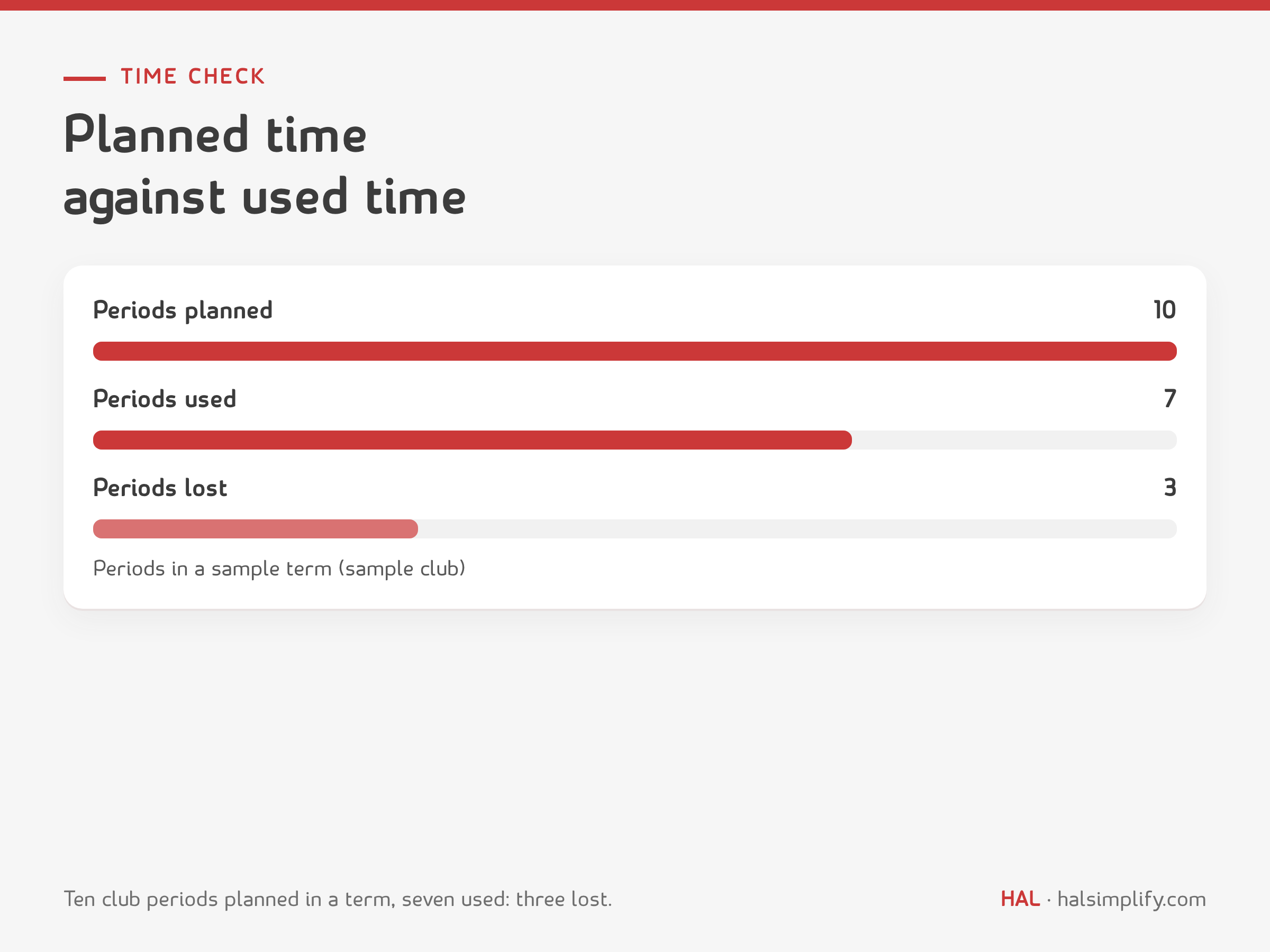
Three simple habits keep the clubs honest.
Take a made-up Debate Club at a sample school.

The kit has two files.
On paper, the planner, the register and the attendance sheet are three files that someone has to bring together. HAL's Clubs module brings programs, a calendar, enrollments, a waitlist, attendance, communications, progress and certificates into one place. HAL Edge, HAL's education management system, keeps academic routines, faculty performance and school data together, in Arabic and English.
They let students explore interests, try new skills and take on responsibility in a setting different from the classroom. A well-run club also gives the school a record of what students have experienced.
A one-page plan for a club: its name and tagline, purpose, vision, values, members and roles, goals for the year, projects with deadlines, the time it will use and the next actions with owners.
Write the planner first: why the club exists, who leads it, what it will do and how much time it needs. Then name the leaders, open a register and protect a period in the timetable.
We suggest it. A rule that every student joins at least one club each year, chosen by interest, helps every student find something they enjoy.
Students from the higher classes can serve as president and secretary, alongside a staff president and secretary. Publish simple rules for choosing them and give each role a term limit so more students get a turn.
Your school decides. A common starting point is one protected period a week. Write the periods and hours in the planner, and compare planned with used each month.
Yes. The kit is a free download: a PDF guide and an Excel workbook with the planner, the register, attendance and a planned-versus-used time check.
Get the next routine in your inbox
One practical school routine a week, each with its free PDF guide and Excel tracker. Unsubscribe any time.